
Anti-acne products Market Share, Growth & Demand by 2034
Coverage: By Type (Cream and lotion, Masks, Serum, Face wash, Others); Distribution Channel (Supermarket and hypermarket, Specialty Stores, Online Retail, Others) , and Geography (North America, Europe, Asia Pacific, and South and Central America)
- Status : Data Released
- Report Code : TIPRE00028439
- Category : Consumer Goods
- No. of Pages : 150
- Available Report Formats :


- Last update date : August 25, 2026


2025 Market Size
US$ 5.91 Bn
Base year value
2034 Forecast
US$ 11.81 Bn
Projected by 2034
CAGR 2026-2034
9.04 %
Growth rate
Addressable Market
US$ 84.05 Bn
(2026-2034)
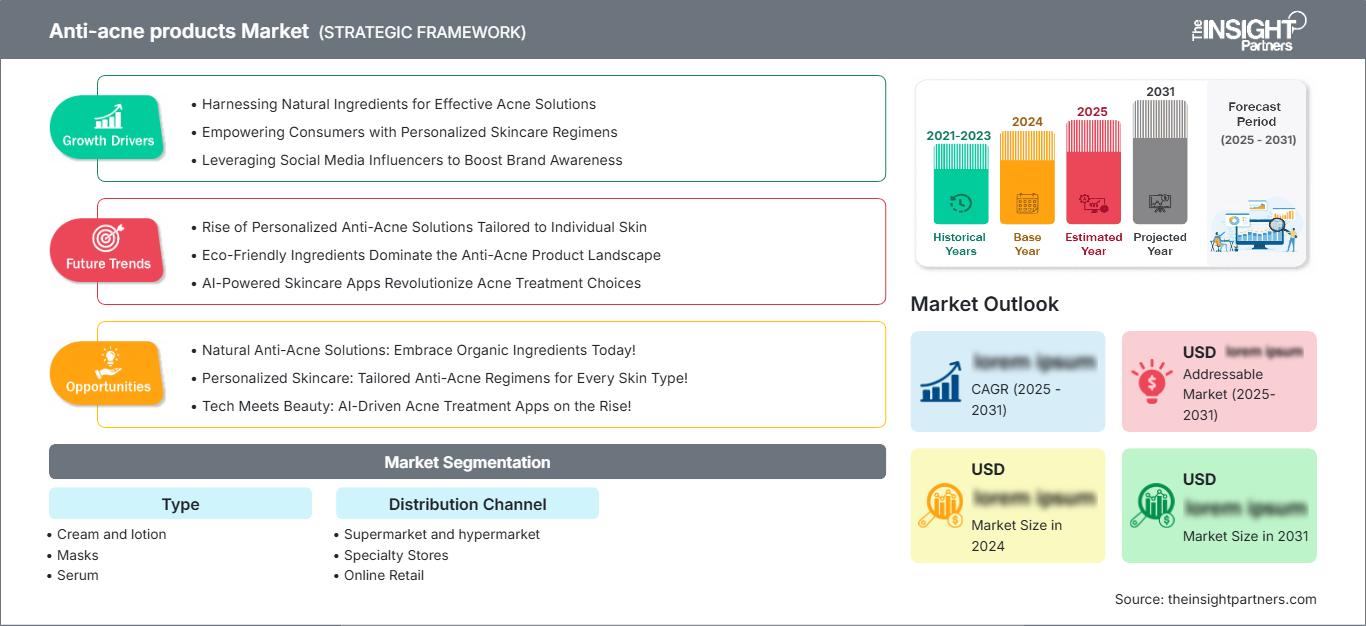
The anti-acne products market was valued at US$ 5.91 Billion in 2025 and is projected to reach US$ 11.81 Billion by 2034, expanding at a CAGR of 9.04% during 2026–2034. Rising awareness of dermatological health, increasing prevalence of acne across adolescent and adult populations, and broader availability of clinically validated topical formulations continue to support demand. Product innovation centered on active ingredients, microbiome-friendly formulations, and dermatologist-endorsed solutions is strengthening the commercial outlook for the market.
Across North America, demand remains supported by high skincare expenditure, strong dermatologist access, and widespread consumer awareness regarding acne management. The anti-acne products market size in the region benefits from premium product adoption, omnichannel retail development, and increasing incidence of adult acne. Regional expansion is expected to remain within a CAGR range of 7.8–8.6% through 2034, aided by continued innovation in over-the-counter formulations and digital skincare engagement.
Anti-acne products Market Assessment and Insights
- North America: Share in 2025 of 34–38% and CAGR between 7.8–8.6%. Strong healthcare awareness, premium skincare consumption, and established dermatology networks continue to support regional leadership.
- US: Accounted for 78–82% of North America in 2025 and is expected to grow at a CAGR of 7.9–8.7% through 2034 due to high product penetration and innovation activity.
- Europe: Share in 2025 of 24–28% and CAGR between 8.0–8.8%. Germany, the UK, and France remain major contributors supported by advanced cosmetic and dermatology industries.
- Asia Pacific: Share in 2025 of 28–32% and CAGR between 10.8–11.8%. China, Japan, South Korea, and India are driving expansion through skincare adoption and e-commerce growth.
- Largest Segment: Face wash held a 32–36% market share in 2025 and is expected to advance at a CAGR of 8.8–9.6% owing to its routine-use nature and broad consumer acceptance.
- High Growth Segment: Serum represented 18–22% market share in 2025 and is projected to register a CAGR of 11.2–12.2% through 2034 due to targeted treatment efficacy.
- Key companies analyzed in detail: Johnson & Johnson Consumer Inc., Taro Pharmaceuticals USA, Inc., Avarelle, Glow Biotics, Clinique Laboratories, LLC, Ancalima Lifesciences Ltd., The Mentholatum Company, KOSÉ Corporation, Galderma Laboratories, L.P., Murad, LLC.
Source: The Insight Partners' analysis based on proprietary research, government publications, company annual reports, investor presentations, industry databases, and expert interviews.
There has been an evolution in manufacturing preferences for the market, leaning more towards ingredients that have scientific backing. These include such ingredients as salicylic acid, adapalene, niacinamide, sulfur, and microbiome-balancing agents. Manufacturers are beginning to incorporate clinical testing and skin barrier protection within their production strategies. Clean label positioning, dermatologist partnerships, and direct-to-consumer distribution are some of the trends gaining traction in manufacturing.
In terms of future prospects, there will be an increased level of investment in Asia, Latin America, and parts of the Middle East due to the increased demand for skincare among urban populations. The regulatory environment will help with the adoption of transparency in terms of ingredient labeling and the safety standards of products. Premiumization, tele-dermatology, and the online consulting ecosystem are some of the trends likely to contribute to market growth.
Anti-acne products Market Report Scope
| Report Attribute | Details |
|---|---|
| Market size in 2025 | US$ 5.91 Billion |
| Market Size by 2034 | US$ 11.81 Billion |
| Global CAGR (2026 - 2034) | 9.04% |
| Historical Data | 2021-2024 |
| Forecast period | 2026-2034 |
Anti-acne products Market Analysis
The trend of growth in the market can be attributed to increased incidences of acne in teenagers and adults, increased concerns about skin appearance, and consumer preferences for scientifically-backed skin care products. There are opportunities in both preventive and curative skin care products. The rise in disposable incomes and enhanced awareness about beauty in urban populations drives the demand further.
An ecosystem including raw materials suppliers, formulators, dermatology clinics, retail outlets, drug stores, and online portals facilitates value creation. Significant improvements have been achieved in terms of accessibility of these products as companies rely on specialty retailing as well as e-commerce platforms. Supply chain efficiency relies on the quality, traceability, and stability of ingredients used.
According to market analysis, the competition in the industry is becoming more intense with features like differentiation, new ingredients, and digital engagement techniques. Firms like Galderma Laboratories, L.P., Murad, LLC, Clinique Laboratories, LLC, and The Mentholatum Company are continuing to build up their portfolio with unique products in the skincare segment. Premium skincare companies are now concentrating on making claims of effectiveness and supporting their claims with dermatology-based evidence.
Strategic investments are being made in research collaborations, personalized skincare technology, microbiome science, and an omnichannel sales approach. Firms like Johnson & Johnson Consumer Inc. and KOSÉ Corporation have a good consumer base through brand portfolios, while some of the new entrants in the skincare business are Glow Biotics and Avarelle.
● REPORT CUSTOMIZATION
Tailor This Report To Align With Your Specific Business Requirements
This report can be customized to align precisely with your business objectives, scope, and target markets. Customization options include tailored segmentation, geography, competitive analysis, and strategic insights to support informed decision-making.
Customize This Report →WHAT YOU CAN ADJUST
- ● Segmentations
- ● Geography
- ● Competitive Analysis
- ● Language Preferences
Anti-acne products Market: Strategic Insights
Regional Insights
North America anti-acne products market
North America accounted for 34–38% anti-acne products market share in 2025 and is projected to expand at a CAGR of 7.8–8.6% through 2034. There is high knowledge about skin diseases, a good level of spending on personal care products, and easy availability of over-the-counter therapies that will keep the market demand intact. Consumers look for products that offer both the treatment of acne and hydration and barrier repair, as well as anti-inflammatory benefits.
The market in this region has developed a retail structure and is highly involved with international skincare firms. Digital health solutions, dermatological consultations, and tailored skincare solutions have greatly helped in enhancing the uptake of treatment. The premium formulations and scientifically-proven ingredients form the core of purchase decisions, especially in the USA and Canada.
U.S. anti-acne products market
The U.S. represented 78–82% of North America in 2025 and is forecast to record a CAGR of 7.9–8.7%. The presence of a substantial customer base, the acne occurrence rate in both teens and adults, and an existing dermatology network are contributing factors to market strength. It becomes important for retail pharmacies, e-commerce sites, and beauty product specialists to participate actively in making products more accessible.
Key players in the market operate with a notable business presence on account of their brands, new product launches, and research. Products that contain salicylic acid, benzoyl peroxide, retinoids, and ingredients good for microbiomes are now popular with consumers.
Europe anti-acne products market
Europe held 24–28% of the market in 2025 and is expected to expand at a CAGR of 8.0–8.8%. The region benefits from strong consumer awareness, sophisticated cosmetic industries, and stringent product-quality standards. Growth remains supported by pharmacy distribution channels, increasing focus on skin health, and preference for clinically tested formulations.
Germany leads regional demand due to its established skincare manufacturing base and strong pharmaceutical presence. The United Kingdom records healthy adoption supported by premium skincare consumption and growing online beauty purchases. France benefits from its influential dermocosmetic sector, while Italy and Spain continue expanding through rising skincare awareness, improved specialty retail access, and growing demand for targeted facial treatment products.
APAC anti-acne products market
Asia Pacific accounted for 28–32% of global revenue in 2025 and is forecast to expand at a CAGR of 10.8–11.8%, making it the fastest-growing regional market. China remains the leading country, supported by extensive skincare consumption and digital commerce penetration.
Japan, South Korea, India, and Australia contribute significantly through innovation, beauty-conscious consumers, and expanding dermatology awareness. Government support for consumer healthcare standards and growing middle-class populations further strengthen regional prospects while accelerating premium skincare adoption.
Middle East & Africa anti-acne products market
The Middle East & Africa market is expected to grow at a CAGR of 8.4–9.2% through 2034. Saudi Arabia and the UAE benefit from modern retail networks, rising beauty expenditures, and increasing acceptance of advanced skincare products.
South Africa remains an important market within the region, while broader MEA growth is supported by urbanization and expanding consumer awareness. Improving healthcare infrastructure and digital retail accessibility are expected to enhance product availability across multiple emerging markets.
Segmentation Analysis
Type
Type is projected to grow at a CAGR of 9.0–9.8% between 2026 and 2034. The market scope across product formats continues to expand as consumers seek solutions tailored to varying acne severity levels, skin types, and treatment preferences. Product innovation increasingly focuses on combining therapeutic efficacy with hydration, barrier support, and convenience, enabling broader adoption across demographic groups.
- Cream and lotion: Widely used for targeted treatment and maintenance therapy, benefiting from familiarity among consumers and compatibility with dermatologist-recommended skincare routines.
- Masks: Growing usage for periodic intensive care applications, supported by demand for deep cleansing, oil control, and visible skin improvement outcomes.
- Serum: Popular among consumers seeking concentrated active ingredients and precision treatment approaches that complement broader skincare regimens.
- Face wash: The largest product category due to daily usage frequency, broad accessibility, and integration into routine cleansing practices.
Distribution Channel
The distribution channel is anticipated to advance at a CAGR of 9.3–10.1% during the forecast period. Consumer purchasing behavior continues shifting toward convenience, product comparison capabilities, and wider assortment availability. Digital commerce remains influential, although physical retail retains importance for brand discovery and immediate purchase needs.
- Supermarket and hypermarket: Important for mass-market accessibility and high product visibility, attracting consumers seeking convenience and competitive pricing.
- Specialty Stores: Critical for premium positioning, expert recommendations, and access to dermatology-oriented product portfolios.
- Online Retail: Fast-expanding channel driven by convenience, consumer reviews, digital marketing, and direct-to-consumer business models.
Opportunity Snapshot
| Segment Name | Revenue Contribution | Trend Tag | Adoption Stage |
| Cream and lotion | High | Barrier Care | Mature |
| Masks | Medium | Deep Cleanse | Scaling |
| Serum | High | Active Precision | Scaling |
| Face wash | High | Daily Routine | Mature |
Anti-acne products Market Growth Drivers and Impact Analysis
Rising prevalence of acne across multiple age groups
There has been an increasing prevalence of acne amongst both teenage and adult groups, thus making the requirement for preventative and curative skincare products a constant one. Increased knowledge about the importance of skin protection and the issue of acne scarring has made early and consistent use of these treatments essential. There has been a lot of emphasis from healthcare companies and dermatological bodies on evidence-based skincare treatments, thus enhancing the use of such treatments. The presence of adult acne, especially amongst women, has become a major revenue generator in the skincare products industry.
Expansion of e-commerce and digital skincare ecosystems
The digital retail platforms have changed the way consumers purchase by enhancing availability, transparency, and consumer education. The online portals give room for ingredient comparison, review evaluation, and personalized recommendations. The beauty influencers, tele-dermatological consultations, and AI-powered skin analysis systems are additional factors in purchasing decisions. The subscription models and direct-to-consumer marketing approaches allow businesses to retain their customers while gaining vital consumer data. Improved digital interaction makes geography irrelevant and facilitates entry into underserved markets. Consequently, organizations get an opportunity to distribute their products effectively and build their brands.
Advancements in ingredient science and formulation technology
Advances in ingredients and delivery mechanisms have helped boost treatment effectiveness and alleviate any issues related to irritation. Today, products are being developed that incorporate both anti-acne ingredients and skin soothers or moisturizers, thus making it easier to ensure consumer compliance. Microbiome-compatible ingredients, encapsulation techniques, and combination products have helped differentiate brands. The scientific proof and dermatologists’ recommendations have turned out to be key differentiators, motivating brands to conduct extensive clinical studies and engage in research collaborations. Such advancements help brands develop products for various skin conditions and address the need for multifunctional skincare products.
Anti-acne products Market Future Trends
Personalized dermatology-inspired skincare solutions
The anti-acne products market trends increasingly point toward personalized treatment pathways supported by digital diagnostics, consumer data analytics, and AI-enhanced skincare recommendations. Brands are expected to expand product customization capabilities based on skin sensitivity, acne severity, environmental exposure, and lifestyle patterns. Personalized subscription services, virtual consultations, and algorithm-driven product matching are likely to improve treatment outcomes and customer retention. As personalization technologies become more accessible, companies will gain opportunities to strengthen differentiation while addressing evolving consumer expectations for individualized skincare experiences. This direction may significantly influence future product development and go-to-market strategies.
Integration of skin barrier and microbiome protection
Future advancements will place focus on creating formulations that combine the effectiveness of acne treatment with the preservation of skin integrity. Ingredient companies are developing ingredients that help maintain the microbiome, systems that gently exfoliate, and barrier repair systems to minimize skin irritation from conventional treatments. Attention from regulatory authorities on ingredient transparency will also drive companies to develop scientifically proven formulations. Consumers are seeking products that treat acne while maintaining hydration levels in their skin. Future advancements will enable the development of multi-functionality products to find more commercial success.
Anti-acne products Market Opportunities
Premium product expansion in emerging economies
The growing middle-class population across the Asia Pacific, the Middle East, and selected Latin American countries creates substantial opportunities for premium skincare brands. anti-acne products market Forecasts indicate increasing demand for scientifically validated formulations as consumers become more informed regarding skin health and ingredient efficacy. Companies can capitalize through localized product portfolios, strategic retail partnerships, and digital engagement initiatives. Premiumization is particularly attractive where consumers are transitioning from basic skincare routines toward specialized treatment products. Investments in education, influencer collaborations, and dermatologist partnerships can help accelerate adoption while supporting sustainable market penetration and revenue generation.
Development of multifunctional treatment platforms
Manufacturers have opportunities to create products addressing acne, hyperpigmentation, scarring, hydration, and skin barrier restoration within a single regimen. Consumers increasingly seek convenience and comprehensive skincare outcomes, creating favorable conditions for multifunctional solutions. Combining therapeutic and cosmetic benefits can improve product differentiation while supporting premium pricing. Strategic investments in formulation science, clinical validation, and consumer research may enable companies to capture higher-value market segments. Brands capable of delivering measurable outcomes with simplified routines are positioned to strengthen customer loyalty and enhance long-term competitive positioning.
Frequently Asked Questions

- Comprehensive Market Sizing and Forecast Analysis
- Detailed Segmentation Analysis
- In-Depth Market Dynamics Assessment
- Regional and Country-Level Insights
- Competitive Landscape and Company Benchmarking
- Strategic Business Intelligence
Recent Reports
Testimonials

The Insight Partners' SCADA System Market report is comprehensive, with valuable insights on current trends and future forecasts. The team was highly professional, responsive, and supportive throughout. We are very satisfied and highly recommend their services.
RAN KEDEM Partner, Reali Technologies LTDs
I requested a report on a very specific software market and the team produced the report in a few days. The information was very relevant and well presented. I then requested some changes and additions to the report. The team was again very responsive and I got the final report in less than a week.
JEAN-HERVE JENN Chairman, Future Analytica
We worked with The Insight Partners for an important market study and forecast. They gave us clear insights into opportunities and risks, which helped shape our plans. Their research was easy to use and based on solid data. It helped us make smart, confident decisions. We highly recommend them.
PIYUSH NAGPAL Sr. Vice President, High Beam Global
The Insight Partners delivered insightful, well-structured market research with strong domain expertise. Their team was professional and responsive throughout. The user-friendly website made accessing industry reports seamless. We highly recommend them for reliable, high-quality research services
YUKIHIKO ADACHI CEO, Deep Blue, LLC.
This is the first time I have purchased a market report from The Insight Partners.While I was unsure at first, I visited their web site and felt more comfortable to take the risk and purchase a market report.I am completely satisfied with the quality of the report and customer service. I had several questions and comments with the initial report, but after a couple of dialogs over email with their analyst I believe I have a report that I can use as input to our strategic planning process.Thank you so much for taking the extra time and making this a positive experience.I will definitely recommend your service to others and you will be my first call when we need further market data.
JOHN SUZUKI President and Chief Executive Officer, Board Director, BK Technologies
I wish to appreciate your support and the professionalism you displayed in the course of attending to my request for information regarding to infectious disease IVD market in Nigeria. I appreciate your patience, your guidance, and the fact that you were willing to offer a discount, which eventually made it possible for us to close a deal. I look forward to engaging The Insight Partners in the future, all thanks to the impression you have created in me as a result of this first encounter.
DR CHIJIOKE ONYIA MANAGING DIRECTOR, PineCrest Healthcare Ltd.Reason to Buy
- Informed Decision-Making
- Understanding Market Dynamics
- Competitive Analysis
- Identifying Emerging Markets
- Customer Insights
- Market Forecasts
- Risk Mitigation
- Boosting Operational Efficiency
- Strategic Planning
- Investment Justification
- Tracking Industry Innovations
- Aligning with Regulatory Trends





 Get Free Sample for