
Anti-Venom Market Size, Trends & Growth by 2034
Coverage: By Type (Monovalent Antivenom, Polyvalent Antivenom); Reptile (Snake, Scorpion, Spider, Others (If Any)); Mode of Action (Cytotoxic, Neurotoxic, Haemotoxic, Cardiotoxic, Myotoxic, Others (If Any)), and Geography (North America, Europe, Asia Pacific, and South and Central America)
- Status : Data Released
- Report Code : TIPRE00007741
- Category : Life Sciences
- No. of Pages : 151
- Available Report Formats :


- Last update date : August 27, 2026


2025 Market Size
US$ 1.54 Bn
Base year value
2034 Forecast
US$ 2.84 Bn
Projected by 2034
CAGR 2026-2034
7.07 %
Growth rate
Addressable Market
US$ 19.81 Bn
(2026-2034)
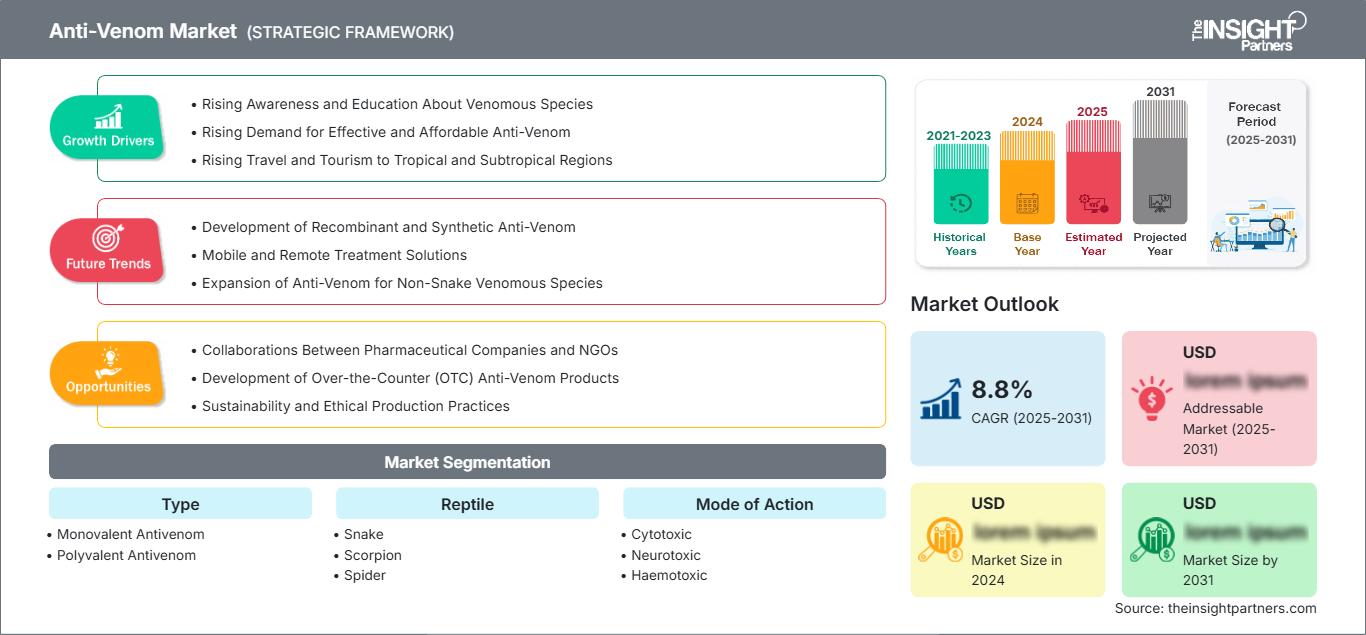
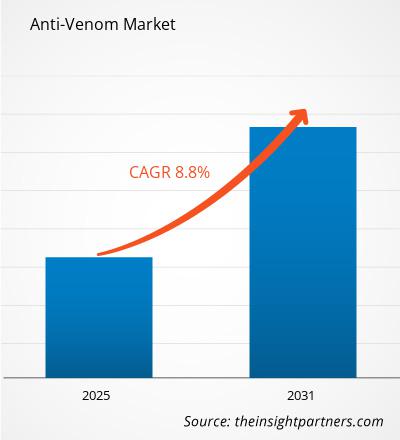
The anti-venom market size stood at US$ 1.54 Billion in 2025 and is estimated to touch US$ 2.84 Billion by 2034, growing at a CAGR of 7.07% in the forecast period of 2026-2034. The growth can be attributed to sustained demand for snake bite therapy, awareness about envenoming as a neglected tropical disease, and efforts towards improving antivenom efficacy, regional specificity, production capacity, and availability in the clinics.
North America is set to sustain its relatively stable position due to well-developed emergency care infrastructure, networks of poison control specialists, and the presence of antivenom products. The anti-venom market in North America is estimated to grow at a CAGR of 5.1-6.2% from 2026-2034.
Anti-Venom Market Assessment and Insights
- North America: North America is expected to account for 24–28% anti-venom market share in 2025 and grow at a 5.1–6.2% CAGR during 2026–2034, supported by hospital-based emergency treatment, established toxicology services, regulated products, and comparatively high treatment accessibility.
- US: The US is projected to represent 82–87% of North America's 2025 share and expand at a 5.0–6.1% CAGR during 2026–2034, led by hospital demand and specialized poison-management pathways.
- Europe: Europe is estimated to hold 18–22% share in 2025 and grow at a 5.4–6.5% CAGR during 2026–2034, with Germany, the UK, France, Spain, and Italy contributing through specialist hospital procurement and established biological-product regulation.
- Asia Pacific: Asia Pacific is estimated at 27–31% share in 2025 and is expected to grow at a 6.8–8.0% CAGR during 2026–2034, led by India, China, Japan, and Australia as access programs and regional production capabilities expand.
- Largest Segment: Polyvalent Antivenom is expected to hold a 62–68% market share in 2025, growing at a 6.0–7.0% CAGR during 2026–2034, reflecting broad venom coverage and procurement efficiency.
- High Growth Segment: Neurotoxic applications are represented within the mode-of-action portfolio, with the broader Mode of Action segment expected to grow at a 6.4–7.4% CAGR during 2026–2034, driven by product specificity and clinical targeting.
- Key companies analyzed in detail: Alomone Labs, Ltd., Boehringer Ingelheim International GmbH, BTG International Ltd., CSL Limited, Flynn Pharma (Micropharm), Haffkine Bio-Pharmaceutical Corporation Limited, Laboratorios Silanes, Merck & Co., Inc., Pfizer Inc., Sigma-Aldrich Co.
Source: The Insight Partners' analysis based on proprietary research, government publications, company annual reports, investor presentations, industry databases, and expert interviews.
There have been efforts to improve the specificity, purification, antibody makeup, stability, and manufacturing process in the development of antivenoms. The traditional animal plasma-derived antivenoms have continued to be relevant while research is leaning towards recombinant antibodies and other molecules. Economics of production depend on venom acquisition, immunization of donor animals, plasma production, purification, quality control, and special cold chain/hospital logistics.
Future growth will be more about improving supply in high burden areas and not just increasing the volume of antivenoms produced for the developed countries. WHO guidelines on traditional and new antivenom treatments will be helpful in shaping future development efforts. Governments and procurement agencies will be looking at quality, regional venoms covered, cost, and availability.
Anti-Venom Market Report Scope
| Report Attribute | Details |
|---|---|
| Market size in 2025 | US$ 1.54 Billion |
| Market Size by 2034 | US$ 2.84 Billion |
| Global CAGR (2026 - 2034) | 7.07% |
| Historical Data | 2021-2024 |
| Forecast period | 2026-2034 |
Anti-Venom Market Analysis
The anti-venom Market forecast indicates that demand is primarily dependent on the prevalence of venomous bites and the promptness of patients to seek treatment. WHO estimates that there are millions of cases of snakebites each year, but the majority are in rural and resource-poor areas. Therefore, the market growth for anti-venom depends on hospitals, public procurement, physician awareness, emergency referral, and the epidemiologic significance of the venoms used in the production of the anti-venom. The anti-venom value chain includes the procurement of the venom and animal immunization, as well as plasma collection, purification, formulation, quality control and testing, regulatory approval, and distribution. The supply is inherently limited by the lack of capability for venom characterization and biological manufacturing.
Market positioning is becoming increasingly dependent on the geographical coverage of the venoms, clinical data, manufacturing capability, and regulatory acceptability. The anti-venom market analysis, therefore, involves more than availability of the product, especially when there are several products with different neutralization capacity. The Australian company, CSL Limited, has an important portfolio of anti-venoms, while MicroPharm and Laboratorios Silanes have regional relevance. The Haffkine Bio-Pharmaceutical Corporation Limited supplies Indian public sector needs, while Pfizer Inc. and Boehringer Ingelheim International GmbH do so through their pharmaceutical and biological product capabilities.
There is also a change in the priorities in investments. WHO has set up target product profiles for conventional antivenoms as well as new small molecule and engineered antibody-based products. This presents the opportunity for firms to combine conventional plasma based technology with innovative products. Strategic alliances, donor support for research and development, regional production, and government purchasing agreements can help mitigate business risk.
● REPORT CUSTOMIZATION
Tailor This Report To Align With Your Specific Business Requirements
This report can be customized to align precisely with your business objectives, scope, and target markets. Customization options include tailored segmentation, geography, competitive analysis, and strategic insights to support informed decision-making.
Customize This Report →WHAT YOU CAN ADJUST
- ● Segmentations
- ● Geography
- ● Competitive Analysis
- ● Language Preferences
Anti-Venom Market: Strategic Insights
Regional Insights
North America anti-venom market
North America is estimated to account for 24–28% market share in 2025 and grow at a CAGR of 5.1–6.2% in 2026–2034. The USA is the largest regional market, since venomous snake bites occur mainly in regions where hospitals have protocols for prompt assessment, laboratory tests, antivenom use, and supportive care. Hospital purchases are the main commercial channel.
Demand in the region is not as dependent on population growth but rather on preparedness, availability, cooperation with poison centers, and treatment standards. Canada represents a smaller share in the regional market because of the geographical limitation of venomous snake bites. High-priced products still remain commercially viable due to relatively low patient numbers because the treatment usually includes hospital care and monitoring.
U.S. anti-venom Market
The US is expected to contribute 82–87% of North America's 2025 market share and grow at a 5.0–6.1% CAGR during 2026–2034. Demand is concentrated in emergency departments, trauma hospitals, intensive-care settings, and poison-control networks. Treatment requirements vary according to regional snake species, particularly rattlesnakes, copperheads, cottonmouths, and coral snakes.
The commercial setting rewards those products that are backed by regulatory approval, manufacturing stability, and well-defined clinical dosage regimens. The hospitals stock up on products based on local exposures and their emergency preparedness needs rather than outpatient needs. Products related to special venom therapy, such as those from Laboratorios Silanes and Rare Disease Therapeutics, highlight the significance of biological portfolios tailored for specific needs. The focus on health care resource utilization could also prove beneficial to products that minimize complications and treatment duration.
Europe anti-venom Market
In 2025, Europe will have a market share of 18-22%, and it will have a CAGR of 5.4-6.5% for 2026-2034. Important demand centers will include the UK, Germany, France, Italy, and Spain, and the access to products will be influenced by procurement procedures, toxicology services, and biological products regulations. The UK continues to be important strategically due to the supply of specialist antivenoms that is important for selected international markets.
Germany is characterized by advanced emergency infrastructure along with hospital procurement and specialist toxicology. France, Italy, and Spain create demand through regional hospital networks and treatment of envenomings occurring either locally or imported. The demand in Europe is more predictable since there is good healthcare access; however, the exposure varies considerably among countries. Strategic importance of the region is not only related to its demand but also to pharmaceutical development, quality system, regulatory knowledge, and specialized distribution.
APAC anti-venom Market
It is projected that APAC will have a market share of 27–31% in 2025 and grow at a CAGR of 6.8–8.0% from 2026–2034. The major demand driver in APAC would be India. Besides India, there are established markets in China, Japan, South Korea, and Australia. In India, there is a significant clinical demand coupled with local manufacturing capabilities.
Government purchasing, rural health initiatives, better reporting, and focus on improving treatment quality are the growth drivers in the region. Australia has an advanced antivenom infrastructure for different venomous snakes, while India has a significantly higher epidemiology and demand for regional antivenoms. WHO has designated South Asia as one of the key regions requiring antivenoms.
Middle East & Africa anti-venom Market
Middle East and Africa represent a smaller commercial base but significant unmet medical need. The region is projected to grow at approximately 6.2–7.3% CAGR during 2026–2034, with Saudi Arabia and the UAE supported by advanced healthcare infrastructure, while South Africa serves as an important regional treatment and manufacturing center.
Rest of MEA demand is strongly influenced by rural exposure, agricultural activity, hospital accessibility, and public procurement. Energy-sector investment and infrastructure development can improve access to emergency facilities in remote areas, but geographic distribution remains challenging. The region's long-term opportunity depends on reliable procurement, quality-assured products, appropriate venom coverage, and stronger treatment pathways rather than solely on commercial expansion.
Segmentation Analysis
Type
Type represents a central purchasing consideration because venom coverage determines clinical applicability and inventory requirements. The segment is expected to expand at a 6.0–7.0% CAGR during 2026–2034. Polyvalent products generally offer broader coverage and procurement efficiency, while monovalent products can provide greater specificity where a particular venom is epidemiologically dominant.
- Monovalent Antivenom: Monovalent products target a specific venom or closely related venom profile, making them strategically valuable where species identification is reliable and localized clinical protocols support focused inventory management.
- Polyvalent Antivenom: Polyvalent products provide coverage against multiple venom profiles and remain important for emergency settings where species identification is uncertain, supporting broader hospital inventory utility and public-sector procurement.
Reptile
Reptile segmentation reflects the biological source of venom and resulting treatment requirements. The segment is expected to grow at a 6.5–7.5% CAGR during 2026–2034. Snake-related products dominate commercial demand because of the global burden of snakebite, while scorpion and spider products remain regionally important.
- Snake: Snake-related products represent the core commercial opportunity because snakebite envenoming creates substantial mortality and disability, particularly in South Asia, sub-Saharan Africa, and rural tropical regions.
- Scorpion: Scorpion antivenoms are particularly relevant in arid and semi-arid regions, where pediatric exposures can create significant emergency-care requirements and support specialized hospital inventory.
- Spider: Spider antivenoms address geographically concentrated exposures and require species-specific clinical awareness, creating smaller but strategically important demand pools in countries with medically significant spider populations.
Mode of Action
Mode of Action provides a clinical framework for understanding venom effects and therapeutic requirements. The segment is projected to grow at a 6.4–7.4% CAGR during 2026–2034 as manufacturers improve venom characterization and develop products with clearer neutralization profiles. This also supports research into targeted adjunctive therapies.
- Cytotoxic: Cytotoxic envenoming can produce severe local tissue injury, making rapid treatment important for limiting necrosis, secondary complications, and potential long-term disability.
- Neurotoxic: Neurotoxic effects can compromise neuromuscular function and breathing, increasing the importance of rapid hospital treatment and products capable of neutralizing relevant neurotoxins.
- Haemotoxic: Haemotoxic envenoming can disrupt coagulation and produce serious bleeding complications, requiring prompt antivenom administration alongside laboratory monitoring and supportive management.
- Cardiotoxic: Cardiotoxic venom effects can create acute cardiovascular instability, requiring specialized emergency monitoring and treatment protocols in addition to venom neutralization.
- Myotoxic: Myotoxic effects can cause muscle injury and systemic complications, creating demand for timely intervention and products designed around regionally relevant venom profiles.
Opportunity Snapshot
| Segment Name | Revenue Contribution (High/Medium/Low) | Trend Tag | Adoption Stage |
|---|---|---|---|
| Hospitals & Clinics | High | Emergency Care | Mature |
| Government Agencies | High | Bulk Procurement | Scaling |
| Non Profit Organizations | Medium | Access Programs | Scaling |
Anti-Venom Market Growth Drivers and Impact Analysis
Increasing recognition of snakebite as a major neglected tropical disease
Greater recognition of snakebite envenoming as a preventable public-health problem is strengthening policy attention and procurement priorities. WHO estimates that approximately 4.5–5.4 million people are bitten by snakes annually, with 1.8–2.7 million developing clinical illness and tens of thousands dying from complications. This burden creates a substantial gap between epidemiological need and commercially realized treatment demand. Governments and international organizations increasingly view reliable antivenom availability as an essential health-system requirement. The impact is particularly significant in countries where underreporting has historically weakened procurement forecasting. Better surveillance can translate into more accurate demand planning, improved buffer inventories, and stronger incentives for manufacturers to maintain region-specific products.
Regional venom specificity is reshaping product development priorities
Venom composition can vary across geographic populations of the same species, limiting the effectiveness of products developed without adequate regional characterization. This issue is particularly relevant in South Asia and sub-Saharan Africa, where diverse snake populations and differences in venom profiles complicate standardized procurement. Manufacturers are therefore placing greater emphasis on representative venom immunogens, improved characterization, validated neutralization testing, and clinical evidence. The commercial impact is twofold: companies with regionally appropriate products can gain stronger institutional acceptance, while manufacturers relying on broad but poorly matched formulations may face procurement barriers. Better specificity can also improve confidence among clinicians, an important factor in markets where historical use of inappropriate products has weakened trust and reduced effective treatment uptake.
Expansion of quality assurance and procurement standards
The anti-venom Market Trends indicate that regulatory and procurement standards are becoming more influential in determining which antivenoms achieve sustainable market access. WHO's risk-benefit assessment process evaluates quality, safety, efficacy, and performance characteristics, while its target product profiles establish clearer expectations for both conventional and emerging treatments. These mechanisms can reduce the competitive advantage of poorly characterized products and encourage manufacturers to strengthen GMP compliance, venom sourcing, validation, and documentation. For healthcare systems, stronger quality assurance can reduce uncertainty when selecting products for national or institutional procurement. For manufacturers, compliance may increase development costs initially but can improve access to international procurement channels and support longer-term commercial stability in high-need markets.
Anti-Venom Market Future Trends
Next-generation therapies will complement conventional antivenoms
The next phase of therapeutic development is likely to extend beyond conventional animal-plasma-derived antivenoms toward engineered antibodies and small-molecule inhibitors. WHO published target product profiles in 2025 for novel snakebite treatments, including products intended for hospital and pre-hospital settings. This framework could accelerate development of therapies capable of addressing venom effects before a patient reaches definitive care. The commercial implication is not necessarily replacement of conventional products. Instead, new treatments may initially function as adjuncts that stabilize patients, reduce toxin-mediated damage, or provide broader coverage. Companies that combine established biological manufacturing capabilities with modern antibody engineering and translational research could gain strategic advantages as clinical development becomes more structured.
Anti-Venom Market Opportunities
Regional manufacturing partnerships can address persistent supply gaps
Manufacturing partnerships represent an attractive opportunity in regions where disease burden is high but production capacity remains limited. Local or regional facilities can reduce dependence on long-distance supply chains, improve responsiveness to seasonal demand, and support products designed around locally relevant venoms. Partnerships between established biological manufacturers, governments, universities, and procurement organizations can distribute development and manufacturing risks. Technology transfer may be particularly valuable for plasma processing, purification, quality testing, and GMP systems. Commercial models based on advance purchase agreements or pooled procurement can further improve demand visibility. Such arrangements could encourage manufacturers to maintain capacity even when individual national markets are too small to support dedicated production economically.
Diagnostics and venom characterization can create adjacent investment opportunities
Better diagnostics could improve the precision of antivenom selection and reduce uncertainty when the biting species is unknown. WHO has highlighted diagnostic tools as an important component of stronger snakebite surveillance and treatment systems. Investment opportunities therefore extend beyond the therapeutic vial itself to venom detection, immunological assays, reference laboratories, and digital epidemiological systems. A diagnostic ecosystem could support more accurate mapping of venom profiles, improve procurement forecasting, and guide development of future monovalent or targeted polyvalent formulations. Companies entering this area can potentially create integrated solutions combining diagnostics, treatment selection, clinical decision support, and surveillance. Such approaches may be particularly valuable in high-burden countries where healthcare resources must be allocated according to verified local epidemiology.
Recent Developments
- February 2026: World Health Organization published its first guidance on novel snakebite treatments, establishing target product profiles for small-molecule and engineered-antibody therapies intended for hospital and pre-hospital settings. The guidance is designed to help developers and regulators align new treatments with clinical requirements and addresses the need for therapies for millions of annual snakebite cases.
- December 2025: CSL Limited opened a US$1 billion vaccine and antivenom manufacturing facility in Melbourne. The facility produces Australia's eleven antivenoms and incorporates digitally connected manufacturing, automated execution systems, predictive maintenance, and enhanced quality-control capabilities. CSL also stated that Australian antivenoms are supplied to several neighboring countries and that annual donations support antivenom access in Papua New Guinea.
- October 2025: Laboratorios Silanes participated with REDTOX and IEST Anáhuac in a symposium addressing poisoning from medically important venomous animals. The event included a technical presentation on antivenom innovation and biotechnology, highlighting the company's continuing involvement in clinical education, toxicology networks, and development of biological capabilities supporting antivenom production and treatment.
Frequently Asked Questions

- Comprehensive Market Sizing and Forecast Analysis
- Detailed Segmentation Analysis
- In-Depth Market Dynamics Assessment
- Regional and Country-Level Insights
- Competitive Landscape and Company Benchmarking
- Strategic Business Intelligence
Recent Reports
Testimonials

The Insight Partners' SCADA System Market report is comprehensive, with valuable insights on current trends and future forecasts. The team was highly professional, responsive, and supportive throughout. We are very satisfied and highly recommend their services.
RAN KEDEM Partner, Reali Technologies LTDs
I requested a report on a very specific software market and the team produced the report in a few days. The information was very relevant and well presented. I then requested some changes and additions to the report. The team was again very responsive and I got the final report in less than a week.
JEAN-HERVE JENN Chairman, Future Analytica
We worked with The Insight Partners for an important market study and forecast. They gave us clear insights into opportunities and risks, which helped shape our plans. Their research was easy to use and based on solid data. It helped us make smart, confident decisions. We highly recommend them.
PIYUSH NAGPAL Sr. Vice President, High Beam Global
The Insight Partners delivered insightful, well-structured market research with strong domain expertise. Their team was professional and responsive throughout. The user-friendly website made accessing industry reports seamless. We highly recommend them for reliable, high-quality research services
YUKIHIKO ADACHI CEO, Deep Blue, LLC.
This is the first time I have purchased a market report from The Insight Partners.While I was unsure at first, I visited their web site and felt more comfortable to take the risk and purchase a market report.I am completely satisfied with the quality of the report and customer service. I had several questions and comments with the initial report, but after a couple of dialogs over email with their analyst I believe I have a report that I can use as input to our strategic planning process.Thank you so much for taking the extra time and making this a positive experience.I will definitely recommend your service to others and you will be my first call when we need further market data.
JOHN SUZUKI President and Chief Executive Officer, Board Director, BK Technologies
I wish to appreciate your support and the professionalism you displayed in the course of attending to my request for information regarding to infectious disease IVD market in Nigeria. I appreciate your patience, your guidance, and the fact that you were willing to offer a discount, which eventually made it possible for us to close a deal. I look forward to engaging The Insight Partners in the future, all thanks to the impression you have created in me as a result of this first encounter.
DR CHIJIOKE ONYIA MANAGING DIRECTOR, PineCrest Healthcare Ltd.Reason to Buy
- Informed Decision-Making
- Understanding Market Dynamics
- Competitive Analysis
- Identifying Emerging Markets
- Customer Insights
- Market Forecasts
- Risk Mitigation
- Boosting Operational Efficiency
- Strategic Planning
- Investment Justification
- Tracking Industry Innovations
- Aligning with Regulatory Trends





 Get Free Sample for