
Application Hosting Market Size, Growth & Demand by 2034
Coverage: by Hosting Type (Cloud hosting, Infrastructure-as-a-Service (IaaS), Platform-as-a-Service (PaaS), Software-as-a-Service (SaaS), Managed hosting, Colocation hosting); Service Type (Application monitoring, Application programming interface management, Infrastructure services, Database administration, Backup and recovery, Application security); Application Type (Web-based applications, Mobile-based applications); Organization Size (Small and Medium-sized Enterprises (SMEs), Large enterprises); Vertical (Media and entertainment, Banking, BFSI, Telecommunications and IT, Healthcare, Retail and eCommerce, Manufacturing, Energy and utilities, Others) , and Geography (North America, Europe, Asia Pacific, and South and Central America)
- Status : Data Released
- Report Code : TIPRE00010792
- Category : Technology, Media and Telecommunications
- No. of Pages : 150
- Available Report Formats :


- Last update date : August 26, 2026


2025 Market Size
US$ 92.68 Bn
Base year value
2034 Forecast
US$ 256.09 Bn
Projected by 2034
CAGR 2026-2034
11.96 %
Growth rate
Addressable Market
US$ 1,530.59 Bn
(2026-2034)
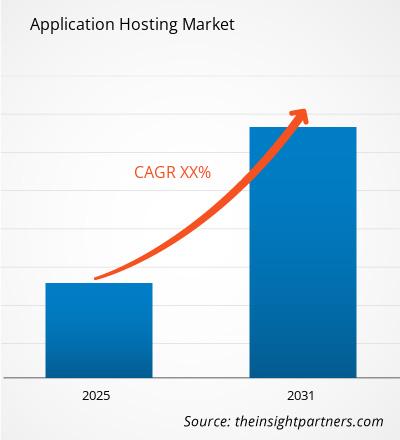
The application hosting market is projected to grow from US$ 92.68 Billion in 2025 to US$ 256.09 Billion by 2034, registering a CAGR of 11.96% during 2026–2034. Growth is supported by enterprise migration from owned infrastructure to hosted environments, rising demand for resilient digital services, and wider adoption of cloud-native development across customer-facing and internal business applications.
North America remains a central revenue base as enterprises modernize legacy workloads, increase use of hybrid cloud architecture, and prioritize secure application delivery. The application hosting market size in the region is supported by mature cloud adoption, strong hyperscaler presence, and rising demand for managed services that combine monitoring, backup, recovery, compliance, and application security.
Application Hosting Market Assessment and Insights
- North America accounted for 38–41% share in 2025 and is expected to grow at a CAGR of 10.8–11.6% during 2026–2034, supported by advanced cloud maturity, strong SaaS consumption, and large enterprise modernization programs.
- US represented 78–82% of North America share in 2025 and is expected to expand at a CAGR of 10.9–11.7% as enterprises deploy hosted applications for AI, e-commerce, banking, healthcare, and collaboration workloads.
- Europe held 24–27% share in 2025 and is expected to grow at a CAGR of 10.4–11.2%, led by the UK, Germany, France, Italy, and Spain as data residency and sovereign cloud priorities shape hosting decisions.
- Asia Pacific accounted for 22–25% share in 2025 and is expected to grow at a CAGR of 13.1–14.3%, with China, India, Japan, South Korea, and Australia advancing cloud migration, mobile applications, and digital commerce.
- Largest Segment: Cloud hosting represented 46–50% market share in 2025 and is expected to grow at a CAGR of 12.4–13.2% as IaaS, PaaS, and SaaS models become default deployment options.
- High Growth Segment: Application security held 12–15% market share in 2025 and is expected to grow at a CAGR of 14.2–15.4% as enterprises strengthen hosted workload protection.
- Key companies analyzed in detail: Amazon Web Services, Inc., International Business Machines Corporation, Rackspace Technology, Google LLC, Liquid Web, LLC, Microsoft Corporation, Sungard Availability Services, DXC Technology Company, Atos SE, and NaviSite, Inc.
Source: The Insight Partners' analysis based on proprietary research, government publications, company annual reports, investor presentations, industry databases, and expert interviews.
Enterprise hosting has moved from basic server outsourcing toward integrated platforms that combine runtime environments, observability, identity controls, automation, and disaster recovery. The application hosting market growth reflects demand for flexible capacity, faster application release cycles, and lower infrastructure ownership costs. Hosted models also support containerization, API-led integration, and DevOps workflows, allowing organizations to standardize deployment while maintaining performance and service continuity.
Demand will be driven by regulated workload, applications on the edge, and specific industry hosting needs. New geography is investing more in cloud due to scalable applications used by banks, telecoms, government, and retail. Cloud providers who offer managed infrastructure, regulatory compliance, application performance management, and security orchestration will be able to secure more lucrative deals.
Application Hosting Market Report Scope
| Report Attribute | Details |
|---|---|
| Market size in 2025 | US$ 92.68 Billion |
| Market Size by 2034 | US$ 256.09 Billion |
| Global CAGR (2026 - 2034) | 11.96% |
| Historical Data | 2021-2024 |
| Forecast period | 2026-2034 |
Application Hosting Market Analysis
Demand is rising as businesses replace fragmented infrastructure with hosted environments that support uptime, scalability, and predictable operating costs. Application hosting market growth is closely linked to cloud migration, API-driven application design, remote workforce enablement, and the need to deploy updates without disrupting customer experience. These include infrastructure services, database administration, monitoring, backup, and recovery, which have become fundamental components of hosting agreements instead of being additional value-added services.
Supply characteristics are determined by hyperscale investments, managed services differentiation, and adoption of hybrid deployment strategies. Competition among Amazon Web Services, Microsoft Corporation, Google LLC, International Business Machines Corporation, and Rackspace Technology is based on platform diversity, partner networks, automation, and enterprise-level services. Liquid Web, DXC Technology Company, Sungard Availability Services, Atos SE, and NaviSite, Inc. enhance the industry via managed hosting, recovery, and vertical services offerings.
Competitive positioning is shifting toward full lifecycle application operations. Application hosting market analysis indicates that buyers increasingly compare providers on service-level commitments, security posture, migration expertise, integration depth, and cost governance. A combination of managed Kubernetes, monitoring, backup, database, API, and compliant infrastructure will be able to help companies with cloud native as well as legacy modernization.
The trends of investment reveal an increased focus on AI readiness, low-latency hosting, sovereign clouds, and efficiency in data center operations. There is a trend where companies want to adopt a multi-cloud operating model to avoid vendor lock-in.
● REPORT CUSTOMIZATION
Tailor This Report To Align With Your Specific Business Requirements
This report can be customized to align precisely with your business objectives, scope, and target markets. Customization options include tailored segmentation, geography, competitive analysis, and strategic insights to support informed decision-making.
Customize This Report →WHAT YOU CAN ADJUST
- ● Segmentations
- ● Geography
- ● Competitive Analysis
- ● Language Preferences
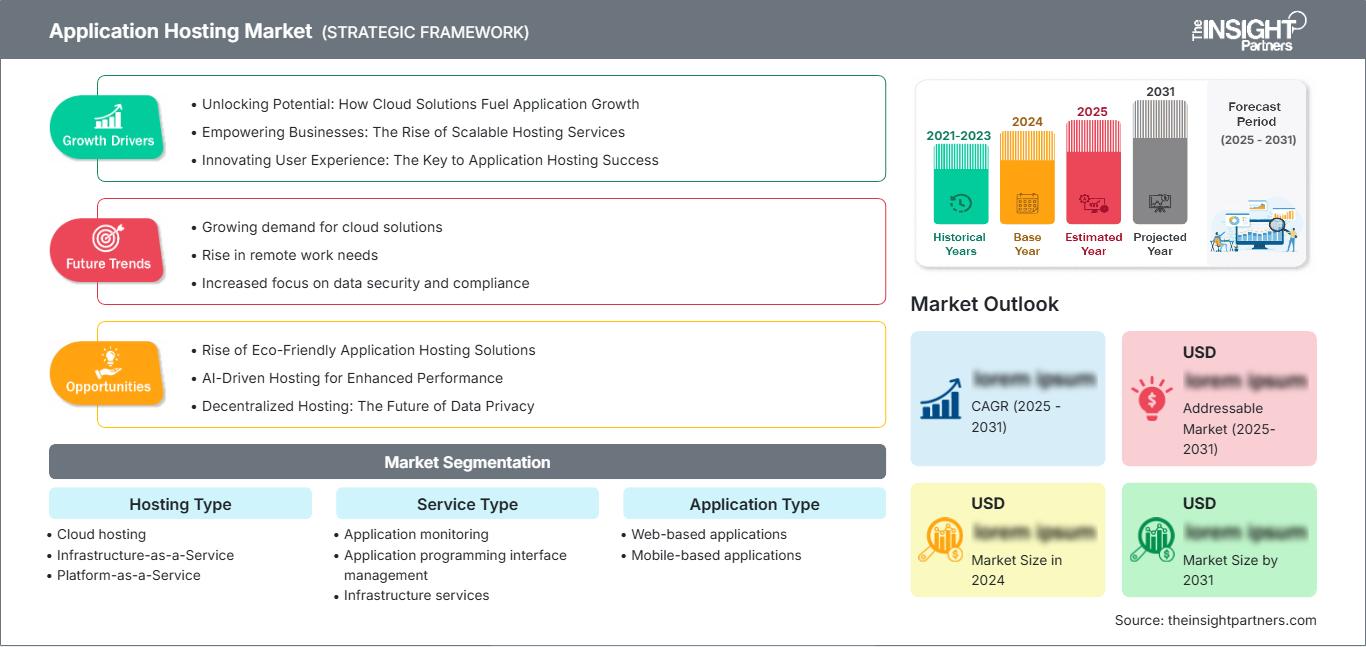
Application Hosting Market: Strategic Insights
Regional Insights
North America application hosting market
North America held 38–41% share in 2025 and is expected to grow at a CAGR of 10.8–11.6% during 2026–2034. The region benefits from high enterprise cloud maturity, dense data center availability, strong SaaS adoption, and broad use of hosted applications across financial services, healthcare, retail, media, and technology sectors.
Application hosting market share in North America is reinforced by hyperscaler infrastructure, managed service providers, and enterprise demand for resilient application operations. Buyers increasingly seek hosting contracts that include application monitoring, backup automation, recovery assurance, API management, and security controls aligned with compliance obligations.
U.S. application hosting Market
The US accounted for 78–82% of North America share in 2025 and is projected to record a CAGR of 10.9–11.7% during 2026–2034. Demand is supported by large-scale enterprise modernization, AI-enabled applications, fintech platforms, healthcare systems, digital commerce, and collaboration software requiring secure hosted environments.
Company presence remains strong because major providers operate extensive US cloud regions, partner networks, and managed service practices. Enterprises are prioritizing application security, performance monitoring, and workload portability as hosted applications become central to customer engagement and operational resilience.
Europe application hosting Market
Europe represented 24–27% share in 2025 and is expected to grow at a CAGR of 10.4–11.2% during 2026–2034. The reason behind the leadership in adoption for the UK and Germany is enterprise cloud modernization, digitalization of financial services, and the creation of data center capacities. For France, Italy, and Spain, it is the government’s cloud initiatives, modernization of retail and digitalization of manufacturing.
European market needs are affected by the issues of data residency, cybersecurity regulations, and sovereign clouds. The hosted application market cares about compliance, auditability, energy savings, and localized support. The providers with regional infrastructure, security certification, and hosted migration have more chances to succeed.
APAC application hosting Market
APAC held 22–25% share in 2025 and is expected to grow at a CAGR of 13.1–14.3% during 2026–2034. China, India, Japan, South Korea, and Australia are expanding hosted application adoption through mobile commerce, digital banking, gaming, logistics, manufacturing automation, and public cloud investments.
Growth is supported by rising internet-scale applications, cloud-first start-ups, and enterprise modernization across fast-growing economies. Policy-driven digital infrastructure investments, local data center expansion, and demand for cost-efficient scalability make APAC one of the highest-growth regions for hosted applications.
Middle East & Africa application hosting Market
The Middle East & Africa is expected to grow at a CAGR of 11.8–12.8% during 2026–2034, supported by Saudi Arabia, the UAE, South Africa, and the rest of MEA. Demand is linked to smart city initiatives, energy sector digitization, financial services modernization, and government cloud transformation.
Regional buyers prioritize secure hosting, disaster recovery, and application availability as digital services scale. Cloud regions in Gulf markets, connectivity improvements, and enterprise investments in managed infrastructure are creating opportunities for providers that can support compliance, resilience, and multilingual digital platforms.
Segmentation Analysis
Hosting Type
Hosting Type is expected to grow at a CAGR of 11.9–12.8% during 2026–2034. Application hosting market scope within this segment spans cloud hosting, IaaS, PaaS, SaaS, managed hosting, and colocation hosting. Cloud hosting leads because enterprises prefer elastic capacity, automated provisioning, and usage-based commercial models.
- Cloud hosting remains the largest option as enterprises shift web, mobile, and business applications to scalable environments that improve availability and reduce infrastructure ownership burdens.
- Infrastructure-as-a-Service supports compute, storage, and networking control for enterprises modernizing legacy applications while maintaining flexibility over operating systems, workloads, and security architecture.
- Platform-as-a-Service accelerates development by giving teams managed runtime environments, middleware, databases, and integration tools that reduce setup time and operational complexity.
- Software-as-a-Service remains important for standardized business applications delivered through hosted models, enabling faster implementation, updates, and subscription-based access.
- Managed hosting supports organizations that require expert administration, monitoring, backup, patching, and support for workloads that cannot be fully self-managed.
- Colocation hosting remains relevant for enterprises needing physical infrastructure control while using third-party facilities for power, cooling, connectivity, and resilience.
Service Type
Service Type is expected to grow at a CAGR of 12.1–13.0% during 2026–2034. Demand is led by infrastructure services, application monitoring, database administration, backup and recovery, API management, and application security as buyers seek complete operational support for hosted workloads.
- Application monitoring helps enterprises maintain performance visibility, detect outages, manage service levels, and improve user experience across hosted web and mobile applications.
- Application programming interface management supports integration-heavy architectures by securing, governing, and scaling APIs used across digital platforms, partner ecosystems, and internal systems.
- Infrastructure services provide compute, storage, networking, and operating environment support required for resilient application deployment across cloud, hybrid, and hosted platforms.
- Database administration remains essential for hosted applications that require availability, tuning, backup coordination, migration assistance, and secure data lifecycle management.
- Backup and recovery strengthen continuity by protecting hosted workloads from outages, data loss, cyber incidents, and operational failures through automated recovery processes.
- Application security is the fastest-growing service area as organizations prioritize vulnerability management, access controls, encryption, compliance, and runtime protection.
Application Type
According to the Application Hosting Market report, the Application Type segment is expected to grow at a CAGR of 11.5–12.6% during 2026–2034. Web-based applications continue to account for the larger share of demand, as enterprise portals, e-commerce platforms, collaboration tools, and back-office systems rely heavily on hosted availability and centralized management. Meanwhile, mobile-based applications are witnessing rapid growth due to rising digital consumer engagement, increasing smartphone usage, and expanding demand for mobile-first business and customer services.
- Web-based applications dominate adoption because enterprises rely on hosted portals, SaaS interfaces, transaction platforms, workflow tools, and browser-accessible applications for daily operations.
- Mobile-based applications are expanding as banks, retailers, healthcare providers, media companies, and public agencies deliver always-on services to smartphones and connected devices.
Organization Size
Organization Size is expected to grow at a CAGR of 11.7–12.7% during 2026–2034. Large enterprises lead spending due to complex workloads and compliance needs, while small and medium-sized enterprises adopt hosted models to access enterprise-grade infrastructure without high capital investment.
- Small organizations use hosted services to launch applications quickly, limit infrastructure spending, and access managed support without building dedicated IT operations teams.
- Medium-sized Enterprises are adopting cloud and managed hosting to scale applications, integrate digital workflows, and improve resilience while controlling administrative complexity.
- Large enterprises remain the largest buyers because they manage distributed workloads, regulatory obligations, global users, and complex integration requirements across hybrid environments.
Opportunity Snapshot
| Application Type | Revenue Contribution | Trend Tag | Adoption Stage |
| Web-based applications | High | Portal Scaling | Mature |
| Mobile-based applications | Medium | App Modernization | Scaling |
Application Hosting Market Growth Drivers and Impact Analysis
Enterprise Migration Toward Cloud-Native Hosting
Enterprise migration acts as the major force behind the trend owing to the fact that hosted environments decrease dependency on in-house data centers and increase deployment agility. Enterprises are moving customer portals, ERP extensions, analytic dashboards, and collaborative applications into a managed environment that enables elastic scalability. As a consequence of this trend, uptime becomes better, release cycles become faster, and IT staff can concentrate on application value rather than hardware management.
Rising Security and Resilience Requirements
Increasing demand for business continuity and security is increasing the importance of hosted applications. Companies are beginning to require hosting companies to offer backup automation, disaster recovery, vulnerability assessment, identity management, encryption, and monitoring of their applications. Cyber risks, compliance issues, and high availability demands mean that simply hosting an infrastructure will no longer do. Hosting providers who have both application security and recovery capabilities are well-placed to capture more valuable contracts.
Growth of Digital Customer Engagement Platforms
Increased digital customer engagement is driving demand for applications hosted on platforms that handle traffic surges, personalize services, provide mobile accessibility, and process transactions reliably. The need for scalable environments for web and mobile services is a necessity for retailers, banks, media sites, hospitals, government entities, and more. Application hosting offers faster delivery of features and constant availability without heavy investments in internal infrastructures.
Application Hosting Market Future Trends
AI-Ready Hosted Infrastructure
Application hosting market trends will increasingly center on AI-ready infrastructure that supports inference workloads, intelligent monitoring, automated remediation, and data-intensive applications. Enterprises will require hosting platforms with scalable compute, strong data governance, and integration with AI development services. Providers able to combine managed infrastructure with AI operations, observability, and cost controls will gain relevance as hosted applications become more intelligent and resource-intensive.
Sovereign and Industry-Specific Hosting Models
The sovereign cloud and industry vertical hosting solutions are predicted to get traction as organizations that are governed and regulated attempt to find the right balance between their digital transformation efforts and the need to have control over their data, its placement, and the ability to audit the same. Banking, health care, governmental bodies, and critical infrastructure providers will favor those hosting solutions that comply with local regulations.
Application Hosting Market Opportunities
Managed Application Security Services
The managed application security service is a high-value opportunity in light of the increasing exposure of hosted workloads to sophisticated threats. The need for enterprises is for continuous vulnerability assessment, web application protection, API security, access management, encryption, compliance, and incident response. Hosting vendors who offer security services as part of their hosting deals can boost their revenue stream and minimize buyer complexity.
Hybrid Hosting for Legacy Modernization
Hybrid hosting creates an opportunity because many enterprises cannot move all applications directly to the public cloud. Legacy systems, compliance constraints, and latency-sensitive workloads require staged modernization. Providers can support assessment, migration, refactoring, managed infrastructure, and ongoing operations across private, public, and colocation environments. Application hosting market Forecasts indicate that hybrid models will remain important as buyers seek modernization without operational disruption or uncontrolled migration risk.
Frequently Asked Questions

- Comprehensive Market Sizing and Forecast Analysis
- Detailed Segmentation Analysis
- In-Depth Market Dynamics Assessment
- Regional and Country-Level Insights
- Competitive Landscape and Company Benchmarking
- Strategic Business Intelligence
Recent Reports
Testimonials

The Insight Partners' SCADA System Market report is comprehensive, with valuable insights on current trends and future forecasts. The team was highly professional, responsive, and supportive throughout. We are very satisfied and highly recommend their services.
RAN KEDEM Partner, Reali Technologies LTDs
I requested a report on a very specific software market and the team produced the report in a few days. The information was very relevant and well presented. I then requested some changes and additions to the report. The team was again very responsive and I got the final report in less than a week.
JEAN-HERVE JENN Chairman, Future Analytica
We worked with The Insight Partners for an important market study and forecast. They gave us clear insights into opportunities and risks, which helped shape our plans. Their research was easy to use and based on solid data. It helped us make smart, confident decisions. We highly recommend them.
PIYUSH NAGPAL Sr. Vice President, High Beam Global
The Insight Partners delivered insightful, well-structured market research with strong domain expertise. Their team was professional and responsive throughout. The user-friendly website made accessing industry reports seamless. We highly recommend them for reliable, high-quality research services
YUKIHIKO ADACHI CEO, Deep Blue, LLC.
This is the first time I have purchased a market report from The Insight Partners.While I was unsure at first, I visited their web site and felt more comfortable to take the risk and purchase a market report.I am completely satisfied with the quality of the report and customer service. I had several questions and comments with the initial report, but after a couple of dialogs over email with their analyst I believe I have a report that I can use as input to our strategic planning process.Thank you so much for taking the extra time and making this a positive experience.I will definitely recommend your service to others and you will be my first call when we need further market data.
JOHN SUZUKI President and Chief Executive Officer, Board Director, BK Technologies
I wish to appreciate your support and the professionalism you displayed in the course of attending to my request for information regarding to infectious disease IVD market in Nigeria. I appreciate your patience, your guidance, and the fact that you were willing to offer a discount, which eventually made it possible for us to close a deal. I look forward to engaging The Insight Partners in the future, all thanks to the impression you have created in me as a result of this first encounter.
DR CHIJIOKE ONYIA MANAGING DIRECTOR, PineCrest Healthcare Ltd.Reason to Buy
- Informed Decision-Making
- Understanding Market Dynamics
- Competitive Analysis
- Identifying Emerging Markets
- Customer Insights
- Market Forecasts
- Risk Mitigation
- Boosting Operational Efficiency
- Strategic Planning
- Investment Justification
- Tracking Industry Innovations
- Aligning with Regulatory Trends





 Get Free Sample for