
Application Lifecycle Management (ALM) Software Market Share, Growth & Demand by 2034
Coverage: By Type (Cloud-based, On-premises); Application (Automotive and Transportation, Aerospace and Defense, BFSI, Retail, Healthcare, IT and Telecom, Others) , and Geography (North America, Europe, Asia Pacific, and South and Central America)
- Status : Data Released
- Report Code : TIPRE00017037
- Category : Technology, Media and Telecommunications
- No. of Pages : 150
- Available Report Formats :


- Last update date : August 26, 2026


2025 Market Size
US$ 4,608.81 Mn
Base year value
2034 Forecast
US$ 11,817.5 Mn
Projected by 2034
CAGR 2026-2034
11.03 %
Growth rate
Addressable Market
US$ 72,571.18 Mn
(2026-2034)
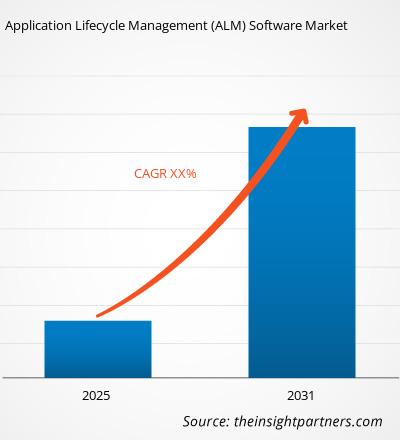
The application lifecycle management software market was valued at US$ 4,608.81 Million in 2025 and is projected to reach US$ 11,817.5 Million by 2034, recording a CAGR of 11.03% during 2026–2034. Adoption is being shaped by complex software release cycles, compliance-led engineering, cloud-native development, and the need to unify requirements, testing, deployment, and operational feedback across distributed enterprise teams.
Across North America, the application lifecycle management software market size is supported by software-defined vehicles, defense modernization, cloud migration, and regulated digital banking programs. The region is estimated to expand at a CAGR range of 10.2–11.8% during 2026–2034, with sustained demand from enterprises standardizing DevSecOps governance, traceability, and quality engineering workflows across hybrid, multi-cloud, and safety-critical environments.
Application Lifecycle Management (ALM) Software Market Assessment and Insights
- North America held 35–38% share in 2025 and is expected to grow at a CAGR range of 10.2–11.8% during 2026–2034, led by mature DevOps budgets, cybersecurity requirements, and regulated engineering adoption.
- US accounted for 78–82% of North America in 2025 and is projected to grow at 10.0–11.6% CAGR during 2026–2034, supported by cloud-native product teams and federal software assurance needs.
- Europe represented 24–27% share in 2025 and is forecast to grow at 9.4–10.9% CAGR during 2026–2034, with Germany, the UK, and France leading adoption in automotive, aerospace, and banking.
- Asia Pacific captured 25–28% share in 2025 and is expected to grow at 12.0–13.8% CAGR during 2026–2034, driven by China, India, Japan, South Korea, and Australia.
- Largest Segment: Cloud-based deployment held 62–66% market share in 2025 and is expected to grow at 11.7–13.2% CAGR during 2026–2034 as enterprises prioritize scalability and remote engineering collaboration.
- High Growth Segment: Healthcare held 8–11% market share in 2025 and is expected to grow at 12.8–14.6% CAGR during 2026–2034 due to software validation and connected-care compliance needs.
- Key companies analyzed in detail: Aha! Labs Inc., Bunnyshell S.R.L., Digital.ai Software, Inc., Delphix Corp., Dynatrace LLC, Enalean SAS, Favro AB, Open Text Corporation, ReQtest AB, Siemens AG.
Source: The Insight Partners' analysis based on proprietary research, government publications, company annual reports, investor presentations, industry databases, and expert interviews.
The market has progressed from project-specific requirements repositories to a holistic engineering platform that links planning, source control, quality management, release management, observability, and compliance evidence. Cloud delivery transformed the production process through continuous vendor releases alongside fewer customer upgrades. In regulated sectors, ALM solutions serve as audit systems of record that link software requirements to verification, validation, test results, and operational telemetry.
Going forward, growth is anticipated to expand geographically across the Asia-Pacific region, the Middle East, and Eastern Europe through larger software development hubs and government prioritization of digital infrastructure. Future investment will be on AI-driven requirements engineering, test automation, secure software supply chains, and linkage with enterprise architecture platforms. Tailwinds from regulation through financial resiliency, medical software validation, cybersecurity reporting, and automotive safety regulations are reinforcing long-cycle demand.
Application Lifecycle Management (ALM) Software Market Report Scope
| Report Attribute | Details |
|---|---|
| Market size in 2025 | US$ 4,608.81 Million |
| Market Size by 2034 | US$ 11,817.5 Million |
| Global CAGR (2026 - 2034) | 11.03% |
| Historical Data | 2021-2024 |
| Forecast period | 2026-2034 |
Application Lifecycle Management (ALM) Software Market Analysis
Demand for application lifecycle management software market growth is being reinforced by rising release frequency and expanding software complexity across embedded, cloud, and enterprise systems. Automotive suppliers must manage software bills of materials, functional safety controls, and over-the-air update traceability. A more stringent audit trail is needed for application changes by banks, and workflow validation is needed by healthcare organizations where software is used in clinical and operational settings. Such needs create a situation where ALM becomes part of the digital delivery control plane.
The value chain is made up of platform providers, implementation partners, cloud providers, DevOps tool integrators, cybersecurity experts, and enterprise architecture teams. There is a change in the supply dynamics towards software as a service, API-led integration, and configurable workflows. This is making it easier for companies with good connectors to Jira, Azure DevOps, Git repositories, test automation, and observability solutions.
Competitive intensity is high because application lifecycle management software market analysis increasingly overlaps with DevOps platforms, test management, product lifecycle management, and observability. Siemens AG distinguishes itself by Polarion for regulated engineering, Open Text Corporation by quality governance, and Dynatrace LLC by operational feedback within software development processes. Digital.ai Software Inc., Aha! Labs Inc., Favro AB, Enalean SAS, ReQtest AB, Delphix Corp., and Bunnyshell S.R.L. differentiate themselves through agility portfolio management, testing, data virtualization, and environment automation capabilities.
Ventures in ALM are focused on AI copilot capabilities, compliance automation, cloud-based enterprise editions, and workflow template solutions tailored to specific industries. Strategic positioning is also dependent on collaboration with hyperscalers, as enterprises require ALM platforms to be compatible with identity, security, analytics, and data governance stacks. Most competitive vendors are predicted to leverage both lifecycle traceability and measurable developer productivity, risk mitigation, and audit preparedness.
● REPORT CUSTOMIZATION
Tailor This Report To Align With Your Specific Business Requirements
This report can be customized to align precisely with your business objectives, scope, and target markets. Customization options include tailored segmentation, geography, competitive analysis, and strategic insights to support informed decision-making.
Customize This Report →WHAT YOU CAN ADJUST
- ● Segmentations
- ● Geography
- ● Competitive Analysis
- ● Language Preferences
Application Lifecycle Management (ALM) Software Market: Strategic Insights

Regional Insights
North America application lifecycle management software market
North America held 35–38% share of the application lifecycle management software market in 2025 and is projected to expand at 10.2–11.8% CAGR during 2026–2034. The application lifecycle management software market share remains high because enterprises in the region have larger cloud budgets, mature software engineering organizations, and stricter governance expectations across finance, healthcare, aerospace, and defense.
The demands are enhanced through DevSecOps, software supply chain security, and the development of AI-based development processes. The ALM is being applied in the U.S. and Canada in linking product planning, cybersecurity assessment, testing automation, and release proofing. Vendor consolidation will also help speed up adoption through regional sales, implementation, partners, and regulated industry deployments.
U.S. application lifecycle management software Market
The U.S. accounted for 78–82% of North America application lifecycle management software market in 2025 and is forecast to grow at 10.0–11.6% CAGR during 2026–2034. Larger firms such as those involved in technology, defense, financial services, and health care make use of ALM products for software governance in a multi-cloud environment, outsourced engineering groups, and mission-critical applications.
The companies have an established presence, with Dynatrace LLC, Aha! Labs Inc., Digital.ai Software, Inc., Siemens AG, and Open Text Corporation are the suppliers of ALM products to enterprise programs in the USA. The areas showing the most application include BFSI, Automotive Software, Aerospace, Health Care Validation, and IT Modernization.
Europe application lifecycle management software Market
Europe held 24–27% share of the application lifecycle management software market in 2025 and is expected to grow at 9.4–10.9% CAGR during 2026–2034. Germany is the leading country because automotive, industrial automation, and embedded software teams require requirements traceability, safety evidence, and integration between ALM and PLM platforms.
Adoption can be seen steadily across various verticals in the UK, including finance & banking, insurance, telecom, and government technology initiatives that feature resilience and change control, driving adoption. Germany gets an advantage through software-defined car development processes and Industrial 4.0 engineering workflows. France, Italy, and Spain are moving ahead through aerospace, military, rail, energy, and retail modernization initiatives.
APAC application lifecycle management software Market
APAC represented 25–28% share in 2025 and is projected to record 12.0–13.8% CAGR during 2026–2034. China has been a regional leader in spending on electric vehicles, telecommunication equipment, industrial software, and cloud-based enterprise platforms, whereas Japan and South Korea focus on quality, safety, and software integration using electronics. India has been expanding its adoption of ALM in the region via global capability centers, BFSI technology centers, and SaaS engineering. Australian spending is driven by public sector modernization, risk management in banking, and the digitization of healthcare.
Middle East & Africa application lifecycle management software Market
MEA is forecast to grow at 8.6–10.4% CAGR during 2026–2034. Saudi Arabia leads regional adoption as Vision-aligned digital programs, smart city platforms, energy technology, and public sector modernization increase demand for governed software delivery and vendor-managed engineering ecosystems.
The UAE is advancing through banking, logistics, retail, and aviation digitization, while South Africa provides a base for financial services and telecom software programs. The rest of MEA demand remains project-led, with adoption tied to cloud migration, infrastructure modernization, cybersecurity frameworks, and enterprise application renewal.
Segmentation Analysis
Type
Type is expected to register a CAGR range of 10.6–12.4% during 2026–2034. The application lifecycle management software market scope across deployment types reflects a transition from installed enterprise systems toward cloud-managed collaboration, although on-premises remains relevant for defense, regulated manufacturing, and data-sensitive sectors. Buyers increasingly assess deployment models by integration depth, security controls, customization needs, and total upgrade burden.
- Cloud-based platforms dominate demand because they support distributed teams, faster updates, elastic collaboration, and integration with DevOps pipelines, making them strategically important for enterprises standardizing global software delivery operations.
- On-premises deployment remains important where data residency, air-gapped environments, regulatory evidence, and legacy integrations are critical, particularly in defense, aerospace, public sector, and complex industrial engineering settings.
Application
Application is expected to grow at a CAGR range of 10.8–12.7% during 2026–2034. Adoption differs by industry because each vertical faces distinct software complexity, compliance, release velocity, and operational risk. Automotive, aerospace, BFSI, healthcare, retail, and telecom organizations are all expanding lifecycle governance, but the strongest value cases link ALM with safety, auditability, resilience, and customer-facing digital services.
- Automotive and Transportation demand is driven by software-defined vehicles, fleet systems, connected mobility, functional safety requirements, and the need to synchronize requirements, testing, embedded code, and release validation.
- Aerospace and Defense users prioritize traceability, configuration control, supplier collaboration, and certification evidence, making ALM central to mission software, avionics programs, weapons systems, and secure engineering workflows.
- BFSI adoption focuses on application change governance, regulatory auditability, cyber resilience, and release risk reduction as banks modernize core systems, payments, fraud platforms, and customer-facing digital channels.
- Retail organizations use ALM to manage omnichannel platforms, loyalty engines, mobile apps, supply chain software, and rapid release cycles without losing quality control across seasonal demand peaks.
- Healthcare demand is expanding as providers, insurers, and medical technology firms manage validated software, patient platforms, connected devices, cybersecurity requirements, and documentation for regulated digital health workflows.
- IT and Telecom remain a major user base because operators and technology service providers require scalable engineering coordination, defect management, automation integration, and release visibility across complex distributed systems.
Opportunity Snapshot
| Application | Revenue Contribution | Trend Tag | Adoption Stage |
| Automotive and Transportation | High | Software Vehicles | Scaling |
| Aerospace and Defense | Medium | Safety Traceability | Mature |
| BFSI | High | Resilience Testing | Mature |
| Retail | Medium | Omnichannel Releases | Scaling |
| Healthcare | Medium | Validated Software | Emerging |
| IT and Telecom | High | DevOps Governance | Mature |
Application Lifecycle Management (ALM) Software Market Growth Drivers and Impact Analysis
Compliance-led software engineering in regulated industries
There is an increase in the use of ALM within regulated industries due to the need for software documentation to be complete, searchable, and traceable from requirement to test to defect to approval and release. In the automotive industry, there is a need for functional safety documentation; in aerospace, configuration management is mandatory; and within banks, there is a need for change control documentation. This driver changes purchasing practices since there is more than engineering efficiency driving ALM budgets. There are other justifications in terms of lower auditing costs, lower release risk, and continuous compliance.
Cloud-native delivery and distributed engineering models
Hybrid work, outsourcing of software development, and dispersed product teams have created the need for centralized lifecycle visibility. ALM in the cloud helps in lowering infrastructure maintenance costs, increases onboarding efficiency, and allows consistent workflows regardless of geographic location. The effect is especially pronounced when it comes to big companies maintaining application portfolios in multiple cloud providers and DevOps toolchains. Centralized lifecycle solutions assist in coordinating product managers, developers, testers, security teams, and release managers based on a single source of information. In an environment of shortening release cycles, the demand for ALM with CI/CD support is growing.
Rising software complexity across physical and digital products
Automotive, Healthcare, Industrial Automation, Aerospace, and Telecom products have an increased amount of embedded code, connected services, artificial intelligence, and cybersecurity dependencies. It makes the consequences of unmanaged changes to requirements and defects in later phases more expensive. ALM solutions provide companies with the management of dependencies through the process of development from the conception phase to the release phase by linking up the intent, implementation, verification, and readiness. The market consequences will be an increased number of buyers, including engineers, quality, compliance, security, and operations executives.
Application Lifecycle Management (ALM) Software Market Future Trends
AI-assisted lifecycle governance
AI will reshape application lifecycle management software market trends by helping teams detect duplicate requirements, suggest test cases, summarize defects, identify release risks, and recommend traceability links. Moving from developer coding assistants to governance intelligence that helps product owners, QA, compliance, and release managers, this trend will add proactivity to ALM systems by decreasing the need for manual documentation and improving decision-making. The enterprise uptake will require explainability, permissions management, model governance, and privacy-preserving processing of engineering data in authorized cloud infrastructures.
Convergence of ALM, PLM, and observability
The next big move in architecture will come from tying lifecycle management to real-world operational data. Engineers will become more adept at tying their requirements and testing results to production issues, telemetry data, and customer experience metrics. Thus comes a feedback loop in software development, wherein performance determines the order in which things get prioritized and tested. Siemens and Dynatrace serve as two examples on opposite sides of the spectrum in this regard: lifecycle management on the one side, and operational visibility on the other.
Application Lifecycle Management (ALM) Software Market Opportunities
Industry-specific ALM templates for regulated buyers
Application lifecycle management software market Forecasts indicate strong opportunity for vendors and integrators that package ALM around industry requirements rather than generic workflows. Automotive, medical device, aerospace, banking, and public sector buyers need configurable evidence models, approval flows, risk registers, and reporting structures aligned with their operating context. Providers can accelerate adoption by offering templates for safety cases, requirements reviews, validation plans, defect triage, and release signoff. This approach shortens implementation timelines, improves user confidence, and creates premium services revenue around compliance process design, migration, training, and integration.
ALM modernization for legacy enterprise portfolios
Large enterprises still operate fragmented requirements databases, spreadsheets, legacy test tools, and disconnected release processes. Modernization creates an opportunity for vendors that can migrate historical artifacts, preserve audit trails, and connect ALM with existing DevOps and service management platforms. Buyers need practical transformation paths that avoid disrupting active programs. Service partners can build value through repository consolidation, taxonomy redesign, workflow rationalization, and dashboard development. The opportunity is especially attractive in BFSI, telecom, defense, and industrial manufacturing, where application portfolios are large and compliance exposure is high.
Frequently Asked Questions

- Comprehensive Market Sizing and Forecast Analysis
- Detailed Segmentation Analysis
- In-Depth Market Dynamics Assessment
- Regional and Country-Level Insights
- Competitive Landscape and Company Benchmarking
- Strategic Business Intelligence
Recent Reports
Testimonials

The Insight Partners' SCADA System Market report is comprehensive, with valuable insights on current trends and future forecasts. The team was highly professional, responsive, and supportive throughout. We are very satisfied and highly recommend their services.
RAN KEDEM Partner, Reali Technologies LTDs
I requested a report on a very specific software market and the team produced the report in a few days. The information was very relevant and well presented. I then requested some changes and additions to the report. The team was again very responsive and I got the final report in less than a week.
JEAN-HERVE JENN Chairman, Future Analytica
We worked with The Insight Partners for an important market study and forecast. They gave us clear insights into opportunities and risks, which helped shape our plans. Their research was easy to use and based on solid data. It helped us make smart, confident decisions. We highly recommend them.
PIYUSH NAGPAL Sr. Vice President, High Beam Global
The Insight Partners delivered insightful, well-structured market research with strong domain expertise. Their team was professional and responsive throughout. The user-friendly website made accessing industry reports seamless. We highly recommend them for reliable, high-quality research services
YUKIHIKO ADACHI CEO, Deep Blue, LLC.
This is the first time I have purchased a market report from The Insight Partners.While I was unsure at first, I visited their web site and felt more comfortable to take the risk and purchase a market report.I am completely satisfied with the quality of the report and customer service. I had several questions and comments with the initial report, but after a couple of dialogs over email with their analyst I believe I have a report that I can use as input to our strategic planning process.Thank you so much for taking the extra time and making this a positive experience.I will definitely recommend your service to others and you will be my first call when we need further market data.
JOHN SUZUKI President and Chief Executive Officer, Board Director, BK Technologies
I wish to appreciate your support and the professionalism you displayed in the course of attending to my request for information regarding to infectious disease IVD market in Nigeria. I appreciate your patience, your guidance, and the fact that you were willing to offer a discount, which eventually made it possible for us to close a deal. I look forward to engaging The Insight Partners in the future, all thanks to the impression you have created in me as a result of this first encounter.
DR CHIJIOKE ONYIA MANAGING DIRECTOR, PineCrest Healthcare Ltd.Reason to Buy
- Informed Decision-Making
- Understanding Market Dynamics
- Competitive Analysis
- Identifying Emerging Markets
- Customer Insights
- Market Forecasts
- Risk Mitigation
- Boosting Operational Efficiency
- Strategic Planning
- Investment Justification
- Tracking Industry Innovations
- Aligning with Regulatory Trends





 Get Free Sample for