
Application Performance Monitoring (APM) Software Market Trends, Size & Growth by 2034
Coverage: By Access Type (Web APM, Mobile APM); Deployment Type (On-Premises, Cloud); Organization Size (SMEs, Large Enterprise); End-Users (IT and Telecom, BFSI, Retail, Manufacturing, Healthcare, Others), and Geography (North America, Europe, Asia Pacific, and South and Central America)
- Status : Data Released
- Report Code : TIPRE00015360
- Category : Technology, Media and Telecommunications
- No. of Pages : 150
- Available Report Formats :


- Last update date : August 26, 2026


2025 Market Size
US$ 10.31 Bn
Base year value
2034 Forecast
US$ 26.71 Bn
Projected by 2034
CAGR 2026-2034
11.15 %
Growth rate
Addressable Market
US$ 163.34 Bn
(2026-2034)
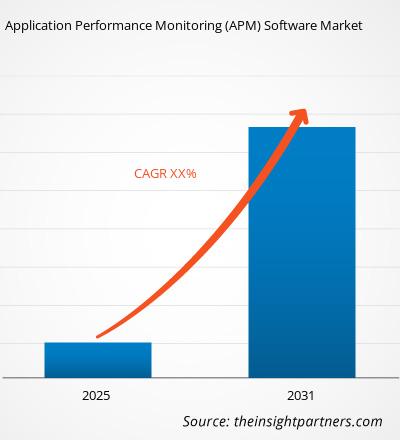
The application performance monitoring software market is projected to grow from US$ 10.31 Billion in 2025 to US$ 26.71 Billion by 2034, registering a CAGR of 11.15% during 2026–2034. The expansion reflects rising enterprise dependence on digital channels, distributed cloud architectures, real-time customer experience monitoring, and application reliability programs that connect software performance directly with revenue protection, operational continuity, and compliance-focused service assurance.
North America remains a priority region as enterprises modernize cloud-native estates and adopt AI-assisted observability across hybrid environments. The application performance monitoring software market size in the region is expected to advance at a CAGR range of 10.2–10.8% between 2026 and 2034, driven by high cloud spending, regulated digital banking, large-scale telecom modernization, and platform consolidation among enterprises seeking lower incident response costs.
Application Performance Monitoring (APM) Software Market Assessment and Insights
- North America held 39–42% share in 2025 and is growing at a CAGR range of 10.2–10.8% during 2026–2034, supported by mature cloud operations, strict uptime expectations, and advanced SRE adoption.
- US accounted for 82–85% of North America in 2025 and is growing at a CAGR range of 10.0–10.6% during 2026–2034, led by hyperscale cloud, fintech, and healthcare workloads.
- Europe represented 25–28% share in 2025 and is growing at a CAGR range of 9.6–10.3% during 2026–2034, with the UK, Germany, and France leading adoption in regulated digital services.
- Asia Pacific captured 22–25% share in 2025 and is growing at a CAGR range of 12.8–13.6% during 2026–2034, driven by China, India, Japan, South Korea, and Australia.
- Largest Segment: Cloud deployment held 61–65% market share in 2025, growing at a CAGR range of 11.9–12.7% during 2026–2034 as enterprises prioritize scalable telemetry ingestion.
- High Growth Segment: Mobile APM held 31–35% market share in 2025, growing at a CAGR range of 13.4–14.2% during 2026–2034 due to app-led commerce and banking.
- Key companies analyzed in detail: Adobe Inc., Compuware Corporation, a BMC company, Fair Isaac Corporation, IBM Corporation, Infor, Microsoft Corporation, Oracle Corporation, Salesforce, Inc., SAP SE, SAS Institute Inc.
Source: The Insight Partners' analysis based on proprietary research, government publications, company annual reports, investor presentations, industry databases, and expert interviews.
Enterprise monitoring has evolved from infrastructure-level alarms to observability of the entire chain comprising application code, APIs, containers, databases, user sessions, and business transactions. The production environment has also seen some dynamics due to the increasing frequency of releases by DevOps and the growth in telemetry generated by microservices and Kubernetes. Vendor differentiation is now based on automated topology discovery, anomaly detection, digital experience monitoring, and cost-efficient data retention.
In the forecast period, new regions will see faster cloud adoption, modern digital public infrastructure, and payment reform. Tailwinds in terms of regulations on cybersecurity resilience, banking continuity, health data infrastructure, and quality of service in telecom networks will drive uptake. Investments will focus on cloud-native APM, OpenTelemetry integration, AI-powered remediation, and platforms minimizing the number of tools used by engineering, security, and infrastructure teams.
Application Performance Monitoring (APM) Software Market Report Scope
| Report Attribute | Details |
|---|---|
| Market size in 2025 | US$ 10.31 Billion |
| Market Size by 2034 | US$ 26.71 Billion |
| Global CAGR (2026 - 2034) | 11.15% |
| Historical Data | 2021-2024 |
| Forecast period | 2026-2034 |
Application Performance Monitoring (APM) Software Market Analysis
Rapid digital service expansion is increasing the need for resilient software operations. The application performance monitoring software market growth is tied to rising online transaction volumes, API-dependent business models, and real-time user experience expectations across banking, retail, healthcare, and telecom. The trend now is to invest in monitoring solutions that can identify latencies, transaction failures, and poor services before the enterprise faces financial or regulatory risk.
The environment comprises Application Performance Management (APM) vendors, cloud platforms, managed service providers, system integrators, DevOps practitioners, and open source telemetry communities. The supply environment is moving towards a software-as-a-service delivery model, metered billing, and lightweight agents. There has been an improvement in OpenTelemetry for better data portability, and AI models are helping incident classification, log correlation, and metric analysis.
Competition is shaped by platform breadth, cloud ecosystem integration, AI operations, and enterprise service assurance. The application performance monitoring software market analysis indicates that IBM Corporation, Microsoft Corporation, Oracle Corporation, SAP SE, Salesforce, Inc., and Adobe Inc. are using installed enterprise relationships to expand observability across clouds, applications, analytics, and customer experience systems.
The specialists, on the one hand, and the software companies, on the other hand, have positioned themselves around the ability to deploy, regulate workload management, and monitor particular industries. Compuware Corporation is still known as a mainframe performance visibility company, but it belongs to BMC. The companies, such as Fair Isaac Corporation, Infor, and SAS Institute Inc., link the application performance to analytic systems.
● REPORT CUSTOMIZATION
Tailor This Report To Align With Your Specific Business Requirements
This report can be customized to align precisely with your business objectives, scope, and target markets. Customization options include tailored segmentation, geography, competitive analysis, and strategic insights to support informed decision-making.
Customize This Report →WHAT YOU CAN ADJUST
- ● Segmentations
- ● Geography
- ● Competitive Analysis
- ● Language Preferences
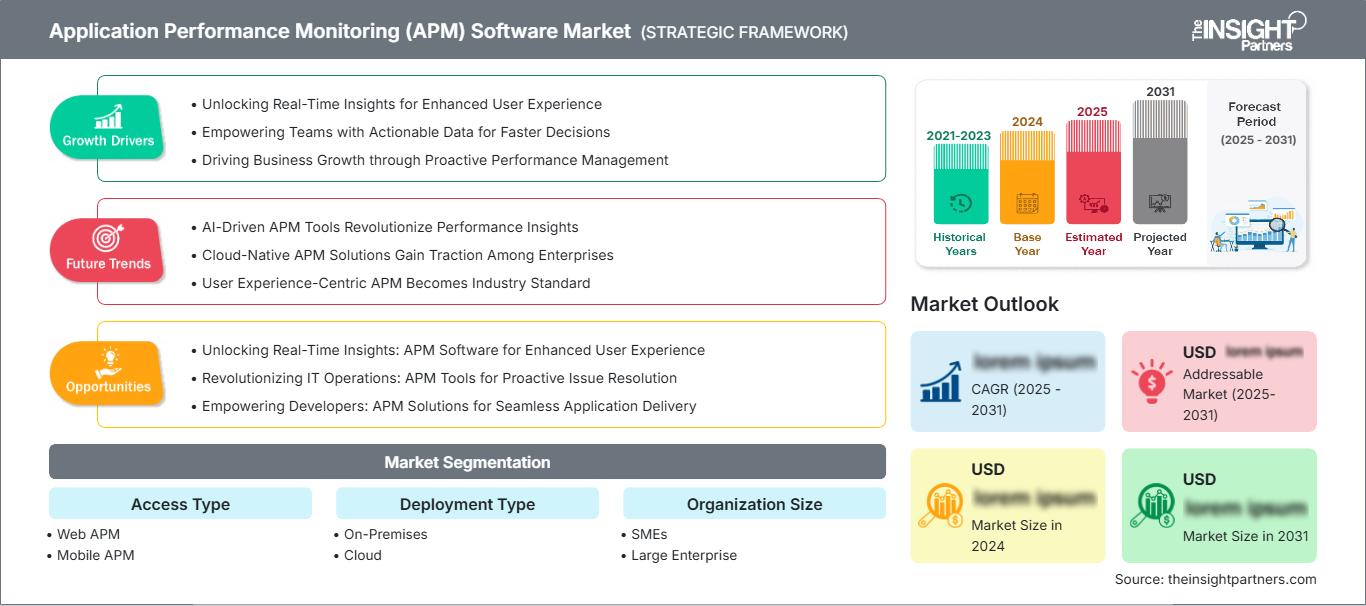
Application Performance Monitoring (APM) Software Market: Strategic Insights
Regional Insights
North America Application Performance Monitoring Software Market
North America held 39–42% share in 2025 and is projected to expand at a CAGR range of 10.2–10.8% from 2026 to 2034. The region benefits from mature cloud penetration, high software release velocity, and widespread adoption of DevOps and SRE practices. Strong spending by BFSI, healthcare, telecom, and retail enterprises supports demand for full-stack visibility.
The application performance monitoring software market share in North America is reinforced by hyperscale infrastructure, advanced cybersecurity compliance needs, and the concentration of global software vendors. Enterprises increasingly prefer unified observability suites that combine APM, logs, infrastructure monitoring, and digital experience analytics. AI-assisted root cause analysis is particularly relevant where outage costs and service-level penalties are material.
U.S. Application Performance Monitoring Software Market
The U.S. accounted for 82–85% of the North America Application Performance Monitoring Software Market in 2025 and is forecast to grow at a CAGR range of 10.0–10.6% during 2026–2034. Adoption is strongest among cloud-native banks, health systems, e-commerce platforms, telecom operators, and software-as-a-service providers. Continuous delivery pipelines create steady demand for production observability and release validation.
Microsoft Corporation, IBM Corporation, Oracle Corporation, Salesforce, Inc., Adobe Inc., and SAS Institute Inc. have significant U.S. enterprise footprints, supporting integration-led adoption across analytics, cloud, and customer platforms. Application trends include mobile banking stability, patient portal uptime, digital commerce conversion protection, and AI workload monitoring, where latency, model response reliability, and transaction traceability matter.
Europe Application Performance Monitoring Software Market
Europe represented 25–28% share of the Application Performance Monitoring Software Market in 2025 and is expected to grow at a CAGR range of 9.6–10.3% between 2026 and 2034. In the UK, there is a high demand driven by technologies such as fintech, e-commerce, telco modernization, and government cloud implementations. There is a rising demand for auditable monitoring and incident forensics because of the high operational resilience standards.
Germany continues to be a big market thanks to manufacturing digitalization, automotive software platforms, industrial IoT, and SAP-centric business landscapes. Companies have a preference for hybrid deployments, data sovereignty, and integrations with existing solutions. In France, Italy, and Spain, the adoption of the product is growing thanks to banking modernization, healthcare portals, omnichannel retail, and telco infrastructures.
Europe's demands are impacted by requirements regarding privacy, cybersecurity, and digital operational resilience. It is beneficial for vendors to offer solutions for regional data residency, explainable AI operations, and telemetry retention. SAP SE, IBM Corporation, Oracle Corporation, and Microsoft Corporation are some of the players active in complex business environments with APM having to integrate with ERP, analytics, and clouds.
APAC Application Performance Monitoring Software Market
APAC held 22–25% share of the Application Performance Monitoring Software Market in 2025 and is projected to register a CAGR range of 12.8–13.6% during 2026–2034, the fastest among major regions. China leads regional demand, while India, Japan, South Korea, and Australia contribute through cloud migration, digital payments, super-app ecosystems, and enterprise modernization.
Industrial and policy drivers include smart manufacturing, 5G-enabled applications, national digital identity systems, and public cloud adoption. Enterprises are deploying APM to manage scale, latency, and app availability across mobile-first markets. Growth is supported by regional data centers, managed services, and modernization of banking, telecom, retail, and healthcare platforms.
Middle East & Africa Application Performance Monitoring Software Market
The Middle East & Africa Application Performance Monitoring Software Market is expected to grow at a CAGR range of 9.8–10.6% during 2026–2034. Saudi Arabia is the leading country, followed by the UAE, South Africa, and the rest of MEA. National digital transformation programs, cloud regions, smart city platforms, and banking modernization are creating demand for application reliability tools.
Energy, infrastructure, aviation, and government services are important adoption areas because digital platforms increasingly support field operations, citizen services, and industrial workflows. Enterprises are using APM to reduce downtime, improve customer-facing portals, and support hybrid infrastructure. Vendor partnerships with regional integrators remain critical for skills, implementation, and managed observability operations.
Segmentation Analysis
Access Type
Access Type is projected to grow at a CAGR range of 10.8–11.6% during 2026–2034. This segment defines how enterprises monitor web and mobile application experiences across user journeys, APIs, networks, and backend services. The application performance monitoring software market scope within the access type is expanding as businesses connect front-end performance to conversion, service reliability, and digital customer retention.
- Web APM remains essential for monitoring browser transactions, page load performance, API response, and server-side dependencies across enterprise portals, e-commerce sites, banking platforms, and SaaS applications.
- Mobile APM is gaining strategic importance as banks, retailers, telecom operators, and healthcare providers rely on mobile apps for customer engagement, payments, claims, appointments, and loyalty services.
Deployment Type
Deployment Type is estimated to grow at a CAGR range of 11.0–11.8% during 2026–2034. Cloud adoption is reshaping deployment preferences as enterprises seek scalable telemetry ingestion, faster implementation, and lower infrastructure management effort. On-premises deployment remains relevant for regulated workloads, mainframe estates, and organizations with strict data control requirements.
- On-Premises deployment continues in banking, government, defense-adjacent systems, and legacy enterprise estates where telemetry residency, operational control, and integration with existing monitoring tools remain critical.
- Cloud deployment leads adoption as enterprises prefer elastic data processing, SaaS upgrades, integrated AI features, faster rollout, and simplified monitoring across distributed cloud-native environments.
Organization Size
Organization Size is forecast to grow at a CAGR range of 10.5–11.3% during 2026–2034. Adoption patterns differ by maturity, budget, and operational complexity. Large enterprises use APM for resilience, governance, and cross-domain observability, while SMEs increasingly adopt cloud-based tools to improve uptime without building large internal operations teams.
- SMEs favor subscription-based APM platforms with automated setup, simplified dashboards, and bundled infrastructure visibility, helping small technology teams manage digital services with limited specialist resources.
- Large Enterprise users require multi-cloud visibility, role-based governance, integration with ITSM workflows, advanced analytics, and scalable retention policies across thousands of services and applications.
End-Users
End-Users are expected to grow at a CAGR range of 10.9–11.7% during 2026–2034. Demand is strongest where digital platforms directly affect revenue, service continuity, regulatory compliance, and customer experience. IT and telecom lead early maturity, while BFSI, retail, manufacturing, and healthcare are expanding observability to mission-critical application estates.
- IT and Telecom rely on APM to manage service availability, API performance, customer portals, network-facing applications, and complex cloud-native systems with high transaction and telemetry volumes.
- BFSI uses APM for payment uptime, mobile banking stability, trading platform latency, fraud analytics availability, and compliance evidence across hybrid and highly regulated technology environments.
- Retail adoption is driven by digital commerce, personalization engines, inventory platforms, peak-season traffic, and omnichannel applications where latency directly affects conversion and loyalty.
- Manufacturing uses APM for connected factories, ERP performance, supply chain platforms, industrial IoT applications, and production dashboards that support operational continuity.
- Healthcare depends on APM for patient portals, electronic health records, claims systems, digital appointments, and secure data exchange platforms requiring uptime and transaction traceability.
Opportunity Snapshot
| End-Users | Revenue Contribution | Trend Tag | Adoption Stage |
| IT and Telecom | High | Service Assurance | Mature |
| BFSI | High | Payment Reliability | Scaling |
| Retail | Medium | Commerce Uptime | Scaling |
| Manufacturing | Medium | Factory Visibility | Emerging |
| Healthcare | Medium | Patient Portals | Scaling |
Application Performance Monitoring (APM) Software Market Growth Drivers and Impact Analysis
Cloud-Native Complexity Increasing Need for Full-Stack Visibility
Cloud-native designs result in higher levels of interdependencies when compared to monoliths; as such, isolated monitoring of the infrastructure does not suffice. With containers, serverless computing, APIs, managed database services, and microservices, there are massive volumes of telemetry that need to be correlated. This driver is driving enterprises to invest in platforms that enable traceability, logging, metric correlation, and user experience data in one view. The effect that this is having is enabling faster isolation of incidents, reducing gaps in visibility during deployments, and increasing accountability among DevOps, SRE, infrastructure, and application teams.
Digital Revenue Dependence Raising Uptime Expectations
Workflows that contribute to revenue today are contingent upon applications being available within mobile banking, e-commerce checkouts, telecommunications self-service portals, healthcare scheduling, and enterprise software-as-a-service (SaaS) offerings. Any degradation can impact customer loyalty, transactional success, credibility, and compliance. This trend is driving enterprises to evaluate their performance in terms of the user experience rather than mere server-based measures of performance. Application performance management (APM) solutions facilitate the detection of latency issues, failed requests, bottleneck services, and problems with APIs well before they impact a wider set of users. The commercial impact is most pronounced in the BFSI and retail industries, where performance dashboards increasingly relate technical metrics to business results.
AI-Assisted Operations Reducing Manual Incident Resolution
Enterprises are employing AI-driven operations to minimize alert noise, incident prioritization, and recognition of abnormal performance patterns faster than what is possible through manual incident management. APM vendors are integrating machine learning, causation analysis, and generative summaries into their processes to help teams identify causation within the complexity of service maps. This trend helps improve operational efficiency by freeing up the engineering team from manually connecting disparate events and solving service-affecting problems. It also enables small-sized operations teams to handle larger software ecosystems. With AI becoming increasingly production-ready, APM vendors are now monitoring model latency, token usage, retrieval processes, and agents in addition to applications.
Application Performance Monitoring (APM) Software Market Future Trends
OpenTelemetry-Centered Observability Architectures
The application performance monitoring software market trends are moving toward open instrumentation as enterprises seek telemetry portability and reduced vendor lock-in. OpenTelemetry is quickly gaining popularity as a means for trace, metric, and log data collection in multi-cloud and hybrid settings. It will push vendors to differentiate themselves by offering high-quality analytics, automation, better economics of data storage, and tight integration with the workflow instead of proprietary agents only. In the long run, organizations are expected to adopt standardized data collection while relying on commercial solutions for correlation, visualization, governance, and remediation.
Monitoring for AI Applications and Agentic Workflows
AI-powered software raises performance concerns that cannot be addressed by current APM technologies. In the future, systems will analyze prompt chains, model delays, retrieval, token usage, policy adherence, hallucinations and the associated workflow breakdowns, and tool-to-agent communications. This will be a crucial development in view of GenAI implementation in the areas of customer support, software development, analytics, and knowledge management within companies. For APM solution providers, it will become critical to link AI telemetry data with infrastructure, application traces, and business outcomes. Another implication of this change will be the need for governance frameworks.
Application Performance Monitoring (APM) Software Market Opportunities
Industry-Specific Reliability Packages for Regulated Enterprises
Vendors can create differentiated growth by packaging APM capabilities for regulated sectors such as banking, healthcare, telecom, and manufacturing. These packages should combine transaction tracing, audit-ready reporting, data residency controls, compliance dashboards, and predefined service-level indicators. The application performance monitoring software market Forecasts point to strong demand where operational resilience and customer trust are board-level priorities. Providers that align monitoring with regulations, executive reporting, and industry workflows can move beyond technical user seats into enterprise-wide reliability programs. This opportunity favors vendors with strong consulting ecosystems and integrations into ITSM, security, ERP, and analytics platforms.
Managed Observability Services for Skills-Constrained Enterprises
Many enterprises lack enough SRE, cloud operations, and telemetry engineering talent to operate advanced APM platforms effectively. Managed observability services can fill this gap by combining platform deployment, dashboard design, alert tuning, incident review, and continuous optimization. This creates a channel opportunity for system integrators, cloud partners, telecom providers, and managed service providers. Vendors that offer partner-ready tooling, standardized onboarding, and flexible commercial models can accelerate adoption among mid-market firms and distributed enterprises. The opportunity is especially strong in APAC and the Middle East & Africa, where digital transformation speed often exceeds internal operations maturity.
Frequently Asked Questions

- Comprehensive Market Sizing and Forecast Analysis
- Detailed Segmentation Analysis
- In-Depth Market Dynamics Assessment
- Regional and Country-Level Insights
- Competitive Landscape and Company Benchmarking
- Strategic Business Intelligence
Recent Reports
Testimonials

The Insight Partners' SCADA System Market report is comprehensive, with valuable insights on current trends and future forecasts. The team was highly professional, responsive, and supportive throughout. We are very satisfied and highly recommend their services.
RAN KEDEM Partner, Reali Technologies LTDs
I requested a report on a very specific software market and the team produced the report in a few days. The information was very relevant and well presented. I then requested some changes and additions to the report. The team was again very responsive and I got the final report in less than a week.
JEAN-HERVE JENN Chairman, Future Analytica
We worked with The Insight Partners for an important market study and forecast. They gave us clear insights into opportunities and risks, which helped shape our plans. Their research was easy to use and based on solid data. It helped us make smart, confident decisions. We highly recommend them.
PIYUSH NAGPAL Sr. Vice President, High Beam Global
The Insight Partners delivered insightful, well-structured market research with strong domain expertise. Their team was professional and responsive throughout. The user-friendly website made accessing industry reports seamless. We highly recommend them for reliable, high-quality research services
YUKIHIKO ADACHI CEO, Deep Blue, LLC.
This is the first time I have purchased a market report from The Insight Partners.While I was unsure at first, I visited their web site and felt more comfortable to take the risk and purchase a market report.I am completely satisfied with the quality of the report and customer service. I had several questions and comments with the initial report, but after a couple of dialogs over email with their analyst I believe I have a report that I can use as input to our strategic planning process.Thank you so much for taking the extra time and making this a positive experience.I will definitely recommend your service to others and you will be my first call when we need further market data.
JOHN SUZUKI President and Chief Executive Officer, Board Director, BK Technologies
I wish to appreciate your support and the professionalism you displayed in the course of attending to my request for information regarding to infectious disease IVD market in Nigeria. I appreciate your patience, your guidance, and the fact that you were willing to offer a discount, which eventually made it possible for us to close a deal. I look forward to engaging The Insight Partners in the future, all thanks to the impression you have created in me as a result of this first encounter.
DR CHIJIOKE ONYIA MANAGING DIRECTOR, PineCrest Healthcare Ltd.Reason to Buy
- Informed Decision-Making
- Understanding Market Dynamics
- Competitive Analysis
- Identifying Emerging Markets
- Customer Insights
- Market Forecasts
- Risk Mitigation
- Boosting Operational Efficiency
- Strategic Planning
- Investment Justification
- Tracking Industry Innovations
- Aligning with Regulatory Trends





 Get Free Sample for