
Aptamers Technology Market Share, Growth & Forecast by 2034
Coverage: By Technique (SELEX Technique, MARAS, and Others), By Type (Nucleic Acid and Peptide Aptamers), Application (Diagnostics, Therapeutics, Research and Development), by End User (Biotechnology and Pharmaceutical Companies, Academic and Research Institutions, Contract Research Organization), and Geography (North America, Europe, Asia Pacific, Middle East & Africa, and South & Central America)
- Status : Data Released
- Report Code : TIPRE00037801
- Category : Life Sciences
- No. of Pages : 150
- Available Report Formats :


- Last update date : September 01, 2026


2025 Market Size
US$ 3.72 Bn
Base year value
2034 Forecast
US$ 26.45 Bn
Projected by 2034
CAGR 2026-2034
24.36 %
Growth rate
Addressable Market
US$ 116.11 Bn
(2026-2034)
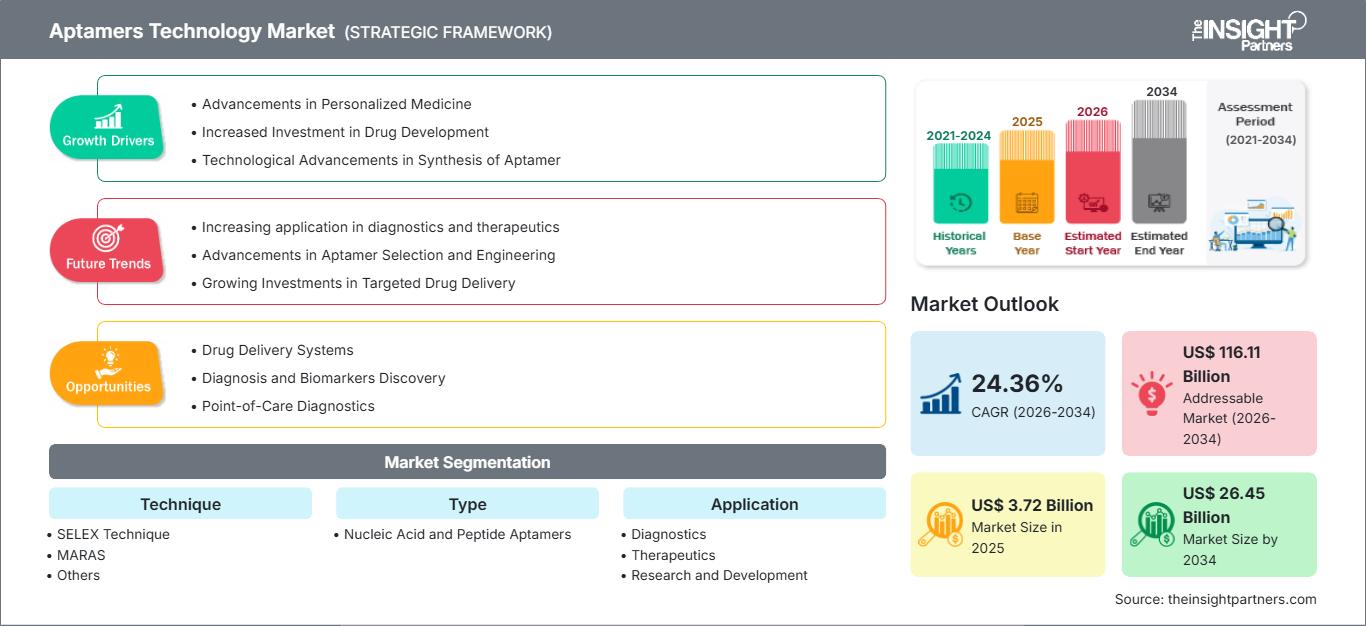
The Aptamers Technology Market size is advancing as nucleic-acid and peptide-based recognition technologies move from laboratory research toward diagnostics, therapeutics, and commercial assay development. The market size is valued at US$ 3.72 Billion in 2025 and is projected to reach US$ 26.45 Billion by 2034, registering a CAGR of 24.36% during 2026–2034. Expansion reflects improvements in selection platforms, molecular engineering, sequencing, computational screening, and application-specific aptamer optimization.
North America is positioned as a leading regional market, supported by established biotechnology clusters, pharmaceutical research expenditure, and academic infrastructure. The regional CAGR is estimated at 23.2–25.2% during 2026–2034. Increasing use of synthetic binders in biomarker discovery and precision diagnostics, combined with partnerships between biotechnology companies and pharmaceutical developers, should sustain investment and technology adoption.
Aptamers Technology Market Assessment and Insights
- North America: North America is estimated to hold 42–46% Aptamers Technology Market share in 2025 and grow at a CAGR of 23.2–25.2% between 2026–2034, supported by biotechnology investment, pharmaceutical R&D, and specialized aptamer development capabilities.
- US: The US is expected to represent 87–91% of North America's 2025 share and expand at a CAGR of 23.0–25.0% during 2026–2034, supported by pharmaceutical research and platform development.
- Europe: Europe is estimated at 23–27% share in 2025 and is projected to grow at 22.1–24.1% CAGR through 2034, led by the UK, Germany, France, Spain, and Italy.
- Asia Pacific: Asia Pacific is estimated to account for 17–21% share in 2025 and grow at 26.1–28.1% CAGR during 2026–2034, with China, Japan, South Korea, India, and Australia driving adoption.
- Largest Segment: SELEX Technique is estimated to represent 62–67% market share in 2025 and grow at 23.4–25.4% CAGR through 2034, supported by established selection workflows.
- High Growth Segment: Therapeutics is estimated at 24–28% market share in 2025 and projected to grow at 26.0–28.0% CAGR during 2026–2034 as targeted delivery advances.
- Key companies analyzed in detail: SomaLogic; Aptamer Group plc; APTADEL THERAPEUTICS SL; Base Pair Biotechnologies, Inc.; NOXXON Pharma AG; Vivonics, Inc.; Aptagen, LLC; TriLink Biotechnologies, LLC; Altermune LLC; AM Biotechnologies, LLC.
Source: The Insight Partners' analysis based on proprietary research, government publications, company annual reports, investor presentations, industry databases, and expert interviews.
The technology space is evolving from traditional iterative selections to multiplex, automation, and data-enabled selections. SELEX continues to be the base technology for most discovery projects, with sequencing and bioinformatics aiding in the discovery phase post-enrichment. The focus on commercialization has shifted towards functional performance of candidates within their application conditions, necessitating selection, characterization, maturation, and assay validation to work as a process rather than separate experimental steps.
Investments in the Aptamers Technology Market during the forecast period are expected to shift from discovery technologies to application-ready platforms. The biotechnology ecosystem in the Asia Pacific is expected to increase research capability, whereas Europe and North America will keep focusing on translating their discoveries into therapies and diagnostics. Commercialization is expected to be favored by familiarity with synthetic nucleic acid products, enhanced contract development, and licensing strategy.
Aptamers Technology Market Report Scope
| Report Attribute | Details |
|---|---|
| Market size in 2025 | US$ 3.72 Billion |
| Market Size by 2034 | US$ 26.45 Billion |
| Global CAGR (2026 - 2034) | 24.36% |
| Historical Data | 2021-2024 |
| Forecast period | 2026-2034 |
Aptamers Technology Market Analysis
According to the Aptamers Technology Market report, growth in demand will be fueled by the need for specific molecular recognition technologies in diagnostics, therapeutics, and research. Market growth is aided by the existence of value chains encompassing library design, target preparation, selection, sequencing, bioinformatics, maturation of candidates, chemical synthesis, and application validation. More and more customers are opting for integrated service providers with capabilities ranging from target definition to application validation without technology transfers.
Changing dynamics of supply in the Aptamers Technology Market will be driven by availability of more affordable production processes of synthetic oligonucleotides and specialization in selection services. Biotech companies will be able to outsource discovery and have their resources available for downstream development. Such arrangement will enable participation of CROs and monetization of custom selection services, assay development, licensing and reagent supply. The demand will not be limited to finished aptamers but will extend to technology-enabled discovery and optimization services.
The competitive environment in the Aptamers Technology Market is characterized by fragmentation between platform developers, specialized discovery service providers, diagnostic developers, and therapeutic biotechnology companies. SomaLogic possesses a reputation for its aptamer-based proteomic analysis services, Aptamer Group plc specializes in developing synthetic Optimer binders. Discovery, characterization, and application development are the focus of Base Pair Biotechnologies, Inc., Aptagen, LLC, and AM Biotechnologies, LLC. Therapeutic applications will be provided by Aptadel Therapeutics and NOXXON Pharma AG. Specialized service providers include Vivonics, Inc., TriLink Biotechnologies, LLC, and Altermune LLC.
Investment strategy in this space tends to favor platforms with differentiated IP and clear proof of utility downstream. Analysis of Aptamers Technology Market shows that positioning of any commercial effort hinges on such elements as target-selection efficiency, sequence diversity, stability engineering, application validation, and partnering capability. Companies with access to pharmaceutical and diagnostic customers will benefit from the ability to commercialize their offering via milestone-based projects and licensing.
● REPORT CUSTOMIZATION
Tailor This Report To Align With Your Specific Business Requirements
This report can be customized to align precisely with your business objectives, scope, and target markets. Customization options include tailored segmentation, geography, competitive analysis, and strategic insights to support informed decision-making.
Customize This Report →WHAT YOU CAN ADJUST
- ● Segmentations
- ● Geography
- ● Competitive Analysis
- ● Language Preferences
Aptamers Technology Market: Strategic Insights
Regional Insights
North America Aptamers Technology Market
North America is estimated to hold 42–46% share in 2025 and grow at a CAGR of 23.2–25.2% during 2026–2034. The US dominates regional activity because of its pharmaceutical industry, biotechnology clusters, academic research network, and concentration of companies specializing in aptamer discovery. Canada contributes through university research, molecular diagnostics, and biotechnology development.
The region has been assisted by the need for affinity reagents in proteomics, biomarkers, diagnostics, and drug discovery. Developers are beginning to assess the use of synthetic binders in fields that require programmable molecular recognition. CROs are also involved in selecting and characterizing smaller biotechnology companies. There is federal research funding, venture capital investment, and sequencing capabilities as well. The region should continue to have a strong commercialization effort moving forward.
U.S. Aptamers Technology Market Market
The US represents approximately 87–91% of North America's 2025 share and is expected to grow at a CAGR of 23.0–25.0% through 2034. The country benefits from strong pharmaceutical R&D, specialized biotechnology clusters, federal research programs, and extensive availability of sequencing and synthetic biology infrastructure.
The above-mentioned companies are among others that help to develop the domestic ecosystem. Applications include but not limited to proteomic profiling, biomarker discovery, diagnostics, therapeutics development and research. The use of the technology in the commercial field is dependent on the functional performance of the technologies in the respective applications environments. Partnership with pharmaceutical companies and diagnostic product developers would expedite such translation efforts.
Europe Aptamers Technology Market
Europe is estimated to account for 23–27% share in 2025 and grow at 22.1–24.1% CAGR during 2026–2034. United Kingdom is an important market due to commercialization of biotechnologies and development of synthetic binders. Germany has good infrastructure for pharmacological and molecular studies. France provides assistance in academic and translational research. Italy and Spain make their contributions in terms of biotechnological and diagnostic research studies.
Commercialization of synthetic binders and development models are present in the UK. Infrastructure of industrial research of Germany helps in the development of assays and molecular technologies. Opportunities exist in France, Italy and Spain due to universities, diagnostic laboratories, and biotechnology parks. The future demand of Europe should increasingly focus on precision diagnostics, biomarkers and drug targets.
APAC Aptamers Technology Market
Asia Pacific is estimated at 17–21% share in 2025 and is projected to grow at 26.1–28.1% CAGR through 2034. China is the leading regional market, followed by Japan and South Korea, while India and Australia are developing broader research and biotechnology capabilities.
China would profit greatly from the development of biotechnology infrastructure and pharmaceutical research. Japan and South Korea back molecular diagnostics and academic research, whereas India is building its biotechnology capabilities and translation. Australia provides support through university-based research and biomedical programs. Public investment in biotechnology, localization of pharmaceutical research, and improvement of synthetic biology infrastructure could lead to wider adoption of selection technology.
Middle East & Africa Aptamers Technology Market Market
Middle East and Africa are expected to grow at approximately 19.2–22.2% CAGR during 2026–2034. Saudi Arabia and the UAE are emerging markets because of healthcare modernization, biotechnology investment, and economic diversification initiatives. South Africa has comparatively established research capabilities, while the Rest of MEA remains an earlier-stage opportunity.
Saudi Arabia is expected to drive the development of commerce in the region, backed by infrastructure for health care and biotechnology investments. The initiatives from the UAE have focused on diagnostic and research infrastructure. The South African contribution has been through research and academic studies. In the broader region, the demand will be contingent upon laboratory infrastructure, trained personnel, research investments, and availability of molecular manufacturing facilities.
Segmentation Analysis
Technique
The Technique segment is projected to grow at 23.4–25.4% CAGR during 2026–2034. SELEX remains the principal approach because of its established scientific foundation and adaptability to different targets. MARAS and other approaches provide alternatives for specialized selection objectives and technology diversification. Greater automation, sequencing integration, and computational analysis should improve selection efficiency and candidate screening.
- SELEX Technique: SELEX remains the dominant approach because iterative enrichment can identify high-affinity candidates across diverse targets and can incorporate multiplexing, sequencing, and bioinformatics for improved selection efficiency.
- MARAS: MARAS provides an alternative selection pathway for specialized discovery programs, supporting developers seeking differentiated workflows and potentially improved performance against challenging molecular targets.
- Others: Other techniques contribute to technology diversification by incorporating specialized selection, engineering, screening, or computational methods designed for specific targets and downstream application requirements.
Type
The Type segment is expected to grow at 24.0–26.0% CAGR through 2034. Nucleic acid aptamers maintain broad commercial relevance because of established synthesis and modification capabilities. Peptide aptamers provide complementary binding characteristics and can address targets where peptide structure offers functional advantages. Continued engineering should expand application-specific selection across both formats.
- Nucleic Acid: Nucleic acid aptamers benefit from mature synthesis, programmable sequences, chemical modification options, and extensive research adoption across diagnostics, therapeutics, biosensing, and laboratory applications.
- Peptide Aptamers: Peptide aptamers provide structurally distinct recognition capabilities and can be engineered for selected protein interactions, supporting specialized therapeutic and research applications.
Application
The Application segment is projected to expand at 24.2–26.2% CAGR during 2026–2034. Diagnostics and research provide established demand, while therapeutics represent a higher-value opportunity as targeted delivery and precision medicine programs mature. Commercial development is increasingly tied to application validation, reproducibility, and the ability to demonstrate performance in biological matrices.
- Diagnostics: Diagnostics use aptamers as selective recognition elements in assays and biosensors, with potential advantages where chemical stability, reproducibility, or compact sensor integration is required.
- Therapeutics: Therapeutics applications emphasize targeted recognition, delivery, and direct therapeutic concepts, creating opportunities for partnerships between aptamer technology developers and pharmaceutical companies.
- Research and Development: Research and Development remains a major use area for target validation, biomarker discovery, assay development, molecular biology, and early-stage therapeutic research.
End User
The End User segment is forecast to grow at 24.1–26.1% CAGR through 2034. Biotechnology and pharmaceutical companies represent the most commercially significant group because they require validated technologies for drug discovery and development. Academic institutions remain important for innovation, while CROs increasingly provide outsourced selection and characterization services.
- Biotechnology and Pharmaceutical Companies: These organizations use selection platforms for diagnostics, therapeutic discovery, biomarker research, targeted delivery, and development programs requiring specialized molecular recognition technologies.
- Academic and Research Institutions: Academic users contribute foundational research, target identification, technology development, and validation that create future commercial applications and improve scientific understanding.
- Contract Research Organization: CROs provide outsourced selection, screening, sequencing, characterization, and application-development capabilities, allowing smaller organizations to access specialized expertise without extensive internal infrastructure.
Opportunity Snapshot
| End User | Revenue Contribution (High/Medium/Low) | Trend Tag (MAX 2 words) | Adoption Stage |
| Biotechnology and Pharmaceutical Companies | High | Targeted Delivery | Scaling |
| Academic and Research Institutions | Medium | Biomarker Discovery | Mature |
| Contract Research Organization | Medium | Outsourced Selection | Scaling |
Aptamers Technology Market Growth Drivers and Impact Analysis
Increasing Demand for Programmable Molecular Recognition
Synthetic binders are gaining attention because their sequences can be engineered and chemically modified for specific performance requirements. This flexibility supports applications where conventional biological recognition reagents may have limitations related to stability, production consistency, or modification. Diagnostic developers can evaluate aptamers for assays and biosensors, while pharmaceutical researchers can explore them for targeted delivery and molecular imaging. The commercial impact is strongest when technology providers demonstrate performance in real sample matrices rather than only in controlled laboratory conditions. As application requirements become more sophisticated, selection providers capable of integrating discovery, sequencing, maturation, and functional testing can capture greater project value. This shift also encourages customers to outsource complex development activities, supporting recurring service revenue and broader adoption among smaller biotechnology companies.
Growth of Precision Medicine and Targeted Therapeutic Research
Precision medicine is increasing demand for molecular technologies capable of recognizing specific biomarkers, receptors, cells, and disease-associated targets. Aptamer platforms can contribute to this environment by generating binders that are subsequently engineered for diagnostics, targeted delivery, imaging, or therapeutic development. The commercial effect is particularly relevant to oncology, where target specificity and controlled delivery are central development objectives. Therapeutic programs require longer validation cycles than research applications, but successful candidates can generate substantially higher downstream value through licensing and partnerships. Platform developers are therefore increasingly developing proprietary assets alongside fee-for-service projects. This dual model can improve strategic positioning by creating potential royalty streams while maintaining near-term project revenue. Growing pharmaceutical interest should support continued investment in target-specific selection and optimization technologies.
Integration of Sequencing, Bioinformatics, and Automation
High-throughput sequencing and computational analysis are transforming the way enriched aptamer pools are evaluated after selection. Instead of relying solely on repeated experimental screening, developers can analyze sequence abundance, structural characteristics, enrichment patterns, and candidate relationships to prioritize molecules for testing. Automation further improves reproducibility by standardizing selection and screening steps. The impact is significant for multiplexed discovery programs involving several targets because the number of candidates and datasets can rapidly exceed manual analysis capacity. Integrated platforms can therefore reduce development time while improving candidate prioritization. This trend also creates demand for companies with proprietary bioinformatics, sequencing workflows, and data-analysis capabilities. Over time, technology differentiation is likely to depend increasingly on the complete discovery workflow rather than the selection chemistry alone.
Aptamers Technology Market Future Trends
Convergence of Aptamer Platforms With Multiomics
The Aptamers Technology Market trends are likely to increasingly reflect integration with proteomics, transcriptomics, metabolomics, and genomic datasets. Multiomics can identify disease-associated targets and help prioritize molecules for subsequent binder development. Platform providers may combine target ranking, library design, automated selection, sequencing, and computational analysis into unified workflows. This approach can reduce project handoffs and improve the probability of selecting candidates relevant to defined biological pathways. Pharmaceutical and diagnostic customers may increasingly request end-to-end services rather than standalone selection. Proprietary datasets linking target properties with sequence performance could become strategically valuable because they enable predictive candidate prioritization. As computational tools mature, aptamer discovery may shift from heavily empirical workflows toward increasingly data-guided development models with shorter optimization cycles.
Expansion of Aptamer-Based Portable and Decentralized Testing
Portable testing is expected to create additional opportunities for aptamer technologies in diagnostics, environmental monitoring, and field-based analysis. Their compatibility with optical, electrochemical, and microfluidic sensing formats supports integration into compact devices. Future development is likely to focus on binders that maintain performance across temperature changes, complex sample matrices, and extended storage periods. Diagnostic companies may increasingly evaluate aptamers for lateral-flow, point-of-care, and continuous-monitoring formats where reagent stability is commercially important. Environmental applications could also expand through detection of pathogens, contaminants, and chemical analytes. Successful commercialization will depend on analytical sensitivity, specificity, reproducibility, manufacturing consistency, and device integration. These requirements should encourage closer partnerships between aptamer developers, sensor companies, and diagnostic manufacturers.
Aptamers Technology Market Opportunities
Licensing of Validated Therapeutic Aptamer Assets
A major opportunity exists in developing target-specific binders into validated assets that can be licensed to pharmaceutical companies. The Aptamers Technology Market Forecasts indicate that higher-value opportunities should increasingly emerge from applications where a successful binder becomes part of a therapeutic delivery or diagnostic platform. Developers can retain intellectual property while transferring downstream development responsibilities to larger partners. This approach can reduce capital requirements while creating milestone and royalty opportunities. Investors should prioritize companies with differentiated libraries, validated target interactions, strong stability data, and evidence of application performance. Therapeutic areas with significant unmet needs, particularly oncology and targeted delivery, may provide attractive opportunities because a validated molecular recognition asset can become strategically valuable to multiple pharmaceutical programs.
Expansion Into Industrial and Environmental Detection
Environmental testing, food analysis, industrial biotechnology, and water monitoring offer opportunities to diversify beyond pharmaceutical applications. Aptamers can be developed against pathogens, toxins, contaminants, and other analytes, supporting integration into portable sensing systems. These markets can provide alternative commercialization pathways because customers may prioritize rapid detection, field usability, and reagent stability rather than lengthy clinical development. Partnerships with sensor manufacturers can combine molecular recognition expertise with established hardware and distribution capabilities. Developers should focus on targets with measurable economic or regulatory relevance and applications where conventional laboratory testing is slow or costly. Diversification into nonclinical markets can also create additional revenue streams while enabling technology platforms to demonstrate performance across different operating environments.
Recent Developments
- March 2026: Aptamer Group plc launched a targeted radiopharmaceutical program with Radiopharmium Ltd. The program selected three therapeutic targets and is intended to expand the company's radiotherapy pipeline to four assets. Aptamer Group also reported improved stability for Lu-177 Optimer radioligands compared with peptide comparators, with in vivo data targeted by the end of 2026.
- December 2025: Aptamer Group plc entered a non-exclusive licensing agreement with Twist Bioscience covering an enzyme-modulating Optimer binder for hot-start PCR and next-generation sequencing applications. The agreement extends the technology into genomics workflows and provides a downstream commercialization pathway for the binder.
- July 2025: Aptamer Group plc received additional paid work from Unilever for further testing and development of Optimer binders intended for deodorant applications. The work builds on an existing collaboration and focuses on binders targeting C-S Lyase associated with body-odour formation, demonstrating expansion into consumer and nonclinical applications.
Frequently Asked Questions

- Comprehensive Market Sizing and Forecast Analysis
- Detailed Segmentation Analysis
- In-Depth Market Dynamics Assessment
- Regional and Country-Level Insights
- Competitive Landscape and Company Benchmarking
- Strategic Business Intelligence
Recent Reports
Testimonials

The Insight Partners' SCADA System Market report is comprehensive, with valuable insights on current trends and future forecasts. The team was highly professional, responsive, and supportive throughout. We are very satisfied and highly recommend their services.
RAN KEDEM Partner, Reali Technologies LTDs
I requested a report on a very specific software market and the team produced the report in a few days. The information was very relevant and well presented. I then requested some changes and additions to the report. The team was again very responsive and I got the final report in less than a week.
JEAN-HERVE JENN Chairman, Future Analytica
We worked with The Insight Partners for an important market study and forecast. They gave us clear insights into opportunities and risks, which helped shape our plans. Their research was easy to use and based on solid data. It helped us make smart, confident decisions. We highly recommend them.
PIYUSH NAGPAL Sr. Vice President, High Beam Global
The Insight Partners delivered insightful, well-structured market research with strong domain expertise. Their team was professional and responsive throughout. The user-friendly website made accessing industry reports seamless. We highly recommend them for reliable, high-quality research services
YUKIHIKO ADACHI CEO, Deep Blue, LLC.
This is the first time I have purchased a market report from The Insight Partners.While I was unsure at first, I visited their web site and felt more comfortable to take the risk and purchase a market report.I am completely satisfied with the quality of the report and customer service. I had several questions and comments with the initial report, but after a couple of dialogs over email with their analyst I believe I have a report that I can use as input to our strategic planning process.Thank you so much for taking the extra time and making this a positive experience.I will definitely recommend your service to others and you will be my first call when we need further market data.
JOHN SUZUKI President and Chief Executive Officer, Board Director, BK Technologies
I wish to appreciate your support and the professionalism you displayed in the course of attending to my request for information regarding to infectious disease IVD market in Nigeria. I appreciate your patience, your guidance, and the fact that you were willing to offer a discount, which eventually made it possible for us to close a deal. I look forward to engaging The Insight Partners in the future, all thanks to the impression you have created in me as a result of this first encounter.
DR CHIJIOKE ONYIA MANAGING DIRECTOR, PineCrest Healthcare Ltd.Reason to Buy
- Informed Decision-Making
- Understanding Market Dynamics
- Competitive Analysis
- Identifying Emerging Markets
- Customer Insights
- Market Forecasts
- Risk Mitigation
- Boosting Operational Efficiency
- Strategic Planning
- Investment Justification
- Tracking Industry Innovations
- Aligning with Regulatory Trends





 Get Free Sample for