
Aramid Honeycomb Core Materials Market Size, Share & Trends by 2034
Coverage: by Aramid Type (Meta, Para); Application (Exterior, Interior); Raw Material (Aramid fiber, Carbon fiber, Fiberglass, Nomex paper) , and Geography (North America, Europe, Asia Pacific, and South and Central America)
- Status : Data Released
- Report Code : TIPRE00011864
- Category : Chemicals and Materials
- No. of Pages : 150
- Available Report Formats :


- Last update date : September 01, 2026


2025 Market Size
US$ 1.46 Bn
Base year value
2034 Forecast
US$ 2.21 Bn
Projected by 2034
CAGR 2026-2034
4.75 %
Growth rate
Addressable Market
US$ 16.69 Bn
(2026-2034)
The aramid honeycomb core materials market was valued at US$ 1.46 Billion in 2025 and is projected to reach US$ 2.21 Billion by 2034, expanding at a CAGR of 4.75% during 2026–2034. Demand is anchored in lightweight sandwich structures used across aircraft interiors, exterior panels, rotorcraft components, radomes, and other applications requiring high stiffness, low density, fire resistance, and dimensional stability.
North America remains a strategically important production and consumption center, supported by commercial aerospace programs, defense procurement, and established composite manufacturing infrastructure. The region is estimated to expand at a 4.6–5.0% CAGR during 2026–2034. The aramid honeycomb core materials market size is supported by aircraft production recovery, rising defense spending, and increasing use of lightweight structural panels.
Aramid Honeycomb Core Materials Market Assessment and Insights
- North America: North America is estimated to account for a 32–36% aramid honeycomb core materials Market share in 2025 and expand at a 4.6–5.0% CAGR between 2026–2034, supported by aerospace manufacturing, defense programs, and mature composite processing capabilities.
- US: The US represents approximately 82–86% of North America's 2025 market, with growth of 4.7–5.1% CAGR between 2026–2034, led by aircraft production, defense modernization, and space applications.
- Europe: Europe is estimated at a 27–31% share in 2025 and a 4.4–4.8% CAGR during 2026–2034, with Germany, France, the UK, Italy, and Spain supported by aerospace manufacturing and composite supply chains.
- Asia Pacific: Asia Pacific represents an estimated 25–29% share in 2025 and is projected to grow at a 5.0–5.5% CAGR during 2026–2034, led by China, Japan, South Korea, and India as aerospace capacity expands.
- Largest Segment: Nomex is estimated to hold a 70–76% market share in 2025, growing at 4.4–4.8% CAGR during 2026–2034, reflecting established aerospace qualification and broad interior applications.
- High Growth Segment: Para aramid is estimated at a 25–30% market share in 2025 and is expected to register 5.1–5.6% CAGR during 2026–2034, driven by higher-performance structural requirements.
- Key companies analyzed in detail: ACP Composites, Inc.; Advanced Honeycomb Technologies; Aramicore Composites Co., Ltd.; Argosy International Inc.; Euro-Composites Corporation; Hexcel Corporation; Plascore, Inc.; Showa Aircraft Industry Co., Ltd.; The Gill Corporation; Toray Industries, Inc.
Source: The Insight Partners' analysis based on proprietary research, government publications, company annual reports, investor presentations, industry databases, and expert interviews.
The market has progressed from the traditional use of honeycomb paper to manufactured cores having controllable cell shape, density, thickness, formability, and heat conductivity. The differentiation among manufacturers will be achieved through over-expansion, machining, high-temperature processes, and light-weight paper. Also, honeycomb producers are combining the process of core manufacture with composite manufacture to shorten the number of steps required and increase precision in aerospace constructions.
Future growth in the aramid honeycomb core materials Market will focus on Asia-Pacific aerospace centers, defense industry programs, and advanced air mobility vehicles. Aerospace qualification standards will still determine the choice of materials, while aircraft producers will favor lighter products, better fire behavior, manufacturability, and lifecycle efficiency. Thus, investment will be made into scalable core manufacture, automation, and advanced product design.
Aramid Honeycomb Core Materials Market Report Scope
| Report Attribute | Details |
|---|---|
| Market size in 2025 | US$ 1.46 Billion |
| Market Size by 2034 | US$ 2.21 Billion |
| Global CAGR (2026 - 2034) | 4.75% |
| Historical Data | 2021-2024 |
| Forecast period | 2026-2034 |
Aramid Honeycomb Core Materials Market Analysis
Demand growth in the aramid honeycomb core materials Market is closely connected with aircraft production because honeycomb cores provide high bending stiffness without the mass penalty associated with solid structural materials. The market growth is therefore influenced by aircraft deliveries, defense procurement, rotorcraft production, and increasing adoption of composite sandwich panels. The value chain begins with aramid paper production, followed by resin treatment, sheet bonding, expansion, curing, cutting, machining, inspection, and integration with composite skins.
The aramid honeycomb core materials Market report indicates that availability and the need for qualification of raw materials determine the economics of supply. Manufacturers of aramid papers, resins suppliers, honeycomb converters, manufacturers of composite panels, aircraft components suppliers and OEMs operate within the tightly regulated ecosystem. Specifications of products depend on the size of cells, density, thickness of papers, resin systems, temperatures and mechanical characteristics. Long qualification periods may cause supplier stickiness, but changes in production rates of airplanes may immediately affect ordering patterns and inventory levels.
Competitive positioning in the aramid honeycomb core materials Market is based not on the pricing of commodities, but on the qualified portfolio of products, manufacturing quality, engineering competences and relationships with aerospace customers. Analysis of market for aramid honeycomb core materials shows that Hexcel Corporation possesses broad capabilities both in honeycomb and in engineered cores, whereas The Gill Corporation and Plascore, Inc. are positioning themselves as providers of aerospace core solutions. Toray Industries, Inc. has competitive advantages in the field of advanced composite materials and aerospace applications.
Strategic investments in the aramid honeycomb core materials Market are oriented towards capacity resilience, vertically integrated composite manufacturing and application engineering. Euro-Composites Corporation puts special emphasis on advanced composites and honeycombs, while Showa Aircraft Industry Co., Ltd. has competitive advantages due to the integration into Japanese aerospace manufacturing ecosystem. ACP Composites, Inc., Advanced Honeycomb Technologies, Aramicore Composites Co., Ltd. and Argosy International Inc. contribute with their specialized products, distribution, fabrication and aerospace core solutions.
● REPORT CUSTOMIZATION
Tailor This Report To Align With Your Specific Business Requirements
This report can be customized to align precisely with your business objectives, scope, and target markets. Customization options include tailored segmentation, geography, competitive analysis, and strategic insights to support informed decision-making.
Customize This Report →WHAT YOU CAN ADJUST
- ● Segmentations
- ● Geography
- ● Competitive Analysis
- ● Language Preferences
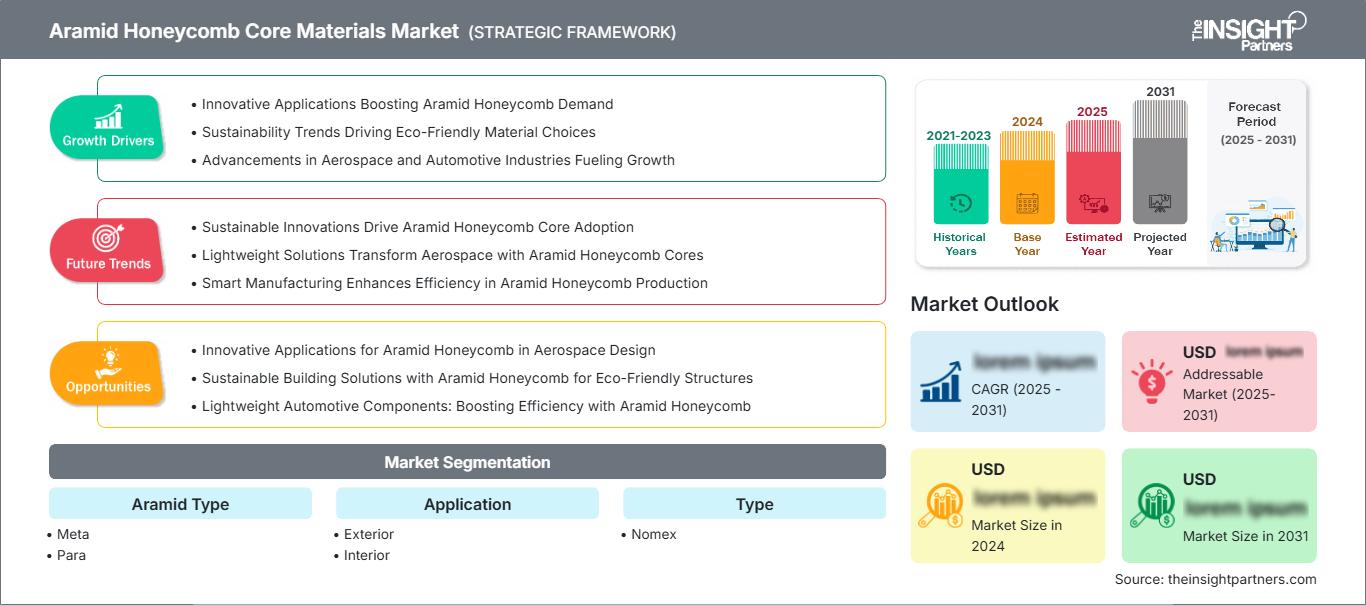
Aramid Honeycomb Core Materials Market: Strategic Insights
Regional Insights
North America aramid honeycomb core materials market
North America is estimated to hold a 32–36% share in 2025, with a 4.6–5.0% CAGR through 2034. The US dominates regional consumption because commercial aerospace, defense, space, and business aviation programs require qualified lightweight sandwich structures. Established composite manufacturing infrastructure also supports repeat demand for honeycomb cores.
Interior surfaces of aircraft, aircraft flooring, aircraft doors, fairings, rotorcraft, and radomes can be considered as significant applications. Canada is represented by the aerospace industry and manufacture of composites, while the United States plays an active role in manufacturing of these materials in the region. Modernization of the defense, space craft design and aircraft manufacturing should drive demand in the future.
U.S. aramid honeycomb core materials Market
The US accounts for approximately 82–86% of North America's 2025 share and is projected to grow at a 4.7–5.1% CAGR during 2026–2034. Its market base includes commercial aircraft interiors, military aircraft, helicopters, spacecraft, missiles, and advanced composite structures. Major suppliers operate alongside aircraft OEMs and tier-one component manufacturers.
Demand is bolstered by the extensive network of aerospace manufacturing in the country along with the military procurements that take place. The firms such as Hexcel Corporation, The Gill Corporation, Plascore, Inc., and ACP Composites, Inc. already occupy a foothold in the markets for honeycomb, engineered core, and composite panels. Increase in the usage of light-weight interiors and sandwich panels drives further substitution of heavy materials.
Europe aramid honeycomb core materials Market
Europe is estimated to represent a 27–31% share in 2025, expanding at a 4.4–4.8% CAGR. Germany and France is one of the key markets due to aircraft manufacturing, aerostructures, and defense manufacturing. The United Kingdom is another country with aerospace capabilities, along with Italy and Spain, whose aircraft structures, aircraft interiors, and components manufacturing also play a role.
The market in the United Kingdom is driven by existing aerospace engineering programs and defense programs, thus requiring lightweight panels and special core materials. In Germany, there is a combination of aircraft manufacturing and industry-wide composite use. France continues to be a significant market due to commercial and military aerospace operations.
APAC aramid honeycomb core materials Market
APAC is estimated to account for a 25–29% share in 2025, with a 5.0–5.5% CAGR, making it the fastest-growing major region. China leads regional demand, followed by Japan, South Korea, India, and Australia. Expanding aircraft assembly, defense localization, and composite manufacturing are strengthening the supply base.
The Chinese aerospace industry is responsible for having the largest regional demand pool, while Japan and South Korea provide mature materials and aircraft component capabilities. The Indian aerospace manufacturing activities and defense localization efforts generate new opportunities, while Australia adds through defense and aerospace applications. Support policies by the region for aircraft and defense production must promote local honeycomb processing.
Middle East & Africa aramid honeycomb core materials Market
The Middle East and Africa represent a smaller demand base, with growth estimated around 4.0–4.5% CAGR during 2026–2034. Saudi Arabia and the UAE are leading regional markets because aviation investment, defense modernization, and aerospace localization are expanding their advanced-material requirements.
The aramid honeycomb core materials Market report shows that South Africa contributes through aerospace engineering and defense capabilities, while the rest of MEA remains driven by aircraft maintenance, refurbishment, and infrastructure-linked aviation demand. The region's expanding aviation fleets and investments in aerospace ecosystems create opportunities for imported and locally converted honeycomb products, particularly for interiors, panels, and repair applications.
Segmentation Analysis
Aramid Type
Aramid Type is divided between meta and para chemistries, with meta aramid remaining broadly established in conventional honeycomb applications. The segment is projected to expand at 4.5–5.0% CAGR during 2026–2034, while higher-performance para aramid benefits from applications where strength-to-weight optimization is prioritized.
- Meta: Meta aramid provides a well-established balance of thermal resistance, flame performance, manufacturability, and cost, supporting widespread use in aerospace interior and secondary structural sandwich panels.
- Para: Para aramid offers higher mechanical performance for selected demanding structures and can support weight reduction where increased strength and stiffness justify higher material and processing requirements.
Application
Application demand is concentrated in aircraft structures requiring weight efficiency, impact resistance, fire performance, and stable sandwich construction. The segment is estimated to grow at 4.7–5.2% CAGR during 2026–2034. Exterior applications offer comparatively stronger growth potential as composite-intensive aircraft and advanced rotorcraft designs increase structural lightweighting requirements.
- Exterior: Exterior applications include fairings, control surfaces, rotorcraft components, access panels, radomes, and other structures where low weight and stiffness are essential to aerodynamic and mechanical performance.
- Interior: Interior applications include flooring, partitions, ceilings, galleys, lavatories, sidewalls, overhead bins, and monuments, where low density combines with strict flammability and smoke requirements.
Raw Material
The Raw Material segment is expected to advance at a CAGR of 4.6–5.0% during 2026–2034. Aramid fiber remains central to the market's performance proposition, while carbon fiber and fiberglass provide alternative reinforcement pathways. Nomex paper is particularly important within established aerospace honeycomb production because of its processing characteristics and qualification history.
- Aramid fiber: Aramid fiber provides the fundamental combination of low density, strength, toughness, thermal resistance, and fire performance that defines high-value honeycomb applications.
- Carbon fiber: Carbon fiber is positioned where higher stiffness and compatibility with carbon composite skins justify its cost, particularly in advanced structural designs requiring controlled mechanical performance.
- Fiberglass: Fiberglass remains relevant where cost, thermal performance, dielectric behavior, and mechanical requirements create a balanced alternative to higher-priced aramid or carbon-based solutions.
- Nomex paper: Nomex paper supports established aerospace honeycomb architectures and remains strategically important because of its proven processing behavior, fire performance, and compatibility with phenolic resin systems.
Opportunity Snapshot
| Application | Revenue Contribution | Trend Tag | Adoption Stage |
| Exterior | High | Structural Lightweighting | Scaling |
| Interior | High | Cabin Lightweighting | Mature |
Aramid Honeycomb Core Materials Market Growth Drivers and Impact Analysis
Aircraft Lightweighting and Composite Content Expansion
Reducing weight continues to be a key design consideration since lighter weight construction can lead to improved payload capacity, better fuel efficiency, range, and cost of operation. Since honeycomb cores allow the creation of very stiff panels using a small amount of material weight, they become ideal choices for use on aircraft interiors and secondary structures. An increase in the use of composite materials in aircraft construction increases the requirement for suitable core material that is needed. The requirement goes beyond new aircraft since refurbishment of aircraft cabins and replacement of aircraft structures also need certification of lightweight panels. Those manufacturers that are capable of offering consistency in density, cell structure, machinability, and fire resistance will be better suited to fulfill such requirements.
Defense and Space Procurement Supporting High-Performance Core Demand
Modernization of the defense sector and increased activities in space generate the need for materials that have the capability to sustain themselves in rigorous mechanical, thermal, and environmental conditions. Aramid honeycomb core materials are employed in aerospace applications including aircraft structures, helicopter applications, radomes, satellites, and more. Increased demand can also help minimize the cyclicality of the commercial aerospace sector, since the military and space sectors do not follow the same production cycle. The qualification process itself sets up hurdles to the quick replacement of materials, which makes long-term supplier relationships a likely scenario once they have been qualified. For manufacturers, such an environment is one that will benefit them from the perspective of traceability, testing, process control, and application engineering.
Growth of Advanced Composite Manufacturing Ecosystems
Expansion of composite manufacturing capabilities is widening the geographic base for honeycomb core consumption. New aerostructure facilities, aircraft assembly programs, defense localization initiatives, and specialized composite suppliers require access to qualified core materials and associated processing expertise. This development is particularly relevant in Asia Pacific, where aircraft manufacturing and defense industrialization are increasing the need for domestic supply chains. Local conversion and machining can shorten lead times, reduce logistics exposure, and enable customization for regional customers. At the same time, established suppliers can protect market position through technical support, qualification assistance, and integration with composite panel manufacturing. The effect is a gradual shift from purely material-based competition toward broader engineered-core solutions that combine material selection, processing, design support, and quality assurance.
Aramid Honeycomb Core Materials Market Future Trends
Ultra-Lightweight Paper and Higher-Performance Core Architectures
Future product development is expected to focus on reducing core density without sacrificing structural integrity, fire performance, or durability. Advances in aramid paper production can enable thinner sheets and lower areal weights, allowing manufacturers to produce lighter honeycomb structures for aircraft interiors and advanced mobility platforms. Cell geometry will also become more application-specific, with over-expanded and tailored configurations supporting complex shapes. Digital manufacturing and precision machining should improve dimensional control and reduce material waste during core conversion. The aramid honeycomb core materials market trends will increasingly reflect the convergence of lightweighting, manufacturability, and qualification requirements, rather than simple substitution between competing core materials.
Application-Specific Thermal and Acoustic Engineering
Future honeycomb development will increasingly incorporate thermal, acoustic, electromagnetic, and fire-management requirements into core selection. Aircraft designers are seeking multifunctional structures that perform several roles without adding separate components or excessive mass. Engine-adjacent structures, cabin panels, radomes, and specialized defense systems can benefit from tailored core properties. Manufacturers are likely to develop combinations of resin systems, paper constructions, cell configurations, and surface treatments for defined operating environments. These solutions can command stronger customer retention because qualification becomes linked to a specific design architecture. The direction also supports closer collaboration among core suppliers, composite manufacturers, aircraft integrators, and OEM engineering teams during early design stages.
Aramid Honeycomb Core Materials Market Opportunities
Capacity Expansion in Emerging Aerospace Manufacturing Hubs
Investment opportunities are emerging in countries developing local aerospace and defense manufacturing capabilities, particularly across India and selected Asian markets. Local honeycomb conversion and machining can reduce dependence on imported finished cores while improving delivery flexibility for aircraft programs. Investors and manufacturers can target facilities capable of producing standardized Nomex structures alongside application-specific configurations, allowing broader utilization of equipment and technical personnel. Partnerships with aircraft component manufacturers can accelerate qualification and provide predictable demand during facility ramp-up. The aramid honeycomb core materials market Forecasts indicate that regional diversification can become strategically important as aerospace manufacturers seek resilient supply chains. Companies that combine localized production with established international material specifications may capture opportunities without requiring immediate displacement of incumbent global suppliers.
Integrated Core-to-Panel Manufacturing Solutions
A second opportunity lies in integrating honeycomb production, machining, adhesive processing, and composite panel fabrication within a single manufacturing platform. Such integration can reduce handling, improve dimensional consistency, shorten production cycles, and simplify quality control. Aerospace customers increasingly value suppliers capable of delivering finished engineered components rather than only raw or semi-finished core. The approach is particularly relevant for cabin interiors, flooring, access panels, and specialized structures where geometry and surface integration matter as much as core properties. Companies can strengthen customer relationships by offering design-for-manufacturing support, prototyping, qualification assistance, and repeat production under one commercial arrangement. This model can also improve capacity utilization by allowing the same core-processing assets to serve multiple aircraft and industrial programs.
Recent Developments
- March 2026: Applied Aerospace & Defense acquired Ultracor, a supplier of specialized honeycomb core materials used in complex bonded composites. The transaction expands vertical integration across space and defense manufacturing, where honeycomb cores are used in satellites, spacecraft, aircraft, missiles, antennas, and radomes.
- June 2025: Kongsberg Defence & Aerospace and Hexcel Corporation signed a five-year partnership covering HexWeb engineered honeycombs and HexPly prepregs for strategic production programs. The agreement provides longer-term visibility for qualified lightweight composite materials within defense manufacturing and reinforces demand from European defense programs.
Frequently Asked Questions

- Comprehensive Market Sizing and Forecast Analysis
- Detailed Segmentation Analysis
- In-Depth Market Dynamics Assessment
- Regional and Country-Level Insights
- Competitive Landscape and Company Benchmarking
- Strategic Business Intelligence
Recent Reports
Testimonials

The Insight Partners' SCADA System Market report is comprehensive, with valuable insights on current trends and future forecasts. The team was highly professional, responsive, and supportive throughout. We are very satisfied and highly recommend their services.
RAN KEDEM Partner, Reali Technologies LTDs
I requested a report on a very specific software market and the team produced the report in a few days. The information was very relevant and well presented. I then requested some changes and additions to the report. The team was again very responsive and I got the final report in less than a week.
JEAN-HERVE JENN Chairman, Future Analytica
We worked with The Insight Partners for an important market study and forecast. They gave us clear insights into opportunities and risks, which helped shape our plans. Their research was easy to use and based on solid data. It helped us make smart, confident decisions. We highly recommend them.
PIYUSH NAGPAL Sr. Vice President, High Beam Global
The Insight Partners delivered insightful, well-structured market research with strong domain expertise. Their team was professional and responsive throughout. The user-friendly website made accessing industry reports seamless. We highly recommend them for reliable, high-quality research services
YUKIHIKO ADACHI CEO, Deep Blue, LLC.
This is the first time I have purchased a market report from The Insight Partners.While I was unsure at first, I visited their web site and felt more comfortable to take the risk and purchase a market report.I am completely satisfied with the quality of the report and customer service. I had several questions and comments with the initial report, but after a couple of dialogs over email with their analyst I believe I have a report that I can use as input to our strategic planning process.Thank you so much for taking the extra time and making this a positive experience.I will definitely recommend your service to others and you will be my first call when we need further market data.
JOHN SUZUKI President and Chief Executive Officer, Board Director, BK Technologies
I wish to appreciate your support and the professionalism you displayed in the course of attending to my request for information regarding to infectious disease IVD market in Nigeria. I appreciate your patience, your guidance, and the fact that you were willing to offer a discount, which eventually made it possible for us to close a deal. I look forward to engaging The Insight Partners in the future, all thanks to the impression you have created in me as a result of this first encounter.
DR CHIJIOKE ONYIA MANAGING DIRECTOR, PineCrest Healthcare Ltd.Reason to Buy
- Informed Decision-Making
- Understanding Market Dynamics
- Competitive Analysis
- Identifying Emerging Markets
- Customer Insights
- Market Forecasts
- Risk Mitigation
- Boosting Operational Efficiency
- Strategic Planning
- Investment Justification
- Tracking Industry Innovations
- Aligning with Regulatory Trends





 Get Free Sample for