
Architectural Lighting Market Share, Demand & Growth by 2034
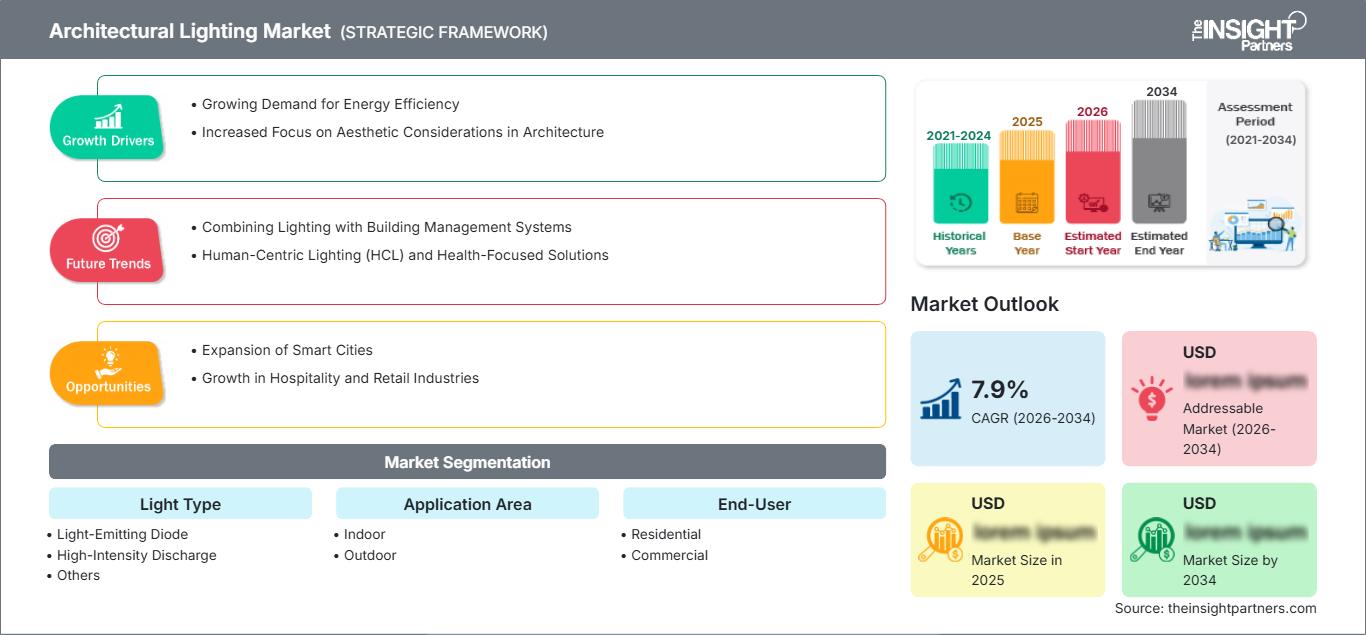
Coverage: By Light Type (Light-Emitting Diode (LED), High-Intensity Discharge (HID), Others); Application Area (Indoor, Outdoor); End-User (Residential, Commercial), and Geography (North America, Europe, Asia Pacific, and South and Central America)
- Status : Data Released
- Report Code : TIPRE00013786
- Category : Electronics and Semiconductor
- No. of Pages : 150
- Available Report Formats :


- Last update date : July 15, 2026


2025 Market Size
US$ 12.06 Bn
Base year value
2034 Forecast
US$ 19.86 Bn
Projected by 2034
CAGR 2026-2034
5.71 %
Growth rate
Addressable Market
US$ 144.75 Bn
(2026-2034)
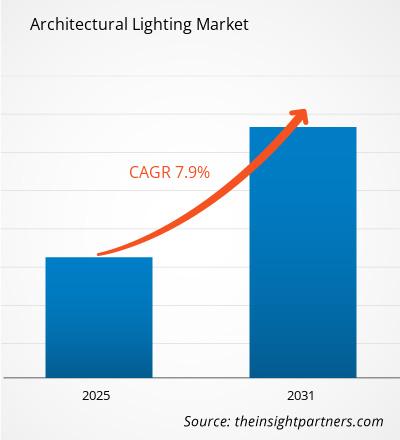
The Architectural Lighting Market is valued at US$ 12.06 Billion in 2025 and is projected to reach US$ 19.86 Billion by 2034, advancing at a CAGR of 5.71% during 2026–2034. The market showcases an increased specificity towards lighting solutions which incorporate illumination performance, energy efficiency, controls and design purpose within residential and non-residential environments.
Within the North American region, the Architectural Lighting Market Size is boosted by commercial renovations, luxury housing construction, city aesthetics, and compliance-driven efficiency improvements. The region is expected to register a CAGR value range of 4.8% to 5.6% in the years 2026-2034 due to the increased adoption of LEDs, networking capabilities and low-maintenance architectural luminaires.
Architectural Lighting Market Assessment and Insights
- North America holds 29–33% share in 2025 and is growing at a CAGR range of 4.8–5.6% during 2026–2034, led by LED retrofits, smart-building codes, and commercial renovation demand.
- US accounts for 78–82% of North American revenue in 2025 and grows at 4.7–5.5% CAGR, supported by office, healthcare, hospitality, and municipal lighting upgrades.
- Europe represents 24–28% share in 2025 and grows at 4.5–5.3% CAGR, with Germany, the UK, France, Italy, and Spain leading design-led commercial and public infrastructure projects.
- Asia Pacific captures 31–35% share in 2025 and expands at 6.2–7.2% CAGR, led by China, Japan, South Korea, India, and Australia across urban development and premium buildings.
- The largest segment is Light-Emitting Diode, holding 66–70% market share in 2025 and growing at 6.0–7.0% CAGR as efficiency mandates and flexible design accelerate adoption.
- High Growth Segment is Outdoor, with 34–38% share in 2025 and 6.4–7.4% CAGR, driven by façades, landscapes, smart cities, and tourism-linked urban illumination.
- Key companies analyzed in detail: Acuity Brands Lighting, Inc., Delta Light NV, GE Current, a Daintree company, Hubbell Incorporated, ORLIGHT LTD., OSRAM GmbH, Siteco GmbH, Sylvania Lighting, Technical Consumer Products, Inc., and Zumtobel Group AG.
Source: The Insight Partners' analysis based on proprietary research, government publications, company annual reports, investor presentations, industry databases, and expert interviews.
The evolution of architectural lighting is from decoration and lighting fixtures to infrastructure within buildings. Technologies such as LED engines, optical lenses, tunable white lights, low voltage control, and dimming through sensors are influencing product designs and purchase decisions. The production environment is evolving towards modularized luminaires, replaceable drivers, and digital commissioning as manufacturers cope with cost pressures from electronics, aluminum casings, diffusion panels, and compliance testing. Expectations from lighting designers and engineers include visual comfort, less glare, energy efficiency, and design consistency.
Future growth in the lighting fixture market is forecast in developing urban districts, redeveloped hospitality sectors, public transport infrastructure, and high density residential complexes. Spending is moving towards connected luminaires, façade lighting, adaptive outdoor lighting systems, and human-centric indoor environments. The tailwind factors from regulation in terms of energy efficiency, environmental building certification, and municipal safety legislation ensure longer lifecycles. Architects prefer lighting solutions that offer lower lifecycle costs and maintenance while adding value to occupant experience and building uniqueness.
Architectural Lighting Market Report Scope
| Report Attribute | Details |
|---|---|
| Market size in 2025 | US$ 12.06 Billion |
| Market Size by 2034 | US$ 19.86 Billion |
| Global CAGR (2026 - 2034) | 5.71% |
| Historical Data | 2021-2024 |
| Forecast period | 2026-2034 |
Architectural Lighting Market Analysis
The Architectural Lighting Market growth is driven by the shift from commodity lamps to engineered lighting systems that support aesthetics, energy management, safety, and brand identity. According to the International Energy Agency, energy-saving LED lights are an essential part of zero carbon ready buildings, and building owners are requiring more control options, daylight harvesting, and increased luminaire life to save operational costs.
The value chain consists of LED chips, drivers, optics, housing, controls, architectural designers, electrical contractors, distributors, and facilities management. The supply chain continues to be driven by factors such as electronic component quality, heat dissipation, certification cycles, and regional manufacturing. Customers favor manufacturers who provide consistent color rendition, dimming capability, technical information for projects, and replacements.
As seen from the market analysis, there is competition in the market in the form of either broad portfolio manufacturers or design-oriented specialty firms. The companies that offer strong competition to others in North America's commercial segments are Acuity Brands Lighting, Inc., Hubbell Incorporated, GE Current, a Daintree company, and Technical Consumer Products, Inc., whereas Delta Light NV, OSRAM GmbH, Siteco GmbH, Sylvania Lighting, ORLIGHT LTD., and Zumtobel Group AG provide lighting for designs in Europe.
The investments would go into areas of connected controls, reduced glare optics, use of recycleable materials, lighting and acoustic solutions, emergency guidance systems, and outdoor lighting products with beam control. Strategic positioning involves building partnerships with lighting designers, architects, contractors, and distributors since specifications are made at the very beginning of the projects. Firms with sustainable information and digital design files have an edge over others.
● REPORT CUSTOMIZATION
Tailor This Report To Align With Your Specific Business Requirements
This report can be customized to align precisely with your business objectives, scope, and target markets. Customization options include tailored segmentation, geography, competitive analysis, and strategic insights to support informed decision-making.
Customize This Report →WHAT YOU CAN ADJUST
- ● Segmentations
- ● Geography
- ● Competitive Analysis
- ● Language Preferences
Architectural Lighting Market: Strategic Insights
Regional Insights
North America Architectural Lighting Market
North America holds an estimated 29–33% Architectural Lighting Market share in 2025 and is projected to grow at a CAGR range of 4.8–5.6% during 2026–2034. The demand drivers include office space renovation, hotel renovations, health care facility building, retail remodeling efforts, and the city replacing old external lighting systems with newer controllable LED-based lighting.
Market adoption has been high where there is convergence between the energy code, utilities incentives, and corporate sustainability goals. ASHRAE/IES guidelines and state building codes motivate low lighting power density, along with control. There are opportunities for the manufacturers due to their existing distribution network, project specifications, and demand for luminaires providing glare control and emergency lighting capability.
U.S. Architectural Lighting Market Market
The U.S. accounts for 78–82% of North American revenue in 2025 and grows at a CAGR range of 4.7–5.5% through 2034. Acuity Brands Lighting, Inc., Hubbell Incorporated, GE Current, a Daintree company, and Technical Consumer Products, Inc. have good channel coverage for commercial, institutional, retail, and outdoor projects.
Applications are steady for downlight fixtures, linear systems, wall washer fixtures, landscape lighting, and façade lighting at office buildings, hotels, mixed-use, healthcare, and high-end residential buildings. In the United States, purchasers give more weight to lumen maintenance, warranties, ease of commissioning, and control compatibility. Efficiency measures at the federal level and energy codes at the state level drive retrofits of fluorescent and HID systems.
Europe Architectural Lighting Market Market
Europe represents 24–28% share in 2025 and grows at a CAGR range of 4.5–5.3%. Germany drives regional demand with commercial structures, industrial campuses, transport centers, and efficient public infrastructures. The UK is busy with the hospitality sector, office fit-outs, and cultural facilities, whereas France, Italy, and Spain promote lighting in architecture with the help of tourism, retailing, and historic renovations.
Adoption in Europe is affected by the Ecodesign rules, the circular economy, and professional lighting design organizations. Germany and the UK are leading countries for market penetration; however, France is becoming popular in museums, luxury shopping, and urban nightscape projects. The buyers seek replaceability of components, minimal glare, product declarations, and emergency lighting compliance, besides the quality of light.
APAC Architectural Lighting Market Market
Asia Pacific captures 31–35% share in 2025 and records the fastest CAGR range of 6.2–7.2% during 2026–2034. China is driving regional demand with redevelopment programs, commercial buildings, and manufacturing capabilities, whereas Japan and South Korea are focused on high-end design, electronics and optical quality.
Indian and Australian demand is growing based on metro projects, high-end residential projects, office parks, airports, and hospitality development. Government encouragement of energy efficiency, smart cities, and electronics manufacturing is making the economics of adoption attractive. Competition among regional manufacturers is based on price, yet specification-driven projects still look for reliability in color and thermal performance.
Middle East & Africa Architectural Lighting Market Market
The Middle East and Africa grow at a CAGR range of 5.0–6.0%, with Saudi Arabia and the UAE leading adoption through mega projects, hospitality destinations, airports, cultural districts, and façade lighting. South Africa is the most advanced market in Sub-Saharan Africa, thanks to retrofitting and upgrades to retailers.
Energy saving measures is one such factor, considering that large structures, outdoor facilities, and illuminated outdoor areas have high cooling loads and electrical consumption. Gulf projects prefer programmed lighting, landscaping, and a superior indoor atmosphere. Other MEA countries have inconsistent adoption, but cities benefit from tourism and improved nightlife safety.
Segmentation Analysis
Light Type
Market Scope for Light Type Segmentation consists of Light Emitting Diode, High Intensity Discharge, and Others, with major segments expected to grow at a CAGR from 5.8 to 6.8 percent between 2026 and 2034. The shift in demand is clearly towards Light Emitting Diode due to its capability of providing compactness, color control, low heat generation, and dimming capabilities.
- Light Emitting Diode (LED) fixtures have come to define the standard by dint of their high efficiency, durability, optical accuracy, and control capacity, forming an essential part of interior ambiance, facades, landscaping, and commercial retrofit applications.
- High Intensity Discharge (HID) lighting systems have maintained their selectivity in outdoor, high-bay, and wide area applications where existing equipment is still functional. However, replacement cycles are favoring LED alternatives.
Application Area
Application Area Segmentation consists of Indoor and Outdoor applications, witnessing a CAGR of 5.6-6.6% for the period 2026-2034. Growth in the Indoor segment can be attributed to office refurbishment, hospitality settings, shopping experience, and wellness-based lighting. The Outdoor segment is experiencing rapid growth owing to city lighting, resort lighting, campus lighting, and development lighting.
- Indoor lighting is highly in demand in workplaces, commercial buildings, hotels, hospitals, schools, and residential applications where visual comfort, glare-free, dimming, and design flexibility become factors that contribute to purchasing decisions.
- Outdoor lighting has a strategic role in façades, walkways, landscapes, public spaces, and transportation nodes where safety, durability, weather-proof, and programmed lighting scenes become significant.
End-User
The End-User Segmentation encompasses Residential and Commercial, with the key segment exhibiting CAGR growth between 5.4%-6.4% in 2026-2034. The commercial end-users specify volumes through office buildings, hotels, retail outlets, healthcare facilities, and public infrastructure. The residential segment gains from premium housing, smart homes, exteriors, and remodeling that focuses on aesthetic values and savings.
- The residential sector is backed by luxury flats, villas, landscaping, kitchens, living rooms, and smart homes, wherein the consumer appreciates mood lighting, reduced energy bills, and personalized designs.
- The commercial sector exhibits increased specification intensity, whether in office spaces, hotels, shopping malls, airports, hospitals, and municipal buildings, wherein lighting impacts operational cost, branding, safety, and occupant comfort.
Opportunity Snapshot
| End-User | Revenue Contribution | Trend Tag | Adoption Stage |
| Residential | Medium | Smart Homes | Scaling |
| Commercial | High | Connected Buildings | Mature |
Architectural Lighting Market Growth Drivers and Impact Analysis
Energy Codes Accelerating LED Retrofits
Energy policy has transformed architectural lighting from an optional feature to an obligatory investment. According to the IEA, LED lighting is the most energy-efficient form of lighting, and this can be accelerated through minimum energy performance standards, labeling programs, and building policies. This applies to offices, hotels, hospitals, retail outlets, schools, and outdoor spaces since the lighting operation time is high. Replacement of fluorescent, halogen, and HID lights will reduce energy use, maintenance frequency, and heat generation. The influence in the market sector is greater in nations where there is high retrofitting due to the ability of building owners to make investments even without constructing new buildings.
Design-Led Commercial Renovation and Hospitality Demand
The lighting of commercial buildings helps to enhance the experience of their tenants and guests, visual merchandising, and asset values. Office environments call for luminaires with minimal glare that cater to hybrid office settings, while hotels need ambiance lighting in lobbies and hotel rooms. Retailers require color-corrected lighting to help sell their products. Cycles of renovations help generate repeat business since lighting is among the quickest changes made to the physical environment. Facade and landscape lighting of commercial buildings are used by developers to distinguish mixed-use developments during nighttime hours. The supplier advantages from this lighting driver include a portfolio of indoor and outdoor lighting solutions and good connections with lighting designers.
Connected Controls and Smart Building Integration
Lighting is evolving into a sensor-filled network layer for smart buildings, as opposed to being an independent electric system. With controlled lighting, there can be dimming based on occupancy, daylight harvesting, scheduling, diagnostics of faults, emergency testing, and energy monitoring. The change is evident in the way lighting networks can lead to savings in operations and greater visibility of the building facility. Interoperability with building management systems and sustainability reporting platforms is becoming a requirement for commercial building owners. This shift also supports recurring service opportunities through analytics, maintenance planning, and software updates, giving the Architectural Lighting Market report a stronger digital revenue component.
Architectural Lighting Market Future Trends
Human-Centric and Adaptive Lighting Specifications
Architectural Lighting Market trends point toward lighting systems that adapt to people, tasks, and time of day rather than remaining fixed. Specifying tunable white, dim-to-warm, circadian scenes, and glare control optics is becoming more common in office, health care, educational, hospitality, and high-end residential applications. The future will see more integration of lighting scenes with occupancy information, daylight harvesting, and well-being goals. This will increase the need for better drivers, controls, and commissioning. The question will be demonstrating benefits without creating operational complications, particularly when it comes to maintaining simple control interfaces.
Circular Design and Serviceable Luminaire Platforms
Expectations for sustainability have evolved from focusing on energy usage to encompassing product lifespan, ease of repair, material, packaging, and waste disposal. Luminaires will be designed to make the replacement of LED boards, drivers, lenses, and mounting systems feasible for performance improvements without having to replace the fixture as a whole. Practices in the circular economy in Europe will probably shape worldwide specifications, particularly when it comes to public works and corporate property assets. Vendors with environmental product declarations, modularity, and warranty policies will enhance their credibility.
Architectural Lighting Market Opportunities
Outdoor Placemaking and Smart City Illumination
The outdoor applications provide a great business opportunity due to improved safety, attraction for tourists, night-time shopping, and city branding. Architectural Lighting Market Forecasts report states that the Outdoor application area has the potential for a high growth rate with 34-38% share in 2025 and 6.4-7.4% CAGR during 2026-2034. Cities, airports, campuses, resorts, and developers of mixed-use areas require façade illumination, path lighting systems, landscaping, and programmable scenes that could function successfully under any weather condition. Suppliers should focus on weather proofing, optical quality, reduced spill light, and control options. Alliance with urban planners, landscape designers, and electrical contractors will help to transform design-driven projects into outdoor collections.
Commercial Retrofits with Controls Bundles
Retrofits for commercial spaces still make sense because there is much space in use today that still uses fluorescent, halogen, and HIDs lighting, which uses more electricity and has no sophisticated controls. Combining luminaires along with the ability to have occupancy sensors, daylight harvesting, emergency testing, and digital commissioning would boost the value of the project while decreasing the payback period for the customer. Office, hospitals, schools, retail chains, and hotels can be interesting because the light works here for many hours and influences the quality of people's lives. It is possible for manufacturers to stand out because they can offer audits, financing, installation kits, and compatibility with wiring in use.
Recent Developments
- February 2026: GE Current, a Daintree company Current, opened a new Toronto Distribution Center to strengthen support for the Canadian lighting market. The facility is intended to improve product availability, reduce lead times, and support customers purchasing HLI and GLI brand lighting and controls portfolios across commercial and industrial applications.
- November 2025: Zumtobel expanded its application portfolio with acoustic lighting elements, adaptive safety lighting, cleanroom luminaires, art-oriented spotlights, and SMARTSIGN dynamic escape route guidance. The launch positioned light as both infrastructure and experience for offices, healthcare, hospitality, education, museums, and complex public buildings.
- August 2025: Acuity Brands Lighting, Inc. — Nine Acuity Brands Lighting solutions were selected for the 2025 Illuminating Engineering Society Progress Report, including Aculux, Eureka, Gotham, Holophane, Hydrel, Lithonia Lighting, and Nightingale products. The recognition highlighted advances in precision optics, 3D printed fixtures, healthcare luminaires, pathway lighting, and architectural downlights.
Frequently Asked Questions

- Comprehensive Market Sizing and Forecast Analysis
- Detailed Segmentation Analysis
- In-Depth Market Dynamics Assessment
- Regional and Country-Level Insights
- Competitive Landscape and Company Benchmarking
- Strategic Business Intelligence
Recent Reports
Testimonials

The Insight Partners' SCADA System Market report is comprehensive, with valuable insights on current trends and future forecasts. The team was highly professional, responsive, and supportive throughout. We are very satisfied and highly recommend their services.
RAN KEDEM Partner, Reali Technologies LTDs
I requested a report on a very specific software market and the team produced the report in a few days. The information was very relevant and well presented. I then requested some changes and additions to the report. The team was again very responsive and I got the final report in less than a week.
JEAN-HERVE JENN Chairman, Future Analytica
We worked with The Insight Partners for an important market study and forecast. They gave us clear insights into opportunities and risks, which helped shape our plans. Their research was easy to use and based on solid data. It helped us make smart, confident decisions. We highly recommend them.
PIYUSH NAGPAL Sr. Vice President, High Beam Global
The Insight Partners delivered insightful, well-structured market research with strong domain expertise. Their team was professional and responsive throughout. The user-friendly website made accessing industry reports seamless. We highly recommend them for reliable, high-quality research services
YUKIHIKO ADACHI CEO, Deep Blue, LLC.
This is the first time I have purchased a market report from The Insight Partners.While I was unsure at first, I visited their web site and felt more comfortable to take the risk and purchase a market report.I am completely satisfied with the quality of the report and customer service. I had several questions and comments with the initial report, but after a couple of dialogs over email with their analyst I believe I have a report that I can use as input to our strategic planning process.Thank you so much for taking the extra time and making this a positive experience.I will definitely recommend your service to others and you will be my first call when we need further market data.
JOHN SUZUKI President and Chief Executive Officer, Board Director, BK Technologies
I wish to appreciate your support and the professionalism you displayed in the course of attending to my request for information regarding to infectious disease IVD market in Nigeria. I appreciate your patience, your guidance, and the fact that you were willing to offer a discount, which eventually made it possible for us to close a deal. I look forward to engaging The Insight Partners in the future, all thanks to the impression you have created in me as a result of this first encounter.
DR CHIJIOKE ONYIA MANAGING DIRECTOR, PineCrest Healthcare Ltd.Reason to Buy
- Informed Decision-Making
- Understanding Market Dynamics
- Competitive Analysis
- Identifying Emerging Markets
- Customer Insights
- Market Forecasts
- Risk Mitigation
- Boosting Operational Efficiency
- Strategic Planning
- Investment Justification
- Tracking Industry Innovations
- Aligning with Regulatory Trends





 Get Free Sample for