
Art Gallery Software Market Growth, Trends & Forecast by 2034
Coverage: by Deployment Type (Cloud, On-premises); Application (PC, Mobile Terminal) , and Geography (North America, Europe, Asia Pacific, and South and Central America)
- Status : Data Released
- Report Code : TIPRE00011345
- Category : Technology, Media and Telecommunications
- No. of Pages : 150
- Available Report Formats :


- Last update date : September 01, 2026


2025 Market Size
US$ 2.64 Bn
Base year value
2034 Forecast
US$ 5.98 Bn
Projected by 2034
CAGR 2026-2034
9.53 %
Growth rate
Addressable Market
US$ 38.50 Bn
(2026-2034)
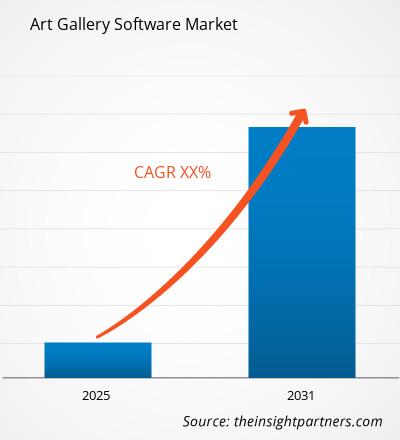
The art gallery software market was valued at US$ 2.64 Billion in 2025 and is projected to reach US$ 5.98 Billion by 2034, growing at a CAGR of 9.53% during 2026–2034. The expansion reflects sustained digitization across galleries, dealers, collections, and art advisory businesses as operators shift from spreadsheet-based administration toward integrated inventory, CRM, sales, reporting, and online viewing room platforms.
Across North America, adoption is expected to advance at a CAGR range of 8.9–9.4% through 2034, supported by gallery consolidation, higher reliance on digital collector engagement, and demand for secure cloud workflows. The art gallery software market size in the region is shaped by strong U.S. uptake, mobile sales enablement at fairs, and software spending tied to private collections, multi-site galleries, and hybrid exhibition models.
Art Gallery Software Market Assessment and Insights
- North America accounted for 36–39% share in 2025 and is growing at a CAGR between 2026–2034 of 8.9–9.4%, led by gallery digitization, collector CRM upgrades, and integrated online sales infrastructure.
- US represented 78–82% of North America in 2025 and is growing at a CAGR between 2026–2034 of 8.8–9.3%, supported by cloud-first gallery operations and art fair selling tools.
- Europe held 28–31% share in 2025 and is growing at a CAGR between 2026–2034 of 8.4–8.9%, with the UK, Germany, and France leading adoption among commercial galleries.
- Asia Pacific captured 19–22% share in 2025 and is growing at a CAGR between 2026–2034 of 10.6–11.2%, led by China, Japan, South Korea, India, and Australia.
- Largest Segment: Cloud held 62–66% market share in 2025, with a CAGR range of 10.1–10.7% during 2026–2034, reflecting remote access, lower maintenance, and faster upgrades.
- High Growth Segment: Mobile Terminal held 31–35% market share in 2025, with a CAGR range of 11.4–12.1% during 2026–2034, driven by fair-floor selling and remote collection access.
- Key companies analyzed in detail: Art Galleria Pty Ltd, ArtSystems Inc., ArtBase, Inc., Artfundi Ltd, Artlogic Media Ltd, Artlook Software Limited, GalleryTool, ITGallery, Masterpiece Solutions Inc., Primer Archives LLC.
Source: The Insight Partners' analysis based on proprietary research, government publications, company annual reports, investor presentations, industry databases, and expert interviews.
The operating model for galleries has moved from basic artwork databases to interconnected business platforms that combine inventory, client intelligence, invoicing, catalog publishing, and website synchronization. In the art gallery software market, production dynamics are less about physical output and more about software scalability, data migration support, API connectivity, and cybersecurity assurance. Competition will continue to heat up among vendors offering fast deployment, multi-currency capabilities, condition documentation, and the capacity to turn collection data into sales-ready digital assets.
During the forecast period, new geographies will see increased spending driven by growing art fairs, private museums, and collecting environments related to wealth management. Regulatory headwinds on data protection, digital provenance, anti-money laundering practices, and auditable transaction history will also play a role. Key areas of investment will be in mobile workflows, AI-powered cataloging, multilingual client engagement, and subscription offerings for galleries without dedicated technology departments.
Art Gallery Software Market Report Scope
| Report Attribute | Details |
|---|---|
| Market size in 2025 | US$ 2.64 Billion |
| Market Size by 2034 | US$ 5.98 Billion |
| Global CAGR (2026 - 2034) | 9.53% |
| Historical Data | 2021-2024 |
| Forecast period | 2026-2034 |
Art Gallery Software Market Analysis
Demand is being shaped by the need to connect artwork records, client histories, consignments, and sales communication in one operational layer. Art gallery software market growth is strongest where galleries manage frequent exhibitions, multiple storage locations, and collector outreach across digital and physical channels. Supply is increasingly characterized by SaaS-based services that provide services such as onboarding services, import templates, cloud hosting, and integrations with accounting systems, websites, payments, and marketplace solutions.
Value chain activities include software developers, implementation consultants, gallery managers, registrars, artists, collectors, and third-party platforms. Data integrity is important for buyers because artwork information is associated with provenance, insurance, taxes, price, and conditions. For this reason, vendor proficiency is evaluated both in terms of the quality of the interface and other aspects such as permissions, frequency of backups, metadata, export restrictions, and sustainability.
Competitive positioning is becoming more layered as Artlogic Media Ltd, Art Galleria Pty Ltd, ArtSystems Inc., Artfundi Ltd, and ITGallery emphasize integrated workflows for galleries with different levels of complexity. art gallery software market analysis shows that specialists compete against broader collection management tools by offering art-specific terminology, private viewing rooms, consignment handling, and collector relationship features that generic CRM systems cannot replicate efficiently.
Investment trends indicate that the vendors who offer the combination of both product depth and support for customers are favored due to the fact that gallery staff usually lack IT resources. ArtBase, Inc., GalleryTool, Masterpiece Solutions Inc., Artlook Software Limited, and Primer Archives LLC each cater to different target markets, ranging from small galleries to archives. Differentiation strategy will rely on mobility orientation, automatic creation of catalogs, document vaults, and low-migration pricing.
● REPORT CUSTOMIZATION
Tailor This Report To Align With Your Specific Business Requirements
This report can be customized to align precisely with your business objectives, scope, and target markets. Customization options include tailored segmentation, geography, competitive analysis, and strategic insights to support informed decision-making.
Customize This Report →WHAT YOU CAN ADJUST
- ● Segmentations
- ● Geography
- ● Competitive Analysis
- ● Language Preferences
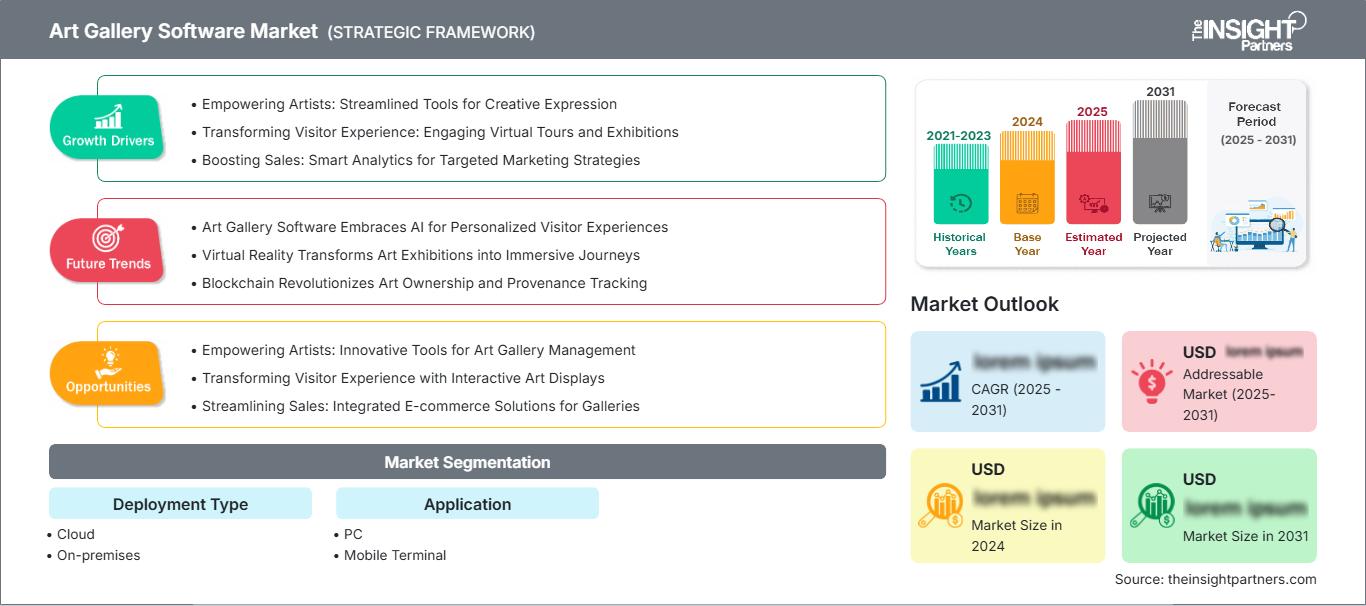
Art Gallery Software Market: Strategic Insights
Regional Insights
North America art gallery software market
North America held 36–39% of global revenue in 2025 and is projected to grow at a CAGR range of 8.9–9.4% from 2026 to 2034. The regional art gallery software market share is supported by high SaaS acceptance, professionalized gallery operations, and the concentration of dealers, art advisors, private collectors, and foundations in major U.S. and Canadian cities.
Demand is also connected to the hybrid approach of selling, which requires that exhibitions, fairs, private view rooms, and post-fair follow-ups work within a single database. Suppliers gain greatly from the high willingness to pay for their assistance, integration, and reporting. North American galleries measure the performance of the platform by its cybersecurity, mobile capabilities, and CRM performance, among others.
U.S. art gallery software Market
The U.S. represented 78–82% of North America in 2025 and is forecast to expand at a CAGR range of 8.8–9.3% during 2026–2034. Adoptions are limited to galleries located in New York, Los Angeles, Miami, Chicago, and other art capitals, where the sales cycle requires effective communication with collectors, the generation of offers promptly and the visibility of inventory.
The company’s reach is wide and extends from domestic vendors to international vendors, providing services to galleries, artists, dealers, and collection managers. There is a high demand among U.S. customers for administration using a PC and access to mobile terminals at the same time.
Europe art gallery software Market
Europe accounted for 28–31% share in 2025 and is expected to grow at a CAGR range of 8.4–8.9% from 2026 to 2034. The UK retains leadership due to its developed gallery ecosystem, dynamic secondary market, and widespread adoption of digital cataloging by London-based dealers and advisory companies.
Germany demonstrates consistent adoption as galleries, museums, and private collections enhance their data tracking and logistics capabilities and develop multilingual content. Adoption drivers include participation at art fairs and the need for systems capable of handling provenance, VAT accounting, and inventory movements between different storage, exhibiting, and consignment locations. There is an increasing trend of cloud adoption, although some organizations stick to on-premise solutions.
France, Italy, and Spain participate due to the presence of dense gallery networks, historical collections, and modern art happenings in those countries. France’s demand is driven by the key role of Paris in art commerce throughout Europe, whereas Italy and Spain emphasize the importance of catalog integrity and documentation of works’ restoration, as well as international communication with buyers.
APAC art gallery software Market
APAC held 19–22% share in 2025 and is forecast to grow at a CAGR range of 10.6–11.2% during 2026–2034. China is the leading country, supported by gallery modernization, expanding collector networks, and digital presentation tools used by dealers in major cities.
Japan, South Korea, India, and Australia add demand through contemporary art growth, private museum activity, and rising professionalization among galleries. Policy support for cultural digitization and infrastructure investment around art districts, fairs, and creative economies is encouraging galleries to adopt platforms that manage inventory, sales communication, and multilingual digital viewing.
Middle East & Africa art gallery software Market
The Middle East & Africa is growing at a CAGR range of 9.8–10.4% from 2026 to 2034, with the UAE as the leading country. Saudi Arabia, the UAE, South Africa, and the Rest of MEA are expanding cultural infrastructure, galleries, and private collection ecosystems.
Energy-backed diversification programs and museum investments are increasing the need for professional collection records, mobile access, and secure digital documentation. South Africa contributes through established gallery networks and Artfundi Ltd’s regional relevance, while Gulf demand is linked to international fairs, cultural tourism, and high-value collection governance.
Segmentation Analysis
Deployment Type
The deployment type segment is projected to grow at a CAGR range of 9.4–10.0% from 2026 to 2034 as buyers balance control, access, cost, and implementation complexity. The market scope within deployment is widening as galleries choose systems based on remote work, data security, upgrade cycles, and integration with websites, payments, and accounting platforms.
- Cloud remains the preferred model because galleries need real-time access across offices, fairs, storage sites, and mobile devices. Its strategic importance lies in faster onboarding, automatic updates, backups, and easier collaboration.
- On-premises retains relevance among buyers with strict internal data policies, legacy databases, or customized workflows. Demand is narrower but persistent where institutions prioritize direct control, tailored hosting, and complex archival requirements.
Application
The application segment is projected to grow at a CAGR range of 9.7–10.3% from 2026 to 2034, reflecting the need to support both administrative depth and client-facing mobility. PC usage remains central for cataloging, invoicing, reporting, and data cleanup, while mobile terminals are becoming essential for sales presentations, fair-floor access, and rapid collector engagement.
- PC is the core environment for registrars, gallery managers, and finance teams handling structured cataloging, document uploads, reports, and invoicing. It remains strategically important for accuracy-heavy workflows.
- Mobile Terminal is gaining priority as galleries use tablets and smartphones for private previews, inventory checks, offer sharing, and contact updates during exhibitions, fairs, studio visits, and remote advisory interactions.
Opportunity Snapshot
| Application | Revenue Contribution | Trend Tag | Adoption Stage |
|---|---|---|---|
| PC | High | Admin Control | Mature |
| Mobile Terminal | Medium | Fair Selling | Scaling |
Art Gallery Software Market Growth Drivers and Impact Analysis
Expansion of Hybrid Gallery Sales Models
The trend of hybrid selling has changed the way galleries have to deal with art visibility, collector communication, and timing of transactions. Physical shows are still important, but now collectors often request an exclusive digital show where the price, availability, provenance information, and installation images are discussed. There are software solutions that help galleries transform the efforts put into the creation of an exhibition into reusable sales material, avoiding redundancy for the gallery, website, newsletter, and private room presentations. The effect on the market will be most evident among mid-size galleries without big staff who have to keep their collector relations professional.
Need for Secure Provenance and Documentation Workflows
Art pieces have become valuable from a commercial, legal, insurance, preservation, and reputational perspective. It becomes important to maintain a structured framework to track provenance information, ownership history, condition reports, photographs, invoices, and consignment documentation without any loss in the audit trail. This particular driver becomes critical when handling expensive art pieces and international transactions because incomplete documentation might lead to delays in selling and higher compliance risks. Digital document management vaults, user permission models, backups, and export restrictions are becoming buying considerations rather than optional features. The practical implication becomes the move from informal file systems to systems that allow traceability and continuity.
Rising Operational Pressure on Small and Mid-Sized Galleries
A lot of galleries work with small teams, while also having to deal with artists, buyers, exhibitions, trade shows, transportation, and digital communication at the same time. There is growing usage of software because efficiency in administration directly influences sales follow-up and employee efficiency. Programs for automating the creation of catalogs, creation of invoices, mailing lists, and websites can help save time spent on routine processes. This driver is especially pertinent to galleries that are going global while keeping the same amount of staff. This is clear from the growing tendency to use subscription services offering templates and onboarding.
Art Gallery Software Market Future Trends
AI-Assisted Cataloging and Collector Intelligence
AI-assisted workflows are expected to reshape art gallery software market trends by improving metadata creation, image tagging, client segmentation, and offering personalization. The most practical use cases will not replace expert judgment but will reduce time spent on repetitive data entry and relationship mapping. Galleries may use AI to identify collector preferences, recommend artworks for private viewing rooms, and standardize descriptions across multilingual communications. Adoption will depend on transparent controls, data privacy, and the ability to keep sensitive sales information protected. Vendors that frame AI as an efficiency layer, not as a substitute for connoisseurship, are likely to gain trust.
Interoperable Art Business Infrastructure
Future platforms will be evaluated on how well they connect to external systems rather than functioning as isolated databases. Galleries increasingly need integrations with accounting platforms, payment processors, websites, email tools, logistics providers, valuation records, and online marketplaces. Interoperability will become a competitive requirement as galleries seek a single source of truth without abandoning specialized tools. Open APIs, clean exports, standardized artwork metadata, and reliable synchronization will matter more in vendor selection. The trend favors providers that can serve as the operational backbone while allowing galleries to maintain flexibility across sales, marketing, and compliance workflows.
Art Gallery Software Market Opportunities
Mobile-First Tools for Fairs and Private Sales
Art fairs, pop-up exhibitions, studio visits, and off-site advisory meetings create high-value moments where staff need instant access to accurate artwork data. Mobile-first tools can improve sales conversion by giving teams availability, pricing, images, client notes, and offer templates at the point of conversation. This creates a strong investment opportunity for vendors building offline functionality, secure sharing controls, and tablet-optimized presentations. Art gallery software market Forecasts indicate that mobile terminal adoption will remain one of the most attractive growth paths because it links operational data directly to buyer engagement. Differentiation will depend on speed, design quality, and secure synchronization.
Localized Platforms for Emerging Art Hubs
Emerging gallery markets require software that supports local currencies, multilingual interfaces, tax rules, cultural workflows, and varying levels of digital maturity. Vendors can expand by offering localized onboarding, migration support, and pricing tiers suited to smaller galleries in the Asia Pacific, the Middle East, Africa, and Latin America. The opportunity is not only geographic expansion but also product adaptation, especially for galleries joining international fairs or selling to overseas collectors. Partnerships with art associations, fair organizers, and cultural institutions can accelerate adoption. Companies that combine global platform reliability with local commercial relevance are likely to improve market penetration.
Frequently Asked Questions

- Comprehensive Market Sizing and Forecast Analysis
- Detailed Segmentation Analysis
- In-Depth Market Dynamics Assessment
- Regional and Country-Level Insights
- Competitive Landscape and Company Benchmarking
- Strategic Business Intelligence
Recent Reports
Testimonials

The Insight Partners provided valuable market intelligence that supported our global go-to-market strategy. Their team was professional, responsive, and attentive to our feedback, providing thoughtful analysis and helpful methodological clarifications throughout the project.
Junmo Kim Chief Financial Officer (CFO), Enertech Co., Ltd.
The Insight Partners' SCADA System Market report is comprehensive, with valuable insights on current trends and future forecasts. The team was highly professional, responsive, and supportive throughout. We are very satisfied and highly recommend their services.
RAN KEDEM Partner, Reali Technologies LTDs
I requested a report on a very specific software market and the team produced the report in a few days. The information was very relevant and well presented. I then requested some changes and additions to the report. The team was again very responsive and I got the final report in less than a week.
JEAN-HERVE JENN Chairman, Future Analytica
We worked with The Insight Partners for an important market study and forecast. They gave us clear insights into opportunities and risks, which helped shape our plans. Their research was easy to use and based on solid data. It helped us make smart, confident decisions. We highly recommend them.
PIYUSH NAGPAL Sr. Vice President, High Beam Global
The Insight Partners delivered insightful, well-structured market research with strong domain expertise. Their team was professional and responsive throughout. The user-friendly website made accessing industry reports seamless. We highly recommend them for reliable, high-quality research services
YUKIHIKO ADACHI CEO, Deep Blue, LLC.
This is the first time I have purchased a market report from The Insight Partners.While I was unsure at first, I visited their web site and felt more comfortable to take the risk and purchase a market report.I am completely satisfied with the quality of the report and customer service. I had several questions and comments with the initial report, but after a couple of dialogs over email with their analyst I believe I have a report that I can use as input to our strategic planning process.Thank you so much for taking the extra time and making this a positive experience.I will definitely recommend your service to others and you will be my first call when we need further market data.
JOHN SUZUKI President and Chief Executive Officer, Board Director, BK Technologies
I wish to appreciate your support and the professionalism you displayed in the course of attending to my request for information regarding to infectious disease IVD market in Nigeria. I appreciate your patience, your guidance, and the fact that you were willing to offer a discount, which eventually made it possible for us to close a deal. I look forward to engaging The Insight Partners in the future, all thanks to the impression you have created in me as a result of this first encounter.
DR CHIJIOKE ONYIA MANAGING DIRECTOR, PineCrest Healthcare Ltd.Reason to Buy
- Informed Decision-Making
- Understanding Market Dynamics
- Competitive Analysis
- Identifying Emerging Markets
- Customer Insights
- Market Forecasts
- Risk Mitigation
- Boosting Operational Efficiency
- Strategic Planning
- Investment Justification
- Tracking Industry Innovations
- Aligning with Regulatory Trends





 Get Free Sample for