
Arterial Blood Collection Devices Market Trends, Size & Growth by 2034
Coverage: By Type (Blood Collection Tubes, Lancet Needles, Vacuum Blood Collection System, Microfluidic System, Others); Application (Arterial Blood Gas Sampling, Intraoperative Blood Salvage); End User (Hospital, Clinics, Others) , and Geography (North America, Europe, Asia Pacific, and South and Central America)
- Status : Data Released
- Report Code : TIPRE00018021
- Category : Life Sciences
- No. of Pages : 150
- Available Report Formats :


- Last update date : September 02, 2026


2025 Market Size
US$ 1.24 Bn
Base year value
2034 Forecast
US$ 1.93 Bn
Projected by 2034
CAGR 2026-2034
5.07 %
Growth rate
Addressable Market
US$ 14.41 Bn
(2026-2034)
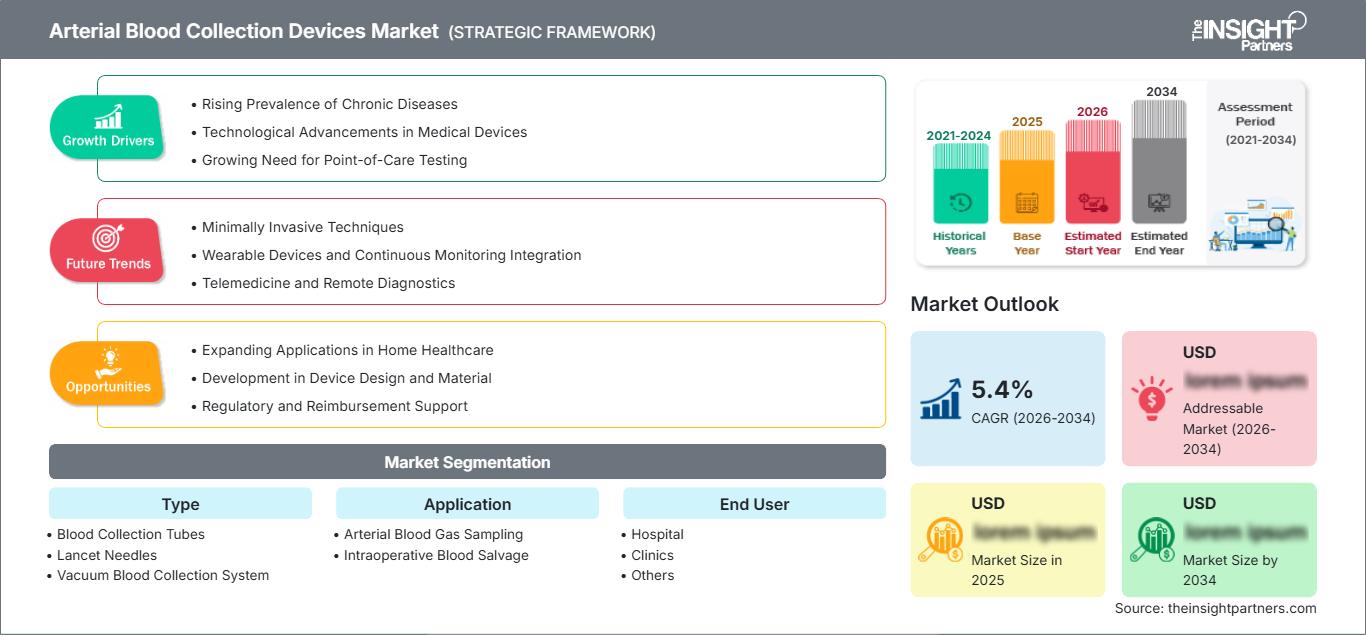
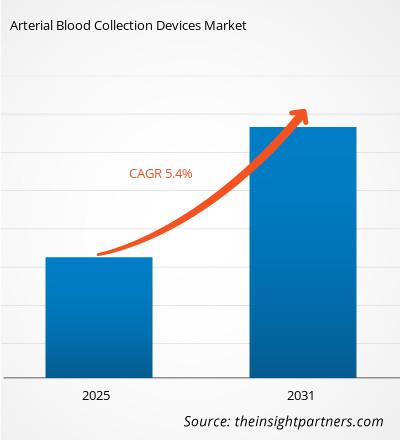
The arterial blood collection devices market was valued at US$ 1.24 Billion in 2025 and is projected to reach US$ 1.93 Billion by 2034, expanding at a CAGR of 5.07% during 2026–2034. The market encompasses specialized collection technologies supporting arterial blood gas sampling, intraoperative blood salvage, critical care monitoring, and related diagnostic workflows. Demand is shaped by acute-care utilization, specimen-quality requirements, healthcare-worker safety, and increasing preference for standardized, pre-heparinized collection systems.
North America is expected to remain a structurally important market, supported by established critical-care infrastructure, high utilization of arterial blood gas testing, and widespread adoption of safety-engineered collection products. The arterial blood collection devices market size in the region is projected to expand at approximately 4.6–5.3% CAGR during 2026–2034, with demand reinforced by intensive-care capacity, emergency medicine, and hospital efforts to reduce preanalytical errors.
Arterial Blood Collection Devices Market Assessment and Insights
- North America: North America is projected to command a 39–43% arterial blood collection devices market share in 2025 and expand at a 4.6–5.3% CAGR between 2026–2034, supported by mature critical-care infrastructure, standardized procurement, and established arterial blood gas workflows.
- US: The US is expected to represent 84–89% of North American revenue in 2025, growing at a 4.5–5.2% CAGR during 2026–2034 as critical-care testing and safety-engineered collection remain widely adopted.
- Europe: Europe is estimated to hold a 24–28% share in 2025 and grow at a 4.7–5.4% CAGR, led by Germany, the UK, France, Italy, and Spain, where laboratory quality systems support standardized specimen collection.
- Asia Pacific: Asia Pacific is estimated to account for a 21–25% share in 2025 and record a 6.0–6.8% CAGR through 2034, with China, Japan, India, South Korea, and Australia driving hospital modernization.
- Largest Segment: Blood Collection Tubes are estimated to hold a 34–39% market share in 2025 and grow at a 4.5–5.2% CAGR through 2034, reflecting broad specimen-management use.
- High Growth Segment: Microfluidic System is estimated to represent an 8–12% market share in 2025 and expand at a 7.0–8.0% CAGR, supported by miniaturization and low-volume sampling.
- Key companies analyzed in detail: Bio-Rad Laboratories, Inc.; NIPRO CORPORATION; QIAGEN N.V.; F. Hoffmann-La Roche Ltd; Terumo Corporation; Thermo Fisher Scientific Inc.; Becton, Dickinson and Company; Medtronic plc.; Greiner Bio-One International GmbH; Narang Medical Limited.
Source: The Insight Partners' analysis based on proprietary research, government publications, company annual reports, investor presentations, industry databases, and expert interviews.
The arterial blood collection devices market has transitioned from traditional collection using needles and syringes to devices engineered for standardization and safety, with features for controlling specimen volumes, anticoagulation, exposure to air, and handling. Pre-heparinized syringes, safety shields, arterial-line devices, and better connectors can help establish repeatable workflows. WHO guidelines recommend pre-heparinized devices and proper handling since air exposure, incorrect anticoagulation, and delay in transport may affect blood-gas results.
Growth will become increasingly tied to hospital modernization in Asia Pacific and select Middle Eastern markets, with the development of critical care services and point-of-care testing facilities. Single-use device requirements, traceability, safety from needlesticks, and preservation of specimens are factors that could play to the advantage of existing suppliers. Acquisition strategies will also favor interoperability with arterial lines and analyzers, while microfluidics provides opportunities for low volume sampling and decentralized testing.
Arterial Blood Collection Devices Market Report Scope
| Report Attribute | Details |
|---|---|
| Market size in 2025 | US$ 1.24 Billion |
| Market Size by 2034 | US$ 1.93 Billion |
| Global CAGR (2026 - 2034) | 5.07% |
| Historical Data | 2021-2024 |
| Forecast period | 2026-2034 |
Arterial Blood Collection Devices Market Analysis
The demand for the product is driven by emergency departments, intensive care units, operating rooms, and other locations where the arterial blood gas data can help to make a decision right away. In this regard, the expansion of the arterial blood collection devices market will be tightly linked to critical care practice and will not be based only on the increased frequency of venous phlebotomies.
Value chain includes companies that manufacture polymers, manufacturers of needles used in arterial blood collection and syringe assemblers, anticoagulant coating producers, sterilization centers, wholesalers, hospitals, and point-of-care testing departments. Differentiation in the supply side is currently being achieved by consistency of heparin coating, controlled volume of draw, small dead space, packaging characteristics, and compatibility with the analyzers. Manufacturers that have wide hospital distribution can offer their arterial blood collection devices together with the entire vascular access and specimen management portfolio.
The competitive environment is characterized by portfolio size, regulatory approval, production capacities, and integration into clinical workflow. Becton, Dickinson and Company operates the largest critical-care collection portfolio, while Terumo Corporation, NIPRO CORPORATION, Greiner Bio-One International GmbH, and Narang Medical Limited provide solutions for the arterial blood collection and other procedural needs in multiple regions. Arterial blood collection devices market trends show that increasing differentiation is achieved by developing safety mechanisms, ergonomic design, and arterial line access solutions.
Companies like Bio-Rad Laboratories, Inc., QIAGEN N.V., F. Hoffmann-La Roche Ltd, and Thermo Fisher Scientific Inc. increase the diagnostic value of the arterial blood collection through laboratory technologies and specimen management solutions. Medtronic plc. supports the industry through the development of critical-care and vascular-access technologies, while procurement opportunities for collection systems will remain highest in standardized hospitals. The current investments go to automation of workflows, microvolume collection, traceability, and decentralization solutions.
● REPORT CUSTOMIZATION
Tailor This Report To Align With Your Specific Business Requirements
This report can be customized to align precisely with your business objectives, scope, and target markets. Customization options include tailored segmentation, geography, competitive analysis, and strategic insights to support informed decision-making.
Customize This Report →WHAT YOU CAN ADJUST
- ● Segmentations
- ● Geography
- ● Competitive Analysis
- ● Language Preferences
Arterial Blood Collection Devices Market: Strategic Insights
Regional Insights
North America arterial blood collection devices market
North America is estimated to account for 39–43% of global revenue in 2025 and grow at a 4.6–5.3% CAGR through 2034. The advantages are the presence of an advanced structure of intensive care, high hospital spending, presence of point-of-care tests, and occupational-safety requirements. The USA is the primary market for the industry, and Canada acts as a supplement due to hospital purchasing and laboratories networks. Products selection includes consideration of the needlestick protection, arterial-line compatibility, and standard draw volumes.
Critical-care departments are the main centers of demand in the arterial blood collection devices market because arterial testing allows assessing the respiratory function, metabolic process, and circulation. The region enjoys established reimbursement and purchasing systems that allow the replacement of traditional devices with safety-engineered products. Companies with diverse clinical portfolio use hospital contracts to enter the market, while specialized companies compete in product ergonomics and specimen quality features.
U.S. arterial blood collection devices market Market
The US is estimated to contribute 84–89% of North American arterial blood collection devices market in 2025 and expand at a 4.5–5.2% CAGR through 2034. Hospital systems that are big, emergency rooms, ICUs, and perioperative departments have constant demand for arterial sampling products. Becton, Dickinson and Company possesses a critical care collection product line that comprises arterial syringes and others.
Trends in the use of products are moving towards the following: Arterial-line sampling, pre-heparinized syringes, control of draw volume, and safety aspects to limit occupational exposure. Hospitals require products which limit the need for recollection due to clots, air contamination, or poor handling of the specimen. Evaluation of suppliers therefore moves past cost-per-unit into issues like reliability, compatibility, training, and standardization of procurement. The US is a mature and technologically advanced market.
Europe arterial blood collection devices market Market
Europe is projected to hold a 24–28% arterial blood collection devices market in 2025 and expand at a 4.7–5.4% CAGR through 2034, with Germany expected to remain the leading national market. UK, Germany, France, Italy, and Spain benefit from established hospital systems, laboratory quality frameworks, and relatively high adoption of standardized disposable collection technologies.
Demand is supported by central procurement and critical care pathways in the UK. Germany boasts of high medical device manufacturing and quality levels along with a robust hospital base. France, Italy, and Spain offer extra demand through intensive care and surgery uses; however, the purchasing framework varies from one country to another. Safety, traceability, and integrity of specimens become increasingly important for European vendors, and compatibility of arterial access and blood gas analysis procedures becomes more of an issue for hospitals.
APAC arterial blood collection devices market Market
Asia Pacific is estimated to represent 21–25% of 2025 revenue and grow at a 6.0–6.8% CAGR through 2034, making it the fastest-expanding major region. China is the leading market, followed by Japan, South Korea, India, and Australia. Hospital construction, critical-care expansion, and increasing point-of-care testing support adoption.
While China and India are potential large-volume markets due to hospitals upgrading their diagnostic equipment, Japan and Australia are mature markets requiring high-quality standardizing devices. South Korea has developed hospitals along with technology-led procurement practices. With localization of industry, increased distribution channels, and government spending on public healthcare, arterial sampling products are likely to see better availability. Growth in the region will be greatest in locations where critical care capacity outpaces procurement penetration.
Middle East & Africa arterial blood collection devices market Market
Middle East and Africa is expected to record a 5.2–6.1% CAGR through 2034. Saudi Arabia and the UAE lead regional demand because of healthcare infrastructure investment, tertiary-care expansion, and modernization of intensive-care services. South Africa remains the principal sub-Saharan market, while the rest of MEA develops more selectively.
Healthcare transformation programs and increased hospitals make Saudi Arabia benefit from it; the UAE focuses on tertiary and advanced healthcare systems. Established clinical networks help South Africa in stimulating the demand, while other MEA regions depend on the distributors for supplying healthcare goods. Money coming from energy can be used to finance the development of healthcare, although purchasing costs and import reliance are still crucial factors. The potential of the region is thus limited to major cities.
Segmentation Analysis
Type
The Type segment is expected to expand at a 4.8–5.6% CAGR during 2026–2034. Product demand is influenced by procedural frequency, specimen requirements, safety considerations, and integration with point-of-care analyzers. Blood Collection Tubes remain the principal category because of their broad use, while microfluidic systems provide a differentiated growth pathway through low-volume sampling.
- Blood Collection Tubes: These products provide standardized specimen containment and remain important across arterial and broader critical-care workflows. Demand is influenced by additive selection, volume control, sample stability, labeling, and compatibility with laboratory processing.
- Lancet Needles: Lancet needles support controlled sampling applications where small blood volumes are sufficient. Their strategic importance centers on safety engineering, patient comfort, consistent penetration, and integration with decentralized diagnostic workflows.
- Vacuum Blood Collection System: Vacuum systems support controlled specimen acquisition and standardized handling. Adoption is strongest where hospitals prioritize reproducibility, closed collection processes, workflow efficiency, and compatibility with established laboratory infrastructure.
- Microfluidic System: Microfluidic systems address low-volume sampling and miniaturized diagnostics. Their strategic importance lies in reducing specimen requirements, enabling compact workflows, and supporting future point-of-care applications where conventional collection volumes are restrictive.
- Others: Other products support specialized arterial collection workflows, accessories, and procedural requirements. Demand depends on clinical protocols, hospital procurement specifications, and compatibility with existing vascular access and specimen-management systems.
Application
The Application segment is projected to grow at a 5.0–5.8% CAGR during 2026–2034. Arterial Blood Gas Sampling remains central because rapid assessment of oxygenation, ventilation, and acid-base balance is essential in critical care. Intraoperative Blood Salvage creates a complementary demand pathway in surgical settings requiring efficient blood recovery.
- Arterial Blood Gas Sampling: This application remains the core use case, particularly in intensive care, emergency medicine, respiratory management, and perioperative monitoring where rapid blood-gas assessment supports immediate clinical decisions.
- Intraoperative Blood Salvage: Intraoperative blood salvage supports surgical blood-management protocols by recovering and processing blood during procedures. Adoption depends on procedure complexity, institutional protocols, equipment availability, and efforts to reduce dependence on donor blood.
End User
The End User segment is expected to grow at a 4.9–5.7% CAGR during 2026–2034. Hospitals remain the principal purchasers because arterial sampling is concentrated in critical-care environments. Clinics provide a smaller opportunity, while specialized settings represented within Others support targeted demand for decentralized and procedural collection.
- Hospital: Hospitals represent the primary demand center because intensive-care, emergency, surgical, and respiratory departments require frequent arterial sampling. Procurement emphasizes reliability, safety, standardized volume, and compatibility with analyzers and arterial access systems.
- Clinics: Clinics generally represent lower-volume demand, concentrated in facilities offering respiratory, emergency, procedural, or specialized diagnostic services. Compact collection products and simplified workflows can improve suitability where laboratory infrastructure is limited.
- Others: Other end users include specialized diagnostic and procedural environments requiring targeted arterial sampling capabilities. Their importance depends on decentralization, institutional protocols, patient acuity, and adoption of point-of-care diagnostic workflows.
Opportunity Snapshot
| End User | Revenue Contribution | Trend Tag | Adoption Stage |
|---|---|---|---|
| Hospital | High | ICU Sampling | Mature |
| Clinics | Medium | Point Care | Scaling |
| Others | Low | Specialty Sampling | Emerging |
Arterial Blood Collection Devices Market Growth Drivers and Impact Analysis
Expansion of Critical-Care and Emergency Diagnostics
Increased capacity in intensive care units, emergency medicine, pulmonary care, and advanced surgery will increase the number of instances when clinical care requires arterial sampling. According to guidelines published by the WHO, the collection of arterial blood is considered a special test that is mainly used for the determination of arterial blood gases and radial artery sampling that is generally done by trained medical professionals. With the development of more intensive care units in hospitals, there will be increasing demand for standard specimen collection products, which enable quick testing with minimal preanalytical variance. These effects will have the highest impact in acute care hospitals where delays in treatment due to recollection of specimens can affect the decision-making process.
Increasing Focus on Specimen Integrity and Preanalytical Quality
Preanalytical errors have a direct impact on the clinical and operational outcome of tests since they may lead to changes in the blood gas analysis due to factors such as exposure to air, incorrect amount of anticoagulant, clotted sample, and transportation problems. These factors are identified by WHO recommendations and require the use of appropriate pre-heparinized devices as well as controlled collection methods. In this way, it becomes important for hospitals to test collection devices depending on the preservation of samples from their collection to analysis. In other words, new devices should possess characteristics of vented plungers, balanced heparin coating, sealed caps, and standardized sample volume.
Occupational Safety and Safety-Engineered Collection
The importance of needle safety in purchasing will be continued because arterial puncture involves an invasive technique and takes place in a high-stress environment. Safety engineering can provide such features as shielding, locking, safety needle, and closure of connectors in order to minimize the risk of contamination. WHO stresses out blood-borne occupational hazards as one of the critical factors for phlebotomy practice. The impact on the market will not be limited only to individual devices, as modern hospitals start incorporating the concept of occupational safety in purchasing standards and personnel education. Devices combining the safety feature and convenience will find their advantage among clinicians needing rapid mobilization of devices without extra procedures.
Arterial Blood Collection Devices Market Future Trends
Integration of Collection With Point-of-Care Diagnostics
Collection workflows for future arteries will become more closely tied with point-of-care diagnosis systems, thus minimizing the time gap between the collection of specimens and the receipt of results. Devices for the collection of blood samples will become more widely examined not as separate consumables but as parts of a workflow system. Standardized connections, control of the volume of samples, low dead space, and the compatibility with analyzers could help to increase the level of operational uniformity. The use of digital methods of identification and traceability could also decrease errors in specimen-matching. Arterial blood collection devices industry trends will therefore be oriented towards collection systems designed for rapid bedside analysis, particularly for intensive care and emergency settings.
Microvolume and Miniaturized Collection Platforms
Miniaturization is expected to influence product development as healthcare providers seek lower sample volumes, less invasive workflows, and greater compatibility with compact diagnostic platforms. Microfluidic collection technologies can potentially reduce blood requirements while supporting rapid processing close to the patient. Development will depend on achieving adequate specimen integrity, reproducible anticoagulation, manufacturing consistency, and regulatory acceptance. The opportunity is particularly relevant for pediatric, geriatric, and fragile-patient populations, as well as decentralized testing environments. Over time, manufacturers may combine microvolume collection with integrated sensors, automated sample transfer, or digital identification. These developments could broaden the addressable clinical applications while reducing reliance on conventional collection architectures in selected workflows.
Arterial Blood Collection Devices Market Opportunities
Localized Manufacturing and Distribution in Emerging Markets
Emerging markets offer investment opportunities where hospital infrastructure is expanding faster than established medical-device penetration. Manufacturers can strengthen positions through regional manufacturing, local sterilization, distributor partnerships, and localized training programs. China and India are particularly relevant because expanding tertiary-care capacity can increase demand for standardized critical-care consumables. The arterial blood collection devices market Forecasts indicate that regional expansion should favor suppliers able to combine competitive pricing with regulatory compliance and dependable availability. Strategic partnerships with hospitals and diagnostic networks can help validate products while improving procurement visibility. Localized production can also reduce import dependence, shorten supply chains, and support participation in public tenders where cost, continuity of supply, and domestic manufacturing capabilities influence purchasing decisions.
Integrated Critical-Care Portfolio Expansion
A second opportunity involves combining arterial collection products with broader vascular access, blood-gas, specimen-management, and critical-care portfolios. Hospitals increasingly seek standardized workflows that reduce the number of suppliers and simplify staff training. Companies with complementary technologies can use existing relationships to cross-sell arterial syringes, line-access products, stabilization devices, and related consumables. The opportunity is especially relevant for large hospital systems pursuing procurement consolidation. Manufacturers can also create value through training, quality-assessment programs, and workflow-support materials that address specimen handling. Such strategies shift competition from individual product pricing toward total workflow economics. Companies with established regulatory capabilities and broad distribution can use this approach to defend mature markets while entering adjacent critical-care categories.
Recent Developments
- June 2026: Greiner Bio-One International GmbH highlighted new 2026 product catalogues and continued development of safe blood-collection solutions, including VACUETTE safety products and digital preanalytics. The company’s current portfolio emphasizes automated safety mechanisms and specimen-management workflows, reinforcing the industry shift toward safer collection and greater preanalytical standardization.
- November 2025: Thermo Fisher Scientific Inc. announced US FDA 510(k) clearance for the EXENT automated system, expanding its clinical diagnostics portfolio with an automated workflow for multiple-myeloma diagnosis. Although broader than arterial collection, the development demonstrates continued investment in automated blood-based diagnostic workflows and laboratory integration.
- September 2025: QIAGEN N.V. issued a revised Blood Collection protocol for QFT-Plus Blood Collection Tubes, specifying validated collection volumes and handling requirements. The update reinforces the importance of controlled specimen collection and standardized preanalytical procedures across blood-based diagnostic workflows.
Frequently Asked Questions

- Comprehensive Market Sizing and Forecast Analysis
- Detailed Segmentation Analysis
- In-Depth Market Dynamics Assessment
- Regional and Country-Level Insights
- Competitive Landscape and Company Benchmarking
- Strategic Business Intelligence
Recent Reports
Testimonials

The Insight Partners' SCADA System Market report is comprehensive, with valuable insights on current trends and future forecasts. The team was highly professional, responsive, and supportive throughout. We are very satisfied and highly recommend their services.
RAN KEDEM Partner, Reali Technologies LTDs
I requested a report on a very specific software market and the team produced the report in a few days. The information was very relevant and well presented. I then requested some changes and additions to the report. The team was again very responsive and I got the final report in less than a week.
JEAN-HERVE JENN Chairman, Future Analytica
We worked with The Insight Partners for an important market study and forecast. They gave us clear insights into opportunities and risks, which helped shape our plans. Their research was easy to use and based on solid data. It helped us make smart, confident decisions. We highly recommend them.
PIYUSH NAGPAL Sr. Vice President, High Beam Global
The Insight Partners delivered insightful, well-structured market research with strong domain expertise. Their team was professional and responsive throughout. The user-friendly website made accessing industry reports seamless. We highly recommend them for reliable, high-quality research services
YUKIHIKO ADACHI CEO, Deep Blue, LLC.
This is the first time I have purchased a market report from The Insight Partners.While I was unsure at first, I visited their web site and felt more comfortable to take the risk and purchase a market report.I am completely satisfied with the quality of the report and customer service. I had several questions and comments with the initial report, but after a couple of dialogs over email with their analyst I believe I have a report that I can use as input to our strategic planning process.Thank you so much for taking the extra time and making this a positive experience.I will definitely recommend your service to others and you will be my first call when we need further market data.
JOHN SUZUKI President and Chief Executive Officer, Board Director, BK Technologies
I wish to appreciate your support and the professionalism you displayed in the course of attending to my request for information regarding to infectious disease IVD market in Nigeria. I appreciate your patience, your guidance, and the fact that you were willing to offer a discount, which eventually made it possible for us to close a deal. I look forward to engaging The Insight Partners in the future, all thanks to the impression you have created in me as a result of this first encounter.
DR CHIJIOKE ONYIA MANAGING DIRECTOR, PineCrest Healthcare Ltd.Reason to Buy
- Informed Decision-Making
- Understanding Market Dynamics
- Competitive Analysis
- Identifying Emerging Markets
- Customer Insights
- Market Forecasts
- Risk Mitigation
- Boosting Operational Efficiency
- Strategic Planning
- Investment Justification
- Tracking Industry Innovations
- Aligning with Regulatory Trends





 Get Free Sample for