
Articulated Robot Market Size, Trends & Demand by 2034
Coverage: by Payload (Up to 16.00 Kg, 16.01 – 60.00 Kg, 60.01 – 225.00 Kg, More Than 225.00 Kg); Function (Handling, Welding, Dispensing, Assembly, Processing, Others); Industry (Automotive, Electrical and Electronics, Metal and Machinery, Food and Beverages, Precision Engineering and Optics, Pharmaceuticals and Cosmetics, Others) , and Geography (North America, Europe, Asia Pacific, and South and Central America)
- Status : Data Released
- Report Code : TIPRE00012038
- Category : Electronics and Semiconductor
- No. of Pages : 150
- Available Report Formats :


- Last update date : July 15, 2026


2025 Market Size
US$ 32.93 Bn
Base year value
2034 Forecast
US$ 64.95 Bn
Projected by 2034
CAGR 2026-2034
8.86 %
Growth rate
Addressable Market
US$ 464.04 Bn
(2026-2034)
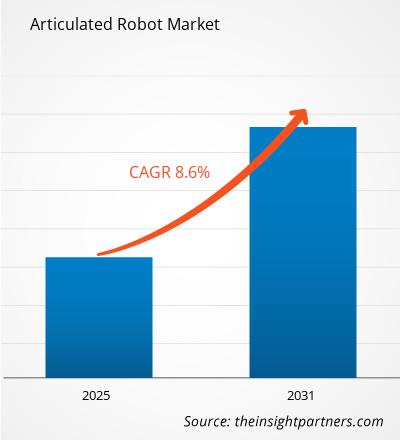
The Articulated Robot Market was valued at US$ 32.93 Billion in 2025 and is projected to reach US$ 64.95 Billion by 2034, growing at a CAGR of 8.86% during 2026–2034. The Articulated Robots Market is growing due to the increasing use of multi-jointed robot arms in welding, handling, dispensing, assembly, and processing applications that need to be fast, repeatable, and safe for the efficiency of factories.
The North American continent still has potential for automation growth since reshoring, production of electric cars, aerospace products, and semiconductors has increased the need for robots. The Articulated Robot Market size in the region is projected to grow at a CAGR rate between 7.6% and 8.1% from 2026 to 2034.
Articulated Robot Market Assessment and Insights
- North America: The region holds 30–34% share in 2025 and grows at a CAGR range of 7.6–8.1% during 2026–2034, supported by reshoring, EV platforms, aerospace automation, and warehouse-linked manufacturing investments.
- US: The country represents 78–82% of North America in 2025 and grows at a CAGR range of 7.7–8.2% during 2026–2034, led by automotive, semiconductor, and metalworking upgrades.
- Europe: The region accounts for 22–26% share in 2025 and grows at a CAGR range of 6.9–7.4% during 2026–2034, with Germany, Italy, France, Spain, and the UK leading deployment.
- Asia Pacific: The region holds 38–42% share in 2025 and grows at a CAGR range of 9.6–10.1% during 2026–2034, led by China, Japan, South Korea, India, and Taiwan.
- Largest Segment: Handling holds 34–38% market share in 2025 and grows at a CAGR range of 8.2–8.7% during 2026–2034 as factories automate loading, unloading, and palletizing.
- High Growth Segment: Pharmaceuticals and Cosmetics hold 5–8% market share in 2025 and grow at a CAGR range of 10.1–10.6% during 2026–2034 as clean production automation rises.
- Key companies analyzed in detail: ABB Ltd.; KUKA AG; Mitsubishi Electric Corporation; FANUC Corporation; Kawasaki Heavy Industries, Ltd.; DENSO WAVE INCORPORATED; OMRON Corporation; Nachi-Fujikoshi Corp.; Yaskawa Electric Corporation; Seiko Epson Corporation.
Source: The Insight Partners' analysis based on proprietary research, government publications, company annual reports, investor presentations, industry databases, and expert interviews.
Automation within manufacturing operations has shifted away from hard-coded fixed cells to flexible robotic ecosystems incorporating arms, control technology, sensor systems, vision systems, end effectors, and digital services solutions. According to the International Federation of Robotics estimates, 542,000 industrial robots have been installed in 2024, and the operational base has grown to 4.664 million. The existing installed base represents the demand for articulated robots due to balancing labor availability, quality assurance, and production flexibility by the manufacturers.
Further adoption will continue since manufacturing capabilities based on electronics, mobility, machinery, and consumer products will move into India, Southeast Asia, Mexico, and Eastern Europe. Domestic manufacturing, safety at work sites, and efficient utilization of resources will ensure that robot investments remain relevant. Suppliers having local integration expertise, application engineering, and lifetime services will fare better than companies focusing only on arms.
Articulated Robot Market Report Scope
| Report Attribute | Details |
|---|---|
| Market size in 2025 | US$ 32.93 Billion |
| Market Size by 2034 | US$ 64.95 Billion |
| Global CAGR (2026 - 2034) | 8.86% |
| Historical Data | 2021-2024 |
| Forecast period | 2026-2034 |
Articulated Robot Market Analysis
The Articulated Robot Market growth is driven by the need to automate repetitive, hazardous, and precision-intensive tasks while preserving throughput during labor shortages. Welding of vehicles, assembling electronics, material handling, food packing, and tending machines continue to be major applications. According to IFR statistics, in 2024, Asia accounted for 74% of newly installed industrial robots due to manufacturing investments and demand from volume electronic product supply chains.
The industrial robot value chain consists of robot manufacturers, servo and drive systems suppliers, control platforms, gripper manufacturers, machine vision systems, integrators, experts in safety, and maintenance service providers. The supply chain dynamics are driven by control systems availability, payload capacity, application software, local support, and system integration. Buyers judge cell efficiency, not just the robot itself, since fixtures, programming, up-time, and operator training influence return on investment.
The Articulated Robot Market analysis reveals that the market is dominated by leading robot manufacturers on a global level with an extensive applications portfolio. The leading players in automotive, welding, and general industries include ABB Ltd., FANUC Corporation, KUKA AG, and Yaskawa Electric Corporation. These companies are followed by Mitsubishi Electric Corporation, Kawasaki Heavy Industries, Ltd., DENSO WAVE INCORPORATED, OMRON Corporation, Nachi-Fujikoshi Corp., and Seiko Epson Corporation, which contribute to precision assembly, compact automation, and Asian manufacturers.
The investment focus has shifted to AI-enabled programming, digital twins, predictive maintenance, and flexible small cells for mixed-model manufacturing. The best strategy for suppliers is those who can offer their controller ecosystem, offline simulation, vision guidance, and regional services. The clients value vendors that can shorten commissioning time and assist in regulatory safety requirements and integration with MES, PLC, and factory data systems.
● REPORT CUSTOMIZATION
Tailor This Report To Align With Your Specific Business Requirements
This report can be customized to align precisely with your business objectives, scope, and target markets. Customization options include tailored segmentation, geography, competitive analysis, and strategic insights to support informed decision-making.
Customize This Report →WHAT YOU CAN ADJUST
- ● Segmentations
- ● Geography
- ● Competitive Analysis
- ● Language Preferences
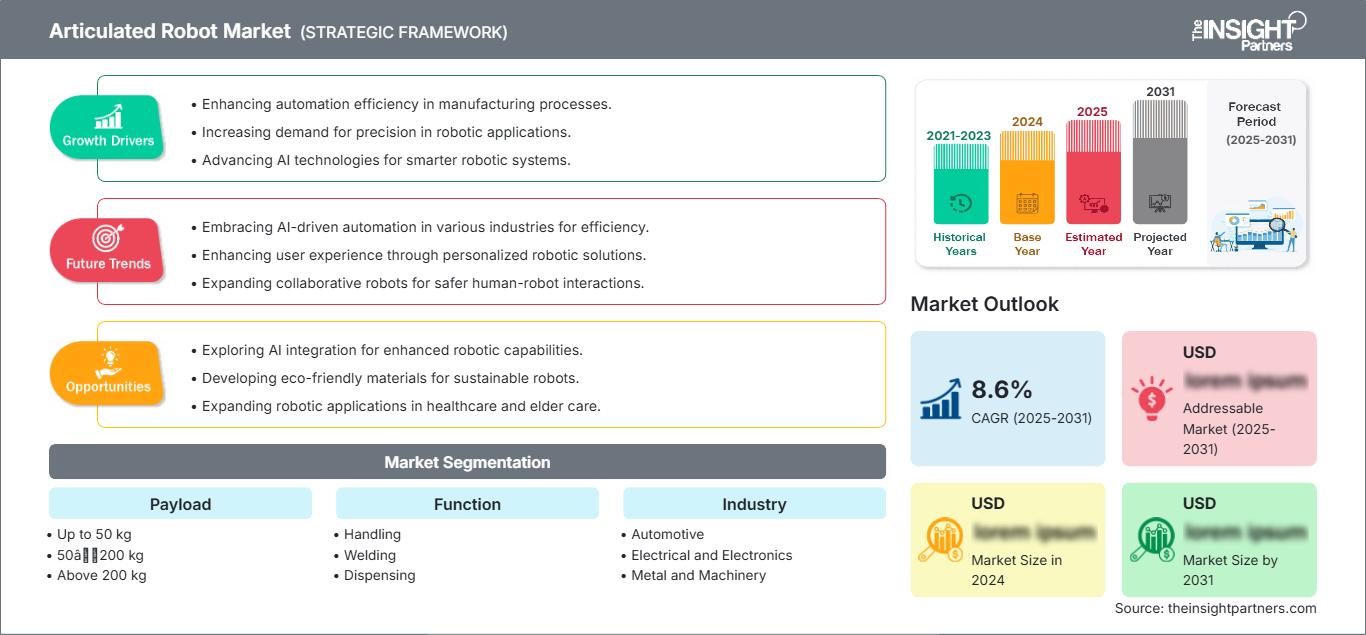
Articulated Robot Market: Strategic Insights
Regional Insights
North America Articulated Robot Market
North America holds 30–34% share in 2025 and is projected to grow at a CAGR range of 7.6–8.1% during 2026–2034. The Articulated Robot Market share is supported by the reshoring of production, EV battery plants, aerospace work packages, semiconductor facilities, and metal fabrication upgrades. The US contributed to 68% of the installations in the Americas in the 2025 reports of IFR, suggesting that there is concentrated demand for automation in the US.
The other important players are Canada and Mexico, adding strength through their automobile sector, machinery, food processing, and export-driven manufacturing industry. Buyers in this region place great importance on system uptime, safety compliance, and accessibility of integrators owing to the brownfield lines.
U.S. Articulated Robot Market
The U.S. represents 78–82% of North America in 2025 and grows at a CAGR range of 7.7–8.2% during 2026–2034. Automotive assembly, tier suppliers, aerospace assemblies, consumer products, semiconductor manufacturing equipment, and logistics-driven manufacturing are among the prominent applications. Relevant players include ABB Ltd., FANUC Corporation, Yaskawa Electric Corporation, KUKA AG, and Kawasaki Heavy Industries, Ltd. by way of their robot lineups, training centers, and integrator networks.
Priorities in the deployment of robots have shifted from standalone welding systems to robotic cells with vision, force sensors, and simulation capabilities. Robotic systems should be able to shift from picking up to dispensing and inspecting products without requiring much time. The shortage of labor is structurally embedded; thus, robotics is used to safeguard production, avoid rework, and achieve consistency in manufacturing quality.
Europe Articulated Robot Market
Europe accounts for 22–26% share in 2025 and grows at a CAGR range of 6.9–7.4% during 2026–2034. The German country continues to lead because of its automotive engineering, machinery exports, and robotic factory automation. The IFR statistics demonstrate that 85,000 industrial robots were installed in Europe in 2024, while Germany alone makes up about 32% of the European annual total, despite the difficult automotive cycle.
Automation in food processing, aerospace, and precision engineering industries is increasing in the UK owing to labor shortages and low productivity. The demand is supported by Italy owing to the machinery, packaging, ceramics, and metal industries. Vehicle platforms, batteries, and assembly plants are added to the European growth by France, Spain, and Central European countries.
APAC Articulated Robot Market
Asia Pacific holds 38–42% share in 2025 and is projected to grow at a CAGR range of 9.6–10.1% during 2026–2034. China stays ahead of the pack with 295,000 robots installed in 2024, accounting for 54% of all global installs. Electronics, automotive, semiconductor, and precision machinery from Japan, South Korea, Taiwan, and India drive the demand.
Growth opportunities from policy-based manufacturing modernizations, local robot manufacturing, and export capability make APAC the most attractive region. The impressive number of 9,100 installs in India in 2024, where 45% is attributable to the automotive sector, shows expanding applications beyond established markets.
Middle East & Africa Articulated Robot Market
The Middle East & Africa market is projected to grow at a CAGR range of 8.2–8.7% during 2026–2034. Saudi Arabia leads due to industrial diversification, metals, petrochemicals, logistics centers, and manufacturing districts, generating demand for automation technology. The UAE offers scope in aerospace, packaging, food processing, and high-end industrial plants.
South Africa will come through its expertise in automotive, mining equipment, metals, and consumer goods, while adoption in the rest of MEA depends on projects. Maintenance in the energy sector, manufacturing of infrastructure, and localization policies offer scope for the future. The suppliers must undertake training sessions, ruggedized solutions, and collaboration with regional integrators to materialize the scope.
Segmentation Analysis
Payload
Payload is projected to grow at a CAGR range of 8.5–9.0% during 2026–2034. Factors such as weight, reach, cycle time, floor space, and end-effector complexity define the market potential for different articulated robot load capacities. Robots with lower weights are ideal for electronics and packaging, those in the mid-range are versatile enough for general manufacturing purposes, while those with high payload capabilities are important in the automotive industry.
- Under 50 kg: The robots in this category have many applications in assembly, electronics, dispensing, packaging, machining, and light material handling due to their small size, speed, and safety features.
- 50 – 200 kg: The robots in this category are used in the widest range of applications since they are suitable for welding, palletizing, part handling, and general manufacturing operations.
- Over 200 kg: The heavy payload robots still play an important role in the handling of automotive frames, foundry parts, large castings, metal sheets, and machine parts.
Function
The forecasted growth of the function market over the period of 2026-2034 will be around 8.4% - 8.9%. The handling function will remain the largest, while welding and assembly will dominate the high-end functions like automotive, machinery, and electronics. The dispensing and processing functions will become more significant as the manufacturers need controlled bead deposition, coating application, deburring, polishing, and finishing processes.
- Handling: Handling robots precede other robots in terms of adoption, as loading/unloading, sorting, palletizing, and machine tending tasks provide obvious productivity benefits and safety through ergonomics in fast-moving factory operations.
Welding: Welding robots are mainly employed in the automotive industry, metalworking and machinery and transportation equipment sectors due to better quality control and repeatability throughout multi-shift manufacturing. - Dispensing: Dispensing applications expand to adhesives and sealants, coating and electronics protection, where controlled flow and precise path are key to improving process stability and product quality.
Assembly: Assembly robots perform electronics, appliances and automotive assembly and manufacture precision products with the help of constant force application, proper alignment and repeatability. - Processing: Processing applications include grinding, polishing, cutting and deburring, and surface treatment in which a robot is used to protect the operator and achieve consistent finishing of diverse parts.
Industry
It is expected that the industry will expand at a CAGR of 8.7-9.2%. The automotive sector is still the biggest spender on modular production. However, there is a rise in the shares of the electronics industry, metals and machinery industry, food and beverages industry, and pharmaceuticals and cosmetics industries. Industrial use of modular manufacturing is driven by production volumes, hygienic considerations, defect costs, labor shortages, and workpiece standardization.
- Automotive - The automotive industry uses articulated robots for welding the bodies, painting, handling batteries, assembling the power train, and transferring parts, making it very important in terms of high load and uptime requirements.
- Electrical & Electronics - Companies dealing with electronics make use of small articulated robots in their applications like assembly, inspection, dispensing, and handling, due to miniaturization, clean working conditions, and frequent changes in models.
- Metal & Machinery – Metal & Machinery companies use robots for welding, machine tending, deburring, and heavy lifting.
- Food & Beverage: Food & beverages plants employ robotics for packaging, palletization, pick-and-place operations, and hygienic material handling, where labor scarcity and safety needs make automation a quick decision.
- Precision Engineering and Optics: For precision engineering and optics, there is a need to take care of motion control, clean handling, and repeatability in lenses, instruments, micro-components, and inspection-related manufacturing systems.
- Pharmaceuticals & Cosmetics: In the pharmaceuticals and cosmetics industries, there is an increasing trend of using robots for filling assistance, packaging, inspection, and hygienic material handling.
Opportunity Snapshot
| Industry | Revenue Contribution | Trend Tag | Adoption Stage |
| Automotive | High | EV Lines | Mature |
| Electrical and Electronics | High | Micro Assembly | Scaling |
| Metal and Machinery | Medium | Weld Cells | Scaling |
| Food and Beverages | Medium | Hygienic Packs | Scaling |
| Precision Engineering and Optics | Medium | Micro Handling | Emerging |
| Pharmaceuticals and Cosmetics | Medium | Clean Automation | Scaling |
| Others | Low | Mixed Use | Emerging |
Articulated Robot Market Growth Drivers and Impact Analysis
Factory Productivity Pressure and Labor Constraints
The use of robots by manufacturing organizations has increased since issues like labor shortage, salary inflation, and high turnover rate make it difficult to depend on humans for reliable processes. The robots ensure that tasks such as welding, loading, packaging, and dispensing are handled reliably while the operator is able to oversee various cells. This is evidenced by increased machine usage, fewer cases of ergonomic injuries, and consistent cycle times. The cost-effectiveness is growing for small to midsize manufacturers through the emergence of prefabricated cells, renting, and simplified programming.
Automotive Electrification Rebuilding Production Lines
Manufacturing of electric vehicles and their batteries is bringing about the evolution of automation needs in terms of body shop, module assembly, pack handling, thermal management, and inspection. It will require robots not only to weld but also to apply adhesives, pick and place parts, perform laser welding, and perform repetitive assembly functions for heavy and light parts, respectively. Impacts in terms of market opportunities will be felt not only by the vehicle manufacturers but also by the tier suppliers that manufacture housing, busbars, castings, cooling plates, and electronics.
Connected Controllers Improving Robot Utilization
Robot controllers have become essential for production intelligence as they link information about movement, vision, safety, maintenance, and cell performance. Advanced platforms facilitate quick commissioning, diagnostics, and offline programming, minimizing downtime and making the robotic cells more flexible for relocation. The commercial effect will be that buyers will no longer base their purchase decisions on hardware but rather consider the total lifecycle productivity of robots. The questions asked by manufacturers now will be does the robot have predictive maintenance capability, remote diagnostics, and ability to integrate with plant execution systems?
Articulated Robot Market Future Trends
AI-Assisted Programming Becoming Standard
Articulated Robot Market trends will increasingly center on AI-assisted programming that reduces dependence on scarce robot specialists. Rather than coding the paths individually, the engineers would rely on simulation, vision-based feedback and guidance for creating, testing and refining motions. In doing so, the scope of application is expected to grow even further beyond big companies that are capable of keeping a large automation staff. In due course, programming that is made easier is expected to make it possible for robots to be redeployed faster and with shorter production runs.
Robots Moving into Cleaner and Regulated Production
The regulated manufacturing environment will be increasingly characterized by the use of articulated robots as manufacturers in pharmaceuticals, cosmetics, medical devices, and premium foods demand consistency, traceability, and minimal human intervention. Clean room compatible arms, either stainless or washable types, and verified motion programming will become as critical as the capacity of the arm itself. This scenario will compel robot vendors to cooperate closely with validation consultants, packaging line manufacturers, and quality managers. The adoption of these systems will be selective due to the requirements of documentation, cleaning practices, and change management disciplines among regulated manufacturers.
Articulated Robot Market Opportunities
Modular Cells for Mid-Market Manufacturers
Modular robotic cells create a strong opportunity because mid-market manufacturers need automation without long engineering cycles or large custom projects. Articulated Robot Market Forecasts support packaged solutions for welding, machine tending, palletizing, dispensing, and inspection that can be installed quickly and reconfigured as demand changes. Vendors can combine arms, fixtures, safety systems, grippers, and standard software into repeatable offerings sold through integrators. The opportunity is strongest where customers produce varied parts but share common process steps. Financing, training, and remote support will be decisive because many buyers need confidence before moving from pilot cells to plant-wide deployment.
Service-Led Robotics for Emerging Manufacturing Hubs
Up-and-coming manufacturing clusters in India, Southeast Asia, Mexico, and the Middle East provide a tangible growth opportunity for suppliers with deep service capabilities. Many plants have an interest in automation systems but lack programming capabilities, spare parts availability, and experience in integration. A service-based model allows integration of training services, preventive maintenance, application services, and audits with robot sales. Such a model is lower-risk and generates ongoing revenue. Those companies that create demonstration centers and certify integrators will have the edge in capturing first-time buyers in the market for automotive components, packaging, electronics assembly, metals, and consumer goods manufacturing.
Recent Developments
- July 2026: Symbotic Inc. announced the acquisition of ARMS Innovations Ltd. (ARMS), a UK-based software company specializing in real-time operational intelligence solutions for complex automated warehouse environments. The acquisition marks a significant strategic milestone in Symbotic’s mission to transform supply chain operations by advancing a new industry category: Warehouse Operations Optimization.
- April 2026: German materials manufacturer Covestro has signed strategic Memoranda of Understanding (MoUs) with China’s Hikrobot and Carthane to advance innovative material applications in smart logistics and robotics. Under the agreements, signed during CHINAPLAS 2026, Covestro and Hikrobot will co-develop solutions for parcel sorting, factory automation, and related applications, with Hikrobot prioritizing Covestro’s material solutions and receiving full R&D support. The collaboration with Carthane will focus on commercializing advanced materials for critical robot components such as feet.
- November 2025: Kawasaki Heavy Industries, Ltd. announced the launch of a new model of the 6-axis vertical articulated robot “RS025S” with a maximum payload capacity of 25kg for the Asian market on November 27, 2025, in response to growing demand for small robot implementation centered on the electrical and electronics industries and other manufacturing sectors. This new model, which excels in the motion performance and dust-proof/waterproof performance required for assembly and handling operations, has been added to the R series product lineup of small to medium-sized General Purpose Robots.
Frequently Asked Questions

- Comprehensive Market Sizing and Forecast Analysis
- Detailed Segmentation Analysis
- In-Depth Market Dynamics Assessment
- Regional and Country-Level Insights
- Competitive Landscape and Company Benchmarking
- Strategic Business Intelligence
Recent Reports
Testimonials

The Insight Partners' SCADA System Market report is comprehensive, with valuable insights on current trends and future forecasts. The team was highly professional, responsive, and supportive throughout. We are very satisfied and highly recommend their services.
RAN KEDEM Partner, Reali Technologies LTDs
I requested a report on a very specific software market and the team produced the report in a few days. The information was very relevant and well presented. I then requested some changes and additions to the report. The team was again very responsive and I got the final report in less than a week.
JEAN-HERVE JENN Chairman, Future Analytica
We worked with The Insight Partners for an important market study and forecast. They gave us clear insights into opportunities and risks, which helped shape our plans. Their research was easy to use and based on solid data. It helped us make smart, confident decisions. We highly recommend them.
PIYUSH NAGPAL Sr. Vice President, High Beam Global
The Insight Partners delivered insightful, well-structured market research with strong domain expertise. Their team was professional and responsive throughout. The user-friendly website made accessing industry reports seamless. We highly recommend them for reliable, high-quality research services
YUKIHIKO ADACHI CEO, Deep Blue, LLC.
This is the first time I have purchased a market report from The Insight Partners.While I was unsure at first, I visited their web site and felt more comfortable to take the risk and purchase a market report.I am completely satisfied with the quality of the report and customer service. I had several questions and comments with the initial report, but after a couple of dialogs over email with their analyst I believe I have a report that I can use as input to our strategic planning process.Thank you so much for taking the extra time and making this a positive experience.I will definitely recommend your service to others and you will be my first call when we need further market data.
JOHN SUZUKI President and Chief Executive Officer, Board Director, BK Technologies
I wish to appreciate your support and the professionalism you displayed in the course of attending to my request for information regarding to infectious disease IVD market in Nigeria. I appreciate your patience, your guidance, and the fact that you were willing to offer a discount, which eventually made it possible for us to close a deal. I look forward to engaging The Insight Partners in the future, all thanks to the impression you have created in me as a result of this first encounter.
DR CHIJIOKE ONYIA MANAGING DIRECTOR, PineCrest Healthcare Ltd.Reason to Buy
- Informed Decision-Making
- Understanding Market Dynamics
- Competitive Analysis
- Identifying Emerging Markets
- Customer Insights
- Market Forecasts
- Risk Mitigation
- Boosting Operational Efficiency
- Strategic Planning
- Investment Justification
- Tracking Industry Innovations
- Aligning with Regulatory Trends





 Get Free Sample for