
Aseptic Sampling Market Share, Demand & Growth by 2034
Coverage: By Type (Manual Aseptic Sampling and Automated Aseptic Sampling), Technique (Off-Line Sampling Technique, On-Line Sampling Technique and At-Line Sampling Technique), Application (Upstream Processes and Downstream Processes), End User (Biotechnology and Pharmaceutical Manufacturers, R&D Institutes and Contract Research and Manufacturing Organizations), and Geography (North America, Europe, Asia Pacific, and South and Central America)
- Status : Data Released
- Report Code : TIPRE00002852
- Category : Life Sciences
- No. of Pages : 150
- Available Report Formats :


- Last update date : September 08, 2026


2025 Market Size
US$ 990.00 Mn
Base year value
2034 Forecast
US$ 1,991.00 Mn
Projected by 2034
CAGR 2026-2034
8.07 %
Growth rate
Addressable Market
US$ 13,399.46 Mn
(2026-2034)
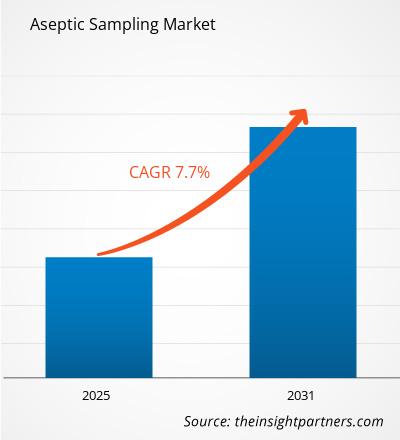
The aseptic sampling market was valued at US$ 990.00 Million in 2025 and is projected to reach US$ 1,991.00 Million by 2034, expanding at a CAGR of 8.07% during 2026–2034. The market mirrors increasing demands for contamination control, process monitoring, and sample integrity in the field of biopharmaceutical manufacturing. These factors will drive the uptake of the market due to the trend towards the use of closed processing, single use products, automation, and higher quality standards in both upstream and downstream processes.
North America continues to represent an attractive market structure due to the existing capabilities for biopharmaceutical manufacturing, the adoption of process analytical technology, and the high density of pharmaceutical manufacturers and contract development & manufacturing organizations. The regional aseptic sampling market size is anticipated to grow at around 7.2–8.1% CAGR during 2026-2034.
Aseptic Sampling Market Assessment and Insights
- North America: North America is expected to account for a 39–42% share in 2025 and grow at a 7.2–8.1% CAGR between 2026–2034, supported by established biologics manufacturing, stringent contamination-control practices, and expanding automated process monitoring.
- US: The US is expected to represent 78–82% of North American revenue in 2025 and expand at a 7.3–8.2% CAGR through 2034, led by biopharmaceutical manufacturing and CDMO investment.
- Europe: Europe is projected to hold a 27–30% share in 2025 and grow at a 7.0–7.9% CAGR between 2026–2034, with Germany, the UK, France, Switzerland, and Ireland providing major bioprocessing demand.
- Asia Pacific: Asia Pacific is estimated to command a 21–24% share in 2025 and expand at an 8.8–10.0% CAGR during 2026–2034, led by China, Japan, South Korea, India, and Australia.
- Largest Segment: Manual Aseptic Sampling is estimated to hold a 52–56% market share in 2025, with a 6.0–6.8% CAGR during 2026–2034, reflecting its installed-base advantage.
- High Growth Segment: Automated Aseptic Sampling is expected to represent a 39–42% market share in 2025 and grow at an 11.5–13.0% CAGR, driven by automation and data integrity requirements.
- Key companies analyzed in detail: GEA Group Aktiengesellschaft, GEMÜ Gebr. Müller Apparatebau GmbH & Co. KG, KEOFITT A/S, Lonza Group AG, Merck KGaA, QualiTru Sampling Systems, Saint-Gobain Performance Plastics, Sartorius AG, Thermo Fisher Scientific Inc., and W. L. Gore & Associates, Inc.
Source: The Insight Partners' analysis based on proprietary research, government publications, company annual reports, investor presentations, industry databases, and expert interviews.
The market for aseptic sampling is moving away from simple sample acquisition towards integrated contamination-control processes. Sampling assemblies, sterilized vessels, aseptic connectors, and closed sample points have been incorporated with bioreactors, filters, chromatography systems, and process analytics tools. The manufacturers have combined the hardware used in sampling with digital documentation, automated operation, and process analytical technologies. Such trends reduce the need for operator interaction, decrease the cleaning steps involved, and improve the traceability of samples. Modular systems that can be adjusted for varied sizes of vessels and process steps while maintaining sterilized barriers are gaining preference in production.
Further growth will be expected to move out of the well-established centers for biopharma production and into China, India, South Korea, Singapore, and some manufacturing centers in the Middle East. Growth in capital expenditure on biologics, vaccines, cell and gene therapy drugs, and biosimilars will boost the demand for flexible manufacturing sampling systems. Regulations focusing on contamination controls and process analytics will also fuel the demand. Suppliers able to combine sterilized parts, customization, documentation, and technical assistance will have a better chance of winning bigger contracts.
Aseptic Sampling Market Report Scope
| Report Attribute | Details |
|---|---|
| Market size in 2025 | US$ 990.00 Million |
| Market Size by 2034 | US$ 1,991.00 Million |
| Global CAGR (2026 - 2034) | 8.07% |
| Historical Data | 2021-2024 |
| Forecast period | 2026-2034 |
Aseptic Sampling Market Analysis
The aseptic sampling market growth in aseptic sampling is tightly connected to the growth of biologics production and production workflows complexity. Market demand comes from process development labs, commercial manufacturing sites, CDMOs, and quality control entities needing samples in the absence of breaking sterile barriers. The supply chain includes valves, connectors, tubing, sample containers, automated actuators, sensors, sterilization, validation, and logistics. The single-use products are especially valuable in case of fast changes in production and lesser cleaning needs.
The supply dynamics are defined by strict standards for materials and validation needs. The vendors have to prove their compatibility with various sterilization methods, levels of extractables and leachables, pressure ranges, and process media types. While stainless steel systems continue to be relevant in the existing facilities, disposable systems get more relevant in flexible production setups. The need for qualification can extend the purchase cycle making it costly to switch suppliers after incorporating a certain vendor into the validated process.
Portfolios now matter more in terms of competitive positioning within the aseptic sampling market report than particular valve and container characteristics. Sartorius AG and Thermo Fisher Scientific Inc. incorporate their sampling solutions into larger bioprocessing portfolios, while Merck KGaA incorporates sampling into fluid management and single use portfolios. The portfolio of GEA Group Aktiengesellschaft and GEMÜ Gebr. Müller Apparatebau GmbH & Co. KG concentrates on engineered process components and sterile flow control, whereas the portfolio of KEOFITT A/S is concentrated around hygienic and representative sampling systems.
The portfolio of Lonza Group AG can be considered as a benchmark because of its involvement in manufacturing and process-development activities, while QualiTru Sampling Systems operates in specialized sampling applications. Saint-Gobain Performance Plastics and W. L. Gore & Associates, Inc. deliver materials, tubing, membranes, and fluid management capabilities, which impact sampling system designs. Now investment moves towards automation, custom assemblies, single use capability, and process monitoring. The strategies of differentiation involve qualification support, installed base compatibility, supply reliability, and ability to operate both in development and commercial scale plants.
● REPORT CUSTOMIZATION
Tailor This Report To Align With Your Specific Business Requirements
This report can be customized to align precisely with your business objectives, scope, and target markets. Customization options include tailored segmentation, geography, competitive analysis, and strategic insights to support informed decision-making.
Customize This Report →WHAT YOU CAN ADJUST
- ● Segmentations
- ● Geography
- ● Competitive Analysis
- ● Language Preferences
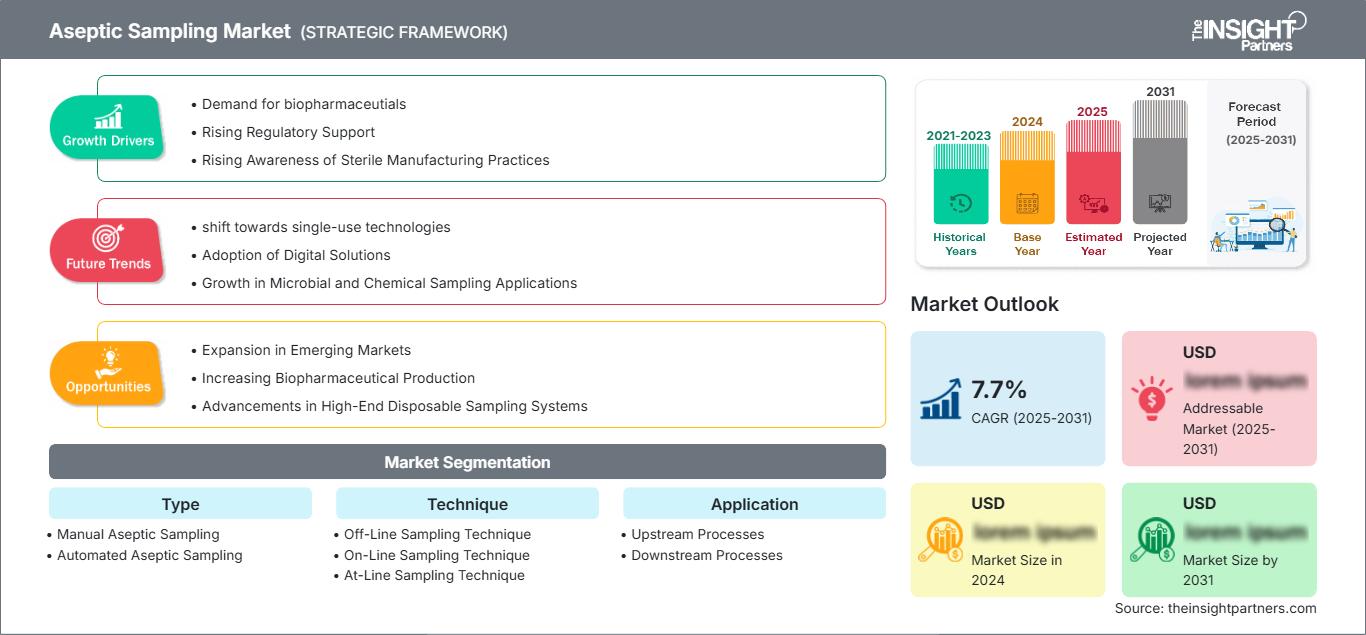
Aseptic Sampling Market: Strategic Insights
Regional Insights
North America aseptic sampling market
North America is expected to command a 39-42% of the aseptic sampling market share in 2025 and grow at a CAGR of 7.2-8.1% until 2034. The region has extensive capabilities for biologics manufacturing, sophisticated CDMO facilities, and wide use of closed processing systems. Most regional demand comes from the US, but there is additional demand from Canada via biopharmaceuticals research and manufacturing.
Regulatory expectations regarding contamination control, data integrity, and validated manufacturing processes encourage the substitution of legacy sampling systems. The manufacturing of cell and gene therapies increases the need for more frequent and representative sampling in controlled conditions. Additional demand comes from the ongoing investments in single-use facilities, which allow the use of sterile preassembled sampling systems to simplify process changeover and cleaning.
U.S. aseptic sampling Market
The largest part in North America belongs to the USA and is about 78-82% in 2025, which will experience an average annual growth rate of 7.3-8.2% CAGR from 2026 to 2034. The reason for the leading position is attributed to commercial biologics manufacturing, advanced therapy manufacturing, and CDMO services. Some of the main companies having a strong market presence include Sartorius AG, Thermo Fisher Scientific Inc., Merck KGaA, etc.
There are some sampling applications that include upstream cell culture, fermentation, downstream purification, buffer preparation, and formulation applications. Automated sampling systems along with the closed systems are becoming vital when there is a requirement of consistency and minimal human intervention. The growing need for advanced therapy manufacturing makes the importance of automated and sensitive sampling systems with small volume at increased frequency vital.
Europe aseptic sampling Market
Europe will have a 27-30% of the aseptic sampling market share in 2025, growing at a CAGR of 7.0-7.9% till 2034, with Germany being one of the major national markets. The UK and Germany will be benefitted by the presence of well-developed biopharmaceutical clusters, whereas France, Italy, and Spain will contribute to the growth due to their involvement in vaccines, injectables, biologics, and contract manufacturing.
Germany will have an advantage owing to its supplier base consisting of firms such as GEA Group Aktiengesellschaft and GEMÜ Gebr. Müller Apparatebau GmbH & Co. KG. The UK will ensure demand through highly advanced facilities for bioprocessing and research. France and Italy will offer well-established bases for pharmaceuticals manufacturing, whereas Spain will continue to expand in biologics and CDMO segments. In Europe, there will be increased demand for validated single use assemblies, closed systems, and sampling solutions.
APAC aseptic sampling Market
APAC is expected to account for a 21–24% share in 2025 and grow at an 8.8–10.0% CAGR through 2034. China is the leading market, followed by Japan, South Korea, India, and Australia. Regional growth reflects biologics capacity expansion, vaccine production, biosimilar development, and increasing CDMO activity.
While China and India are enhancing their domestic biomanufacturing infrastructure, South Korea is still developing its biologics plants at a larger scale. The contributions from Japan lie in the developed pharmaceutical manufacturing infrastructure and quality systems. Contributions from Australia arise in the form of demands for advanced sampling technologies owing to its research and biologics manufacturing infrastructure.
Middle East & Africa aseptic sampling Market
MEAA demand will be lower but structurally growing with regional growth expected at a 5.8% to 6.8% CAGR to 2034. Markets like Saudi Arabia and UAE in the Gulf region will lead, benefiting from healthcare industrialization and pharmaceutical localization, respectively, whereas South Africa will offer the most developed manufacturing base in Sub-Saharan Africa.
Construction of new pharmaceutical infrastructure facilities, projects on sterile manufacturing lines, and healthcare diversification programs are improving the addressable customer base. Industrial localization efforts help Saudi Arabia in this regard, while UAE will serve as the regional manufacturing and distribution center. South Africa is contributing through its existing pharmaceutical manufacturing facilities, whereas MEAA markets are importing their needs through centralized sourcing efforts.
Segmentation Analysis
Type
Type segmentation reflects the balance between installed manual infrastructure and the accelerating requirement for automation. The segment is expected to expand at a 6.0–13.0% CAGR range during 2026–2034, with automated solutions gaining share as manufacturers prioritize repeatability, electronic documentation, and reduced operator intervention.
- Manual Aseptic Sampling: Manual systems retain substantial demand across legacy facilities, laboratories, and lower-volume operations because they offer straightforward installation, flexible sampling frequency, and compatibility with established procedures.
- Automated Aseptic Sampling: Automated systems are increasingly selected for commercial bioprocessing where frequent sampling, standardized execution, reduced human intervention, and integration with digital manufacturing systems improve operational control.
Technique
Technique selection depends on process architecture, sampling frequency, analytical turnaround, and the degree of integration required. The segment is projected to grow across an approximately 7.0–10.0% CAGR range during 2026–2034, with integrated approaches gaining importance.
- Off-Line Sampling Technique: Off-line sampling remains important where samples require laboratory-based assays or specialized analytical equipment. It provides broad analytical flexibility but can involve additional handling and longer result turnaround.
- On-Line Sampling Technique: On-line sampling supports continuous or near-continuous process monitoring and is strategically important where immediate process feedback can improve control of critical quality attributes.
- At-Line Sampling Technique: At-line sampling provides a practical bridge between manual laboratory analysis and fully integrated monitoring, supporting rapid testing near the process while limiting system complexity.
Application
Application demand is divided between upstream and downstream process requirements, with downstream workflows generally requiring numerous sampling points across purification and formulation. The application segment is expected to expand at a 7.2–9.2% CAGR range during 2026–2034, supported by increasingly complex biologics workflows.
- Upstream Processes: Upstream sampling supports monitoring of cell growth, viability, nutrients, metabolites, pH, dissolved gases, and contamination indicators during fermentation and cell-culture operations.
- Downstream Processes: Downstream sampling supports purification, filtration, chromatography, concentration, and formulation stages where product quality and contamination control must be assessed across multiple process checkpoints.
End User
End-user demand reflects differences in production scale, process complexity, capital availability, and sampling frequency. The segment is projected to expand across a 6.8–10.2% CAGR range during 2026–2034, with contract organizations benefiting from outsourced manufacturing requirements.
- Biotechnology and Pharmaceutical Manufacturers: These organizations represent core demand because commercial manufacturing requires validated sampling across multiple production stages, supported by established quality systems and recurring consumables requirements.
- R&D Institutes: R&D institutes use sampling systems for process development, scale-up, formulation studies, and laboratory bioprocessing, where flexibility and rapid configuration can outweigh full automation.
- Contract Research and Manufacturing Organizations: CROs and CDMOs increasingly require adaptable sampling platforms because they operate multiple customer processes, modalities, batch sizes, and validation frameworks within shared infrastructure.
Opportunity Snapshot
| End-user | Revenue Contribution | Trend Tag | Adoption Stage |
| Biotechnology and Pharmaceutical Manufacturers | High | Closed Sampling | Mature |
| R&D Institutes | Medium | Pilot Sampling | Scaling |
| Contract Research and Manufacturing Organizations | High | Flexible Sampling | Scaling |
Aseptic Sampling Market Growth Drivers and Impact Analysis
Expansion of Biopharmaceutical Manufacturing Capacity
Growth in biologics, vaccines, biosimilars, and advanced therapies is increasing the number of manufacturing operations that require controlled sampling. Each additional bioreactor, purification train, or formulation line introduces multiple sampling points where sterility, bioburden, metabolites, concentration, pH, and other process attributes may be evaluated. The commercial impact is amplified because manufacturers often require sampling at several stages rather than at a single release point. New facilities also provide suppliers with opportunities to influence system architecture before equipment qualification is completed. Consequently, vendors offering compatible connectors, containers, valves, tubing, and integrated assemblies can secure broader project specifications. Expansion of CDMO capacity further multiplies this effect because one facility may support several customers and modalities, increasing sampling intensity across shared infrastructure.
Stronger Contamination-Control and Data-Integrity Requirements
Manufacturers increasingly treat sampling as an element of contamination-control strategy rather than an isolated quality-control activity. Closed transfer pathways, presterilized components, representative sample collection, and controlled disconnection procedures reduce opportunities for microbial ingress during production. At the same time, electronic documentation expectations increase the value of automated systems that can standardize sampling events and support traceability. These requirements affect purchasing decisions because equipment must be qualified for intended operating conditions and integrated into established procedures. Suppliers with validation packages, material documentation, sterilization evidence, and application support can therefore reduce implementation risk. The resulting market impact extends beyond initial hardware purchases, as customers may establish recurring demand for validated replacement assemblies, sampling containers, connectors, and related consumables.
Migration Toward Single-Use and Flexible Manufacturing Platforms
Single-use processing is changing the economics and design requirements of sampling infrastructure. Disposable assemblies can reduce cleaning and sterilization activities, shorten changeovers, and support multiproduct manufacturing, although they introduce requirements for reliable supply, material qualification, and waste management. The commercial opportunity is particularly relevant to facilities producing smaller batches, personalized therapies, or multiple biologic modalities. Sampling suppliers are consequently developing preassembled, presterilized configurations that connect directly to disposable process equipment. Integration with single-use bioreactors and tubing assemblies can also reduce installation complexity and limit the number of sterile connections performed by operators. As facilities become more modular, suppliers capable of customizing sampling points without lengthy engineering cycles can gain an advantage in project specifications and recurring consumables programs.
Aseptic Sampling Market Future Trends
Integration with Digital Process Monitoring
Future systems in the aseptic sampling market trends are likely to connect sampling events more closely with process data platforms, electronic batch records, and manufacturing execution systems. Rather than treating physical sample collection as a separate activity, manufacturers can increasingly link sampling frequency, location, time, and analytical results with batch records. This architecture can strengthen traceability and help process teams identify deviations earlier. Automated actuation and standardized collection protocols may also reduce variability between operators and manufacturing shifts. Over time, suppliers are likely to differentiate through software compatibility, data interfaces, event logging, and configurable sampling schedules rather than hardware alone. The trend is particularly relevant for advanced therapies, where batch values are high and process deviations can have disproportionate financial consequences.
Sampling for Intensified and Continuous Bioprocessing
Intensified and continuous manufacturing will create new requirements for sampling frequency, representative collection, and rapid analytical feedback. Continuous operations can generate longer process runs with fewer conventional batch boundaries, making conventional periodic sampling strategies less suitable. Future sampling architectures may therefore emphasize compact sampling points, automated collection, rapid transfer, and closer integration with process analytical technology. Vendors will need to demonstrate stable performance over extended operating periods while minimizing dead volume and maintaining sterile barriers. These requirements can favor systems designed specifically for high-frequency sampling rather than adaptations of conventional batch equipment. The trend should also encourage greater collaboration between sampling suppliers, bioreactor manufacturers, analytical technology developers, and process-control specialists.
Aseptic Sampling Market Opportunities
Customized Sampling Assemblies for CDMO Networks
CDMOs provide an attractive aseptic sampling market forecast opportunity as their facilities frequently accommodate multiple customers, process formats, and production scales. Suppliers can target this complexity through modular sampling assemblies that allow different collection containers, connectors, tubing materials, and sampling frequencies to be configured without redesigning the entire process train. Standardized modules combined with customer-specific connection points can shorten engineering cycles while preserving validated operating procedures. Vendors can also establish recurring revenue through replacement assemblies, consumables, qualification support, and application services. The opportunity is strongest where CDMOs are adding flexible suites for biologics, vaccines, cell therapies, or biosimilars. Strategic partnerships with engineering firms and process-equipment suppliers could further improve access to new facility projects before final equipment specifications are locked.
Localized Supply for Emerging Biomanufacturing Hubs
Emerging biomanufacturing markets create opportunities for suppliers to establish regional production, assembly, and technical-support capabilities. India, China, South Korea, and selected Gulf markets are increasing pharmaceutical and biologics capacity, but customers may face longer lead times when specialized sampling assemblies are imported. Localized inventory and application engineering can reduce procurement risk while improving responsiveness for custom configurations and replacement requirements. Suppliers can also develop regional qualification centers to support installation, validation, and operator training. Such models are particularly valuable for CDMOs and newer manufacturers that require technical guidance alongside hardware. A localized strategy can therefore compete on total cost of ownership and service responsiveness rather than product price alone, while creating stronger customer retention after initial installation.
Recent Developments
- April 2025: GEMÜ Gebr. Müller Apparatebau GmbH & Co. KG updated documentation for its sampling bottle portfolio, describing contamination-free sampling and transport, CIP/SIP capability, autoclavability, and sterile sampling applications. The updated specification supports use across pharmaceutical and biotechnology processes and reflects continued development of validated sampling components for controlled production environments.
- February 2025: GEMÜ Gebr. Müller Apparatebau GmbH & Co. KG marked the tenth anniversary of its Mexican subsidiary and stated that the operation had established a strong position in aseptic diaphragm valves while supporting global accounts. The company also highlighted plans to expand its role in the North American market and broaden regional expertise across industries.
- 2025: Sartorius AG continued expanding its aseptic sampling portfolio through TakeOne solutions covering single-use and stainless-steel processes. The portfolio includes preassembled and presterilized configurations designed for representative sampling across cell culture, downstream intermediates, purification, formulation, media preparation, and buffer preparation, supporting increasingly flexible biopharmaceutical workflows.
Frequently Asked Questions

- Comprehensive Market Sizing and Forecast Analysis
- Detailed Segmentation Analysis
- In-Depth Market Dynamics Assessment
- Regional and Country-Level Insights
- Competitive Landscape and Company Benchmarking
- Strategic Business Intelligence
Recent Reports
Testimonials

The Insight Partners' SCADA System Market report is comprehensive, with valuable insights on current trends and future forecasts. The team was highly professional, responsive, and supportive throughout. We are very satisfied and highly recommend their services.
RAN KEDEM Partner, Reali Technologies LTDs
I requested a report on a very specific software market and the team produced the report in a few days. The information was very relevant and well presented. I then requested some changes and additions to the report. The team was again very responsive and I got the final report in less than a week.
JEAN-HERVE JENN Chairman, Future Analytica
We worked with The Insight Partners for an important market study and forecast. They gave us clear insights into opportunities and risks, which helped shape our plans. Their research was easy to use and based on solid data. It helped us make smart, confident decisions. We highly recommend them.
PIYUSH NAGPAL Sr. Vice President, High Beam Global
The Insight Partners delivered insightful, well-structured market research with strong domain expertise. Their team was professional and responsive throughout. The user-friendly website made accessing industry reports seamless. We highly recommend them for reliable, high-quality research services
YUKIHIKO ADACHI CEO, Deep Blue, LLC.
This is the first time I have purchased a market report from The Insight Partners.While I was unsure at first, I visited their web site and felt more comfortable to take the risk and purchase a market report.I am completely satisfied with the quality of the report and customer service. I had several questions and comments with the initial report, but after a couple of dialogs over email with their analyst I believe I have a report that I can use as input to our strategic planning process.Thank you so much for taking the extra time and making this a positive experience.I will definitely recommend your service to others and you will be my first call when we need further market data.
JOHN SUZUKI President and Chief Executive Officer, Board Director, BK Technologies
I wish to appreciate your support and the professionalism you displayed in the course of attending to my request for information regarding to infectious disease IVD market in Nigeria. I appreciate your patience, your guidance, and the fact that you were willing to offer a discount, which eventually made it possible for us to close a deal. I look forward to engaging The Insight Partners in the future, all thanks to the impression you have created in me as a result of this first encounter.
DR CHIJIOKE ONYIA MANAGING DIRECTOR, PineCrest Healthcare Ltd.Reason to Buy
- Informed Decision-Making
- Understanding Market Dynamics
- Competitive Analysis
- Identifying Emerging Markets
- Customer Insights
- Market Forecasts
- Risk Mitigation
- Boosting Operational Efficiency
- Strategic Planning
- Investment Justification
- Tracking Industry Innovations
- Aligning with Regulatory Trends





 Get Free Sample for