
Asia Pacific Portable Gas Detection Market Analysis and Forecast by Size, Share, Growth, Trends 2034
Coverage: By Type (Multi Gas and Single Gas), Multi Gas Type (2 Gas, 3 Gas, 4 Gas, 5 Gas, and 6 & More Gas), End Use Vertical (Oil and Gas, Chemicals and Petrochemicals, Water and Wastewater, Power Generation and Transmission, Metal and Mining, Food and Beverage, Marine, and Others), Product Type (Wearable and Non-wearable), Components (Hardware and Software), Hardware Type (Sensors, Controllers, Transmitters, Alarms and Signaling Devices, Display Modules, Communication Interfaces, and Accessories), Sensor Type (Electrochemical Sensor, Infrared (IR) Sensor, Photo-Ionization Detector (PID)Sensor, Catalytic Sensor, and Others), and Technology (Traditional and Connected)
- Status : Published
- Report Code : TIPRE00043801
- Category : Electronics and Semiconductor
- No. of Pages : 244
- Available Report Formats :


- Last update date : July 14, 2026


2025 Market Size
US$ 821.5 Mn
Base year value
2034 Forecast
US$ 1,744.2 Mn
Projected by 2034
CAGR 2026-2034
8.9 %
Growth rate
Addressable Market
US$ 11,600.08 Mn
(2026-2034)
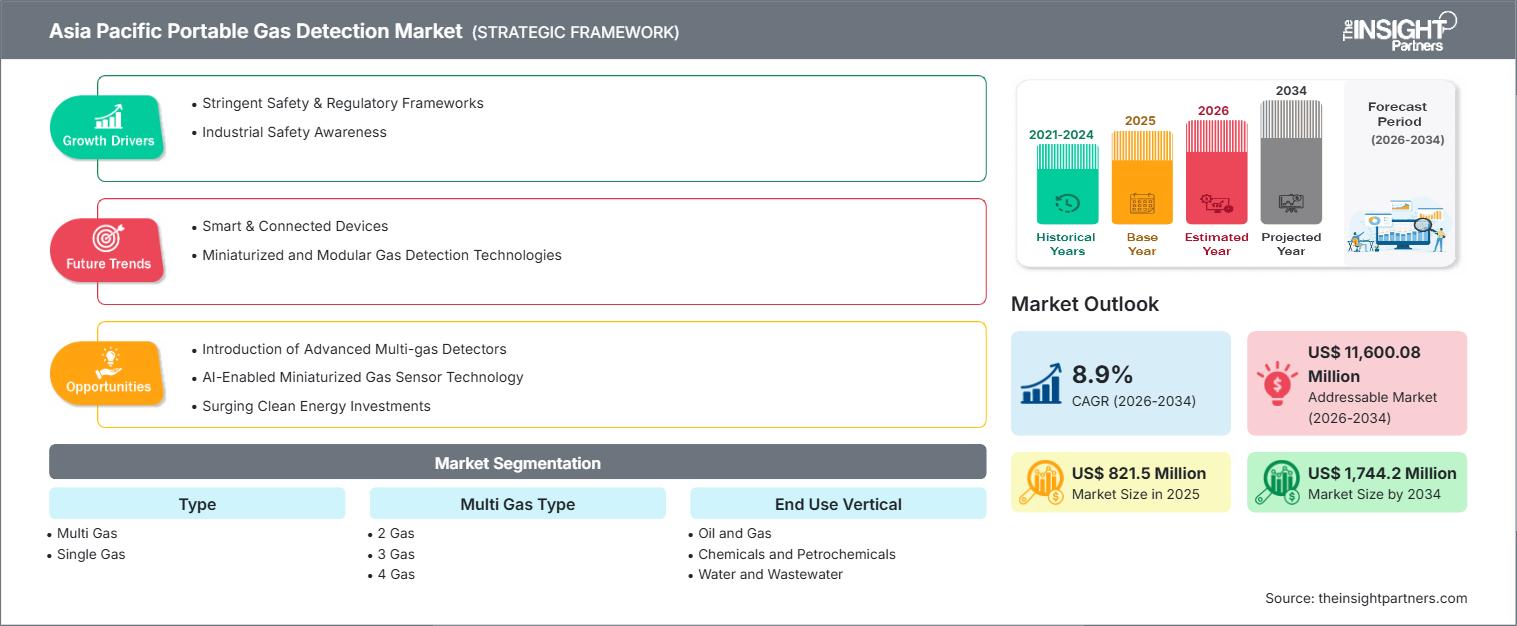
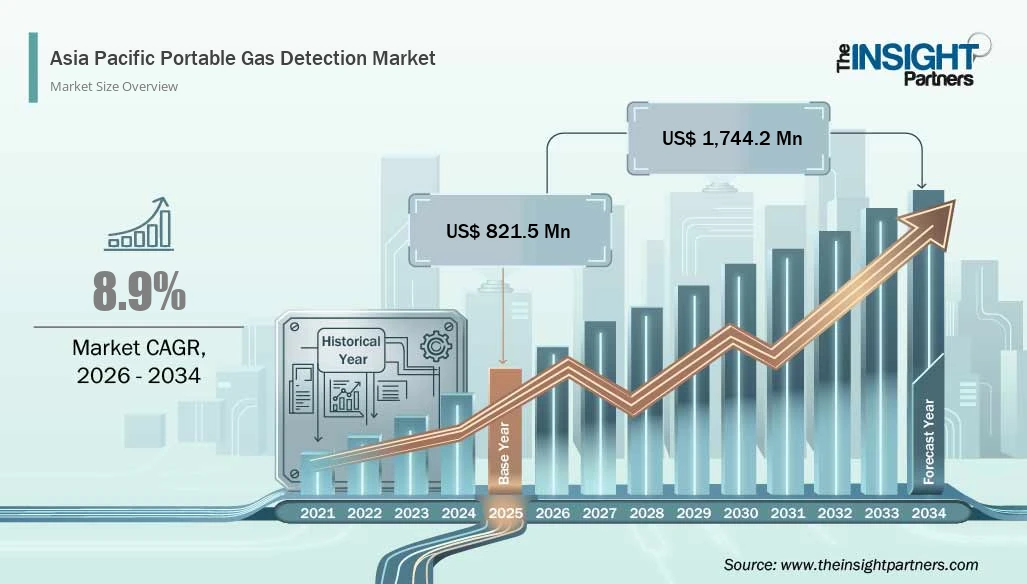
The Asia Pacific Portable Gas Detection Market size is expected to reach US$ 1,744.2 Million by 2034 from US$ 821.5 Million in 2025. The market is estimated to record a CAGR of 8.9% from 2026 to 2034.
Executive Summary and Asia Pacific Portable Gas Detection Market Analysis:
Industries such as oil and gas, chemicals, mining, manufacturing, and utilities are central to the region's economic development, creating demand for portable gas detection devices to ensure worker safety and regulatory compliance.
In May 2025, KARAM Safety, a global leader in occupational safety, unveiled the Portable Multi Gas Detector at the Annual Channel Partner Meet in Baku, Azerbaijan. Designed for hazardous industrial environments, the device can simultaneously detect Oxygen (O₂), Hydrogen Sulfide (H₂S), Carbon Monoxide (CO), and Combustible Gases (LEL). It features visual, audible, and vibration alarms that provide immediate alerts on dangerous gas levels, ensuring real-time worker safety. The launch, attended by over 125 channel partners, demonstrates the growing emphasis on high-performance and compact detection technologies across the region.
Regulatory requirements across APAC are stringent, and non-compliance can result in heavy penalties or operational shutdowns. Japan strengthened its Industrial Safety and Health Act (ISHA) in March 2025 by adding 157 new chemical substances to its regulated list, reflecting a strong commitment to protecting worker health and ensuring safer industrial operations. Companies such as MaiYa Sensor support businesses in meeting these obligations by offering comprehensive gas detection solutions that enable compliance and environmental responsibility while safeguarding workers.
Increasing regulatory oversight, rising industrial activity, and advancements in portable gas detection technology drive sustained growth of the portable gas detection market in the region.
● REPORT CUSTOMIZATION
Tailor This Report To Align With Your Specific Business Requirements
This report can be customized to align precisely with your business objectives, scope, and target markets. Customization options include tailored segmentation, geography, competitive analysis, and strategic insights to support informed decision-making.
Customize This Report →WHAT YOU CAN ADJUST
- ● Segmentations
- ● Geography
- ● Competitive Analysis
- ● Language Preferences
Asia Pacific Portable Gas Detection Market: Strategic Insights
-
Get Top Key Market Trends of this report.This FREE sample will include data analysis, ranging from market trends to estimates and forecasts.
Asia Pacific Portable Gas Detection Market Segmentation Analysis:
- By Type, the Asia Pacific Portable Gas Detection Market is segmented into Multi Gas and Single Gas. The Multi Gas segment dominated the market in 2025.
- By Multi Gas Type, the Asia Pacific Portable Gas Detection Market is segmented into 2 Gas, 3 Gas, 4 Gas, 5 Gas, and 6 and More Gas. The 4 Gas segment dominated the market in 2025.
- By End Use Vertical, the Asia Pacific Portable Gas Detection Market is segmented into Oil and Gas, Chemicals and Petrochemicals, Water and Wastewater, Power Generation and Transmission, Metal and Mining, Food and Beverage, Marine, and Others. The Oil and Gas segment dominated the market in 2025.
- By Product Type, the Asia Pacific Portable Gas Detection Market is segmented into Wearable and Non-wearable. The Non-wearable segment dominated the market in 2025.
- By Components, the Asia Pacific Portable Gas Detection Market is segmented into Hardware and Software. The Hardware segment dominated the market in 2025.
- By Hardware Type, the Asia Pacific Portable Gas Detection Market is segmented into Sensors, Controllers, Transmitters, Alarms and Signaling Devices, Display Modules, Communication Interfaces, and Accessories. The Sensors segment dominated the market in 2025.
- By Sensor Type, the Asia Pacific Portable Gas Detection Market is segmented into Electrochemical Sensor, Infrared (IR) Sensor, Photo-Ionization Detector (PID)Sensor, Catalytic Sensor, and Others. The Electrochemical Sensor segment dominated the market in 2025.
- By Technology, the Asia Pacific Portable Gas Detection Market is segmented into Traditional and Connected. The Traditional segment dominated the market in 2025.
Asia Pacific Portable Gas Detection Market Report Scope
| Report Attribute | Details |
|---|---|
| Market size in 2025 | US$ 821.5 Million |
| Market Size by 2034 | US$ 1,744.2 Million |
| CAGR (2026 - 2034) | 8.9% |
| Historical Data | 2021-2024 |
| Forecast period | 2026-2034 |
| Segments Covered |
By Type
|
| Regions and Countries Covered |
Asia Pacific
|
| Market leaders and key company profiles |
|
Asia Pacific Portable Gas Detection Market Players Density: Understanding Its Impact on Business Dynamics
The Asia Pacific Portable Gas Detection Market is growing rapidly, driven by increasing end-user demand due to factors such as evolving consumer preferences, technological advancements, and greater awareness of the product's benefits. As demand rises, businesses are expanding their offerings, innovating to meet consumer needs, and capitalizing on emerging trends, which further fuels market growth.
Asia Pacific Portable Gas Detection Market Outlook
As industrial operations become more complex and safety regulations more demanding, organizations are looking for intelligent solutions that go beyond basic gas detection and support compliance, fleet management, and real-time decision-making.
In September 2025, Crowcon unveiled the IQ range, a new family of connected portable gas detectors designed to transform how safety teams protect workers and manage safety equipment in high-risk industries. The IQ range includes single-gas wearable detectors, multi-gas devices, rugged area monitors, and a cloud-based platform that provides real-time insights into device status, exposure data, and compliance. Rather than being a single product, the IQ range functions as an integrated ecosystem that adapts to changing site requirements.
Smart connectivity allows safety managers to monitor detector performance, maintenance status, and worker exposure remotely. It is important, as industry analysis indicates that nearly 80% of portable gas detectors are not properly maintained or calibrated, reducing their effectiveness. Connected platforms simplify maintenance by enabling faster bump tests and calibrations, ensuring devices remain reliable without disrupting operations.
The adoption of smart detectors is relevant given that over half of confined space fatalities are linked to oxygen depletion or toxic gas exposure. Advanced, connected devices help address this risk by improving readiness, accuracy, and compliance. As a result, smart and connected gas detection solutions present strong opportunities across industries such as oil & gas, chemicals, pharmaceuticals, utilities, and food & beverage, while supporting higher-value, premium product demand.
Asia Pacific Portable Gas Detection Market Country Insights
By country, the Asia Pacific Portable Gas Detection Market is segmented into China, Japan, South Korea, India, Australia, and the Rest of APAC. China held the largest share in 2025.
Growing awareness of hazardous gas risks and a strong focus on workplace safety are encouraging the deployment of portable gas detection systems across industrial and commercial environments.
In December 2025, the 19th Session of the Standing Committee of the 14th National People's Congress passed the "Law of the People's Republic of China on the Safety of Hazardous Chemicals." The law, officially promulgated by President Xi Jinping through Presidential Decree No. 64, will come into effect on May 1, 2026. This legislation establishes stricter safety standards for the handling, storage, and monitoring of hazardous chemicals, emphasizing the importance of gas detection technologies for compliance and worker protection.
Nanjing AIYI Technologies Co., Ltd., a world-leading manufacturer of portable gas detectors, provides advanced detection devices that enable real-time monitoring of multiple gases in industrial operations. These solutions support compliance with evolving regulations while ensuring safety in high-risk environments.
Regulatory enforcement, industrial expansion, and technological advancement sustain the growth of the portable gas detection market in China.
Asia Pacific Portable Gas Detection Market Company Profiles
Some of the key players operating in the market include Emerson Electric Co, Honeywell International Inc, Dragerwerk AG & Co KGaA, MSA Safety Inc, Halma plc, Teledyne Technologies Inc, Johnson Controls International Plc, Industrial Scientific Corporation, RIKEN KEIKI CO., LTD., and GfG - Gesellschaft für Gerätebau mbH
These players are adopting various strategies such as expansion, product innovation, and mergers and acquisitions to provide innovative products to their consumers and increase their market share.
Asia Pacific Portable Gas Detection Market Research Methodology
The following methodology has been followed for the collection and analysis of data presented in this report:
Secondary Research
The research process begins with comprehensive secondary research, utilizing internal and external sources to gather qualitative and quantitative data for each market. Commonly referenced secondary research sources include, but are not limited to:
- Company websites, annual reports, financial statements, broker analyses, and investor presentations
- Industry trade journals and other relevant publications
- Government documents, statistical databases, and market reports
- News articles, press releases, and webcasts specific to companies operating in the market
Note: All financial data included in the Company Profiles section has been standardized to US$. For companies reporting in other currencies, figures have been converted to US$ using the relevant exchange rates for the corresponding year.
Primary Research
The Insight Partners conducts a significant number of primary interviews each year with industry stakeholders and experts to validate its data analysis and gain valuable insights. These research interviews are designed to:
- Validate and refine findings from secondary research
- Enhance the expertise and market understanding of the analysis team
- Gain insights into market size, trends, growth patterns, competitive dynamics, and future prospects
Primary research is conducted via email interactions and telephone interviews, encompassing various markets, categories, segments, and sub-segments across different regions. Participants typically include:
- Industry stakeholders: Vice Presidents, Business Development Managers, Market Intelligence Managers, and National Sales Managers
- External experts: Valuation specialists, research analysts, and key opinion leaders with industry-specific expertise

- Comprehensive Market Sizing and Forecast Analysis
- Detailed Segmentation Analysis
- In-Depth Market Dynamics Assessment
- Regional and Country-Level Insights
- Competitive Landscape and Company Benchmarking
- Strategic Business Intelligence
Recent Reports
Testimonials

The Insight Partners' SCADA System Market report is comprehensive, with valuable insights on current trends and future forecasts. The team was highly professional, responsive, and supportive throughout. We are very satisfied and highly recommend their services.
RAN KEDEM Partner, Reali Technologies LTDs
I requested a report on a very specific software market and the team produced the report in a few days. The information was very relevant and well presented. I then requested some changes and additions to the report. The team was again very responsive and I got the final report in less than a week.
JEAN-HERVE JENN Chairman, Future Analytica
We worked with The Insight Partners for an important market study and forecast. They gave us clear insights into opportunities and risks, which helped shape our plans. Their research was easy to use and based on solid data. It helped us make smart, confident decisions. We highly recommend them.
PIYUSH NAGPAL Sr. Vice President, High Beam Global
The Insight Partners delivered insightful, well-structured market research with strong domain expertise. Their team was professional and responsive throughout. The user-friendly website made accessing industry reports seamless. We highly recommend them for reliable, high-quality research services
YUKIHIKO ADACHI CEO, Deep Blue, LLC.
This is the first time I have purchased a market report from The Insight Partners.While I was unsure at first, I visited their web site and felt more comfortable to take the risk and purchase a market report.I am completely satisfied with the quality of the report and customer service. I had several questions and comments with the initial report, but after a couple of dialogs over email with their analyst I believe I have a report that I can use as input to our strategic planning process.Thank you so much for taking the extra time and making this a positive experience.I will definitely recommend your service to others and you will be my first call when we need further market data.
JOHN SUZUKI President and Chief Executive Officer, Board Director, BK Technologies
I wish to appreciate your support and the professionalism you displayed in the course of attending to my request for information regarding to infectious disease IVD market in Nigeria. I appreciate your patience, your guidance, and the fact that you were willing to offer a discount, which eventually made it possible for us to close a deal. I look forward to engaging The Insight Partners in the future, all thanks to the impression you have created in me as a result of this first encounter.
DR CHIJIOKE ONYIA MANAGING DIRECTOR, PineCrest Healthcare Ltd.Reason to Buy
- Informed Decision-Making
- Understanding Market Dynamics
- Competitive Analysis
- Identifying Emerging Markets
- Customer Insights
- Market Forecasts
- Risk Mitigation
- Boosting Operational Efficiency
- Strategic Planning
- Investment Justification
- Tracking Industry Innovations
- Aligning with Regulatory Trends





 Get Free Sample for