
Asset Reliability Software Market Size, Demand & Growth by 2034
Coverage: By Revenue Source (Software, Services); Deployment (On-Premise, Cloud); Industry (Aerospace and Defense, Healthcare, Transportation, Manufacturing, Others) , and Geography (North America, Europe, Asia Pacific, and South and Central America)
- Status : Data Released
- Report Code : TIPRE00013839
- Category : Technology, Media and Telecommunications
- No. of Pages : 150
- Available Report Formats :


- Last update date : August 28, 2026


2025 Market Size
US$ 4.5 Bn
Base year value
2034 Forecast
US$ 10. Bn
Projected by 2034
CAGR 2026-2034
9.28 %
Growth rate
Addressable Market
US$ 64.79 Bn
(2026-2034)
The asset reliability software market is projected to grow from US$ 4.5 Billion in 2025 to US$ 10.0 Billion by 2034, registering a CAGR of 9.28% during 2026–2034. Industrial operators are increasing adoption to predict failures, optimize maintenance intervals, improve equipment uptime, and connect asset performance data with enterprise planning, safety, and compliance workflows.
North America remains a high-value adoption hub, with the asset reliability software market size supported by advanced manufacturing, utilities modernization, aerospace maintenance, healthcare facility management, and transportation infrastructure digitization. The region is expected to grow at a CAGR of 8.8–9.5% during 2026–2034 as cloud-based asset performance management, AI alerts, and condition monitoring become standard reliability tools.
Asset Reliability Software Market Assessment and Insights
- North America accounted for 34–37% share in 2025 and is expected to grow at a CAGR of 8.8–9.5% during 2026–2034, led by predictive maintenance maturity and industrial software spending.
- US represented 82–86% of North America revenue in 2025 and is projected to grow at 8.9–9.6%, supported by aerospace, defense, manufacturing, utilities, and healthcare facilities.
- Europe held 25–28% share in 2025 and is forecast to expand at 8.3–9.0%, with Germany, the UK, France, Italy, and Spain leading industrial reliability upgrades.
- Asia Pacific captured 26–29% share in 2025 and is expected to grow at 10.0–10.8%, driven by China, Japan, South Korea, India, and Australia.
- Largest Segment: Software held 62–66% market share in 2025 and is expected to grow at 8.9–9.6% as analytics, dashboards, and integration platforms remain core spending areas.
- High Growth Segment: Cloud held 57–61% share in 2025 and is projected to grow at 10.4–11.2% as multi-site operators adopt scalable reliability monitoring.
- Key companies analyzed in detail: ABB Ltd.; Bentley Systems, Incorporated; CGI Inc.; Dude Solutions, Inc.; IFS AB; International Business Machines Corporation; Oracle Corporation; Ramco Systems Limited; SAP SE; Schneider Electric SE.
Source: The Insight Partners' analysis based on proprietary research, government publications, company annual reports, investor presentations, industry databases, and expert interviews.
Reliability applications are evolving from reactive work order processing to connected asset intelligence. In the past, they would emphasize maintenance history and scheduling inspections, whereas modern reliability applications are a combination of condition data, risk assessment, digital twins, mobile processes, and artificial intelligence-based diagnostics. Reliability evolution is also related to OT and IT convergence, which includes plant sensors, EAM, and analytics applications in reliability decisions for equipment fleets.
The future investments will be influenced by the aging of assets, labor shortages, cybersecurity concerns of cloud migration, and the need to decrease unplanned downtime. New geographies will adopt software as a service and mobile-first reliability applications, and regulated industries require better audit capabilities. Solutions from vendors that provide industry-specific templates, interoperability, and explainable analytics can meet the demands of customers requiring measurable uptime improvement through the gradual replacement of legacy systems.
Asset Reliability Software Market Report Scope
| Report Attribute | Details |
|---|---|
| Market size in 2025 | US$ 4.5 Billion |
| Market Size by 2034 | US$ 10. Billion |
| Global CAGR (2026 - 2034) | 9.28% |
| Historical Data | 2021-2024 |
| Forecast period | 2026-2034 |
Asset Reliability Software Market Analysis
The asset reliability software market growth is reinforced by the cost of equipment failures, production interruptions, and manual maintenance planning. Factories require machine availability, hospitals require facility resilience, airlines require traceable maintenance execution, and transportation operators require asset condition monitoring. Consumers are increasingly demanding that reliability solutions interface with sensor technology, CMMS, EAM, ERP, and field-service software so that action can be taken prior to any issues impacting safety, production, or continued services.
The ecosystem comprises software companies, systems integrators, industrial automation companies, cloud infrastructure companies, sensor companies, and reliability consulting firms. Favorable supply factors are becoming increasingly important as IoT gateways, vibration analysis, heat analysis, and edge computing improve the ability to collect condition data. Nevertheless, data quality and change management are key constraints. Successful consumers always begin with critical assets and gradually roll out their reliability models from there.
The asset reliability software market analysis shows competition between industrial automation leaders, enterprise software companies, infrastructure specialists, and maintenance platform providers. ABB Ltd., International Business Machines Corporation, SAP SE, Oracle Corporation, Schneider Electric SE, Bentley Systems, Incorporated, IFS AB, CGI Inc., Dude Solutions, Inc., and Ramco Systems Limited compete through asset performance management depth, cloud integration, analytics, and domain expertise.
Trends in investment are tilting towards AI co-pilots, predictions, digital twins, reliability-centered maintenance, and cloud-managed services. Big companies focus on enterprise-wide visibility, security, and governance; smaller organizations emphasize rapid deployment and reduced infrastructure impact. Successful positioning has less to do with how much asset data a vendor stores than with the degree to which it is able to generate reliable recommendations from that data.
● REPORT CUSTOMIZATION
Tailor This Report To Align With Your Specific Business Requirements
This report can be customized to align precisely with your business objectives, scope, and target markets. Customization options include tailored segmentation, geography, competitive analysis, and strategic insights to support informed decision-making.
Customize This Report →WHAT YOU CAN ADJUST
- ● Segmentations
- ● Geography
- ● Competitive Analysis
- ● Language Preferences
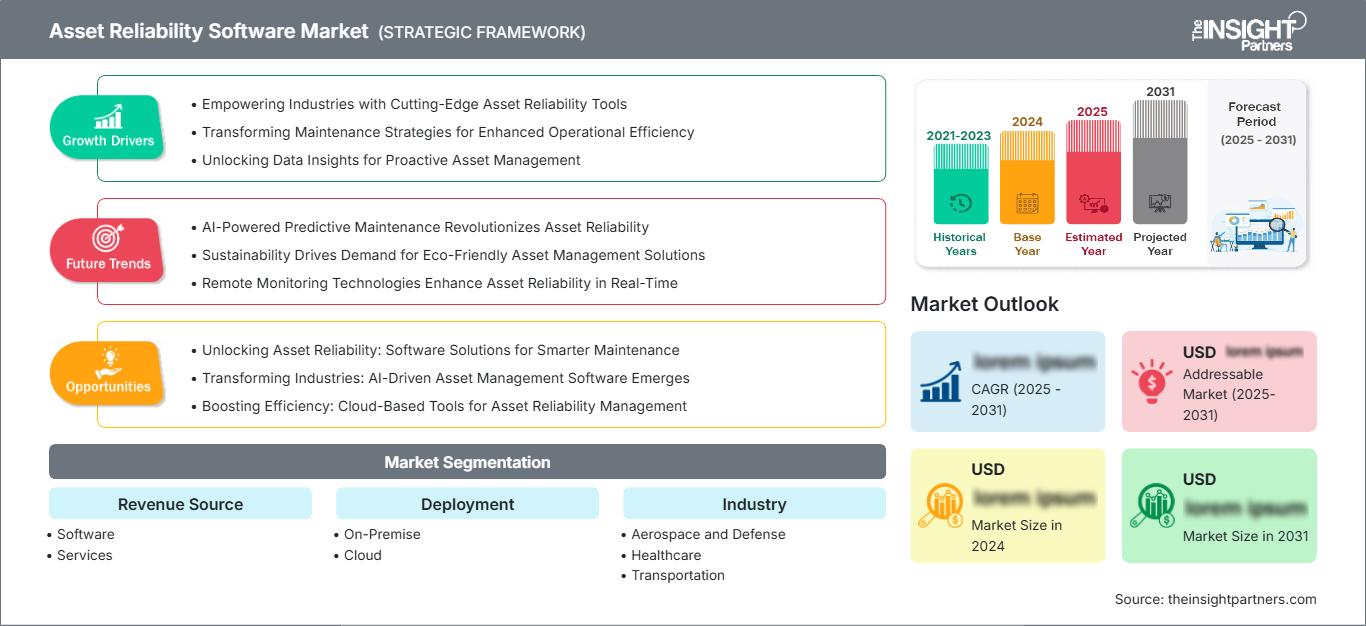
Asset Reliability Software Market: Strategic Insights
Regional Insights
North America asset reliability software market
North America held 34–37% share in 2025 and is projected to grow at a CAGR of 8.8–9.5% during 2026–2034. The asset reliability software market share is supported by advanced industrial automation, utility modernization, airline maintenance programs, and healthcare facilities that need uptime assurance.
Adoption is also strengthened by cloud maturity, skilled reliability teams, and executive focus on reducing unplanned outages. Buyers prefer platforms that link maintenance records, asset health, inspections, and analytics into one operational view. Industrial users are increasingly extending deployments from mission-critical assets to broader equipment classes.
U.S. asset reliability software Market
The US represented 82–86% of North America's revenue in 2025 and is expected to expand at 8.9–9.6% through 2034. Demand is anchored in aerospace and defense, manufacturing, transportation, hospitals, utilities, and energy infrastructure.
Company presence is extensive, with International Business Machines Corporation, Oracle Corporation, SAP SE, Schneider Electric SE, ABB Ltd., Bentley Systems, Incorporated, IFS AB, CGI Inc., Dude Solutions, Inc., and Ramco Systems Limited serving large and mid-sized accounts. Application trends emphasize predictive maintenance, mobile inspections, and compliance-ready asset documentation.
Europe asset reliability software Market
Europe accounted for 25–28% share in 2025 and is forecast to grow at 8.3–9.0% during 2026–2034. Germany is at the forefront of the implementation through automotive, machinery, chemical, and energy systems that demand condition-based maintenance and risk assessment of machinery.
Second in line is the UK with transportation, utilities, and civil infrastructure initiatives, while France, Italy, and Spain are increasing implementation of reliability software in manufacturing, hospitals, and logistics industries. Buyers in Europe place high importance on energy efficiency, safety compliance, and reporting. Cloud implementations are on the increase, but regulated businesses still assess data residency and control issues.
APAC asset reliability software Market
APAC held 26–29% share in 2025 and is projected to grow at 10.0–10.8% during 2026–2034. China leads through manufacturing scale, industrial automation, and smart-factory investment, while Japan and South Korea adopt advanced condition monitoring.
India shows faster adoption as manufacturers, airports, hospitals, and transport networks modernize asset management. Australia adds demand from mining, utilities, and transport infrastructure. Regional growth is supported by expanding cloud access, lower sensor costs, and government-backed digital industry programs.
Middle East & Africa asset reliability software Market
The Middle East & Africa is projected to grow at 8.6–9.4% during 2026–2034. Saudi Arabia and the UAE lead adoption through energy assets, aviation, utilities, logistics corridors, and smart infrastructure programs requiring reliable operations.
South Africa contributes to mining, transport, healthcare, and municipal infrastructure demand, while the rest of MEA remains earlier in adoption. Cloud systems and managed services are attractive where specialist reliability resources are limited, especially for operators managing dispersed or contractor-supported assets.
Segmentation Analysis
Revenue Source
Revenue Source defines the asset reliability software market scope because buyers combine platform subscriptions, implementation, advisory, integration, and lifecycle support. This segment is projected to grow at 9.0–9.8% during 2026–2034 as organizations expand from standalone maintenance applications toward reliability programs that include analytics, workflow redesign, and operational governance.
- Software represents core spending because dashboards, risk models, digital twins, mobile tools, and integrations enable teams to monitor equipment health and prioritize reliability actions.
- Services remain strategically important because data migration, configuration, asset hierarchy design, training, and change management determine whether reliability programs deliver measurable uptime improvement.
Deployment
Deployment is expected to grow at 9.2–10.0% through 2034 as enterprises balance scalability, cybersecurity, data control, and IT resources. Cloud is gaining preference for distributed operations, while on-premise deployments persist where internal control, customized integrations, or sensitive operational data policies remain decisive.
- On-Premise systems support organizations with highly controlled IT environments, legacy plant systems, and strict data governance, although upgrade cycles and infrastructure costs can limit agility.
- Cloud deployment supports multi-site visibility, faster implementation, remote access, automatic updates, and AI-enabled analytics, making it attractive for manufacturing, transportation, and healthcare users.
Industry
Industry demand is forecast to grow at 9.1–9.9% during 2026–2034 as asset-intensive sectors digitize reliability management. Aerospace, healthcare, transportation, and manufacturing each face different operating risks, but all need higher availability, safer maintenance execution, and better capital planning.
- Aerospace and Defense users need maintenance traceability, asset readiness, compliance documentation, and lifecycle risk management across aircraft, ground equipment, defense platforms, and mission-critical support infrastructure.
- Healthcare organizations use reliability tools for facility systems, medical infrastructure, power backup, HVAC, and safety-critical assets where downtime can disrupt care delivery.
- Transportation operators apply reliability software to rail, fleet, airport, port, and road assets, improving inspection planning, condition visibility, and service continuity across distributed networks.
- Manufacturing leads demand because machine downtime directly affects throughput, quality, labor productivity, and delivery commitments across process, discrete, and hybrid production environments.
Opportunity Snapshot
| Industry | Revenue Contribution | Trend Tag | Adoption Stage |
| Aerospace and Defense | Medium | Readiness Control | Scaling |
| Healthcare | Medium | Facility Uptime | Scaling |
| Transportation | Medium | Network Assets | Scaling |
| Manufacturing | High | Plant Reliability | Mature |
Asset Reliability Software Market Growth Drivers and Impact Analysis
Rising Cost of Unplanned Downtime
Unplanned downtime still poses a direct threat to the financial and logistical nature of asset-intensive businesses. Downtime can lead to disruption in the production process, disrupt transportation services, decrease hospital facilities’ readiness, and increase safety risks in the aerospace and defense industries. Reliability software allows companies to shift from the scheduling approach to making decisions based on the data on the current state, criticality, and previous work history of the assets. From a market perspective, it is very important since there will be an incentive to purchase these software products in terms of the absence of unplanned downtime and emergencies, as well as increased asset lifetime.
Industrial IoT and Sensor Data Integration
Increased use of Industrial IoT technologies means that there is increased availability of equipment health information for maintenance and reliability groups. Technologies like vibration monitoring, thermal scanning, lubrication analysis, electrical diagnostics, and edge technologies provide early detection of failure mechanisms compared to visual inspections. These are then used by asset reliability solutions to provide alerts, health indicators, and recommended activities to be performed. It works best where sensor data is linked to work management processes, procurement processes, and enterprise asset management systems.
Compliance and Safety Accountability
Regulated industries demand reliable proof that the equipment is being inspected, maintained, calibrated, and utilized according to safety standards. The buyers of aerospace and defense, healthcare, transportation, and manufacturing industries demand auditable maintenance history, risk register, inspection reports, and exceptions reports. Software solutions help in achieving the goal of accountability by integrating asset conditions, maintenance events, users, authorizations, and other information into a traceable process. The effect is not limited to compliance alone since the improved records will help in root cause analysis, training, and decision-making on capital investments.
Asset Reliability Software Market Future Trends
AI-Assisted Reliability Engineering
Asset reliability software market trends will increasingly include AI assistants that summarize asset history, identify failure patterns, recommend maintenance actions, and guide technicians through diagnostic workflows. These tools can reduce the burden on experienced reliability engineers while helping newer teams interpret complex operational data. Adoption will depend on transparent recommendations, human approval, and clean asset hierarchies. Vendors that combine AI with domain-specific models will be better positioned than platforms offering generic analytics without an industrial context.
Digital Twin-Based Asset Risk Planning
The role of digital twins is likely to be enhanced as operators integrate equipment models, operating context, maintenance records, and sensor information into one reliability perspective. The strategy will help organizations analyze risks before failures happen and plan activities depending on the criticality of the asset. Scenario planning during shutdowns, changes in capacity, and capital investment is also possible with such a solution. Further adoption will necessitate integration of digital twins with engineering data and field inspection.
Asset Reliability Software Market Opportunities
Cloud Reliability Platforms for Mid-Sized Operators
Asset reliability software market Forecasts show opportunity among mid-sized manufacturers, hospitals, transport operators, and service providers that need reliability improvement but lack large IT teams. Cloud platforms can offer preconfigured asset templates, mobile inspections, analytics, and subscription pricing that reduce implementation barriers. Vendors can accelerate conversion by packaging software with onboarding, data migration, and reliability advisory services. The strongest opportunity lies in proving payback quickly through reduced search time, fewer emergency repairs, and better preventive work compliance.
Industry-Specific Reliability Templates
Typical software needs extensive configuration to be ready for use in aerospace, health care, transport, or manufacturing operations. Suppliers can add value by providing industry-specific templates related to assets, failures, inspections, safety, and reporting. This allows for quick deployment and greater confidence among users since they can begin with familiar operational models. Suppliers who also provide integration accelerators for ERP, EAM, and CMMS systems can position themselves better and improve retention in multi-site enterprise accounts.
Frequently Asked Questions

- Comprehensive Market Sizing and Forecast Analysis
- Detailed Segmentation Analysis
- In-Depth Market Dynamics Assessment
- Regional and Country-Level Insights
- Competitive Landscape and Company Benchmarking
- Strategic Business Intelligence
Recent Reports
Testimonials

The Insight Partners provided valuable market intelligence that supported our global go-to-market strategy. Their team was professional, responsive, and attentive to our feedback, providing thoughtful analysis and helpful methodological clarifications throughout the project.
Junmo Kim Chief Financial Officer (CFO), Enertech Co., Ltd.
The Insight Partners' SCADA System Market report is comprehensive, with valuable insights on current trends and future forecasts. The team was highly professional, responsive, and supportive throughout. We are very satisfied and highly recommend their services.
RAN KEDEM Partner, Reali Technologies LTDs
I requested a report on a very specific software market and the team produced the report in a few days. The information was very relevant and well presented. I then requested some changes and additions to the report. The team was again very responsive and I got the final report in less than a week.
JEAN-HERVE JENN Chairman, Future Analytica
We worked with The Insight Partners for an important market study and forecast. They gave us clear insights into opportunities and risks, which helped shape our plans. Their research was easy to use and based on solid data. It helped us make smart, confident decisions. We highly recommend them.
PIYUSH NAGPAL Sr. Vice President, High Beam Global
The Insight Partners delivered insightful, well-structured market research with strong domain expertise. Their team was professional and responsive throughout. The user-friendly website made accessing industry reports seamless. We highly recommend them for reliable, high-quality research services
YUKIHIKO ADACHI CEO, Deep Blue, LLC.
This is the first time I have purchased a market report from The Insight Partners.While I was unsure at first, I visited their web site and felt more comfortable to take the risk and purchase a market report.I am completely satisfied with the quality of the report and customer service. I had several questions and comments with the initial report, but after a couple of dialogs over email with their analyst I believe I have a report that I can use as input to our strategic planning process.Thank you so much for taking the extra time and making this a positive experience.I will definitely recommend your service to others and you will be my first call when we need further market data.
JOHN SUZUKI President and Chief Executive Officer, Board Director, BK Technologies
I wish to appreciate your support and the professionalism you displayed in the course of attending to my request for information regarding to infectious disease IVD market in Nigeria. I appreciate your patience, your guidance, and the fact that you were willing to offer a discount, which eventually made it possible for us to close a deal. I look forward to engaging The Insight Partners in the future, all thanks to the impression you have created in me as a result of this first encounter.
DR CHIJIOKE ONYIA MANAGING DIRECTOR, PineCrest Healthcare Ltd.Reason to Buy
- Informed Decision-Making
- Understanding Market Dynamics
- Competitive Analysis
- Identifying Emerging Markets
- Customer Insights
- Market Forecasts
- Risk Mitigation
- Boosting Operational Efficiency
- Strategic Planning
- Investment Justification
- Tracking Industry Innovations
- Aligning with Regulatory Trends





 Get Free Sample for