
Atrial Fibrillation Market Share, Demand & Growth by 2034
Coverage: By Treatment Type (Non-pharmacological and Pharmacological) and End User (Hospitals, Ambulatory Surgical Centers, and Cardiac Catheterization Laboratories), and Geography (North America, Europe, Asia Pacific, and South and Central America)
- Status : Data Released
- Report Code : TIPRE00003531
- Category : Life Sciences
- No. of Pages : 146
- Available Report Formats :


- Last update date : September 17, 2026


2025 Market Size
US$ 31.19 Bn
Base year value
2034 Forecast
US$ 73.70 Bn
Projected by 2034
CAGR 2026-2034
10.03 %
Growth rate
Addressable Market
US$ 466.61 Bn
(2026-2034)
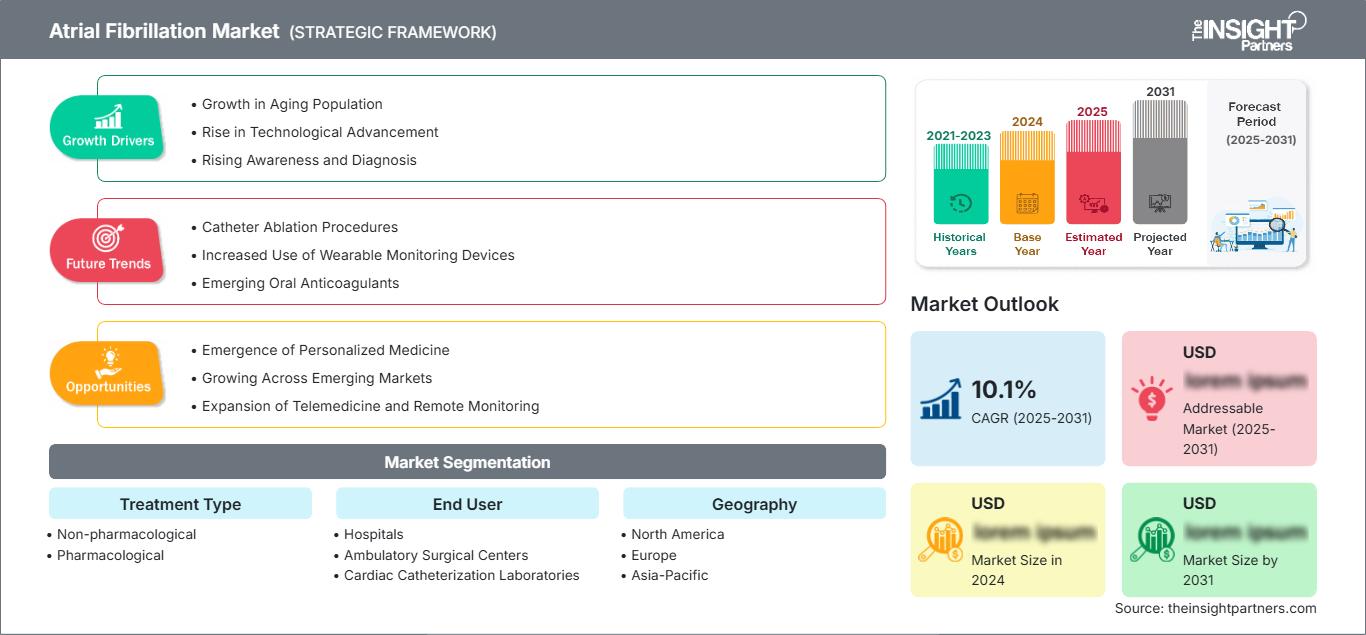
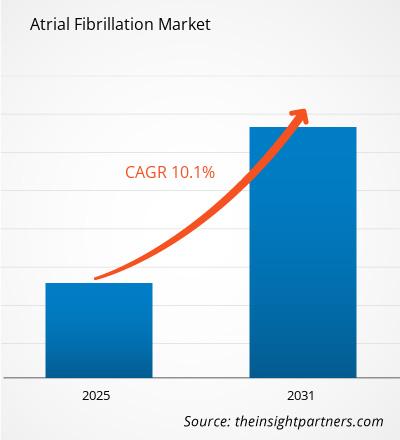
The atrial fibrillation market is valued at US$ 31.19 Billion in 2025 and is projected to reach US$ 73.70 Billion by 2034, expanding at a CAGR of 10.03% during 2026–2034. The market consists of both pharmacological treatments and non-pharmacological therapies performed in hospitals, ambulatory surgery centers, and cardiac catheterization laboratories, which indicates a trend towards early rhythm management.
North America continues to be strategically significant, owing to the presence of a large diagnosed population, electrophysiology infrastructure, reimbursement channels, and fast adoption of new ablation techniques. The North American atrial fibrillation market size is driven by catheter-based rhythm control procedures, higher procedure volumes, and integrated cardiac care initiatives.
Atrial Fibrillation Market Assessment and Insights
- North America: North America represented a 38–42% share in 2025 and is expected to grow at a CAGR of 9.5–10.5% between 2026–2034, supported by mature electrophysiology services, reimbursement depth, and increasing procedural treatment.
- US: The US accounted for 76–80% of North America in 2025 and is projected to expand at a 9.8–10.8% CAGR between 2026–2034, led by high ablation utilization and technology adoption.
- Europe: Europe held a 25–29% share in 2025 and is expected to grow at 9.0–10.0% CAGR between 2026–2034, with Germany, the UK, France, Italy, and Spain supporting procedure volumes and treatment access.
- Asia Pacific: Asia Pacific captured a 20–24% share in 2025 and is forecast to advance at 11.5–12.5% CAGR between 2026–2034, led by China, Japan, South Korea, India, and Australia.
- Largest Segment: Pharmacological treatment held a 38–42% market share in 2025 and is expected to grow at a 7.5–8.5% CAGR between 2026–2034, reflecting sustained anticoagulant and antiarrhythmic use.
- High Growth Segment: Cardiac catheterization laboratories represented an 18–22% market share in 2025 and are projected to grow at 12.5–13.5% CAGR between 2026–2034, driven by procedural rhythm control.
- Key companies analyzed in detail: Boston Scientific Corporation, Medtronic, AtriCure, Inc., Biosense Webster, Inc., Boehringer Ingelheim International GmbH, CardioFocus, Abbott, Sanofi, BIOTRONIK SE & Co. KG, Bristol-Myers Squibb Company.
Source: The Insight Partners' analysis based on proprietary research, government publications, company annual reports, investor presentations, industry databases, and expert interviews.
There is a transition from management dominated by drug-based solutions to an ecosystem of integrated solutions that include anticoagulation therapy, rhythm control drugs, catheter ablation, surgery, imaging, mapping, and monitoring. Pulsed field ablation is driving change through its tissue selective approach and workflow efficiency. Additionally, there are improvements in catheter design, mapping precision, lesion confirmation, and workflow efficiencies to facilitate high volume electrophysiology practices.
In terms of adoption, the pulsed field ablation market is expected to see wider adoption in emerging markets in Asia as well as some countries in the Middle East on account of increasing electrophysiology capabilities. With increased regulatory acceptance of new ablation technology, clinical validation for early rhythm control, and investments in specialist centers, access to these solutions will be improved.
Atrial Fibrillation Market Report Scope
| Report Attribute | Details |
|---|---|
| Market size in 2025 | US$ 31.19 Billion |
| Market Size by 2034 | US$ 73.70 Billion |
| Global CAGR (2026 - 2034) | 10.03% |
| Historical Data | 2021-2024 |
| Forecast period | 2026-2034 |
Atrial Fibrillation Market Analysis
Demands have been determined by the increase in the aging population, hypertension, obesity, diabetes, sleep apnea, and better detection of intermittent arrhythmias. Atrial Fibrillation enhances stroke and heart failure risks and thus creates a clinical need to have anticoagulation and rhythm management. This is what has influenced the atrial fibrillation market growth since its growth is dependent on the diagnosed population and how many of those are able to advance from symptomatic treatment to definite treatment.
The value chain includes pharmaceutical firms, device companies, mapping and imaging firms, hospitals, electrophysiologists, catheterization laboratories, distribution firms, and organizations that determine reimbursement levels. Drug production has been done on a large scale by pharmaceutical manufacturers whereas device production increasingly requires specialized catheters, generators, mapping systems, and accessories. Sometimes there could be limitations in the availability of electrophysiology teams.
The atrial fibrillation market report is focusing more and more on competitive positioning based on clinical evidence, procedure efficiency, mapping ecosystems installed, and the diversity of ablation product portfolio. Boston Scientific Corporation, Medtronic, AtriCure, Inc., Biosense Webster, Inc., Abbott, CardioFocus, and BIOTRONIK SE & Co. KG are competing based on their differentiated technology platforms, whereas Boehringer Ingelheim International GmbH, Sanofi, and Bristol-Myers Squibb Company are still significant pharma players.
Pulsed field ablation, mapping and monitoring technology, procedure time saving while maintaining safety, are gaining investment interest. Recent clinical developments added some competitive pressures in persistent atrial fibrillation and first-line intervention segments. Companies with diversified product portfolio should gain competitive advantage through connecting diagnosis, mapping, ablation, monitoring, and post-procedure management instead of being dependent on just one segment.
● REPORT CUSTOMIZATION
Tailor This Report To Align With Your Specific Business Requirements
This report can be customized to align precisely with your business objectives, scope, and target markets. Customization options include tailored segmentation, geography, competitive analysis, and strategic insights to support informed decision-making.
Customize This Report →WHAT YOU CAN ADJUST
- ● Segmentations
- ● Geography
- ● Competitive Analysis
- ● Language Preferences
Atrial Fibrillation Market: Strategic Insights
Regional Insights
North America Atrial fibrillation market
North America had an atrial fibrillation market share of 38-42% in 2025 and is forecast to grow at a rate of 9.5-10.5% CAGR during 2034. The United States forms the core of North America, whereas Canada gains from growing electrophysiology capabilities. Underlying factors include age-related population trends, developed referral systems, extensive cardiovascular screening, and wide availability of catheter ablation.
Hospitals and specialist facilities prefer same-day or short-stay electrophysiology programs, while vendors are competing on accuracy of mapping technologies and efficiency of procedures. Incentives related to reimbursement facilitate utilization of both medicines and procedures, despite some access disparities that exist in various regions. Boston Scientific Corporation, Medtronic, Abbott, and Biosense Webster, Inc. are among major vendors, whereas pharmaceutical firms back anticoagulation and rhythm control pathways in North America.
U.S. Atrial fibrillation Market
The U.S. represents 76-80% share of the 2025 market of North America and is expected to expand at a 9.8-10.8% CAGR during 2034. Procedural density, availability of specialists, advanced cardiac facilities, and widespread adoption of catheter-based rhythm control explain its dominance. The US serves as a key platform for launch of innovative ablation technology.
There is a trend towards early rhythm control for chosen patients based on scientific data on benefits to symptoms and cardiovascular health. Boston Scientific Corporation, Medtronic, Abbott, Biosense Webster, Inc., AtriCure, Inc., and CardioFocus supply their technologies, while Boehringer Ingelheim International GmbH, Sanofi, and Bristol-Myers Squibb Company provide medications for rhythm control. Electrophysiology in hospitals will be vital, while catheterization laboratories become increasingly important.
Europe Atrial fibrillation Market
Europe accounted for 25-29% market share in 2025 and will maintain growth with a CAGR of 9.0-10.0% until 2034. It is dominated by Germany, followed by the UK, France, Italy, and Spain. Adoption of clinical guidelines, aging population, investments in public health care, and improved access to specialists in electrophysiology are drivers of regional demand.
In the UK, the high number of specialists and growing capability of procedures is important. In Germany, high volumes of cardiac procedures along with device adoption play a crucial role. France, Italy, and Spain still expand referrals and ablation procedures but vary in reimbursement and procedural capabilities. Throughout Europe, the demand is becoming more driven by rhythm control approaches, specialized centers, and new energy platforms.
APAC Atrial fibrillation Market
APAC occupied a market share of 20–24% in 2025 and is projected to have a growth rate of 11.5–12.5% CAGR up to 2034. The dominant markets are China, followed by Japan, South Korea, India, and Australia. The need will be bolstered by increasing specialist manpower and better diagnosis.
China and Japan have large numbers of patients in conjunction with state-of-the-art heart centers, while South Korea and Australia have good procedural capabilities. India has a lot of potential in the long term due to better awareness, heart centers, and specialist training. Local industry, hospitals, and public health care can help overcome access barriers.
Middle East & Africa Atrial fibrillation Market
The Middle East and Africa region is forecasted to grow at an 11.0-12.0% CAGR until 2034, with Saudi Arabia being the top contributor, aided by modernized hospitals and cardiac specialists, along with UAE focusing on building its capability in tertiary care and South Africa remaining one of the key regional markets.
Improved infrastructure development, medical tourism, and healthcare modernization efforts by governments are contributing towards increased access to electrophysiology treatment. While Saudi Arabia and UAE have the potential for adoption of advanced ablation techniques from high-capability centers, South Africa and the Rest of MEA rely more on availability of specialists and referrals. Financial resources from the energy sector may help in setting up cardiac infrastructure facilities.
Segmentation Analysis
Treatment Type
The Treatment Type segment is expected to expand at a 9.0–10.0% CAGR from 2026–2034. The atrial fibrillation market scope increasingly reflects combination management, where anticoagulation addresses thromboembolic risk while rhythm-control interventions target symptoms and disease progression. Non-pharmacological approaches are gaining importance as technology, evidence, and specialist capacity improve.
- Non-pharmacological: Catheter and surgical interventions are becoming increasingly important for eligible patients, supported by advances in energy delivery, mapping, lesion verification, and procedural workflow.
- Pharmacological: Anticoagulants and antiarrhythmic therapies remain foundational, particularly for patients managed medically, those awaiting procedures, and individuals requiring long-term stroke-risk reduction.
End User
The End User segment is projected to grow at a 10.5–11.5% CAGR from 2026–2034. Market scope is increasingly shaped by where complex procedures can be delivered efficiently, with hospitals retaining broad capabilities and specialist facilities expanding focused electrophysiology capacity.
- Hospitals: Hospitals remain the principal treatment environment because they combine emergency care, cardiac imaging, electrophysiology, surgery, pharmacy services, and intensive monitoring.
- Ambulatory Surgical Centers: These centers can capture selected lower-complexity procedures as shorter-stay pathways mature, particularly where anesthesia, monitoring, and electrophysiology support are integrated.
- Cardiac Catheterization Laboratories: Dedicated laboratories are strategically important for ablation volumes because they concentrate specialized equipment, trained teams, mapping systems, and procedural infrastructure.
Opportunity Snapshot
| End User | Revenue Contribution | Trend Tag | Adoption Stage |
| Hospitals | High | Complex Care | Mature |
| Ambulatory Surgical Centers | Medium | Short Stay | Scaling |
| Cardiac Catheterization Laboratories | High | Ablation Volume | Scaling |
Atrial Fibrillation Market Growth Drivers and Impact Analysis
Rising Burden of Cardiometabolic Risk Factors
Aging, hypertension, obesity, diabetes, and sleep-disordered breathing are expanding the population at risk of atrial fibrillation and increasing the need for sustained management. The clinical effect is twofold: more patients require anticoagulation assessment, while symptomatic or inadequately controlled cases create demand for rhythm-control strategies. Healthcare systems therefore face higher requirements for diagnosis, referral, monitoring, and intervention. For suppliers, this enlarges the addressable base for both medicines and procedural technologies. The impact is strongest where primary care screening connects efficiently with cardiology services. Earlier detection can also shift patients into treatment pathways before recurrent episodes become more difficult to manage, supporting demand for integrated solutions spanning diagnostics, pharmaceuticals, ablation, and follow-up.
Expansion of Electrophysiology Infrastructure
Investment in electrophysiology laboratories is increasing the capacity to diagnose and treat complex rhythm disorders, particularly in high-volume hospitals and specialist cardiac centers. New laboratories require mapping platforms, ablation catheters, generators, imaging support, monitoring systems, and trained clinical teams, creating a multiplier effect across the device ecosystem. Greater capacity can also reduce procedure backlogs and enable physicians to treat patients who previously remained on medical therapy. For manufacturers, infrastructure expansion increases the value of integrated technology portfolios and clinical education programs. Regional adoption will depend on reimbursement, capital budgets, specialist density, and procurement models. Markets that combine infrastructure investment with structured referral pathways are likely to convert diagnosed disease burden into higher procedural volumes.
Clinical Shift Toward Earlier Rhythm Control
Evidence supporting rhythm-control strategies is changing treatment discussions for selected patients, moving care beyond symptom suppression alone. Earlier intervention can increase the pool of patients considered for catheter ablation, particularly when symptoms, recurrent episodes, or treatment response justify escalation. This transition affects pharmaceutical and device demand differently. Medicines remain important for anticoagulation and selected rhythm-control needs, while procedural technologies benefit from greater referral intensity. Providers also need reliable patient selection, imaging, mapping, and follow-up capabilities to manage outcomes. The resulting market impact extends beyond catheter sales because each additional procedure can require mapping, access, energy-delivery, monitoring, and post-treatment services. Strategic suppliers therefore benefit from solutions that address the complete procedural pathway rather than an isolated component.
Atrial Fibrillation Market Future Trends
Personalized Ablation and Closed-Loop Monitoring
The next phase of care is likely to combine individualized ablation strategies with continuous rhythm surveillance. Advances in mapping, contact sensing, lesion assessment, and wearable or implantable monitoring can help clinicians tailor intervention intensity to patient-specific arrhythmia patterns. Over time, data generated before and after procedures may support more precise recurrence detection and treatment decisions. Manufacturers are likely to integrate monitoring, mapping, and ablation workflows, while healthcare providers may use longitudinal data to refine follow-up schedules. The atrial fibrillation market trends will increasingly favor platforms that connect procedural evidence with real-world patient outcomes. Such integration could reduce fragmented care and create stronger clinical feedback loops for recurrent disease.
Broader Adoption of Pulsed Field Ablation
Pulsed field ablation is positioned to become a major technology pathway as clinical evidence expands across paroxysmal and persistent disease. Its nonthermal mechanism and workflow potential can support faster procedures and greater laboratory throughput when used within appropriate clinical protocols. Competition is expected to shift from simple energy-source differentiation toward lesion durability, safety, mapping integration, catheter versatility, and evidence quality. New platforms will increasingly be evaluated against established radiofrequency and cryoballoon approaches across defined patient groups. The technology outlook will therefore depend on comparative outcomes, reimbursement, operator learning curves, and regulatory expansion. Vendors with scalable training and integrated procedural ecosystems should be better positioned as adoption broadens.
Atrial Fibrillation Market Opportunities
Emerging Asia Electrophysiology Hubs
Investment in specialist cardiac centers across India, China, Southeast Asia, and selected developed APAC markets creates opportunities to localize electrophysiology training, procedure support, and technology distribution. Suppliers can prioritize high-volume urban centers before expanding through regional referral networks. Partnership models with hospitals and clinical societies can accelerate physician training while reducing the implementation burden associated with sophisticated mapping and ablation systems. Local service capabilities can also improve equipment uptime and procedural consistency. The atrial fibrillation market Forecasts point toward a widening gap between disease burden and treatment capacity in several emerging economies, creating room for companies that combine technology with education, workflow design, and post-procedure monitoring. Commercial strategies should therefore emphasize scalable clinical infrastructure rather than product placement alone.
Integrated Procedure-to-Monitoring Platforms
A second opportunity lies in combining ablation, mapping, monitoring, and longitudinal data into coordinated clinical platforms. Providers increasingly need evidence that demonstrates procedural effectiveness beyond the immediate intervention, including recurrence surveillance and patient management. Companies can pursue interoperability between electrophysiology systems and monitoring technologies, enabling clinicians to access relevant information through a more unified workflow. Investment priorities may include analytics, automated documentation, remote monitoring, and decision-support capabilities that reduce administrative burden. This approach can strengthen customer retention because the value proposition extends across the treatment journey. It also creates opportunities for differentiated service contracts, clinical partnerships, and evidence-generation programs, particularly in health systems seeking measurable outcomes from capital-intensive cardiac technology.
Recent Developments
- June 2026: Medtronic announced the launch of PulseSelect pulsed field ablation technology in India, expanding access to a nonthermal ablation platform for atrial fibrillation. The company highlighted the country’s substantial disease burden and treatment gap, positioning the launch within broader efforts to expand advanced electrophysiology capabilities.
- May 2025: Abbott announced the launch of the TactiFlex Sensor Enabled ablation catheter in India. The device combines a flexible electrode tip with contact-force sensing and is designed for atrial fibrillation treatment when used with the EnSite X EP System, supporting more precise visualization and procedural control.
- April 2025: Boston Scientific Corporation reported positive 12-month primary endpoint results from the second phase of its ADVANTAGE AF study evaluating FARAPULSE pulsed field ablation and the FARAPOINT catheter in persistent atrial fibrillation. The results added clinical evidence for expanding PFA use beyond paroxysmal disease.
Frequently Asked Questions

- Comprehensive Market Sizing and Forecast Analysis
- Detailed Segmentation Analysis
- In-Depth Market Dynamics Assessment
- Regional and Country-Level Insights
- Competitive Landscape and Company Benchmarking
- Strategic Business Intelligence
Recent Reports
Testimonials

The Insight Partners' SCADA System Market report is comprehensive, with valuable insights on current trends and future forecasts. The team was highly professional, responsive, and supportive throughout. We are very satisfied and highly recommend their services.
RAN KEDEM Partner, Reali Technologies LTDs
I requested a report on a very specific software market and the team produced the report in a few days. The information was very relevant and well presented. I then requested some changes and additions to the report. The team was again very responsive and I got the final report in less than a week.
JEAN-HERVE JENN Chairman, Future Analytica
We worked with The Insight Partners for an important market study and forecast. They gave us clear insights into opportunities and risks, which helped shape our plans. Their research was easy to use and based on solid data. It helped us make smart, confident decisions. We highly recommend them.
PIYUSH NAGPAL Sr. Vice President, High Beam Global
The Insight Partners delivered insightful, well-structured market research with strong domain expertise. Their team was professional and responsive throughout. The user-friendly website made accessing industry reports seamless. We highly recommend them for reliable, high-quality research services
YUKIHIKO ADACHI CEO, Deep Blue, LLC.
This is the first time I have purchased a market report from The Insight Partners.While I was unsure at first, I visited their web site and felt more comfortable to take the risk and purchase a market report.I am completely satisfied with the quality of the report and customer service. I had several questions and comments with the initial report, but after a couple of dialogs over email with their analyst I believe I have a report that I can use as input to our strategic planning process.Thank you so much for taking the extra time and making this a positive experience.I will definitely recommend your service to others and you will be my first call when we need further market data.
JOHN SUZUKI President and Chief Executive Officer, Board Director, BK Technologies
I wish to appreciate your support and the professionalism you displayed in the course of attending to my request for information regarding to infectious disease IVD market in Nigeria. I appreciate your patience, your guidance, and the fact that you were willing to offer a discount, which eventually made it possible for us to close a deal. I look forward to engaging The Insight Partners in the future, all thanks to the impression you have created in me as a result of this first encounter.
DR CHIJIOKE ONYIA MANAGING DIRECTOR, PineCrest Healthcare Ltd.Reason to Buy
- Informed Decision-Making
- Understanding Market Dynamics
- Competitive Analysis
- Identifying Emerging Markets
- Customer Insights
- Market Forecasts
- Risk Mitigation
- Boosting Operational Efficiency
- Strategic Planning
- Investment Justification
- Tracking Industry Innovations
- Aligning with Regulatory Trends





 Get Free Sample for