
Automated Security E-gate Market Trends, Size & Growth by 2034
Coverage: by Type (Hardware, Software); Application (Critical Infrastructure Protection, Border Control) , and Geography (North America, Europe, Asia Pacific, and South and Central America)
- Status : Data Released
- Report Code : TIPRE00011833
- Category : Electronics and Semiconductor
- No. of Pages : 150
- Available Report Formats :


- Last update date : July 20, 2026


2025 Market Size
US$ 5.64 Bn
Base year value
2034 Forecast
US$ 7.86 Bn
Projected by 2034
CAGR 2026-2034
4.25 %
Growth rate
Addressable Market
US$ 62.86 Bn
(2026-2034)
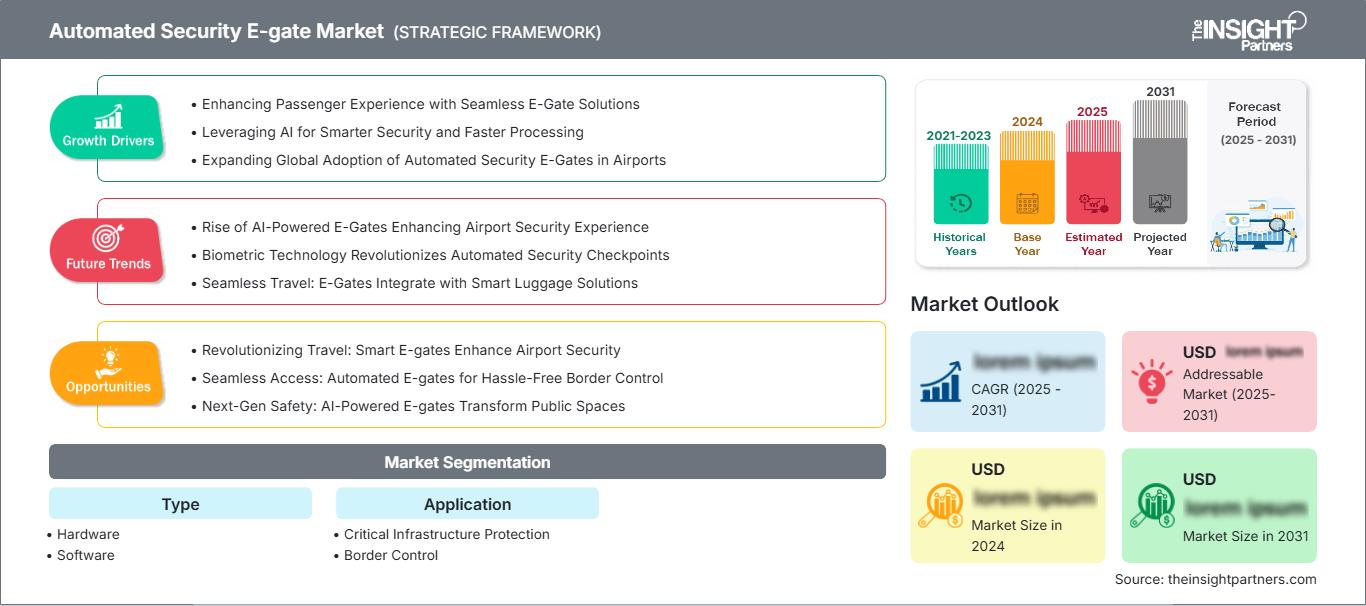
The Automated Security E-Gate Market is projected to grow from US$ 5.64 Billion in 2025 to US$ 7.86 Billion by 2034, registering a CAGR of 4.25% during 2026–2034. Demand is anchored in biometric identity verification, automated access control, and secure passenger or personnel movement across border checkpoints and critical infrastructure sites where operators require faster throughput without weakening risk screening.
North America remains a high-value adoption base, with the Automated Security E-Gate Market size supported by airport modernization, homeland security budgets, and growing use of biometric access at federal facilities. The region is estimated to expand at a 3.9–4.4% CAGR between 2026–2034, led by replacement cycles for legacy screening lanes and integration of identity platforms across airports, ports, and controlled infrastructure.
Automated Security E-gate Market Assessment and Insights
- North America accounted for 31–34% share in 2025 and is projected to grow at a CAGR of 3.9–4.4% during 2026–2034, supported by aviation security upgrades, federal identity programs, and critical infrastructure hardening.
- US represented 78–82% of North America in 2025 and is forecast to grow at a CAGR of 4.0–4.5% during 2026–2034, driven by airport, border, and government facility deployments.
- Europe held 27–30% share in 2025 and is expected to grow at a CAGR of 4.1–4.6% during 2026–2034, with the UK, Germany, France, Italy, and Spain leading biometric border modernization.
- Asia Pacific captured 23–26% share in 2025 and is forecast to expand at a CAGR of 4.7–5.3% during 2026–2034, led by China, Japan, South Korea, India, and Australia.
- Largest Segment Hardware held 64–68% market share in 2025 and is projected to grow at a CAGR of 3.8–4.3% during 2026–2034 due to gate, scanner, and reader replacement demand.
- High Growth Segment Software held 32–36% market share in 2025 and is expected to grow at a CAGR of 4.8–5.4% during 2026–2034 as analytics and identity orchestration expand.
- Key companies analyzed in detail: Atos SE, Gunnebo AB, HID Global Corporation, IDEMIA France SAS, Josanti Infoimaging Ltd., NEC Corporation, OSI Systems, Inc., SITA, Thales S.A., and Vision-Box, S.A.
Source: The Insight Partners' analysis based on proprietary research, government publications, company annual reports, investor presentations, industry databases, and expert interviews.
Product development has gone from separate physical gates into more integrated identity corridors which involve the use of document verification, facial recognition, liveness detection, and access decisioning software. The manufacturing processes are still quite hardware-intensive due to the need to build tough cabinets, sensors, cameras, passport scanners, controllers, and safety features for the e-gates, but the value creation process is now shifting towards software improvements, cybersecurity certifications, and connectivity with national watch-lists, visas, and employee credentials.
The future demand for such solutions will be driven by the growth of airport gateways, smart border crossings, and critical infrastructure security programs which demand less congestion and better identity assurance capabilities. Government authorities will go beyond their pilot projects to full-blown procurement plans, while the critical infrastructure operators will embrace automated gates for perimeter security purposes.
Automated Security E-gate Market Report Scope
| Report Attribute | Details |
|---|---|
| Market size in 2025 | US$ 5.64 Billion |
| Market Size by 2034 | US$ 7.86 Billion |
| Global CAGR (2026 - 2034) | 4.25% |
| Historical Data | 2021-2024 |
| Forecast period | 2026-2034 |
Automated Security E-gate Market Analysis
This is happening at places where there is passenger flow, labor shortages, and the need to ensure security. Automated Security E-Gate Market is driven by a desire for reduced border lines from airports, protected restricted areas from utilities, and replacement of manual checks by consistent biometrics. Trends in IATA passenger recovery and airport digitalization reinforce the case for secure self-service.
The ecosystem consists of gate makers, biometric sensor makers, passport readers, software firms, cybersecurity specialists, and governmental purchasing departments. The supplier dynamics include certification of hardware robustness, low false match rates, and the ability to connect to border databases. Lifecycle support, upgradeability, and data protection controls along with the acquisition cost are becoming more important criteria for buyers.
Competitive differentiation is based on trust, installed base, and biometric capability. In the Automated Security E-Gate Market, it is evident that Thales S.A., IDEMIA France SAS, NEC Corporation, SITA, and Vision-Box, S.A. compete with digital identity platforms while Gunnebo AB and OSI Systems, Inc. fortify the physical security and screening segment.
The trend in investment is towards systems which are capable of being deployed in modular form, giving the airport or the infrastructure owner an option to begin with smaller sites, but add lanes based on better throughput results. Examples of such companies would be Atos SE, HID Global Corporation, and Josanti Infoimaging Ltd.
● REPORT CUSTOMIZATION
Tailor This Report To Align With Your Specific Business Requirements
This report can be customized to align precisely with your business objectives, scope, and target markets. Customization options include tailored segmentation, geography, competitive analysis, and strategic insights to support informed decision-making.
Customize This Report →WHAT YOU CAN ADJUST
- ● Segmentations
- ● Geography
- ● Competitive Analysis
- ● Language Preferences
Automated Security E-gate Market: Strategic Insights
Regional Insights
North America Automated Security E-Gate Market
North America held 31–34% share in 2025, reflecting large airport networks, land-border complexity, and high cybersecurity standards for identity systems. The region is expected to grow at a CAGR of 3.9–4.4% during 2026–2034, with the Automated Security E-Gate Market share supported by government-led modernization and private critical-infrastructure access control.
Procurement processes are always rigorous as agencies must test for compliance, privacy safeguards, and integration with existing credential programs. The airports are focusing on automation of international arrivals lanes, while the utilities, data centers, and transit authorities are using e-gates to minimize guards’ effort. The best prospects for vendors are places where biometrics is reliable and maintainable.
U.S. Automated Security E-Gate Market
The U.S. comprised 78–82% of North America in 2025 and is expected to grow at a CAGR of 4.0–4.5% in 2026–2034. Usage is widespread among major international airports, government facilities, seaports, correctional centers, and highly secure industrial complexes where identity validation is vital from an operational perspective.
Vendor presence is wide due to the availability of biometrics, access control, and screening providers’ sales and support networks in the U.S. Demand trends are favorable for border control applications related to passenger flows and critical infrastructure protection for controlled personnel movements. The trend for replacement is towards camera, liveness, cybersecurity, and software risk assessment upgrades.
Europe Automated Security E-Gate Market
Europe is estimated to hold 27-30% market share in 2025 and expected to grow with a CAGR of 4.1-4.6% from 2026 to 2034. Europe’s early adopters are the UK and Germany that have been deploying biometric technology for airport travel along busy routes and have automation and procurement procedures in place for border management.
Other leading adopters are France, Italy, and Spain as the adoption process becomes faster due to border policies, tourism activity, and airport renovation in Europe. Data privacy and security are extremely important in European countries along with the management of algorithms and the interoperability with ID documents.
APAC Automated Security E-Gate Market
APAC held 23–26% share in 2025 and is expected to grow at a CAGR of 4.7–5.3% during 2026–2034. China is the leading country, while Japan, South Korea, India, and Australia are scaling automated identity verification across airports, transit hubs, and secured public infrastructure.
Apart from border crossings, industrialization, smart city policies, and airport expansion spur use of these applications. The policy factors leading to the development are the need for digitizing identity, airport privatization, and the security needs of the country. The users require systems that have peak processing capability, multilingual abilities, and integration with the country’s database.
Middle East & Africa Automated Security E-Gate Market
MEA is expected to exhibit growth in a range of 4.3-4.9%, driven by countries such as UAE, Saudi Arabia, and South Africa. The key demand drivers include airport expansion, energy security, and digital transformation in the government sector, where the UAE has emerged as an early adopter of biometric travel.
The rest of MEA is driven largely by projects that may be related to seaports, oil and gas assets, and transport routes. Rugged hardware, monitoring, and services become essential features for procurement, especially for dispersed geographies.
Segmentation Analysis
Type
Type is expected to grow at a CAGR of 4.2–4.8% during 2026–2034, with Automated Security E-Gate Market scope shaped by the balance between capital-intensive gate hardware and recurring software upgrades. Hardware remains the anchor for physical deployment, while software increasingly determines identity orchestration, analytics, cybersecurity monitoring, and integration with border or enterprise access systems.
- Hardware dominates installations because cabinets, biometric readers, document scanners, cameras, barriers, and controllers define throughput capacity, site durability, and safety compliance across airports and critical facilities.
- Software is gaining strategic weight as operators require identity decisioning, fraud detection, remote monitoring, audit trails, and integration with immigration, credential, or security-operation platforms.
Application
Application is projected to grow at a CAGR of 4.0–4.7% during 2026–2034. Border control remains the most visible use case because passenger processing is measurable, while critical infrastructure protection is expanding as utilities, data centers, defense sites, and transport operators automate personnel access without adding equivalent guard capacity.
- Critical Infrastructure Protection shows steady demand from energy, transport, defense, and data-center operators that need authenticated access, visitor control, and audit-ready movement records across restricted operational zones.
- Border Control remains strategically important because airports, seaports, and land crossings need higher traveler throughput, reliable document authentication, and biometric matching to reduce manual officer workload.
Opportunity Snapshot
| Application | Revenue Contribution | Trend Tag | Adoption Stage |
| Critical Infrastructure Protection | Medium | Perimeter Identity | Scaling |
| Border Control | High | Biometric Flow | Mature |
Automated Security E-gate Market Growth Drivers and Impact Analysis
Rising Passenger Volumes and Queue Management Pressure
Both airports and border authorities are facing the challenge of processing an increasing number of passengers without increasing the number of counters manned by people in proportion. There is added value in automation through e-gates as they help in streamlining the process of document verification and also assist in managing the peak times for arrivals. Such a driver favors the purchase of multiple lanes as well as the upgrading of the terminals and even software.
Critical Infrastructure Security Modernization
Automated access roads are being installed at energy plants, data centers, railways, military bases, and harbors to increase perimeter security and decrease manning required for manual identification verification. Market influence includes customers outside of the aviation industry requiring durable gates, credential compatibility, and centralized log events of these events. System capabilities include the ability to record access, link to surveillance systems, and perform an emergency lock down. This provides additional replacement periods and services for system integrators able to manage both physical and electronic security elements.
Shift Toward Biometric and Digital Identity Integration
Biometric identity programs are changing e-gates from mechanical access points into trusted decision nodes connected to digital credentials, watchlists, and risk engines. Facial recognition, fingerprint matching, and liveness detection improve automation reliability when supported by strong privacy and cybersecurity controls. The impact is higher software content per deployment and greater need for vendors that can prove accuracy, auditability, and consent management. This driver also supports recurring revenue from updates, monitoring, and compliance-driven platform enhancements.
Automated Security E-gate Market Future Trends
Interoperable Digital Travel Credentials
Automated Security E-Gate Market trends point toward interoperable digital credentials that allow travelers or authorized personnel to verify identity before reaching the gate. Future systems will rely less on isolated document scans and more on trusted credential exchange between issuers, verifiers, and border or facility operators. This will shorten transaction time, reduce manual exception handling, and increase the importance of privacy-by-design architectures that let users control when identity attributes are shared.
AI-Assisted Risk Screening at the Gate
Next-generation gates will increasingly combine biometric matching with AI-assisted anomaly detection, behavioral cues, and real-time risk scoring. The objective is not to replace officers but to prioritize attention toward higher-risk cases while enabling low-risk users to move smoothly. Vendors will need transparent model governance, explainability, and bias testing to satisfy public-sector buyers. The trend will favor platforms that can update algorithms securely without disrupting certified hardware operations.
Automated Security E-gate Market Opportunities
Phased Airport Retrofits in Secondary Hubs
Secondary airports offer a practical opportunity because they face peak congestion but often lack budgets for full terminal redesign. Vendors can position modular gates, cloud-enabled monitoring, and phased software integration as lower-risk entry points. Automated Security E-Gate Market Forecasts support investment cases where operators can document queue reduction, officer redeployment, and passenger satisfaction gains before expanding lane counts. The most attractive projects will combine hardware leasing, maintenance contracts, and identity-platform upgrades.
Converged Access for Industrial and Government Sites
Industrial and government buyers are moving toward unified access architectures that connect e-gates with badges, biometrics, video analytics, and incident-management platforms. This creates opportunities for suppliers that can integrate physical barriers with cyber-secure credential systems and centralized audit trails. High-value use cases include energy plants, data centers, ports, laboratories, and defense facilities. Vendors should emphasize interoperability, uptime guarantees, and compliance reporting because these factors influence procurement more than gate aesthetics.
Recent Developments
- August 2025: CLEAR announced the launch of a biometric eGate pilot program at select U.S. airports in partnership with the Transportation Security Administration (TSA). The first deployments began at Hartsfield-Jackson Atlanta International Airport, followed by Ronald Reagan Washington National Airport and Seattle-Tacoma International Airport. The eGates use facial biometrics to verify a traveler's identity against their government-issued ID and boarding pass in just a few seconds, allowing eligible passengers to proceed directly to security screening while TSA retains full operational control. The initiative is designed to improve airport throughput and security ahead of major events such as the 2026 FIFA World Cup, with plans for a nationwide rollout across CLEAR's airport network.
- June 2025: Phuket International Airport introduced automated biometric eGates to speed up immigration clearance for international passengers. The new system enables travelers with eligible biometric passports to complete immigration checks through facial recognition and automated passport verification, significantly reducing waiting times and easing congestion during peak travel periods. The deployment is part of Thailand's broader effort to modernize border control, enhance passenger convenience, and support the country's growing tourism industry by delivering a faster and more seamless airport experience.
- September 2025: India expanded its Fast Track Immigration – Trusted Traveller Programme (FTI-TTP) by deploying biometric eGates at 13 international airports across the country. The program allows registered Indian citizens and eligible overseas travelers to complete immigration through facial recognition and biometric verification, eliminating the need for manual passport checks. The expansion is expected to reduce immigration processing times, improve passenger flow, and strengthen border security while supporting the government's vision of digitally enabled and globally competitive airports.
Frequently Asked Questions

- Comprehensive Market Sizing and Forecast Analysis
- Detailed Segmentation Analysis
- In-Depth Market Dynamics Assessment
- Regional and Country-Level Insights
- Competitive Landscape and Company Benchmarking
- Strategic Business Intelligence
Recent Reports
Testimonials

The Insight Partners' SCADA System Market report is comprehensive, with valuable insights on current trends and future forecasts. The team was highly professional, responsive, and supportive throughout. We are very satisfied and highly recommend their services.
RAN KEDEM Partner, Reali Technologies LTDs
I requested a report on a very specific software market and the team produced the report in a few days. The information was very relevant and well presented. I then requested some changes and additions to the report. The team was again very responsive and I got the final report in less than a week.
JEAN-HERVE JENN Chairman, Future Analytica
We worked with The Insight Partners for an important market study and forecast. They gave us clear insights into opportunities and risks, which helped shape our plans. Their research was easy to use and based on solid data. It helped us make smart, confident decisions. We highly recommend them.
PIYUSH NAGPAL Sr. Vice President, High Beam Global
The Insight Partners delivered insightful, well-structured market research with strong domain expertise. Their team was professional and responsive throughout. The user-friendly website made accessing industry reports seamless. We highly recommend them for reliable, high-quality research services
YUKIHIKO ADACHI CEO, Deep Blue, LLC.
This is the first time I have purchased a market report from The Insight Partners.While I was unsure at first, I visited their web site and felt more comfortable to take the risk and purchase a market report.I am completely satisfied with the quality of the report and customer service. I had several questions and comments with the initial report, but after a couple of dialogs over email with their analyst I believe I have a report that I can use as input to our strategic planning process.Thank you so much for taking the extra time and making this a positive experience.I will definitely recommend your service to others and you will be my first call when we need further market data.
JOHN SUZUKI President and Chief Executive Officer, Board Director, BK Technologies
I wish to appreciate your support and the professionalism you displayed in the course of attending to my request for information regarding to infectious disease IVD market in Nigeria. I appreciate your patience, your guidance, and the fact that you were willing to offer a discount, which eventually made it possible for us to close a deal. I look forward to engaging The Insight Partners in the future, all thanks to the impression you have created in me as a result of this first encounter.
DR CHIJIOKE ONYIA MANAGING DIRECTOR, PineCrest Healthcare Ltd.Reason to Buy
- Informed Decision-Making
- Understanding Market Dynamics
- Competitive Analysis
- Identifying Emerging Markets
- Customer Insights
- Market Forecasts
- Risk Mitigation
- Boosting Operational Efficiency
- Strategic Planning
- Investment Justification
- Tracking Industry Innovations
- Aligning with Regulatory Trends





 Get Free Sample for