
Automatic Bending Machine Market Trends, Share & Demand by 2034
Automatic Bending Machine Market Size and Forecasts (2021–2034), Global and Regional Share, Trends, and Growth Opportunity Analysis Report Coverage : By Type (Automatic and Semiautomatic), Technology (Electric, Hydraulic, Pneumatic, and Induction Based), Application (Tube/Pipe, Metal Sheet, Bar), Industry (Automotive, Shipbuilding, Aerospace, Construction and Mining, Others)
- Status : Data Released
- Report Code : TIPRE00039736
- Category : Electronics and Semiconductor
- No. of Pages : 150
- Available Report Formats :


- Last update date : May 26, 2026


2025 Market Size
US$ 2.57 Bn
Base year value
2034 Forecast
US$ 4.95 Bn
Projected by 2034
CAGR 2026-2034
8.54 %
Growth rate
Addressable Market
US$ 35.63 Bn
(2026-2034)
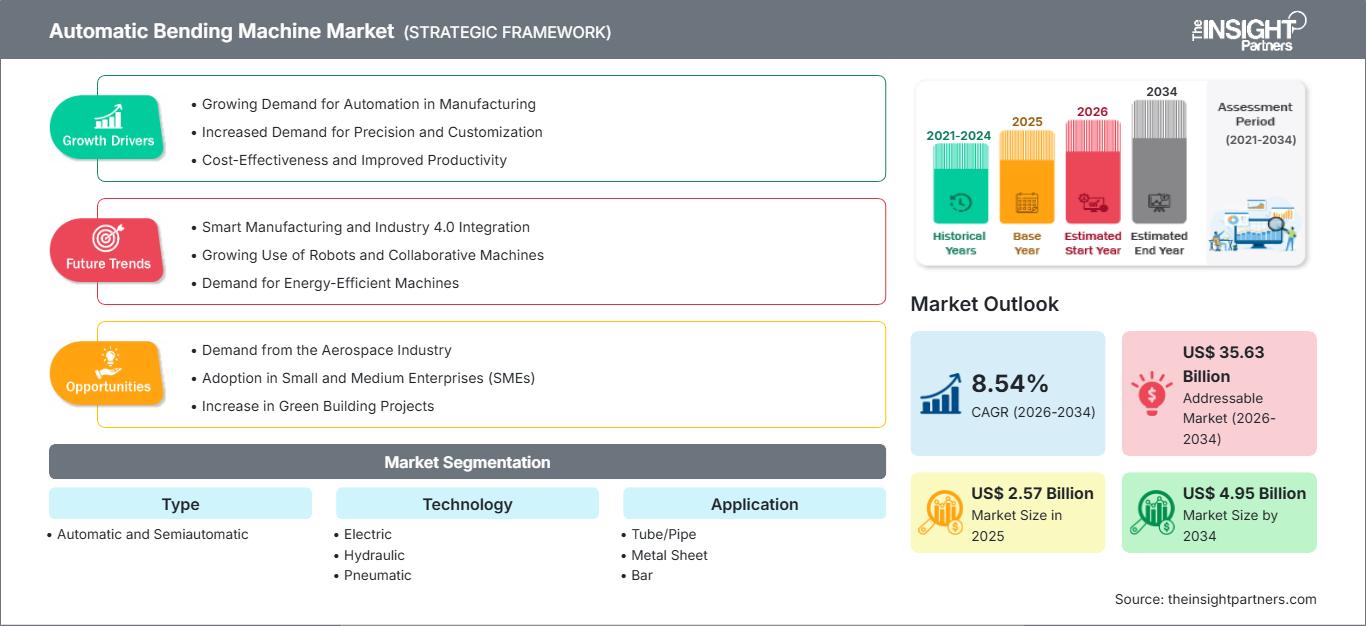
The Automatic Bending Machine Market size is expected to reach US$ 4.95 Billion by 2034 from US$ 2.57 Billion in 2025. The market is estimated to record a CAGR of 8.54% from 2026 to 2034.
The report is segmented by Type (Automatic and Semiautomatic), Technology (Electric, Hydraulic, Pneumatic, and Induction Based), Application (Tube/Pipe, Metal Sheet, Bar), Industry (Automotive, Shipbuilding, Aerospace, Construction and Mining, Others). The global analysis is further broken-down at regional level and major countries. The report offers the value in USD for the above analysis and segments
Purpose of the Report
The report Automatic Bending Machine Market by The Insight Partners aims to describe the present landscape and future growth, top driving factors, challenges, and opportunities. This will provide insights to various business stakeholders, such as:
- Technology Providers/Manufacturers: To understand the evolving market dynamics and know the potential growth opportunities, enabling them to make informed strategic decisions.
- Investors: To conduct a comprehensive trend analysis regarding the market growth rate, market financial projections, and opportunities that exist across the value chain.
- Regulatory bodies: To regulate policies and police activities in the market with the aim of minimizing abuse, preserving investor trust and confidence, and upholding the integrity and stability of the market.
Automatic Bending Machine Market Segmentation Type
- Automatic and Semiautomatic
Technology
- Electric
- Hydraulic
- Pneumatic
- Induction Based
Application
- Tube/Pipe
- Metal Sheet
- Bar
Industry
- Automotive
- Shipbuilding
- Aerospace
- Construction and Mining
Market Assessment and Insights
- Global market for Automatic Bending Machine was valued at US$ 2.57 Billion in 2025
- Annual market size is expected to reach US$ 4.95 Billion by 2034
- Total addressable market (TAM) during 2026-2034 is projected to reach approximately US$ 35.63 Billion
- Market is anticipated to register a CAGR of 8.54% during the forecast period
- The United States represents a key market, supported by Growing Demand for Automation in Manufacturing, Increased Demand for Precision and Customization, Cost-Effectiveness and Improved Productivity, as well as evolving industry dynamics
- Market analysis covers North America, Europe, Asia-Pacific, South and Central America, Middle East and Africa, with growth evaluated across the forecast period
- Market opportunities such as Demand from the Aerospace Industry, Adoption in Small and Medium Enterprises (SMEs), Increase in Green Building Projects are expected to influence market dynamics and addressable market
- Report profiles industry participants, including TRUMPF, AMADA CO., LTD., Haco, Bystronic Group, PRIMA INDUSTRIE S.p.A., WAFIOS AG Germany, AMOB, BLM Group, transfluid Maschinenbau GmbH, COMCO USA, while analyzing competitive strategies and innovation developments
-
Source: The Insight Partners' analysis based on proprietary research, government publications, company annual reports, investor presentations, industry databases, and expert interviews.
● REPORT CUSTOMIZATION
Tailor This Report To Align With Your Specific Business Requirements
This report can be customized to align precisely with your business objectives, scope, and target markets. Customization options include tailored segmentation, geography, competitive analysis, and strategic insights to support informed decision-making.
Customize This Report →WHAT YOU CAN ADJUST
- ● Segmentations
- ● Geography
- ● Competitive Analysis
- ● Language Preferences
Automatic Bending Machine Market: Strategic Insights
-
Get Top Key Market Trends of this report.This FREE sample will include data analysis, ranging from market trends to estimates and forecasts.
Automatic Bending Machine Market Growth Drivers
- Growing Demand for Automation in Manufacturing: The push towards automation in industries like automotive, aerospace, and metal fabrication is a major driver for the automatic bending machine market. Automation reduces the reliance on manual labor, increases production speeds, and improves precision in bending operations. As manufacturers seek to increase operational efficiency and reduce human error, the adoption of automatic bending machines continues to rise, ensuring more consistent product quality and faster turnaround times.
- Increased Demand for Precision and Customization: In industries like automotive and aerospace, where high precision is required, automatic bending machines are crucial. These machines offer high accuracy and the ability to handle complex bending tasks with minimal errors. As industries demand more customized solutions for product designs and materials, automatic bending machines are becoming indispensable, enabling manufacturers to meet specific customer requirements and produce high-quality, customized products efficiently.
- Cost-Effectiveness and Improved Productivity: Automatic bending machines are cost-effective in the long run due to their ability to increase productivity while minimizing labor costs. They significantly reduce production times and enhance throughput by automating the bending process. Moreover, these machines require less maintenance compared to manual alternatives and are capable of operating continuously. The ability to produce high volumes of accurately bent materials with minimal downtime helps manufacturers meet increasing demand without adding extra resources.
Automatic Bending Machine Market Future Trends
- Smart Manufacturing and Industry 4.0 Integration: As part of the Industry 4.0 revolution, automatic bending machines will become increasingly interconnected and integrated with other systems on the factory floor. Through the use of IoT sensors and cloud computing, these machines will be able to collect data, analyze performance metrics, and share information across a central system. This trend will allow manufacturers to optimize workflows, monitor machine health, predict failures, and maintain better control over production, improving the overall efficiency of manufacturing processes.
- Growing Use of Robots and Collaborative Machines: The future of the automatic bending machine market will likely involve more robotics integration. Collaborative robots (cobots) are being developed to work alongside bending machines to handle tasks like part feeding, material handling, and quality inspection. These robots can work alongside human operators in a safe and efficient manner, reducing labor costs and increasing throughput. Cobots will also play a key role in improving the flexibility of automatic bending machines, allowing them to adapt quickly to new tasks and materials.
- Demand for Energy-Efficient Machines: There is an increasing focus on energy efficiency in industrial machinery. Automatic bending machines will evolve to consume less energy while maintaining or improving their performance. This could include the use of energy-efficient motors, hydraulic systems, and more sustainable manufacturing processes. Manufacturers are also exploring regenerative braking systems and low-energy operational modes that can reduce the overall environmental impact of these machines. This trend will be essential as industries strive to meet sustainability goals.
Automatic Bending Machine Market Opportunities
- Demand from the Aerospace Industry: The aerospace industry is another key area of growth for automatic bending machines. As the demand for fuel-efficient, lightweight aircraft components grows, manufacturers need machines that can handle complex bending of high-performance materials. Automatic bending machines can help reduce production costs, improve part quality, and ensure precision in critical aerospace components. This demand is expected to continue rising as aerospace manufacturers look for ways to increase production while maintaining high standards of safety and quality.
- Adoption in Small and Medium Enterprises (SMEs): Small and medium-sized enterprises (SMEs) are increasingly adopting automatic bending machines to stay competitive. The reduction in machine costs, coupled with the increasing availability of affordable, easy-to-use automated solutions, makes these machines accessible to a wider range of businesses. By adopting automatic bending machines, SMEs can improve production quality, reduce labor costs, and enhance operational efficiency. The growing accessibility of such technology presents a significant opportunity for market expansion.
- Increase in Green Building Projects: As the construction industry shifts towards more sustainable practices, there is a growing demand for lightweight and energy-efficient materials in building projects. Automatic bending machines are ideal for fabricating metal components used in green building projects, such as energy-efficient structural elements, facades, and frames. The trend toward eco-friendly and energy-efficient buildings is driving demand for these machines, especially in regions with a strong focus on sustainable construction practices.
Automatic Bending Machine Market Report Scope
| Report Attribute | Details |
|---|---|
| Market size in 2025 | US$ 2.57 Billion |
| Market Size by 2034 | US$ 4.95 Billion |
| Global CAGR (2026 - 2034) | 8.54% |
| Historical Data | 2021-2024 |
| Forecast period | 2026-2034 |
| Segments Covered |
By Type
|
| Regions and Countries Covered |
North America
|
| Market leaders and key company profiles |
|
Automatic Bending Machine Market Players Density: Understanding Its Impact on Business Dynamics
The Automatic Bending Machine Market is growing rapidly, driven by increasing end-user demand due to factors such as evolving consumer preferences, technological advancements, and greater awareness of the product's benefits. As demand rises, businesses are expanding their offerings, innovating to meet consumer needs, and capitalizing on emerging trends, which further fuels market growth.
Key Selling Points
- Comprehensive Coverage: The report comprehensively covers the analysis of products, services, types, and end users of the Automatic Bending Machine Market, providing a holistic landscape.
- Expert Analysis: The report is compiled based on the in-depth understanding of industry experts and analysts.
- Up-to-date Information: The report assures business relevance due to its coverage of recent information and data trends.
- Customization Options: This report can be customized to cater to specific client requirements and suit the business strategies aptly.
The research report on the Automatic Bending Machine Market can, therefore, help spearhead the trail of decoding and understanding the industry scenario and growth prospects. Although there can be a few valid concerns, the overall benefits of this report tend to outweigh the disadvantages.
Frequently Asked Questions

- Comprehensive Market Sizing and Forecast Analysis
- Detailed Segmentation Analysis
- In-Depth Market Dynamics Assessment
- Regional and Country-Level Insights
- Competitive Landscape and Company Benchmarking
- Strategic Business Intelligence
Recent Reports
Testimonials

The Insight Partners' SCADA System Market report is comprehensive, with valuable insights on current trends and future forecasts. The team was highly professional, responsive, and supportive throughout. We are very satisfied and highly recommend their services.
RAN KEDEM Partner, Reali Technologies LTDs
I requested a report on a very specific software market and the team produced the report in a few days. The information was very relevant and well presented. I then requested some changes and additions to the report. The team was again very responsive and I got the final report in less than a week.
JEAN-HERVE JENN Chairman, Future Analytica
We worked with The Insight Partners for an important market study and forecast. They gave us clear insights into opportunities and risks, which helped shape our plans. Their research was easy to use and based on solid data. It helped us make smart, confident decisions. We highly recommend them.
PIYUSH NAGPAL Sr. Vice President, High Beam Global
The Insight Partners delivered insightful, well-structured market research with strong domain expertise. Their team was professional and responsive throughout. The user-friendly website made accessing industry reports seamless. We highly recommend them for reliable, high-quality research services
YUKIHIKO ADACHI CEO, Deep Blue, LLC.
This is the first time I have purchased a market report from The Insight Partners.While I was unsure at first, I visited their web site and felt more comfortable to take the risk and purchase a market report.I am completely satisfied with the quality of the report and customer service. I had several questions and comments with the initial report, but after a couple of dialogs over email with their analyst I believe I have a report that I can use as input to our strategic planning process.Thank you so much for taking the extra time and making this a positive experience.I will definitely recommend your service to others and you will be my first call when we need further market data.
JOHN SUZUKI President and Chief Executive Officer, Board Director, BK Technologies
I wish to appreciate your support and the professionalism you displayed in the course of attending to my request for information regarding to infectious disease IVD market in Nigeria. I appreciate your patience, your guidance, and the fact that you were willing to offer a discount, which eventually made it possible for us to close a deal. I look forward to engaging The Insight Partners in the future, all thanks to the impression you have created in me as a result of this first encounter.
DR CHIJIOKE ONYIA MANAGING DIRECTOR, PineCrest Healthcare Ltd.Reason to Buy
- Informed Decision-Making
- Understanding Market Dynamics
- Competitive Analysis
- Identifying Emerging Markets
- Customer Insights
- Market Forecasts
- Risk Mitigation
- Boosting Operational Efficiency
- Strategic Planning
- Investment Justification
- Tracking Industry Innovations
- Aligning with Regulatory Trends





 Get Free Sample for