
Automatic Fire Sprinkler Systems Market Share, Growth & Forecast by 2034
Coverage: By Type (Dry Fire Sprinkler, Wet Fire Sprinkler, Deluge Fire Sprinkler, Preaction Fire Sprinklers); End User (Commercial, Residential, Oil and Gas, Industrial and Manufacturing, Transport and Logistics, Energy and Power, Others) , and Geography (North America, Europe, Asia Pacific, and South and Central America)
- Status : Data Released
- Report Code : TIPTE00002634
- Category : Electronics and Semiconductor
- No. of Pages : 150
- Available Report Formats :


- Last update date : July 20, 2026


2025 Market Size
US$ 13.12 Bn
Base year value
2034 Forecast
US$ 28.31 Bn
Projected by 2034
CAGR 2026-2034
8.92 %
Growth rate
Addressable Market
US$ 185.45 Bn
(2026-2034)
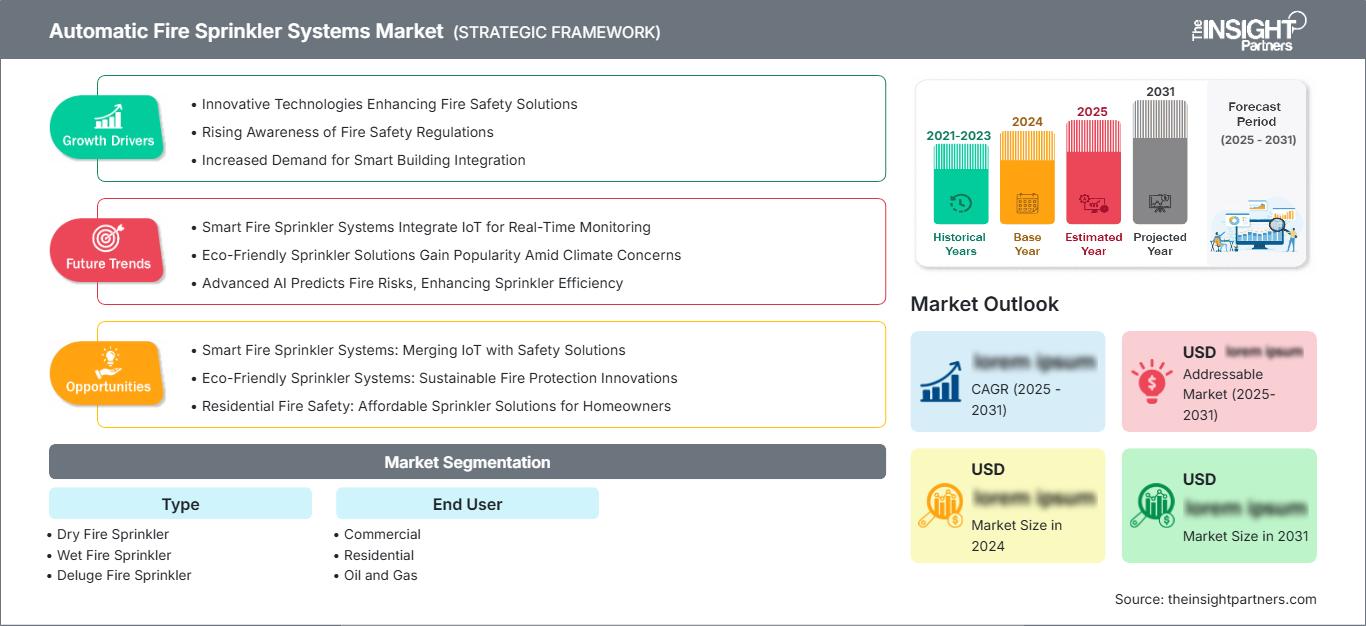
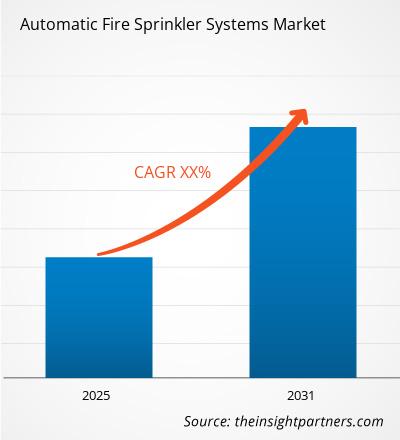
The Automatic Fire Sprinkler Systems Market was valued at US$ 13.12 Billion in 2025 and is projected to reach US$ 28.31 Billion by 2034, registering a CAGR of 8.92% during 2026–2034. Demand is being shaped by code-compliant construction, industrial fire risk mitigation, and growing integration of sprinkler networks with connected building platforms across commercial, residential, manufacturing, logistics, energy, and public infrastructure environments.
Across North America, the Automatic Fire Sprinkler Systems Market size is supported by a mature compliance framework, insurance-linked risk controls, and retrofit activity in warehouses, healthcare facilities, data centers, and high-rise residential buildings. The region is estimated to expand at a CAGR range of 8.5–9.0% through 2034, with connected monitoring and predictive maintenance increasingly influencing procurement decisions among facility owners and fire protection contractors.
Automatic Fire Sprinkler Systems Market Assessment and Insights
- North America held 36–39% share in 2025 and is growing at a CAGR range of 8.5–9.0% during 2026–2034, driven by NFPA-based codes, logistics construction, and smart building retrofits.
- US represented 78–82% of North America in 2025 and is expanding at 8.6–9.1% CAGR during 2026–2034 through warehouses, healthcare, and multifamily mandates.
- Europe accounted for 24–27% share in 2025 and is growing at 8.2–8.7% CAGR, led by Germany, the UK, France, Italy, and Spain, where renovation and industrial safety programs support adoption.
- Asia Pacific captured 22–25% share in 2025 and is advancing at 9.3–9.8% CAGR, led by China, India, Japan, South Korea, and Australia amid rapid urbanization and industrial policy support.
- Largest Segment Wet Fire Sprinkler systems held 52–56% market share in 2025 and are growing at 8.3–8.8% CAGR, reflecting broad use in commercial and residential buildings.
- High Growth Segment Preaction Fire Sprinklers held 13–16% market share in 2025 and are growing at 9.7–10.2% CAGR, supported by data centers and high-value asset environments.
- Key companies analyzed in detail: Adams Fire Tech (Pvt) Ltd., Firewize Holdings Pty Ltd, APi Group Corporation, Cosco Fire Protection, Inc., Grundfos Pumps India Private Limited, Heiser, Kaufman Fire Protection Systems, Inc., Johnson Controls International plc, VFP Fire Systems, Inc., and The Viking Corporation.
Source: The Insight Partners' analysis based on proprietary research, government publications, company annual reports, investor presentations, industry databases, and expert interviews.
System designs have evolved from simple hydraulic systems to those with digital supervision and code-based, occupancy-based design. Wet systems still form the bedrock of installations because they are easier to service; however, dry, deluge, and preaction systems have become increasingly relevant where there are risks of freezing, flammable substances, or expensive interruptions in business operations. Production of systems is also evolving in terms of more corrosion-resistant piping, compact valves, faster-response heads, and monitoring devices that minimize inspection.
The future need for fire sprinklers will be determined by various considerations such as infill development, industrial movement, battery storage sites, and occupancy licensing. New geographies will establish airports, metros, warehousing facilities, hospitals, and multipurpose developments that will offer new opportunities for the fire sprinkler companies. Headwinds in terms of regulatory changes as well as insurer preference for automatic fire suppression systems will fuel replacement and retrofits.
Automatic Fire Sprinkler Systems Market Report Scope
| Report Attribute | Details |
|---|---|
| Market size in 2025 | US$ 13.12 Billion |
| Market Size by 2034 | US$ 28.31 Billion |
| Global CAGR (2026 - 2034) | 8.92% |
| Historical Data | 2021-2024 |
| Forecast period | 2026-2034 |
Automatic Fire Sprinkler Systems Market Analysis
Growth drivers for Automatic Fire Sprinkler Systems Market include increased fire safety regulations, urban densification, and asset value in-built structures. Studies by NFPA reveal that automatic fire sprinkler systems were activated in 92% of U.S. structures that met the qualifications of the study conducted in 2017–2021 and proved to be effective in 97% of operating occurrences.
This market consists of sprinkler head manufacturers, pump manufacturers, fire protection engineers, installation contractors, testers, insurance companies, and code authorities. Supply factors include the cost of steel pipes, availability of pumps, skilled labor, and sequence of work. The Automatic Fire Sprinkler Systems Market report reveals that bid winning increasingly depends on design/build capabilities in complex projects such as industrial, logistics, and commercial facilities.
Competition is fragmented at the unit level but intense in branding in the form of digital monitoring, suppression packages, and components. Johnson Controls International plc, The Viking Corporation, APi Group Corporation, and VFP Fire Systems, Inc. compete on the basis of depth of service, certification of products, national account management, and implementation of retrofit programs. Contractor specialists like Cosco Fire Protection, Inc. and Kaufman Fire Protection Systems, Inc. are significant for regional project implementation.
Capital investment is moving towards inter-connected records of inspection, analysis of pressures and flows, and remote impairment notifications. Grundfos Pumps India Private Limited is making investments in reliability of pumps, while Adams Fire Tech (Pvt) Ltd., Firewize Holdings Pty Ltd, and Heiser are doing so for localized engineering, training, and compliance needs.
● REPORT CUSTOMIZATION
Tailor This Report To Align With Your Specific Business Requirements
This report can be customized to align precisely with your business objectives, scope, and target markets. Customization options include tailored segmentation, geography, competitive analysis, and strategic insights to support informed decision-making.
Customize This Report →WHAT YOU CAN ADJUST
- ● Segmentations
- ● Geography
- ● Competitive Analysis
- ● Language Preferences
Automatic Fire Sprinkler Systems Market: Strategic Insights
Regional Insights
North America Automatic Fire Sprinkler Systems Market
North America held 36–39% share in 2025 and is projected to grow at 8.5–9.0% CAGR during 2026–2034. The region benefits from NFPA 13 adoption, International Building Code updates, and insurer scrutiny of high-value facilities. The Automatic Fire Sprinkler Systems Market share is supported by warehouse expansion, data centers, healthcare assets, and aging commercial buildings requiring retrofit or impairment monitoring.
Adoption has been seen to be strongest in the U.S. and Canada where jurisdictions within the two countries regularly mandate that suppression should be done automatically in commercial, institutional, and multi-occupancy buildings. The use of predictive maintenance technologies has started to gain popularity owing to the impact of sprinkler system failure on occupancy, insurance cover, and business continuity.
U.S. Automatic Fire Sprinkler Systems Market
The U.S. represented 78–82% of North America in 2025 and is estimated to grow at 8.6–9.1% CAGR during 2026–2034. NFPA data showing sprinkler effectiveness in 97% of operating structure-fire incidents strengthens the business case for commercial installation. Company presence is broad, with Johnson Controls International plc, APi Group Corporation, VFP Fire Systems, Inc., and The Viking Corporation serving national accounts.
The trend for application leans towards logistic centers, health care facilities, educational institutions, high rise residential property, and computer data centers. Retrofitting is another area of importance for the country since older buildings need to be fitted with new valves, corrosion-resistant pipes, and proper surveillance mechanisms. There is an increased demand for pre-action systems in server rooms and museums.
Europe Automatic Fire Sprinkler Systems Market
Europe had 24–27% market share in 2025 and was expected to register CAGR of 8.2–8.7% during 2026–2034. Germany is the major player on account of its industry, logistics, and high standards of engineering of properties in terms of risk. In the UK, retrofits continue in residential, care and public buildings due to high safety requirements after incidents.
France, Italy, and Spain will drive growth by means of their hotels, transportation hubs, modernized manufacturing, and mixed-use developments. More attention is paid by European buyers to water consumption, insurance, and EN-standard compliance. Dry and preaction systems may be applicable to cold storage rooms, archival storage, and expensive manufacturing; wet systems to office, commercial, hotel and healthcare facilities.
APAC Automatic Fire Sprinkler Systems Market
APAC was a 22-25% market share in 2025 and is forecast to grow at 9.3-9.8% CAGR from 2026 to 2034. Demand from China is led by industrial parks, metro railways, skyscrapers, and logistics complexes. Japan, South Korea, India, and Australia contribute to demand from building code compliance and high-density urban infrastructure.
Industrial policy is a key driver due to electronic, battery, pharmaceutical, and automotive manufacturing value chain compliance to fire suppression needs. Automatic Fire Sprinkler Systems Market is also seeing growth from greenfield hospitals, airports, and data centers that mandate reliable fire sprinklers from the start of the project.
Middle East & Africa Automatic Fire Sprinkler Systems Market
Middle East and Africa is projected to grow at 8.0–8.5% CAGR during 2026–2034, with Saudi Arabia the leading country. Demand is linked to oil and gas assets, airports, hospitality projects, district cooling plants, and large commercial developments in the UAE and Saudi Arabia.
Demand in South Africa is based on mining, warehousing, malls, and manufacturing, whereas other countries in MEA develop using infrastructural and public safety initiatives. Projects dealing with energy must have deluge and foam systems, whereas commercial towers depend on wet and preaction systems.
Segmentation Analysis
Type
The Type segment is forecast to grow at 8.6–9.1% CAGR during 2026–2034. The Automatic Fire Sprinkler Systems Market scope spans standard wet systems, freeze-resistant dry designs, high-hazard deluge networks, and preaction assemblies for sensitive assets. Selection depends on occupancy risk, temperature exposure, response time, water-damage tolerance, and inspection capability.
- Dry Fire Sprinkler systems serve unheated warehouses, parking structures, loading docks, and cold-storage environments where pipe freezing risk makes water-filled networks unsuitable.
- Wet Fire Sprinkler systems dominate standard occupancies because they offer reliable activation, simpler maintenance, lower installation complexity, and broad acceptance across commercial and residential properties.
- Deluge Fire Sprinkler systems are strategically important in oil and gas, power generation, aircraft hangars, and chemical processing where rapid area-wide water discharge is required.
- Preaction Fire Sprinklers are preferred for data centers, archives, museums, laboratories, and clean rooms where accidental discharge risk must be tightly controlled.
End User
The End User segment is projected to grow at 8.8–9.3% CAGR during 2026–2034. Demand is highest where life safety, asset protection, occupancy approvals, and downtime risk converge. Commercial buildings remain the revenue anchor, while industrial, logistics, energy, and oil and gas facilities require engineered designs aligned with hazard class, water supply, and continuity requirements.
- Commercial users include offices, retail, hospitals, hotels, education, and entertainment assets where code compliance, insurer acceptance, and occupant safety drive broad sprinkler installation.
- Residential demand is rising in multifamily towers, senior living, and premium housing, although single-family adoption remains uneven across jurisdictions and cost-sensitive developments.
- Oil and Gas facilities use specialized sprinkler and deluge configurations to control flammable-liquid hazards, protect process equipment, and support emergency response planning.
- Industrial and Manufacturing users prioritize asset protection, production continuity, and compliance in factories handling machinery, chemicals, packaging, metals, or high-value inventory.
- Transport and Logistics facilities require large-area coverage for warehouses, distribution centers, airports, stations, and ports, where fire spread can disrupt regional supply chains.
- Energy and Power assets adopt sprinkler, deluge, and preaction systems for turbine halls, battery storage rooms, substations, and control buildings with high operational criticality.
Opportunity Snapshot
| End User | Revenue Contribution | Trend Tag | Adoption Stage |
| Commercial | High | Smart Buildings | Mature |
| Residential | Medium | Multifamily Codes | Scaling |
| Oil and Gas | Medium | Hazard Control | Mature |
| Industrial and Manufacturing | High | Plant Safety | Scaling |
| Transport and Logistics | High | Warehouse Risk | Scaling |
| Energy and Power | Medium | Battery Safety | Emerging |
Automatic Fire Sprinkler Systems Market Growth Drivers and Impact Analysis
Stricter Building and Occupancy Codes
Sprinklers are being mandated more broadly on buildings of the high-rise residential, health care, educational, logistics, and mixed use types. The code council's latest changes on the issues of battery energy storage safety and fire separation have drawn more attention to the need for dedicated suppression coverage, which is also supported by NFPA 13 design change cycles. It is important in the sense that designers have to incorporate sprinklers at the stage of construction rather than after the process. Thus, the growth of Automatic Fire Sprinkler Systems Market receives direct market push from regulations via the demand for design engineering, installation, testing, and inspection.
Expansion of Logistics and High-Value Facilities
Fulfillment centers, cold storage, semiconductor fab, pharma manufacture, and data centers are driving demand for engineered sprinkler systems due to high value at stake, and round-the-clock operations leading to fire downtime being greater than the damage to the property. The insurance companies and risk engineers insist on effective hydraulic design, monitoring of valves, and prompt detection of any impairments. In terms of market implications, there will be a move to bigger value installations incorporating wet, dry, deluge, and preaction zones into the same campus. This creates an edge for contractors with design-build services since the process is rather complicated.
Digital Monitoring and Predictive Maintenance
The shift among facility owners is away from sporadic inspection to continuous monitoring of pressure, temperature, valve conditions, and anomalies. The relaunch of Johnson Controls' connected sprinkler service in 2025 serves as an example of how agnostic hardware analysis can transform sprinklers into managed safety devices. The effect is fewer unexpected disruptions, better handling of issues like freezing and pressure imbalance, and better records for insurance companies and authorities. The benefits of this driver are that existing technology can be made to work with less disruption and less need for replacement.
Automatic Fire Sprinkler Systems Market Future Trends
Connected Sprinklers as Compliance Infrastructure
Automatic Fire Sprinkler Systems Market trends will increasingly center on connected compliance rather than standalone suppression. Future systems will feed pressure, flow, temperature, and valve-position data into building platforms, allowing owners to document readiness continuously. This matters for hospitals, airports, industrial campuses, and data centers where an unnoticed impairment can create regulatory, insurance, and operational exposure. The next phase will favor open-protocol monitoring, mobile inspection records, and predictive analytics that help contractors prioritize service visits. As a result, recurring digital service revenue will grow alongside hardware demand.
Hazard-Specific Designs for New Energy Assets
Battery energy storage, distributed power, hydrogen infrastructure, and electrified transport depots will require more specialized suppression strategies. Standard wet networks will not address every risk profile, so engineers will combine sprinklers with detection, compartmentalization, ventilation, and water management. This trend will raise demand for preaction, deluge, and high-density designs in facilities where thermal runaway, transformer fires, or fuel handling can escalate quickly. Suppliers that understand energy-sector codes and testing protocols will be better positioned than general contractors focused only on conventional commercial buildings.
Automatic Fire Sprinkler Systems Market Opportunities
Retrofit Programs in Aging Commercial Buildings
Aging offices, hotels, hospitals, schools, and residential towers create a practical retrofit opportunity where existing sprinkler networks need valve replacement, pipe corrosion remediation, pump upgrades, and digital supervision. Automatic Fire Sprinkler Systems Market Forecasts point to strong replacement spending because owners must keep buildings insurable, leasable, and compliant even when new construction slows. Contractors can build recurring revenue by bundling inspections, impairment management, hydraulic recalculation, and phased installation plans that minimize tenant disruption. This opportunity is especially attractive in North America and Europe, where older building stock is large and enforcement capacity is relatively mature.
Industrial Safety Packages for Emerging Manufacturing Hubs
Manufacturing investment in India, Southeast Asia, the Gulf, and parts of Eastern Europe is creating demand for integrated fire protection packages early in plant design. New electronics, automotive, food processing, and pharmaceutical facilities need sprinkler systems that match hazard classification, water supply, and business continuity goals. Suppliers can capture value by offering pumps, valves, heads, alarms, training, and maintenance under one technical proposal. The opportunity is action-oriented because local contractors often need certified products and engineering support from global specialists to meet insurer and multinational tenant requirements.
Recent Developments
- June 2025: Johnson Controls relaunched its Connected Sprinkler service, introducing a predictive maintenance solution that continuously monitors fire sprinkler systems using connected sensors and real-time analytics. The platform detects issues such as pressure imbalances, water leaks, freezing conditions, and other performance anomalies before they lead to system failures or costly emergency repairs. Compatible with both new and existing sprinkler installations, the service enables facility managers to shift from routine, schedule-based inspections to condition-based maintenance, improving system reliability, regulatory compliance, and overall building safety while reducing maintenance costs and unplanned downtime.
- October 2025: Startup Defense Delivered introduced an autonomous smart wildfire sprinkler system designed to protect homes in wildfire-prone regions. The system uses thermal imaging cameras to detect approaching flames or airborne embers and automatically activates targeted sprinkler zones without requiring homeowner intervention. Capable of delivering up to 35 gallons of water per minute, the technology cools vulnerable areas such as roofs, walls, and surrounding vegetation to reduce the risk of ignition. Remote monitoring and automated activation provide homeowners with an additional layer of protection as climate change increases the frequency and intensity of wildfires.
- July 2026: APi Group completed its acquisition of WTech Fire Group, a leading European provider of fire sprinkler, suppression, and detection solutions, strengthening its international fire protection business. The acquisition expands APi's capabilities in engineered fire suppression systems and broadens its presence across key European markets. The company expects WTech to contribute approximately $175 million in annual revenue, while enhancing its portfolio of fire and life safety services. Following the acquisition, APi also raised its full-year 2026 revenue and adjusted EBITDA guidance, reflecting confidence in the strategic and financial benefits of the deal.
Frequently Asked Questions

- Comprehensive Market Sizing and Forecast Analysis
- Detailed Segmentation Analysis
- In-Depth Market Dynamics Assessment
- Regional and Country-Level Insights
- Competitive Landscape and Company Benchmarking
- Strategic Business Intelligence
Recent Reports
Testimonials

The Insight Partners' SCADA System Market report is comprehensive, with valuable insights on current trends and future forecasts. The team was highly professional, responsive, and supportive throughout. We are very satisfied and highly recommend their services.
RAN KEDEM Partner, Reali Technologies LTDs
I requested a report on a very specific software market and the team produced the report in a few days. The information was very relevant and well presented. I then requested some changes and additions to the report. The team was again very responsive and I got the final report in less than a week.
JEAN-HERVE JENN Chairman, Future Analytica
We worked with The Insight Partners for an important market study and forecast. They gave us clear insights into opportunities and risks, which helped shape our plans. Their research was easy to use and based on solid data. It helped us make smart, confident decisions. We highly recommend them.
PIYUSH NAGPAL Sr. Vice President, High Beam Global
The Insight Partners delivered insightful, well-structured market research with strong domain expertise. Their team was professional and responsive throughout. The user-friendly website made accessing industry reports seamless. We highly recommend them for reliable, high-quality research services
YUKIHIKO ADACHI CEO, Deep Blue, LLC.
This is the first time I have purchased a market report from The Insight Partners.While I was unsure at first, I visited their web site and felt more comfortable to take the risk and purchase a market report.I am completely satisfied with the quality of the report and customer service. I had several questions and comments with the initial report, but after a couple of dialogs over email with their analyst I believe I have a report that I can use as input to our strategic planning process.Thank you so much for taking the extra time and making this a positive experience.I will definitely recommend your service to others and you will be my first call when we need further market data.
JOHN SUZUKI President and Chief Executive Officer, Board Director, BK Technologies
I wish to appreciate your support and the professionalism you displayed in the course of attending to my request for information regarding to infectious disease IVD market in Nigeria. I appreciate your patience, your guidance, and the fact that you were willing to offer a discount, which eventually made it possible for us to close a deal. I look forward to engaging The Insight Partners in the future, all thanks to the impression you have created in me as a result of this first encounter.
DR CHIJIOKE ONYIA MANAGING DIRECTOR, PineCrest Healthcare Ltd.Reason to Buy
- Informed Decision-Making
- Understanding Market Dynamics
- Competitive Analysis
- Identifying Emerging Markets
- Customer Insights
- Market Forecasts
- Risk Mitigation
- Boosting Operational Efficiency
- Strategic Planning
- Investment Justification
- Tracking Industry Innovations
- Aligning with Regulatory Trends





 Get Free Sample for