
Automatic Swimming Pool Monitoring Systems Market Demand, Share & Growth by 2034
Coverage: By Distribution Channel (Online, Offline); End-user (Residential, Commercial), and Geography (North America, Europe, Asia Pacific, and South and Central America)
- Status : Data Released
- Report Code : TIPRE00013842
- Category : Electronics and Semiconductor
- No. of Pages : 150
- Available Report Formats :


- Last update date : July 17, 2026


2025 Market Size
US$ 1.35 Bn
Base year value
2034 Forecast
US$ 2.91 Bn
Projected by 2034
CAGR 2026-2034
8.93 %
Growth rate
Addressable Market
US$ 19.09 Bn
(2026-2034)
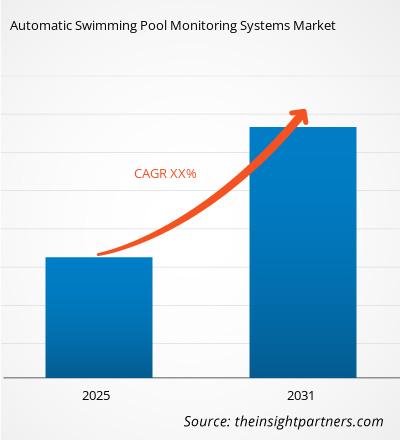
The Automatic Swimming Pool Monitoring System Market size was assessed to be US$ 1.35 Billion in 2025, which is forecasted to increase up to US$ 2.91 Billion in 2034 at a CAGR of 8.93%. The market includes connected sensors, cloud-based dashboard systems, chemical dosing interfaces, alerts, and maintenance services, which are used to keep the pool water quality and the operational effectiveness of the equipment at an optimal level.
North America is still considered a priority demand center because the market is driven by the large presence of private pools, the network of dealerships, and the greater willingness to pay for connected maintenance services. North America's growth will continue at a CAGR rate ranging from 8.4% to 8.9% throughout 2026-2034 due to automation, energy-efficient pool pumps, and service app-based business models.
Automatic Swimming Pool Monitoring Systems Market Assessment and Insights
- North America: The region accounts for 37–41% share in 2025 and grows at a CAGR range of 8.4–8.9% during 2026–2034, led by residential retrofits, pool service digitization, and connected equipment replacement.
- US: The country represents 82–86% of North America in 2025 and grows at a CAGR range of 8.5–9.0% during 2026–2034, driven by dealer-led installation and smart backyard adoption.
- Europe: The region holds 24–28% share in 2025 and grows at a CAGR range of 7.6–8.1% during 2026–2034, with Spain, France, Germany, Italy, and the UK leading demand.
- Asia Pacific: The region holds 20–24% share in 2025 and grows at a CAGR range of 9.6–10.2% during 2026–2034, led by China, Australia, Japan, South Korea, and India.
- Largest Segment: Residential holds 64–68% market share in 2025 and grows at a CAGR range of 8.7–9.2% during 2026–2034 as owners seek lower maintenance effort.
- High Growth Segment: Online holds 31–35% market share in 2025 and grows at a CAGR range of 10.1–10.7% during 2026–2034 as consumers compare connected products digitally.
- Key companies analyzed in detail: Fluidra, S.A.; Guangzhou Fenlin Swimming Pool and Sauna Equipment Co., Ltd.; Guangzhou Vigor Health Equipment Co., Ltd.; Hayward Holdings, Inc.; Maytronics Ltd.; Pentair plc; Pro Automation (Pty) Ltd.; Sutro Connect; Trouble Free Pool; Waterco Limited.
Source: The Insight Partners' analysis based on proprietary research, government publications, company annual reports, investor presentations, industry databases, and expert interviews.
The process of pool monitoring has progressed from strip testing and periodic visits by technical personnel to a process driven by connections and technology. The current state involves sensors measuring pH, oxidation-reduction potential, chlorine, temperature, flow rate, salinity, and equipment conditions, while mobile applications transform measurements into recommendations. The production dynamics have moved from conventional categories of pool equipment to modular probes, cartridges, gateway connections, and subscriptions that make the market more service-oriented.
There is likely to be future demand as households, hotels, wellness centers, schools, and municipal facilities emphasize pool safety, chemical management, and operational efficiency. The adoption of the connected pool technology in emerging markets should be driven by the development of new residential areas, resorts, and recreation sites. It can be helped by the regulatory focus on recreational water safety, energy savings, and maintenance documentation.
Automatic Swimming Pool Monitoring Systems Market Report Scope
| Report Attribute | Details |
|---|---|
| Market size in 2025 | US$ 1.35 Billion |
| Market Size by 2034 | US$ 2.91 Billion |
| Global CAGR (2026 - 2034) | 8.93% |
| Historical Data | 2021-2024 |
| Forecast period | 2026-2034 |
Automatic Swimming Pool Monitoring Systems Market Analysis
Market expansion for Automatic Swimming Pool Monitoring Systems is driven by the combination of Internet-of-things devices, smartphone applications, cloud-based data analysis, and automation controllers. The need comes from pool owners interested in conducting less manual testing and from service companies servicing pools with higher route density. The Centers for Disease Control and Prevention suggest keeping certain levels of disinfectant and pH in public pools, providing grounds for continuous monitoring.
The market is composed of sensor makers, probe and reagent producers, automation controllers makers, chemical products, dealers, pool constructors, ecommerce providers, application creators, and service professionals. Suppliers' performance depends on sensor reliability, waterproofing, frequency of calibration, battery operation, gateway capability, and after-sales support services. Inaccurate measurements may result in water or chemicals misuse, hence consumers opt for products providing hardware quality together with user manuals and technical assistance.
The Automatic Swimming Pool Monitoring System market report highlights competition not only in standalone gadgets but in systems that are able to connect with each other. Fluidra, S.A., Hayward Holdings, Inc., Pentair plc, Maytronics Ltd., and Waterco Limited rely on the range of devices and dealers, whereas Guangzhou Fenlin Swimming Pool and Sauna Equipment Co., Ltd., Guangzhou Vigor Health Equipment Co., Ltd., Pro Automation (Pty) Ltd., Sutro Connect, and Trouble Free Pool cover niche, community, and connectivity markets.
Ventures and investments are aimed at remote monitoring through applications, cloud-based services' dashboards, battery-powered wireless sensors, and software solutions for pool industry professionals. Strategic positioning requires integration of products into systems with pumps, chlorinators, heaters, cleaners, and smart homes. Businesses that are able to minimize maintenance duration and provide stable water quality and recurring service revenue will be able to secure their profit margin despite a decline in pool construction.
● REPORT CUSTOMIZATION
Tailor This Report To Align With Your Specific Business Requirements
This report can be customized to align precisely with your business objectives, scope, and target markets. Customization options include tailored segmentation, geography, competitive analysis, and strategic insights to support informed decision-making.
Customize This Report →WHAT YOU CAN ADJUST
- ● Segmentations
- ● Geography
- ● Competitive Analysis
- ● Language Preferences
Automatic Swimming Pool Monitoring Systems Market: Strategic Insights

Regional Insights
North America Automatic Swimming Pool Monitoring System Market
North America holds 37–41% share in 2025 and is projected to grow at a CAGR range of 8.4–8.9% during 2026–2034. The Automatic Swimming Pool Monitoring System Market share in the region is supported by a large installed pool base, high service technician costs, and widespread adoption of connected backyard equipment. Retailers and dealers increasingly bundle monitoring with automation upgrades.
The region benefits from pool professionals seeking route efficiency, homeowners seeking simplified water care, and commercial operators needing documented readings. Energy-aware pumps and smart controllers make monitoring more valuable because water quality, circulation, and equipment scheduling can be managed together. Growth is moderated by subscription resistance and calibration requirements, but replacement demand remains resilient.
U.S. Automatic Swimming Pool Monitoring System Market
The United States constitutes 82-86% of North America and is projected to experience a compound annual growth rate of 8.5-9.0% between 2026 and 2034. The companies that dominate the industry include Fluidra, S.A., Hayward Holdings, Inc., Pentair plc, Waterco Limited, Sutro Connect, and dealer networks. The application areas are residential surveillance, spa compatibility, alerting chemical dosing, and commercial compliance assistance.
Drivers of the market include high levels of backyard swimming pool ownership, changing weather conditions, and consumer awareness of smart home gadgets. Service providers of swimming pools use dashboards for determining priorities and avoiding emergencies. Commercial swimming pools are concerned about logging because labor shortage complicates regular tests. The highest demand is observed in the Sun Belt states due to constant expenses.
Europe Automatic Swimming Pool Monitoring System Market
The share of Europe in 2025 was 24-28% and it is expected to grow at a compound annual growth rate between 7.6-8.1%. The biggest driver is Spain due to outdoor residential pools, tourism assets, and Fluidra, S.A. regional ecosystem. France is the second in terms of residential pool installations and established channels for dealers to automate the water management system.
Germany focuses on the reliability and energy efficiency of equipment and indoor wellness centers, while the UK market is more selective but appreciates premium automation and monitoring for spas. Italy and France promote demand using hospitality pools, villas and renovations. Customers from Europe are looking for ways to reduce chemicals, multi-language support of mobile applications, conserve water and ensure the compliance of the product.
APAC Automatic Swimming Pool Monitoring System Market
Asia Pacific commands 20-24% market share in 2025 and is expected to witness a CAGR between 9.6 and 10.2% over the forecast period from 2026 to 2034. China is the key country in this region as suppliers introduce cost-effective equipment, and resorts utilize automated maintenance.
Australia is characterized by large pools and good retrofit opportunities, whereas in Japan and South Korea there is preference towards compact and reliable automation systems. India is developing in gated communities, hotels, and wellness facilities. The development of policies concerning tourism, urban entertainment, and smart buildings will drive usage, but price sensitivity prevails.
Middle East & Africa Automatic Swimming Pool Monitoring System Market
The Middle East & Africa market is forecast to grow at a CAGR range of 8.0–8.6% during 2026–2034. The UAE is the leading country, supported by hotels, residential compounds, water parks, and premium wellness assets. Saudi Arabia follows as tourism and leisure infrastructure expands under large development programs.
South Africa contributes through residential pools, schools, and hospitality facilities, while Rest of MEA demand is linked to imported automation and service contracts. High temperatures increase evaporation, chlorine consumption, and equipment stress, making automated alerts valuable. Growth depends on trained technicians, reliable distribution, and connectivity in large properties.
Segmentation Analysis
Distribution Channel
Distribution Channel is projected to grow at a CAGR range of 8.8–9.3% during 2026–2034. The Automatic Swimming Pool Monitoring System Market scope by channel reflects a split between professional installation and self-directed buying. Offline channels remain important for complex automation, while online platforms accelerate comparison, replacement cartridge purchases, and direct-to-consumer subscription models.
- Online: Online channels serve homeowners comparing smart monitors, replacement probes, and app-enabled accessories. Reviews, installation videos, and subscription transparency make the channel strategically important for first-time connected water care buyers.
- Offline: Offline channels dominate complex installations because dealers assess plumbing, controllers, chemical feeders, and service needs. Professional guidance reduces setup errors and supports bundled sales with pumps, chlorinators, and automation panels.
End-user
End-user is expected to grow at a CAGR range of 8.6–9.1% during 2026–2034. Residential demand dominates because homeowners want convenience, chemical savings, and remote visibility. Commercial users adopt systems for operational control, safety documentation, and maintenance consistency across hotels, clubs, schools, municipal pools, spas, and wellness centers.
- Residential: Residential users lead adoption because monitoring reduces guesswork and supports seasonal maintenance. The segment benefits from smart home familiarity, subscription apps, and interest in protecting pool surfaces and equipment.
- Commercial: Commercial operators use monitoring to manage safety, staff workload, and equipment uptime. Hotels, clubs, schools, water parks, and wellness centers value alerts that prevent downtime and support inspection readiness.
Opportunity Snapshot
| End-user | Revenue Contribution | Trend Tag | Adoption Stage |
| Residential | High | Smart Care | Scaling |
| Commercial | Medium | Compliance Logs | Scaling |
Automatic Swimming Pool Monitoring Systems Market Growth Drivers and Impact Analysis
Rising Need for Safer and More Consistent Pool Water
Public health guidance and consumer expectations are raising the value of continuous water visibility. Manual testing can miss short-term changes caused by swimmer load, rainfall, heat, or chemical imbalance, while connected monitoring enables quicker response. Commercial venues benefit from digital records that support operating discipline, and homeowners reduce the risk of algae, corrosion, scaling, and irritated swimmers. The market impact is a shift from reactive maintenance to preventive care. Suppliers that offer accurate readings, simple alerts, and clear dosing recommendations can convert safety concerns into recurring revenue through cartridges, cloud services, and professional support.
Pool Service Labor Constraints Increase Automation Value
Pool service businesses face route density pressure, seasonal workload peaks, and technician training challenges. Automatic monitoring helps prioritize visits, identify abnormal chemistry before a customer complaint, and reduce unnecessary trips for routine checks. This improves labor productivity and creates a stronger business case for connected devices in both residential and commercial accounts. The impact is especially relevant in North America and Australia, where pool ownership is widespread and service costs are high. Vendors can deepen dealer loyalty by offering fleet dashboards, remote diagnostics, and service-ready alerts that integrate with existing maintenance workflows.
Energy and Chemical Optimization Supports Connected Upgrades
Pool owners increasingly evaluate operating cost, water conservation, and chemical use rather than equipment price alone. Monitoring systems create value when they coordinate water quality data with pumps, heaters, chlorinators, and covers. Better information can reduce overchlorination, avoid unnecessary filtration hours, and protect equipment from corrosive conditions. The commercial effect is broader bundling of sensors with automation controllers and variable-speed pumps. Suppliers that demonstrate measurable savings and reliable equipment protection can justify premium pricing. Utilities and energy programs may also encourage connected pool equipment where scheduling can reduce peak-load pressure.
Automatic Swimming Pool Monitoring Systems Market Future Trends
AI-Led Maintenance Recommendations Become Standard
Automatic Swimming Pool Monitoring System Market trends will increasingly include predictive recommendations that combine chemistry readings, weather, usage patterns, equipment status, and chemical inventory. Instead of showing raw values only, platforms will advise what action is needed, when to add chemicals, and whether a technician visit is necessary. This trend will improve customer retention because actionable guidance reduces confusion for homeowners and helps service firms scale. The next competitive layer will be algorithm quality, data transparency, and compatibility with multiple equipment brands rather than sensor hardware alone.
Open Integration with Smart Home and Service Platforms
Future systems will move toward broader integration with home assistants, property management platforms, utility demand-response tools, and pool service software. Buyers will expect monitoring data to trigger pump schedules, heater limits, chlorination adjustments, and maintenance tickets without separate manual workflows. This will favor vendors with application programming interfaces, strong cybersecurity practices, and partnerships across pool equipment brands. Open integration can also help commercial operators consolidate reporting across multiple sites. Closed ecosystems will remain relevant, but flexible connectivity will become a differentiator as pools become part of connected property management.
Automatic Swimming Pool Monitoring Systems Market Opportunities
Dealer-Led Subscription Services for Installed Pools
Automatic Swimming Pool Monitoring System Market Forecasts support investment in dealer-led recurring service models for the installed pool base. Dealers can bundle monitors, replacement sensors, remote oversight, and scheduled maintenance into monthly plans. This approach improves customer stickiness and gives suppliers a channel for software revenue beyond one-time hardware sales. The opportunity is strongest where pool owners already pay for maintenance but want faster issue detection. Vendors should provide training, route dashboards, and margin structures that make dealers active advocates rather than passive resellers.
Commercial Compliance and Multi-Site Pool Management
Hotels, resorts, schools, wellness clubs, and municipal operators need consistent water quality across multiple assets with limited staff. Automatic monitoring can support centralized dashboards, exception alerts, digital logs, and preventive service scheduling. This opportunity is action-oriented because operators can justify investment through reduced downtime, lower chemical waste, and stronger inspection readiness. Vendors should target commercial channels with robust sensors, calibration support, and integrations for facility management software. Large properties also create demand for service contracts, training, and analytics that are less exposed to consumer price sensitivity.
Recent Developments
- May 2026: Pentair Pool announced plans to release a technology integration with Pool Brain, a premier software platform for swimming pool service and repair professionals, to strengthen Pentair Pool’s connected equipment ecosystem and further advance Pentair’s vision for data-driven service and automation for pool professionals. This future integration is designed to equip pool professionals with streamlined, all-in-one insights—enabling faster, more informed service for homeowners.
- January 2026: Aiper announced its participation in The Pool & Spa Show 2026 in Atlantic City, where the company presented its 2026 product lineup and formally launch a Strategic Partnership with the Pool & Hot Tub Alliance (PHTA).
- December 2024: WaterGuru announced launch of LivePool API - empowering developers to incorporate live-pool data into actionable maintenance and asset management solutions. Pool Brain, the leading software provider of management solutions for pool service companies is the first to deliver an end-to-end solution making live-pool data service-actionable.
Frequently Asked Questions

- Comprehensive Market Sizing and Forecast Analysis
- Detailed Segmentation Analysis
- In-Depth Market Dynamics Assessment
- Regional and Country-Level Insights
- Competitive Landscape and Company Benchmarking
- Strategic Business Intelligence
Recent Reports
Testimonials

The Insight Partners provided valuable market intelligence that supported our global go-to-market strategy. Their team was professional, responsive, and attentive to our feedback, providing thoughtful analysis and helpful methodological clarifications throughout the project.
Junmo Kim Chief Financial Officer (CFO), Enertech Co., Ltd.
The Insight Partners' SCADA System Market report is comprehensive, with valuable insights on current trends and future forecasts. The team was highly professional, responsive, and supportive throughout. We are very satisfied and highly recommend their services.
RAN KEDEM Partner, Reali Technologies LTDs
I requested a report on a very specific software market and the team produced the report in a few days. The information was very relevant and well presented. I then requested some changes and additions to the report. The team was again very responsive and I got the final report in less than a week.
JEAN-HERVE JENN Chairman, Future Analytica
We worked with The Insight Partners for an important market study and forecast. They gave us clear insights into opportunities and risks, which helped shape our plans. Their research was easy to use and based on solid data. It helped us make smart, confident decisions. We highly recommend them.
PIYUSH NAGPAL Sr. Vice President, High Beam Global
The Insight Partners delivered insightful, well-structured market research with strong domain expertise. Their team was professional and responsive throughout. The user-friendly website made accessing industry reports seamless. We highly recommend them for reliable, high-quality research services
YUKIHIKO ADACHI CEO, Deep Blue, LLC.
This is the first time I have purchased a market report from The Insight Partners.While I was unsure at first, I visited their web site and felt more comfortable to take the risk and purchase a market report.I am completely satisfied with the quality of the report and customer service. I had several questions and comments with the initial report, but after a couple of dialogs over email with their analyst I believe I have a report that I can use as input to our strategic planning process.Thank you so much for taking the extra time and making this a positive experience.I will definitely recommend your service to others and you will be my first call when we need further market data.
JOHN SUZUKI President and Chief Executive Officer, Board Director, BK Technologies
I wish to appreciate your support and the professionalism you displayed in the course of attending to my request for information regarding to infectious disease IVD market in Nigeria. I appreciate your patience, your guidance, and the fact that you were willing to offer a discount, which eventually made it possible for us to close a deal. I look forward to engaging The Insight Partners in the future, all thanks to the impression you have created in me as a result of this first encounter.
DR CHIJIOKE ONYIA MANAGING DIRECTOR, PineCrest Healthcare Ltd.Reason to Buy
- Informed Decision-Making
- Understanding Market Dynamics
- Competitive Analysis
- Identifying Emerging Markets
- Customer Insights
- Market Forecasts
- Risk Mitigation
- Boosting Operational Efficiency
- Strategic Planning
- Investment Justification
- Tracking Industry Innovations
- Aligning with Regulatory Trends





 Get Free Sample for