
Automotive Bearings Market Demand, Share & Growth by 2034
Coverage: By Bearing Type (Ball Bearings, Roller Bearings); Application (Hub Bearing, Differential, Transmission, Others); Vehicle Type (Passenger Car, Light Commercial Vehicle, Medium and Heavy Commercial Vehicle) , and Geography (North America, Europe, Asia Pacific, and South and Central America)
- Status : Data Released
- Report Code : TIPRE00006031
- Category : Automotive and Transportation
- No. of Pages : 150
- Available Report Formats :


- Last update date : August 12, 2026


2025 Market Size
US$ 22.37 Bn
Base year value
2034 Forecast
US$ 28.27 Bn
Projected by 2034
CAGR 2026-2034
2.63 %
Growth rate
Addressable Market
US$ 229.75 Bn
(2026-2034)
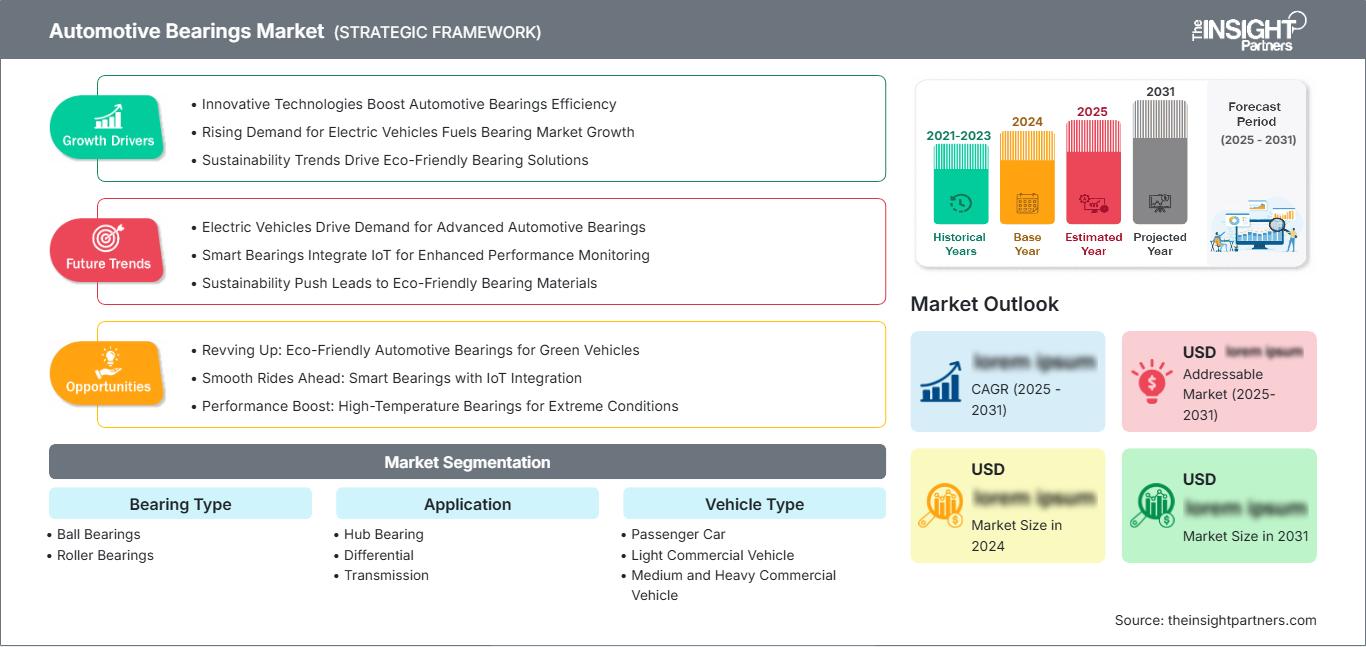
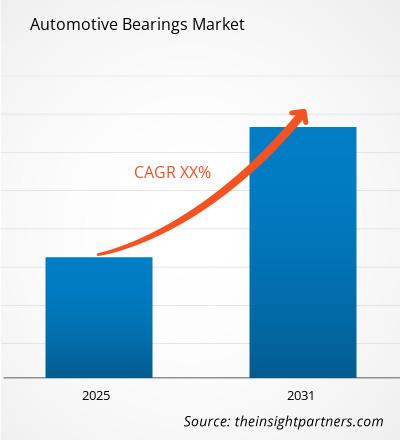
The automotive bearings market was valued at US$ 22.37 Billion in 2025 and is projected to reach US$ 28.27 Billion by 2034, registering a CAGR of 2.63% during 2026–2034. Demand is supported by vehicle production recovery, electrified drivetrain growth, wheel-end replacement activity, and the need for low-friction components across hub, differential, and transmission systems.
North America remains a high-value replacement and technology adoption region as SUVs, pickups, light commercial fleets, and aging vehicles sustain the automotive bearings market size. The region is expected to grow at a CAGR between 2.2–2.8% during 2026–2034, supported by aftermarket hub assemblies, sealed bearing units, and EV-compatible wheel-end specifications.
Automotive Bearings Market Assessment and Insights
- North America: Held 20–23% share in 2025 and is expected to grow at a CAGR between 2.2–2.8% during 2026–2034, supported by aging vehicles, hub replacements, and light truck demand.
- US: Accounted for 78–82% of North America in 2025 and is forecast to grow at a CAGR between 2.3–2.9% during 2026–2034, led by aftermarket wheel-end service.
- Europe: Represented 21–24% share in 2025 and is projected to grow at a CAGR between 2.0–2.6% during 2026–2034, with Germany, the UK, France, Italy, and Spain leading adoption.
- Asia Pacific: Captured 48–52% share in 2025 and is expected to grow at a CAGR between 2.9–3.6% during 2026–2034, led by China, Japan, South Korea, India, and Australia.
- Largest Segment: Ball Bearings held 47–51% market share in 2025 and is projected to grow at a CAGR between 2.4–3.0% during 2026–2034 due to broad use in wheel, motor, and accessory systems.
- High Growth Segment: Hub Bearing held 31–35% share in 2025 and is expected to grow at a CAGR between 3.1–3.8% during 2026–2034 as sealed, sensor-ready wheel-end units expand.
- Key companies analyzed in detail: ILJIN Bearing Co., Ltd., JTEKT Corporation, MinebeaMitsumi Inc., Nachi-Fujikoshi Corp., NSK Ltd., NTN Corporation, Schaeffler Technologies AG & Co. KG, SKF, SNL Bearings Limited, The Timken Company.
Source: The Insight Partners' analysis based on proprietary research, government publications, company annual reports, investor presentations, industry databases, and expert interviews.
Vehicle bearing requirements have moved from basic friction reduction toward sealed, compact, and application-specific units that improve durability and energy efficiency. The automotive bearings market is shaped by the rising use of integrated hub assemblies, low-friction transmission bearings, and high-load roller bearings for utility vehicles. Production dynamics also reflect platform consolidation, localized supply, and tighter quality expectations from OEMs.
Future demand will be influenced by Asia Pacific vehicle output, electrified drivetrains, and longer vehicle service lives in mature economies. EVs reduce some engine bearing demand, but create premium needs for insulated, quiet, and high-speed bearings in e-axles and motors. Suppliers investing in sensor integration, advanced coatings, and regional manufacturing will be better positioned.
Automotive Bearings Market Report Scope
| Report Attribute | Details |
|---|---|
| Market size in 2025 | US$ 22.37 Billion |
| Market Size by 2034 | US$ 28.27 Billion |
| Global CAGR (2026 - 2034) | 2.63% |
| Historical Data | 2021-2024 |
| Forecast period | 2026-2034 |
Automotive Bearings Market Analysis
The automotive bearings market growth is driven by the requirement to reduce friction, support rotating loads, and maintain drivetrain efficiency. Each vehicle uses many bearing types across wheels, transmissions, differentials, steering, pumps, and electric motors. OEM demand follows vehicle production, while aftermarket demand depends on vehicle age, road conditions, mileage, and replacement intervals for hub and wheel-end assemblies.
The automotive bearings market analysis shows that value is shifting toward sealed hub units, high-precision roller bearings, and EV-compatible designs. Steel price volatility, potential counterfeiting, and lower friction demands have to be considered by the suppliers. Rollers continue to be essential since they ensure capacity, durability, and adaptability within passenger cars, light commercial vehicles, and medium and heavy commercial vehicles.
The competition takes place between the global bearing manufacturers with OEM validation and aftermarket presence. They are companies such as JTEKT Corporation, NSK Ltd., NTN Corporation, Schaeffler Technologies AG & Co. KG, SKF, and The Timken Company. ILJIN Bearing Co., Ltd., MinebeaMitsumi Inc., Nachi-Fujikoshi Corp., and SNL Bearings Limited expand regional and application scope.
Investment priorities are low-friction materials, sensor-enabled hub units, automated production facilities, and manufacturing capacity closer to vehicle assembly hubs. Positioning should be based on durability tests, sealing technologies, noise reduction, and the capability to serve ICE and EV platforms. Companies which offer bearing design, condition monitoring systems, and aftermarket presence can protect their margins under average global growth.
● REPORT CUSTOMIZATION
Tailor This Report To Align With Your Specific Business Requirements
This report can be customized to align precisely with your business objectives, scope, and target markets. Customization options include tailored segmentation, geography, competitive analysis, and strategic insights to support informed decision-making.
Customize This Report →WHAT YOU CAN ADJUST
- ● Segmentations
- ● Geography
- ● Competitive Analysis
- ● Language Preferences
Automotive Bearings Market: Strategic Insights
Regional Insights
North America automotive bearings market
North America held 20–23% automotive bearings market share in 2025 and is expected to grow at a CAGR of 2.2–2.8% during 2026–2034. Demand is driven by SUVs, pickups, light commercial vehicles, and extended ownership, which results in the need for more hubs and wheel bearing replacements. The aftermarket segment is still important due to road vibrations, increased load, and harsh weather conditions, which drive faster service intervals.
The market in this region is positively affected by the introduction of EVs, with the need for quieter and low-friction hub and e-drive bearings. Demand from OEMs increases gradually, whereas replacement sales offer stability. Companies with local distribution and anti-counterfeit systems have premium prospects.
U.S. automotive bearings Market
The US accounted for 78–82% of North America in 2025 and is forecast to grow at a CAGR of 2.3–2.9% during 2026–2034. A large vehicle parc, pickup-heavy mix, and high annual mileage sustain recurring wheel-end and transmission bearing service.
The Timken Company, SKF, Schaeffler Technologies AG & Co. KG, NSK Ltd., NTN Corporation, and JTEKT Corporation maintain strong OEM and aftermarket presence. Demand is strongest in hub assemblies, differential bearings, and durable replacements for light trucks, delivery fleets, and aging passenger cars.
Europe automotive bearings Market
Europe represented 21–24% share in 2025 and is projected to grow at a CAGR of 2.0–2.6% during 2026–2034. Germany excels because of premium vehicle manufacturing, powertrain design, and bearing supplier clustering. The UK favors aftermarket and performance segments, whereas France, Italy, and Spain are represented via compact cars and light commercial vehicles.
Electrification and CO2 emissions drive bearing specs towards low-noise, electrical insulation, and compact e-drive integration. Advanced vehicle fleets ensure replacement demand, but rapid electrification reduces bearing requirements for engines. Local suppliers benefit from testing and material advances connected to sustainability.
APAC automotive bearings Market
APAC held 48–52% share in 2025 and is expected to grow at a CAGR of 2.9–3.6% during 2026–2034. China leads through vehicle production and EV scale, while Japan and South Korea support precision manufacturing and global OEM supply.
India adds demand from passenger cars, two-wheelers, and commercial vehicles, while Australia supports replacement through SUVs and utility fleets. Localized production and cost-efficient supply chains keep APAC the largest manufacturing and consumption base.
Middle East & Africa automotive bearings Market
The Middle East and Africa market is expected to grow at a CAGR of 1.8–2.5% during 2026–2034. SUVs, imports, and hot running conditions contribute to the high demands of Saudi Arabia and the UAE.
Assembly activities and aftermarket business in South Africa are well supported, whereas the rest of MEA is replacement-driven. The presence of dust, heat, and heavy load operations offers potential in sealed hub units, sturdy roller bearings, and strong distributors.
Segmentation Analysis
Bearing Type
Bearing Type is expected to grow at a CAGR of 2.4–3.1% during 2026–2034. The automotive bearings market scope is shaped by load profile, rotational speed, packaging, durability, and friction requirements. Ball bearings dominate lighter and high-speed applications, while roller bearings are important where radial load and torque transfer are higher.
- Ball Bearings remain widely used in wheel, motor, steering, accessory, and light-duty transmission systems because they offer low friction, compact packaging, and reliable performance across high-volume vehicle platforms.
- Roller Bearings serve heavier load applications such as differentials, transmissions, commercial vehicles, and wheel-end assemblies where load distribution, durability, and tolerance to harsh duty cycles are critical.
Application
Application is projected to grow at a CAGR of 2.6–3.3% during 2026–2034 as hub bearing units, differentials, and transmissions require distinct performance profiles. Sealed wheel-end designs lead replacement value, while powertrain bearings evolve with electrification and hybridization.
- Hub Bearing demand is supported by replacement cycles, integrated sensors, sealing improvements, and EV wheel-end requirements, where low noise and reliability directly affect safety and customer satisfaction.
- Differential applications require durable roller and tapered bearing solutions that manage torque loads in SUVs, pickups, commercial vehicles, and all-wheel-drive platforms under varied operating conditions.
- Transmission bearings support gear rotation and shaft alignment in manual, automatic, hybrid, and e-drive systems, making precision, lubrication compatibility, and low-friction design central to efficiency.
Vehicle Type
Vehicle Type is forecast to grow at a CAGR of 2.3–3.0% during 2026–2034 as demand follows production volume, vehicle weight, operating cycle, and replacement intensity. Passenger cars dominate volume, while commercial vehicles raise value through heavier-duty specifications.
- Passenger Car applications provide the broadest volume base because bearings are used across wheels, steering, transmissions, electric accessories, and comfort systems in both ICE and electrified models.
- Light Commercial Vehicle demand is supported by delivery growth, high mileage, heavier payloads, and frequent wheel-end service requirements across vans, pickups, and utility fleets.
- Medium and Heavy Commercial Vehicle platforms require robust roller bearings, differential bearings, and hub assemblies that withstand higher loads, longer duty cycles, and demanding maintenance schedules.
Opportunity Snapshot
| Application | Revenue Contribution | Trend Tag | Adoption Stage |
| Hub Bearing | High | Wheel Safety | Mature |
| Differential | Medium | Torque Load | Scaling |
| Transmission | Medium | Low Friction | Scaling |
Automotive Bearings Market Growth Drivers and Impact Analysis
Vehicle Parc Ageing and Wheel-End Replacement
The lengthening period of vehicle ownership is raising the number of vehicles needing wheel and hub bearings. These parts are exposed to road shock, contaminants, water and load cycling, which slowly degrade their performance over time. The vehicle owner gains an advantage from aftermarket suppliers, as service centers will typically replace entire hub bearings in order to save on labor and avoid safety hazards. Replacement rates are high in North America and Europe, whereas APAC has volume from a growing vehicle parc.
Electrification Creates Premium Bearing Requirements
Electrification affects bearing requirements, even where overall part numbers reduce. Electric motors and electric axles need quietness, electrical insulation, high-speed performance, and minimal friction to preserve the driving range and durability of components. This creates a demand for increased value from bearings, which cost more due to their unique construction, such as ceramic hybrids, coatings, and advanced cages. Bearing suppliers can balance the reduction in engine bearing sales through sales into EV wheel ends, electric motor shafts, and transmission applications.
Commercial Vehicle Load and Uptime Needs
Bearing systems in light, medium, and heavy commercial vehicles need to be able to withstand weight changes, long miles, and cyclical operations. Long service intervals are valued by fleet owners since any delays have a direct effect on delivery efficiency and costs. This is one of the reasons behind the demand for roller bearing systems, hub bearing units, and differential bearing systems with good sealing and fatigue resistance properties. Companies that offer durable products, technical assistance, and distributors can secure more profitable deals.
Automotive Bearings Market Future Trends
Sensor-Integrated Smart Bearings
Automotive bearings market trends are moving toward sensor-integrated products that measure speed, temperature, vibration, and condition data near critical rotating points. These functions support predictive maintenance, ADAS wheel-speed accuracy, and connected service diagnostics. Smart hubs will become more relevant as vehicles rely on software to manage safety and uptime. Suppliers that combine mechanical reliability with electronics, sealing, and data quality can differentiate beyond standard bearing supply and secure longer platform relationships with OEMs and fleet channels.
Low-Friction Materials for E-Drives
The future of bearing development would focus on reducing friction losses, electrical insulation, and noise in electric drives, including electric motors, reducers, and compact transmissions. The use of ceramic rolling elements, improved coatings, better lubricants, and lightweight cages would receive increased attention since minor improvements in efficiency will contribute to the driving range and thermal management. This will not displace traditional steel bearings but will lead to the creation of premium applications.
Automotive Bearings Market Opportunities
Aftermarket Hub Assembly Expansion
Large vehicle fleets create opportunity for complete hub assemblies that simplify repair, improve safety, and reduce wrong-part installation. Automotive bearings market Forecasts point to resilient demand in regions with older vehicles, high mileage, and rough roads. Suppliers should expand model coverage, improve catalog accuracy, and offer corrosion-resistant sealed units for SUVs, pickups, vans, and passenger cars. Partnerships with distributors and repair chains can improve availability, while anti-counterfeit packaging protects brand trust in price-sensitive aftermarket channels.
EV-Compatible Bearing Portfolios
The electrification of platforms presents an opportunity for manufacturers of bearings that can insulate and reduce noise and increase the speed of e-motors, e-axles, and wheel hubs. There is a need for validation of products that will mitigate the problems of electrical pitting, vibration, and losses, and still meet the warranty needs. It is recommended that resources be invested in ceramic hybrid bearings, new lubricants, cages, and high-speed thermal testing.
Frequently Asked Questions

- Comprehensive Market Sizing and Forecast Analysis
- Detailed Segmentation Analysis
- In-Depth Market Dynamics Assessment
- Regional and Country-Level Insights
- Competitive Landscape and Company Benchmarking
- Strategic Business Intelligence
Recent Reports
Testimonials

The Insight Partners provided valuable market intelligence that supported our global go-to-market strategy. Their team was professional, responsive, and attentive to our feedback, providing thoughtful analysis and helpful methodological clarifications throughout the project.
Junmo Kim Chief Financial Officer (CFO), Enertech Co., Ltd.
The Insight Partners' SCADA System Market report is comprehensive, with valuable insights on current trends and future forecasts. The team was highly professional, responsive, and supportive throughout. We are very satisfied and highly recommend their services.
RAN KEDEM Partner, Reali Technologies LTDs
I requested a report on a very specific software market and the team produced the report in a few days. The information was very relevant and well presented. I then requested some changes and additions to the report. The team was again very responsive and I got the final report in less than a week.
JEAN-HERVE JENN Chairman, Future Analytica
We worked with The Insight Partners for an important market study and forecast. They gave us clear insights into opportunities and risks, which helped shape our plans. Their research was easy to use and based on solid data. It helped us make smart, confident decisions. We highly recommend them.
PIYUSH NAGPAL Sr. Vice President, High Beam Global
The Insight Partners delivered insightful, well-structured market research with strong domain expertise. Their team was professional and responsive throughout. The user-friendly website made accessing industry reports seamless. We highly recommend them for reliable, high-quality research services
YUKIHIKO ADACHI CEO, Deep Blue, LLC.
This is the first time I have purchased a market report from The Insight Partners.While I was unsure at first, I visited their web site and felt more comfortable to take the risk and purchase a market report.I am completely satisfied with the quality of the report and customer service. I had several questions and comments with the initial report, but after a couple of dialogs over email with their analyst I believe I have a report that I can use as input to our strategic planning process.Thank you so much for taking the extra time and making this a positive experience.I will definitely recommend your service to others and you will be my first call when we need further market data.
JOHN SUZUKI President and Chief Executive Officer, Board Director, BK Technologies
I wish to appreciate your support and the professionalism you displayed in the course of attending to my request for information regarding to infectious disease IVD market in Nigeria. I appreciate your patience, your guidance, and the fact that you were willing to offer a discount, which eventually made it possible for us to close a deal. I look forward to engaging The Insight Partners in the future, all thanks to the impression you have created in me as a result of this first encounter.
DR CHIJIOKE ONYIA MANAGING DIRECTOR, PineCrest Healthcare Ltd.Reason to Buy
- Informed Decision-Making
- Understanding Market Dynamics
- Competitive Analysis
- Identifying Emerging Markets
- Customer Insights
- Market Forecasts
- Risk Mitigation
- Boosting Operational Efficiency
- Strategic Planning
- Investment Justification
- Tracking Industry Innovations
- Aligning with Regulatory Trends





 Get Free Sample for