
Automotive Catalytic Converter Market Trends, Size & Forecast by 2034
Coverage: By Product (Two-way oxidation, Three-way oxidation-reduction, Diesel oxidation catalyst); Material (Platinum, Palladium, Rhodium) , and Geography (North America, Europe, Asia Pacific, and South and Central America)
- Status : Data Released
- Report Code : TIPRE00020742
- Category : Electronics and Semiconductor
- No. of Pages : 150
- Available Report Formats :


- Last update date : July 17, 2026


2025 Market Size
US$ 190.86 Bn
Base year value
2034 Forecast
US$ 390.84 Bn
Projected by 2034
CAGR 2026-2034
8.29 %
Growth rate
Addressable Market
US$ 2,612.41 Bn
(2026-2034)
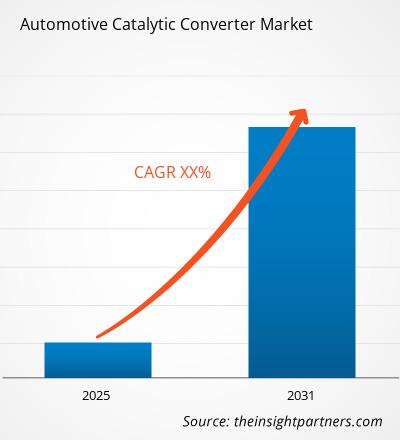
The Automotive Catalytic Converter Market size is projected to grow from US$ 190.86 Billion in 2025 to US$ 390.84 Billion by 2034, registering a CAGR of 8.29% during 2026–2034. The association with respect to demand is still related to ICE manufacturing, hybrid automobile sales, tailpipe emission regulations, and vehicle fleet renewal processes; meanwhile, the catalyst loading process is still balancing performance efficiency and exposure to the price of platinum group metals.
The market value of Automotive Catalytic Converter in North America is set to grow at an approximate CAGR of 6.8-7.4% until 2034, driven by multi-pollutant standards implemented by EPA starting from MY2027 and large gasoline vehicle parc in North America. Higher hybrid sales, in-use durability standards, and replacement demand contribute to the growth of converter demand regardless of battery electric vehicle penetration.
Automotive Catalytic Converter Market Assessment and Insights
- North America accounted for 19–22% of the Automotive Catalytic Converter Market share in 2025 and is projected to grow at a CAGR of 6.8–7.4% between 2026–2034, supported by U.S. regulatory durability requirements and replacement demand.
- US represented 78–82% of North America in 2025 and is expected to expand at a CAGR of 6.9–7.5% between 2026–2034.
- Europe held 17–20% share in 2025 and is forecast to grow at a CAGR of 6.2–6.9% between 2026–2034, led by Germany, France, the UK, Italy, and Spain.
- Asia Pacific captured 53–57% share in 2025 and is expected to grow at a CAGR of 8.8–9.4% between 2026–2034, led by China, India, Japan, and South Korea.
- Largest Segment Three-way oxidation-reduction held 58–62% market share in 2025, with a CAGR of 7.7–8.3% between 2026–2034.
- High Growth Segment Diesel oxidation catalyst held 20–24% market share in 2025, with a CAGR of 8.9–9.6% between 2026–2034.
- Key companies analyzed in detail: BASF SE, BENTELER International Aktiengesellschaft, BOSAL, Marelli Corporation, Standard Motor Products Europe Limited, Eberspächer Gruppe GmbH & Co. KG, FORVIA SE, Johnson Matthey Plc, Tenneco Inc., Umicore SA.
Source: The Insight Partners' analysis based on proprietary research, government publications, company annual reports, investor presentations, industry databases, and expert interviews.
Catalyst technology is shifting from the conventional oxidation process to close-coupled catalytic converters of high cell density that are thermally robust and facilitate cold-start capability as well as extended life. The automobile manufacturers have redesigned their exhaust systems based on hybrid drive cycles since the latter involves frequent start-stop actions that may result in low catalyst temperatures. The suppliers are reacting to this trend through enhanced washcoat formulation, optimal substrate design and efficient precious metals utilization, and production strategies focus more on platform mix, engine downsize and certification cycle.
In the coming years, growth is likely to be widespread in India, Southeast Asia, Latin America, and selected markets in the Middle East with the regulation of urban air quality converging with vehicle emissions on a worldwide basis. The supportive regulatory environment in terms of Euro 7, US EPA regulations, China 6B implementation and the introduction of Bharat Stage VI standards is driving investments in next-generation aftertreatment technology.
Automotive Catalytic Converter Market Report Scope
| Report Attribute | Details |
|---|---|
| Market size in 2025 | US$ 190.86 Billion |
| Market Size by 2034 | US$ 390.84 Billion |
| Global CAGR (2026 - 2034) | 8.29% |
| Historical Data | 2021-2024 |
| Forecast period | 2026-2034 |
Automotive Catalytic Converter Market Analysis
The Automotive Catalytic Converter Market forecast include stricter emission standards, increasing sales of hybrid cars, and the manufacture of gasoline and diesel engines in developing nations. Converter demand is a function of engine production, growth in the car parc, and regulation compliance, thus OEM installation and aftermarket replacement both have equal importance in demand dynamics. Availability of platinum, palladium, and rhodium is key to controlling costs.
Opportunities are found in the process of catalyst development, manufacture of substrates either ceramic or metallic in nature, canning, exhaust integration, and recycling. In the context of the Automotive Catalytic Converter Market, it is observed that suppliers with closed-loop precious metal recycling capabilities, regional coating capabilities, and engine calibration capabilities will be better suited.
In the Automotive Catalytic Converter Market report the competition is led by integrated catalyst and exhaust system specialists. BASF SE, Johnson Matthey Plc, and Umicore SA focus on catalyst chemistry and precious metal optimization, while FORVIA SE, Eberspächer Gruppe GmbH & Co. KG, Tenneco Inc., BENTELER International Aktiengesellschaft, BOSAL, Marelli Corporation, and Standard Motor Products Europe Limited strengthen system integration and replacement channel access.
Investment is being made in high-durability coatings, low PGM content catalyst formulations, local production and recycling partnerships. Positioning will increasingly rely upon OEM assistance via real world emission testing, endurance proving and thermal management suitable for hybrids. Companies capable of combining material science with exhaust packaging capabilities will likely retain market share as batteries gain ground.
● REPORT CUSTOMIZATION
Tailor This Report To Align With Your Specific Business Requirements
This report can be customized to align precisely with your business objectives, scope, and target markets. Customization options include tailored segmentation, geography, competitive analysis, and strategic insights to support informed decision-making.
Customize This Report →WHAT YOU CAN ADJUST
- ● Segmentations
- ● Geography
- ● Competitive Analysis
- ● Language Preferences
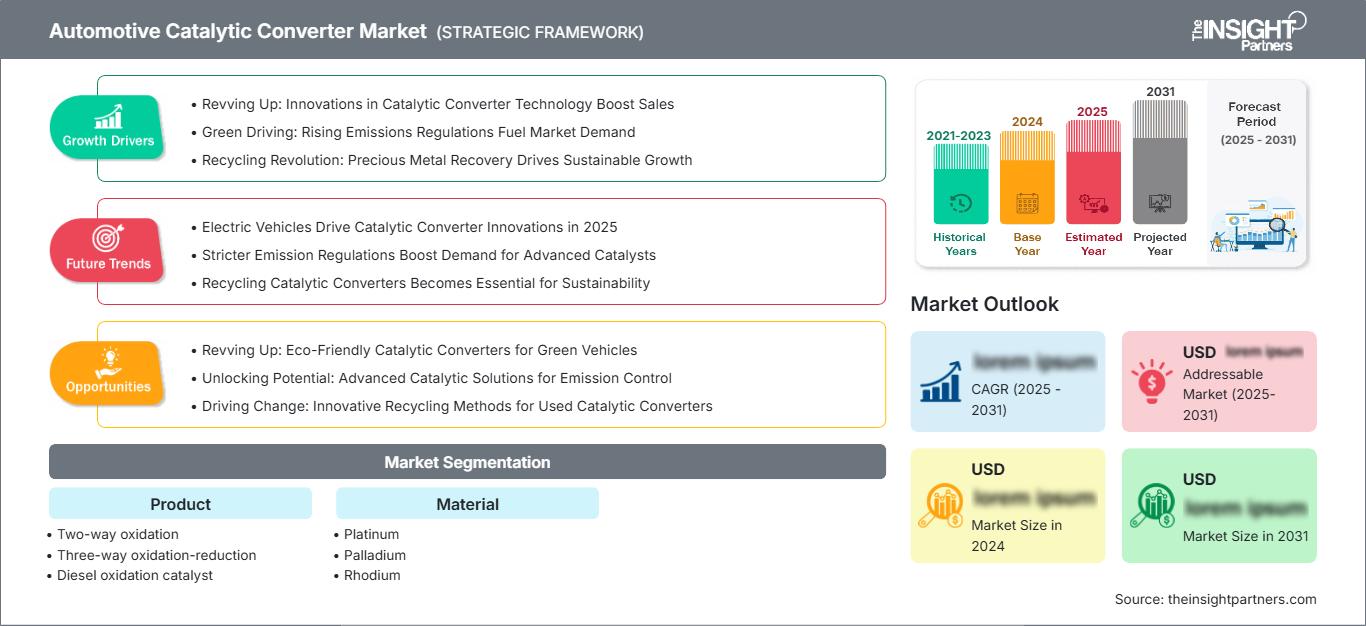
Automotive Catalytic Converter Market: Strategic Insights
Regional Insights
North America Automotive Catalytic Converter Market
North America represented 19–22% of global revenue in 2025 and is expected to grow at a CAGR of 6.8–7.4% through 2034.The demand will be driven by EPA standards for model years 2027 and beyond, state emission inspection requirements, and a high number of installed gasoline SUVs, pickups, and light commercial vehicles which require catalyst systems.
Adoption of hybrid technology has changed the face of catalyst system design since intermittent engine operation requires fast light-off and steady efficiency. Regional market share is further determined by aftermarket replacements, replacements due to theft, and regional sourcing efforts. The presence of suppliers throughout the United States and Mexico ensures coating, canning, and exhaust assembly robustness.
U.S. Automotive Catalytic Converter Market
The U.S. accounted for 78–82% of North American revenue in 2025 and is projected to grow at a CAGR of 6.9–7.5% through 2034. The demand base of the country depends on high yearly mileage, demand for durable pickups and SUVs, effective in-service emissions regulation, and increasing offerings of hybrid cars by popular car brands.
Good relationships between customers and OEMs and aftermarket distributors are enjoyed by BASF SE, Johnson Matthey Plc, Tenneco Inc., FORVIA SE, and Umicore SA. The applications are becoming oriented towards three-way systems coupled close to engines, combinations with gasoline particulate filters, and highly durable catalytic converter assemblies.
Europe Automotive Catalytic Converter Market
Europe held 17–20% share in 2025 and is expected to expand at a CAGR of 6.2–6.9% through 2034. The dominant player is Germany due to its premium car production, engineering prowess at the Tier 1 level, and Euro 7 readiness. The UK market is driven by replacement trends and hybridization of vehicles in both fleets and retail environments.
France, Italy, and Spain contribute to the program through the manufacture of compact cars, park replacement with diesel and testing for emission levels. The specifications of Euro 7 regarding increased durability and monitoring encourage suppliers to develop products that have low thermal breakdown and oxygen storage capabilities. Some companies that are important in technological development include Eberspächer Gruppe GmbH & Co. KG, FORVIA SE, Johnson Matthey Plc and Umicore SA.
APAC Automotive Catalytic Converter Market
APAC accounted for 53–57% share in 2025 and is projected to grow at a CAGR of 8.8–9.4% through 2034. China is the dominant player in the area, thanks to China 6b certification, higher vehicle production, and robust hybrid vehicle production. Japan and South Korea create additional demand through sophisticated gasoline hybrid vehicles and export-driven production.
Stricter inspection methods, Bharat Stage VI emission standards, and replacement of their truck fleet would prove beneficial for India, Australia, and Southeast Asia. In addition, localization of catalyst coatings, exhaust systems production, and recycling would become critical for original equipment manufacturers to help them manage costs, shorten lead time, and source platinum group metals for engines.
Middle East & Africa Automotive Catalytic Converter Market
Middle East & Africa is forecast to grow at a CAGR of 7.1–7.8% through 2034, with Saudi Arabia leading regional demand. Importation of vehicles, fuel quality enhancements, and infrastructural development are boosting converter installations and replacements, particularly in passenger cars, light commercial vehicles, and construction-related transportation operations.
UAE, South Africa, and RoMEA exhibit the need for logistics and tourism fleets as well as urban air quality programs. The growth has been erratic due to the degree of compliance efforts varying among countries; nevertheless, development of inspection procedures and new vehicle importation are promoting use of compliant catalytic converters.
Segmentation Analysis
Product
The product segment is expected to grow at a CAGR of 8.0–8.6% during 2026–2034, reflecting varied emission control needs across gasoline, diesel, hybrid, and commercial vehicle platforms. The Automotive Catalytic Converter Market forecast is strongest in three-way systems because gasoline engines dominate passenger vehicles, while diesel oxidation catalysts remain important for commercial fleets and off-highway-adjacent applications.
- Two-way oxidation systems retain demand in selected gasoline and legacy applications where carbon monoxide and hydrocarbon conversion remain primary requirements, particularly in cost-sensitive replacement channels.
- Three-way oxidation-reduction systems are the largest product category, balancing nitrogen oxide, carbon monoxide, and hydrocarbon control for modern gasoline engines and hybrid vehicles.
- Diesel oxidation catalyst products are strategically important for diesel light commercial vehicles, trucks, and buses, especially when paired with particulate filters and selective catalytic reduction systems.
Material
The material segment is projected to grow at a CAGR of 7.6–8.2% from 2026–2034 as catalyst formulators optimize platinum, palladium, and rhodium loadings for cost, durability, and conversion efficiency. Precious metal substitution remains technically constrained because each metal performs differently under gasoline, diesel, lean-burn, and high-temperature operating conditions.
- Platinum is widely used in diesel oxidation and selected gasoline formulations due to strong oxidation performance, making supply reliability and recycling important for cost management.
- Palladium remains critical in gasoline three-way catalysts because of high hydrocarbon and carbon monoxide conversion efficiency under typical stoichiometric engine conditions.
- Rhodium is strategically essential for nitrogen oxide reduction, and its limited supply encourages precise loading, recovery, and thrifting strategies across advanced catalyst systems.
Opportunity Snapshot
| Product | Revenue Contribution | Trend Tag | Adoption Stage |
| Two-way oxidation | Medium | Legacy Retrofit | Mature |
| Three-way oxidation-reduction | High | Hybrid Light-off | Mature |
| Diesel oxidation catalyst | Medium | Fleet Renewal | Scaling |
Automotive Catalytic Converter Market Growth Drivers and Impact Analysis
Stricter Lifetime Emission Compliance
The rules are shifting towards drive cycle emissions testing, greater durability and robustness in terms of time period and onboard diagnostic systems. The Euro 7 rules demand emission control for extended durability while the United States’ multipollutant rules improve fleet emissions from model year 2027 onwards. It results in high value for thermally stable washcoats, close coupled catalytic converters and robust canning systems. The car manufacturers need the catalysts which have the capability to retain their performance even after traveling thousands of miles and in varied temperatures and hybrid drive cycles. Hence, the Automotive Catalytic Converter Market is gaining due to innovation and not volume.
Hybrid Vehicle Expansion Keeps Aftertreatment Relevant
While hybrid cars are designed to lower fuel usage, they still have high-performance catalytic converters as they operate by restarting the engine periodically after running electrically. These hot and semi-hot startups put great challenges on the light-off process, oxygen storage capability, and nitrogen oxide reduction. Car manufacturers thus demand catalytic converters that are fast-heating, have tight packaging constraints, and are robust in intermittently flowing exhaust environments. This trend is good news to catalytic converter manufacturers with strong capabilities in substrate engineering, heating management, and catalyst coating technology.
Aftermarket Replacement and Recycling Economics
Old vehicles, failing inspections, rusting, theft-related replacements, and warranty expirations ensure ongoing aftermarket activity in developed nations. Simultaneously, recovery of platinum group metals has emerged as an important strategy since platinum, palladium, and rhodium from recycling can help mitigate risks associated with buying and guard against price volatility. The replacement process is increasingly quality oriented with regulators cracking down on parts that do not meet standards. Those with aftermarket products and metal recovery capabilities can benefit from a steady income stream through the supply chain.
Automotive Catalytic Converter Market Future Trends
Low-PGM Catalyst Architecture
The Automotive Catalytic Converter market trends will involve efforts toward minimization of intensity of PGM while maintaining high levels of efficiency. Future suppliers will aim to use optimized washcoat dispersion, oxygen storage materials, advanced ceria-zirconia chemistry, and precise coating in order to reduce the amount of metal used per unit. Such trend is necessary since the supply of rhodium and palladium is relatively centralized and cost-sensitive. Low-PGM designs can bring better margins, allow more affordable compliance in developing countries, and assist OEMs with procurement strategies.
Integrated Aftertreatment Modules
The exhaust system of tomorrow is expected to integrate catalytic reaction, particulate trapping, insulation, sensing, and diagnostic capabilities within smaller modules. Such an architecture facilitates tight integration on hybrid platforms, improves cold start behavior, and eases assembly for vehicle manufacturers looking to reduce the number of interfaces. The module concept also helps in differentiating suppliers since its success relies on a combination of chemistry, substrate, sensing, and mechanical design. With regulatory authorities stressing real-world durability, suppliers able to validate complete exhaust systems will enjoy an advantage over component suppliers, especially in Europe, North America, China, Japan, and South Korea.
Automotive Catalytic Converter Market Opportunities
Localized Catalyst Coating in Emerging Production Hubs
Forecasting on the Automotive Catalytic Converter Market suggests that there will be ample room for coatings, substrates finishing, and canning facilities in India, Southeast Asia, Mexico, and Eastern Europe. OEMs need regional manufacturing facilities that will minimize logistical risks and will help with better currency alignment and homologation modifications. There will be opportunities to invest in manufacturing facilities close to engine and exhaust assembly locations with recycling facilities included in the procurement process. The regional manufacturing facility will also assist the supplier to develop its catalyst recipe according to the local requirements.
Certified Aftermarket and Anti-Theft Replacement Solutions
Certified aftermarket converters present a good opportunity as the inspection programs and enforcement of regulations become more stringent. There is increasing demand for products which perform at the same level as originals, which do not fail prematurely, and have verifiable amounts of precious metals. Prevention of theft presents an additional opportunity for protection against stolen converter assemblies and replacement kits. This opportunity is best presented by distribution and manufacture of certified products for fitment, compliance, warranties, and recovery of metals. It applies mainly to the US, Canada, UK, Germany, Australia, and urban Asia.
Recent Developments
- June 2026: HMS Networks expanded its PEAK product portfolio with the launch of the PAE-Media Converter, its first Automotive Ethernet solution designed for vehicle network development, testing, and validation. The device enables communication between Automotive Ethernet standards such as 100BASE-T1 and 1000BASE-T1 with traditional Ethernet networks, helping engineers simplify testing workflows. The solution supports modern vehicle architectures by improving connectivity validation and accelerating the development of next-generation automotive systems.
- June 2026: Swiss automotive technology company Feintool inaugurated its first production facility in India, located in Pune, to support the growing automotive market in the region. The new plant will manufacture high-precision fine-blanked automotive components and help Feintool strengthen its local-for-local supply strategy. The facility is part of the company's expansion plans to serve Indian automakers and explore future applications in electric mobility, battery systems, and other industrial sectors.
- May 2024:STMicroelectronics introduced new automotive-qualified synchronous DC/DC buck converters designed for low-power, low-noise, and isolated applications in vehicles. The A6983 series includes variants optimized for body electronics, audio systems, and inverter gate drivers, offering improved efficiency and reduced power consumption. The A6983I isolated buck converter is designed for applications such as EV traction inverters and onboard chargers, while the compact devices help simplify integration and reduce component requirements in automotive systems.
Frequently Asked Questions

- Comprehensive Market Sizing and Forecast Analysis
- Detailed Segmentation Analysis
- In-Depth Market Dynamics Assessment
- Regional and Country-Level Insights
- Competitive Landscape and Company Benchmarking
- Strategic Business Intelligence
Recent Reports
Testimonials

The Insight Partners' SCADA System Market report is comprehensive, with valuable insights on current trends and future forecasts. The team was highly professional, responsive, and supportive throughout. We are very satisfied and highly recommend their services.
RAN KEDEM Partner, Reali Technologies LTDs
I requested a report on a very specific software market and the team produced the report in a few days. The information was very relevant and well presented. I then requested some changes and additions to the report. The team was again very responsive and I got the final report in less than a week.
JEAN-HERVE JENN Chairman, Future Analytica
We worked with The Insight Partners for an important market study and forecast. They gave us clear insights into opportunities and risks, which helped shape our plans. Their research was easy to use and based on solid data. It helped us make smart, confident decisions. We highly recommend them.
PIYUSH NAGPAL Sr. Vice President, High Beam Global
The Insight Partners delivered insightful, well-structured market research with strong domain expertise. Their team was professional and responsive throughout. The user-friendly website made accessing industry reports seamless. We highly recommend them for reliable, high-quality research services
YUKIHIKO ADACHI CEO, Deep Blue, LLC.
This is the first time I have purchased a market report from The Insight Partners.While I was unsure at first, I visited their web site and felt more comfortable to take the risk and purchase a market report.I am completely satisfied with the quality of the report and customer service. I had several questions and comments with the initial report, but after a couple of dialogs over email with their analyst I believe I have a report that I can use as input to our strategic planning process.Thank you so much for taking the extra time and making this a positive experience.I will definitely recommend your service to others and you will be my first call when we need further market data.
JOHN SUZUKI President and Chief Executive Officer, Board Director, BK Technologies
I wish to appreciate your support and the professionalism you displayed in the course of attending to my request for information regarding to infectious disease IVD market in Nigeria. I appreciate your patience, your guidance, and the fact that you were willing to offer a discount, which eventually made it possible for us to close a deal. I look forward to engaging The Insight Partners in the future, all thanks to the impression you have created in me as a result of this first encounter.
DR CHIJIOKE ONYIA MANAGING DIRECTOR, PineCrest Healthcare Ltd.Reason to Buy
- Informed Decision-Making
- Understanding Market Dynamics
- Competitive Analysis
- Identifying Emerging Markets
- Customer Insights
- Market Forecasts
- Risk Mitigation
- Boosting Operational Efficiency
- Strategic Planning
- Investment Justification
- Tracking Industry Innovations
- Aligning with Regulatory Trends





 Get Free Sample for