
Automotive Display System Market Size, Share & Forecast by 2034
Coverage: By Display Technology (AMOLED, PMLCD, PMOLED, TFT, LCD); Touch Technology (TP bound, In-cell, Oncell); Applictaions (Head Up Display, Instrument Cluster, Center Stack Display, Rear Seat Entertainment Display, Rear View Mirror Display, Portable Navigation Device, Other) , and Geography (North America, Europe, Asia Pacific, and South and Central America)
- Status : Data Released
- Report Code : TIPRE00004360
- Category : Electronics and Semiconductor
- No. of Pages : 150
- Available Report Formats :


- Last update date : July 17, 2026


2025 Market Size
US$ 26.38 Bn
Base year value
2034 Forecast
US$ 57.32 Bn
Projected by 2034
CAGR 2026-2034
9.00 %
Growth rate
Addressable Market
US$ 374.41 Bn
(2026-2034)
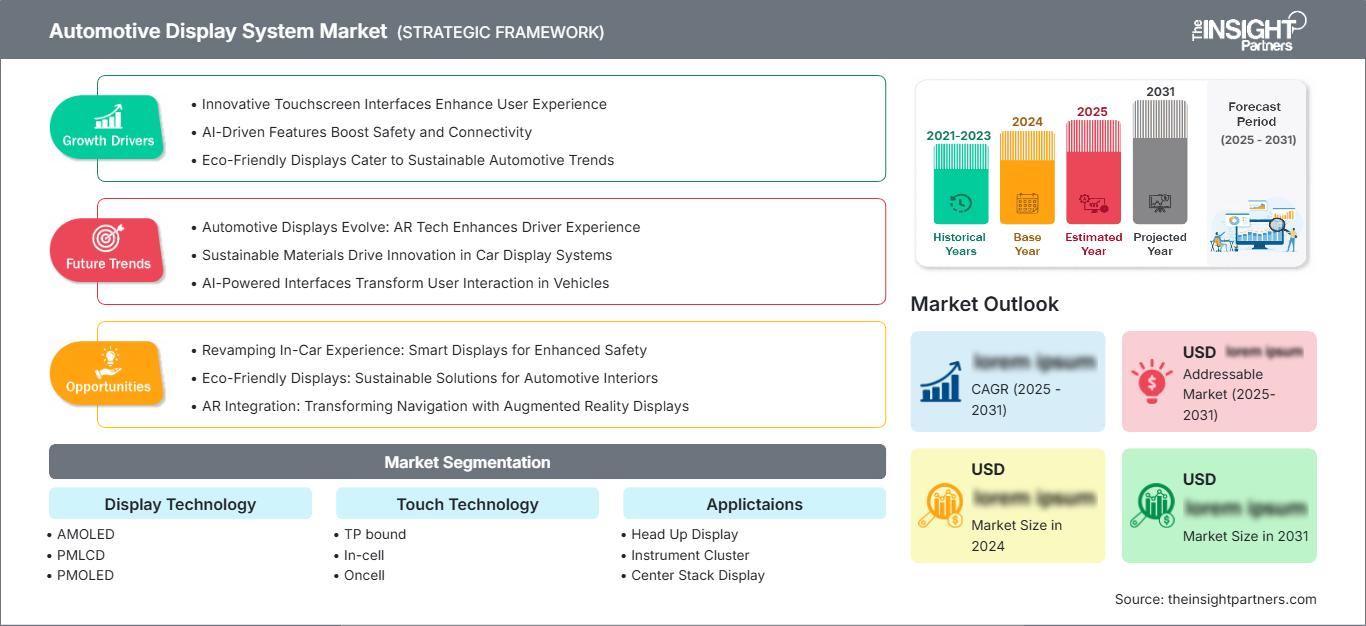
Automotive Display System Market size was estimated at US$ 26.38 Billion in 2025 and is forecast to reach US$ 57.32 Billion by 2034, growing at a CAGR of 9.00% during 2026-2034. The growth will be driven by increasing electronics content in vehicles, shift towards digital cockpit, launch of electric vehicles, and development of safety-focused interfaces for passengers as well as commercial premium and connectivity applications.
North America continues to play a significant role in terms of regions, as the market size for Automotive Display Systems is fuelled by rising adoption of EVs, ADAS technology, and customer demands for large infotainment screens. The regional demand is anticipated to increase in a range of 8.2-8.8% CAGR through 2026-2034.
Automotive Display System Market Assessment and Insights
- North America: The region is estimated to hold 24–28% Automotive Display System Market share in 2025 and grow at a CAGR of 8.2–8.8% during 2026–2034, supported by EV launches, premium cockpit programs, and ADAS-linked display demand.
- US: The country represents 78–82% of North America in 2025 and is projected to grow at a CAGR of 8.4–9.0% during 2026–2034, led by digital cockpit adoption.
- Europe: Europe accounts for 21–25% share in 2025 and is expected to grow at a CAGR of 7.8–8.4% during 2026–2034. Germany, France, the UK, Italy, and Spain lead deployment through premium vehicles and safety regulation.
- Asia Pacific: Asia Pacific represents 43–47% share in 2025 and is forecast to grow at a CAGR of 9.6–10.2% during 2026–2034, with China, Japan, South Korea, and India driving cockpit electronics scale.
- Largest Segment: Center Stack Display holds 34–38% market share in 2025 and is expected to grow at a CAGR of 8.5–9.1% during 2026–2034, reflecting infotainment consolidation.
- High Growth Segment: Head Up Display holds 13–17% market share in 2025 and is expected to grow at a CAGR of 10.6–11.4% during 2026–2034 as AR navigation expands.
- Key companies analyzed in detail: Alpine Electronics, Inc.; Continental AG; Aptiv PLC; Garmin Ltd.; LG Display Co., Ltd.; Nippon Seiki Co., Ltd.; Panasonic Automotive Systems Co., Ltd.; Pioneer Corporation; Robert Bosch GmbH; Yazaki Corporation.
Source: The Insight Partners' analysis based on proprietary research, government publications, company annual reports, investor presentations, industry databases, and expert interviews.
The cockpit’s electronics have evolved from discrete radio and gauge modules to become integrated human machine interface systems. This trend can be seen in increased center screen sizes, cluster flexibility, touch integrated panels, and the development of OLED cockpits where the automotive industry can create differentiation without additional mechanical design effort. Production considerations now include availability of display panels, automotive grade reliability testing, software compatibility, thermal management, optical bonding, and long OEM qualification processes.
Demand in the future will be driven by electrification, connectivity, and more stringent attention management standards. New geographies will be adding display content as their own OEMs compete based on digital technology, while established geographies will be moving towards wider screens, curved displays, and projection heads up display systems. A favorable regulatory environment for driver monitoring and better content presentation will help display manufacturers capable of balancing optics, safety and costs.
Automotive Display System Market Report Scope
| Report Attribute | Details |
|---|---|
| Market size in 2025 | US$ 26.38 Billion |
| Market Size by 2034 | US$ 57.32 Billion |
| Global CAGR (2026 - 2034) | 9.00% |
| Historical Data | 2021-2024 |
| Forecast period | 2026-2034 |
Automotive Display System Market Analysis
Market Growth Factors include the increase in number of displays per vehicle, usage of digital instrument cluster, and driver assist technologies which rely on visual cues. Electric vehicles drive demand due to the fact that range, charging, battery health, navigation, energy management, and telematics are all communicated via display screens. The automotive display system value chain includes substrate, TFT backplane, OLED components, touch sensors, optical bonding, controller, software middleware, Tier 1 integration, and OEM testing.
Supply conditions will be driven by the increasing market penetration of LTPS TFT LCD and OLED screens at the expense of traditional a-Si LCD screens. Industry data suggests that advanced screen technologies have already captured more than half of the automotive panel market revenue in 2025, with the fast-growing shipment of head-up displays outpacing the growth in center stack display sales.
According to Automotive Display System Market analysis, competitive advantage comes from companies offering combined hardware display, cockpit electronics, and OEM programs implementation. Continental AG, Robert Bosch GmbH, Panasonic Automotive Systems Co., Ltd., and Aptiv PLC compete in integrated cockpit and domain controller capabilities, whereas LG Display Co., Ltd. offers advanced display panels. Nippon Seiki Co., Ltd. and Yazaki Corporation retain significance for clusters and instrumentation.
Positioning of the companies depends on software-defined vehicle development. Garmin Ltd., Pioneer Corporation, and Alpine Electronics, Inc. offer navigation, infotainment, and after-market enhanced cockpit experience capabilities, whereas Tier 1 competitors compete in production programs of integrated displays, compute, sensors, and HMI software. The investments are shifting towards panoramic screens, embedded camera displays, dual-view OLED, and AR-HUD optics due to the fact that they increase content value per car.
● REPORT CUSTOMIZATION
Tailor This Report To Align With Your Specific Business Requirements
This report can be customized to align precisely with your business objectives, scope, and target markets. Customization options include tailored segmentation, geography, competitive analysis, and strategic insights to support informed decision-making.
Customize This Report →WHAT YOU CAN ADJUST
- ● Segmentations
- ● Geography
- ● Competitive Analysis
- ● Language Preferences
Automotive Display System Market: Strategic Insights
Regional Insights
North America Automotive Display System Market
North America has 24-28% share in 2025 and is anticipated to witness growth of CAGR of 8.2-8.8% between 2026-2034. The market share in North America has been driven by increased demand for premium pickup trucks, SUVs, EVs, and infotainment packages. Automakers give preference to larger central display screens, digital clusters, and visualization for advanced driver-assistance systems in order to make their products unique.
The region receives a boost from vehicle software architecture development, over-the-air updates, and consumer willingness for cockpit services based on subscriptions. Manufacturers of display units need to satisfy demanding standards of sunlight visibility, thermal, and mechanical robustness, as well as cybersecurity and functional safety. Growth factors include HUD for luxury vehicles, fleet safety interface, and EV displays that facilitate charging and routing.
U.S. Automotive Display System Market
The US holds 78-82% of the North American market in 2025 and is expected to grow at a CAGR of 8.4-9.0% during 2026-2034. Domestic as well as international OEMs use digital cockpit systems to improve their brand value especially in electric vehicles, sport utility vehicles, and higher trim levels owing to customer preference for larger displays and navigation systems.
There are several players operating in the market which include Continental AG, Robert Bosch GmbH, Panasonic Automotive Systems Co., Ltd., Garmin Ltd., Pioneer Corporation, and Alpine Electronics, Inc. Applications comprise center console displays, digital cluster display, AR-HUD pilot, rear seat entertainment for family cars, and camera based rear view mirror display systems.
Europe Automotive Display System Market
Europe has 21% – 25% market share by 2025 and is estimated to have a CAGR of 7.8% – 8.4% between 2026 and 2034. Germany is the leader due to premium OEMs, Tier 1 engineering centers, and strict safety requirements, which promote advanced cockpit installations. The United Kingdom and France foster demand via electric vehicle incentives, connectivity programs, and rich infotainment cars for passengers.
Germany focuses on curved clusters, AR HUD installation, and high-end interior electronics. France and Italy apply displays to distinguish compact and mid-sized electric vehicles from other models. Spain relies on vehicle assembly programs and component localization initiatives. Driver distraction and safety information laws in Europe promote clean designs, fast touch responsiveness, and displays that focus on critical information.
APAC Automotive Display System Market
In 2025, APAC holds the highest share with 43-47%, growing at a CAGR of 9.6-10.2% from 2026-2034. The key countries include China owing to the scale of EVs, competition in smart cockpits, and local display manufacturing. Japan and South Korea offer premium displays, while India and Australia offer growing demands due to increased penetration of digital features.
Key drivers for this segment are EV production benefits, domestic electronic component sourcing, connectivity requirements in vehicles, and consumers' tendency to choose cars with large infotainment displays. Regional OEMs are pushing hard towards AMOLED, TFT, LCD, and touch integrated cockpit initiatives due to screen quality becoming a noticeable purchasing signal in cars.
Middle East & Africa Automotive Display System Market
The Middle East and Africa segment is forecasted to register a CAGR of 7.2-7.9% from 2026 to 2034. Saudi Arabia ranks first due to high sales of luxury cars, fleet renewal, and mobility investments in infrastructural projects. The UAE prioritizes luxury cockpits and connected navigation solutions, whereas South Africa favors replacement needs and commercial truck displays.
In addition to energy and infrastructure-related scenarios, there is a need for high-quality displays in SUVs, buses, logistics fleets, and off-road vehicles. Adoption rates vary across the rest of MEA countries, yet navigation systems, rear-view camera displays, and center stacks updates gain increasing importance, considering imported cars feature cockpit technology.
Segmentation Analysis
Display Technology
The Display Technology segment is projected to grow at a CAGR of 8.8–9.4% during 2026–2034 as OEMs balance cost, brightness, contrast, power use, and cockpit design. Automotive Display System Market scope is widening from conventional LCD toward premium OLED and LTPS-based panels, yet proven TFT and LCD platforms remain essential for durable, high-volume vehicle programs.
- AMOLED is gaining strategic importance in premium EVs and luxury cockpits because it enables deep contrast, flexible form factors, thin profiles, and visually distinctive dashboards.
- PMLCD remains relevant in cost-sensitive displays where simple information presentation, lower component cost, and stable manufacturing quality matter more than advanced contrast or curved designs.
- PMOLED supports compact vehicle information modules, climate indicators, and secondary interfaces where low power consumption, compact size, and readable icons are more important than large-screen performance.
- TFT is widely used across clusters, center displays, and HUD image sources because it combines brightness, resolution, manufacturing scale, and automotive-grade reliability.
- LCD continues to anchor high-volume production due to cost efficiency, mature sourcing, broad size availability, and dependable performance across temperature and vibration conditions.
Touch Technology
The Touch Technology segment is estimated to grow at a CAGR of 8.3–8.9% during 2026–2034 as cockpit controls consolidate into screens. Adoption is shaped by optical clarity, glove usability, haptic feedback, durability, and integration cost. Automakers are also rebalancing touch functions with physical controls to reduce distraction while preserving software-defined flexibility.
- TP bound solutions remain important where durability, repairability, and established assembly processes are valued, particularly in mid-range infotainment and commercial vehicle display programs.
- In-cell technology improves thinness and optical performance by integrating touch sensing inside the display stack, supporting premium cockpit designs and better sunlight readability.
- Oncell touch is positioned between cost and integration advantages, helping suppliers deliver slimmer panels while retaining scalable production for mainstream vehicle models.
Applictaions
The Applictaions segment is forecast to grow at a CAGR of 9.1–9.7% during 2026–2034 as display functions spread across safety, infotainment, rear-seat engagement, and visibility. Center stack displays dominate revenue contribution, but HUD and mirror displays are expanding as automakers use visual interfaces to improve situational awareness and reduce glance time.
- Head Up Display demand is rising as navigation, ADAS warnings, and speed data move closer to the driver’s line of sight, especially in premium and electric vehicles.
- Instrument Cluster displays remain essential because they replace analog gauges with configurable speed, energy, warning, and ADAS information tailored to driving modes and vehicle class.
- Center Stack Display is the largest application because infotainment, climate, navigation, vehicle settings, and connected services increasingly converge into one central cockpit interface.
- Rear Seat Entertainment Display supports premium passenger comfort, family vehicle differentiation, and long-distance travel use cases where streaming, gaming, and device mirroring are valued.
- Rear View Mirror Display adoption is supported by camera monitoring, improved rear visibility, towing assistance, and vehicle designs where pillars or cargo obstruct conventional mirror sightlines.
- Portable Navigation Device demand is more selective, but remains relevant in aftermarket, rental, commercial, and older vehicles lacking embedded navigation or connected infotainment.
Opportunity Snapshot
| Applications | Revenue Contribution | Trend Tag | Adoption Stage |
| Head Up Display | Medium | AR Guidance | Scaling |
| Instrument Cluster | High | Digital Gauges | Mature |
| Center Stack Display | High | Cockpit Hub | Mature |
| Rear Seat Entertainment Display | Medium | Passenger Media | Scaling |
| Rear View Mirror Display | Medium | Camera Mirror | Scaling |
| Portable Navigation Device | Low | Aftermarket Nav | Mature |
Automotive Display System Market Growth Drivers and Impact Analysis
Digital Cockpit Consolidation Across Vehicle Classes
The automobile industry has been lowering the fragmented dashboard hardware by bringing together infotainment, climate controls, vehicle setting, navigation, and connectivity services to be integrated within digital cockpits. The result is a high-value display per vehicle despite an overall increase in vehicle production. The center stack display screens serve as software access points for subscription services, map updates, driver personalization, and electric-vehicle energy management. Such developments have increased the need for bigger display screens, fast touch responses, integrated controls, and enhanced optical bonding processes. It works to the advantage of suppliers where they provide displays as part of the validated cockpit modules rather than standalone screens.
Electrification and ADAS Increase Visual Information Needs
Displays for electric cars and ADAS systems will have to convey more information in real time compared to standard internal combustion automobiles. EV range, charging route, regenerative braking system, thermal management, lane-keeping, collision warning, and assistance systems must be presented to the driver effectively without creating additional distractions. This makes clear demand for digital instrument clusters, center console displays, and head-up displays, all of which should present the relevant information. Market effect is increased content value for premium and mainstream EV architectures. Also, technical challenges of high brightness, contrast, graphics processing, and functional safety become relevant. Display providers that have experience with both hardware and software are in better position here.
Premium Display Technologies Become Brand Differentiators
Display quality has become a visible signal of vehicle sophistication. OLED, LTPS TFT LCD, curved displays, dual-view screens, and embedded camera displays help automakers distinguish models in a crowded EV and connected car market. Premium technologies improve contrast, reduce thickness, support free-form design, and enable wider pillar-to-pillar layouts. The impact is not limited to luxury vehicles because flagship cockpit designs often cascade into mid-range platforms after cost reduction. Panel suppliers and Tier 1 integrators gain leverage when they can deliver automotive-grade reliability, high brightness, low power consumption, and stable supply. This driver also increases collaboration between display makers, semiconductor firms, and cockpit software teams.
Automotive Display System Market Future Trends
AR-HUD and Panoramic Projection Interfaces
Automotive Display System Market trends will increasingly center on AR-HUD systems that overlay navigation, lane guidance, hazard alerts, and ADAS cues onto the driver’s forward view. Future adoption will depend on brighter projection units, wider fields of view, lower distortion, and software that avoids visual overload. Panoramic projection concepts may extend information beyond conventional HUD zones, especially in premium EVs. The trend changes supplier economics because optics, graphics processing, windshield compatibility, and safety validation become part of the display value chain. OEMs that implement AR content carefully can reduce glance time while creating a differentiated cockpit experience.
Embedded Sensing Within Display Surfaces
Next-generation cockpit displays will increasingly integrate sensing functions, including under-display cameras, infrared driver monitoring, and context-aware passenger interfaces. This shifts screens from passive output devices into active safety and personalization nodes. The approach supports regulatory interest in driver monitoring while preserving clean interior design. Technical challenges include camera transmittance, thermal control, image correction, privacy safeguards, and reliability across automotive temperature ranges. Suppliers that combine display engineering with optical sensing and software calibration will be better placed for future programs. The trend also supports dual-view and occupant-specific content, where one display surface delivers different information to different seating positions.
Automotive Display System Market Opportunities
Localized Smart Cockpit Programs in Asia
Automotive Display System Market Forecasts point to strong opportunities in Asia-based smart cockpit programs, where EV makers and local brands compete on screen size, software features, and fast model refresh cycles. Suppliers can win by localizing display modules, shortening validation cycles, and supporting regional interface preferences. The opportunity is investment-oriented because OEMs need scalable platforms that can serve entry, mid-range, and premium models without redesigning every display. Panel makers, touch suppliers, and Tier 1 integrators should align capacity with Chinese, Indian, Japanese, and Korean vehicle programs. Companies that pair cost control with advanced display options can capture both volume and premium margins.
Aftermarket and Fleet Display Upgrades
Aftermarket and fleet upgrades create a practical opportunity outside new vehicle production. Commercial fleets, logistics operators, ride-hailing vehicles, and owners of older cars need navigation, camera mirror, infotainment, and safety display improvements without replacing the vehicle. Suppliers can package rugged center displays, portable navigation, rear-view displays, and fleet dashboards with installation support and software updates. The opportunity is strongest where connected routing, driver coaching, camera visibility, and compliance documentation reduce operating cost. Brands with dealer networks and reliable service can convert demand into recurring revenue through map updates, device management, warranties, and accessory ecosystems.
Recent Developments
- May 2026: LG Electronics has announced a new milestone in its automotive innovation partnership with Google by unveiling advanced Android Automotive OS (AAOS)-based in-vehicle infotainment (IVI) and software-defined vehicle (SDV) solutions. The company's latest technology enables multiple in-vehicle displays to be controlled simultaneously using a single system-on-chip (SoC), reducing hardware complexity and deployment costs for automakers while delivering a seamless experience across navigation, entertainment, and vehicle information.
- July 2026: Panasonic Automotive Systems Co., Ltd. announced its cockpit domain controller (CDC)*1 has been adopted in Mazda Motor Corporation’s all-new MAZDA CX-5. Following its European debut in December 2025 and Japan launch in May 2026, the new CX-5 is scheduled to roll out worldwide, including North America and Europe. Developed under the concept of “New Generation Emotional Daily Comfort,” the all-new CX-5 features evolved design and driving performance, along with enhanced cabin spaciousness, comfort, and quietness.
- September 2025: Valeo and Ennostar unveiled an advanced Mini LED high-definition automotive exterior display at IAA Mobility 2025, marking the first product from their collaboration to enhance vehicle-to-everything (V2X) communication and road safety. The new solution integrates Ennostar's Mini LED technology into Valeo's HD digital exterior signaling system, delivering superior brightness, high contrast, sharp resolution, energy efficiency, and reliable performance in challenging weather and bright daylight conditions.
Frequently Asked Questions

- Comprehensive Market Sizing and Forecast Analysis
- Detailed Segmentation Analysis
- In-Depth Market Dynamics Assessment
- Regional and Country-Level Insights
- Competitive Landscape and Company Benchmarking
- Strategic Business Intelligence
Recent Reports
Testimonials

The Insight Partners provided valuable market intelligence that supported our global go-to-market strategy. Their team was professional, responsive, and attentive to our feedback, providing thoughtful analysis and helpful methodological clarifications throughout the project.
Junmo Kim Chief Financial Officer (CFO), Enertech Co., Ltd.
The Insight Partners' SCADA System Market report is comprehensive, with valuable insights on current trends and future forecasts. The team was highly professional, responsive, and supportive throughout. We are very satisfied and highly recommend their services.
RAN KEDEM Partner, Reali Technologies LTDs
I requested a report on a very specific software market and the team produced the report in a few days. The information was very relevant and well presented. I then requested some changes and additions to the report. The team was again very responsive and I got the final report in less than a week.
JEAN-HERVE JENN Chairman, Future Analytica
We worked with The Insight Partners for an important market study and forecast. They gave us clear insights into opportunities and risks, which helped shape our plans. Their research was easy to use and based on solid data. It helped us make smart, confident decisions. We highly recommend them.
PIYUSH NAGPAL Sr. Vice President, High Beam Global
The Insight Partners delivered insightful, well-structured market research with strong domain expertise. Their team was professional and responsive throughout. The user-friendly website made accessing industry reports seamless. We highly recommend them for reliable, high-quality research services
YUKIHIKO ADACHI CEO, Deep Blue, LLC.
This is the first time I have purchased a market report from The Insight Partners.While I was unsure at first, I visited their web site and felt more comfortable to take the risk and purchase a market report.I am completely satisfied with the quality of the report and customer service. I had several questions and comments with the initial report, but after a couple of dialogs over email with their analyst I believe I have a report that I can use as input to our strategic planning process.Thank you so much for taking the extra time and making this a positive experience.I will definitely recommend your service to others and you will be my first call when we need further market data.
JOHN SUZUKI President and Chief Executive Officer, Board Director, BK Technologies
I wish to appreciate your support and the professionalism you displayed in the course of attending to my request for information regarding to infectious disease IVD market in Nigeria. I appreciate your patience, your guidance, and the fact that you were willing to offer a discount, which eventually made it possible for us to close a deal. I look forward to engaging The Insight Partners in the future, all thanks to the impression you have created in me as a result of this first encounter.
DR CHIJIOKE ONYIA MANAGING DIRECTOR, PineCrest Healthcare Ltd.Reason to Buy
- Informed Decision-Making
- Understanding Market Dynamics
- Competitive Analysis
- Identifying Emerging Markets
- Customer Insights
- Market Forecasts
- Risk Mitigation
- Boosting Operational Efficiency
- Strategic Planning
- Investment Justification
- Tracking Industry Innovations
- Aligning with Regulatory Trends





 Get Free Sample for