
Automotive Door Panel Market Outlook, Dynamics and Strategic Insights by 2034
Coverage: By Vehicle Type (Passenger Vehicle, Heavy Commercial Vehicle, Light Commercial Vehicle, Two Wheelers); Material Type (Plastic Automotive Hoses, Metal Automotive Hoses, Rubber Automotive Hoses); Applications (Coolant Hoses, Turbo Charger Hoses, Air Conditioning Hoses, Windshield Washer Fluid Hoses, Fuel Hoses, Brake Hoses); and Geography
- Status : Data Released
- Report Code : TIPRE00004972
- Category : Automotive and Transportation
- No. of Pages : 150
- Available Report Formats :


- Last update date : August 27, 2026


2025 Market Size
US$ 28.13 Bn
Base year value
2034 Forecast
US$ 41.80 Bn
Projected by 2034
CAGR 2026-2034
4.5 %
Growth rate
Addressable Market
US$ 317.54 Bn
(2026-2034)
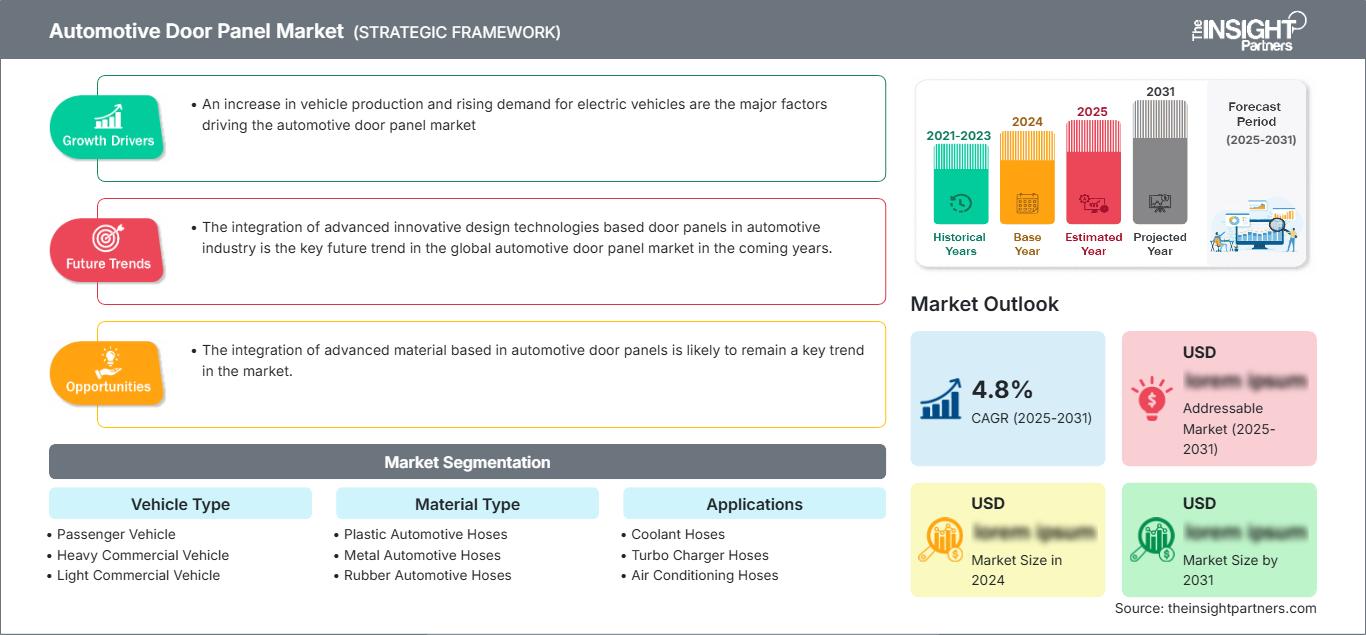
The automotive door panel market size was US$ 28.13 Billion in 2025 and is expected to grow to US$ 41.80 Billion in 2034 with a CAGR of 4.5% during 2026–2034. The growth will be driven by increased automobile manufacturing, growing requirements for interior comfort, side impact protection, lightweight interiors, and integration of switches, speakers, trims, lights, storage, and smart surfaces.
North America is expected to remain a prominent region for automotive door panels due to the market size that will be driven by SUVs, luxury pickups, EV cabin modification, and replacement. The region is expected to grow at a CAGR between 4.1 and 4.7% during 2026 and 2034 due to lightweight substrates, modular interior assemblies, and increased consumer demand.
Automotive Door Panel Market Assessment and Insights
- North America: Accounted for 24–27% share in 2025 and is expected to grow at a CAGR range of 4.1–4.7% between 2026–2034, supported by premium SUVs, pickups, EV launches, and higher trim-content demand.
- US: Represented 78–82% of North America in 2025 and is expected to grow at a CAGR range of 4.2–4.8% between 2026–2034, led by large vehicle platforms and interior replacement channels.
- Europe: Held 21–24% share in 2025 and is projected to grow at a CAGR range of 3.8–4.4% between 2026–2034, with Germany, the UK, France, Italy, and Spain leading demand through premium and compact vehicle programs.
- Asia Pacific: Captured 39–43% share in 2025 and is forecast to grow at a CAGR range of 4.7–5.3% between 2026–2034, led by China, Japan, South Korea, India, and Australia.
- Largest Segment: Passenger Vehicle held 58–62% market share in 2025 and is expected to grow at a CAGR range of 4.3–4.9% during 2026–2034 because passenger cars use higher design variety and comfort features.
- High Growth Segment: Two Wheelers held 8–11% market share in 2025 and is expected to grow at a CAGR range of 5.2–5.8% during 2026–2034 as premium scooters and electric two wheelers add protective and decorative panels.
- Key companies analyzed in detail: Antolin Irausa S.A., Hayashi Telempu Corporation, International Automotive Components Group, T.S. Tech Co., Ltd., Kasai Kogyo Co., Ltd., Reydel Automotive France SAS, Toyota Boshoku Corporation, Brose Fahrzeugteile SE & Co. KG, Dräxlmaier Group, Yanfeng International Automotive Technology Co., Ltd., Aisin Corporation, Automotive Systems LLC, FORVIA SE, Magna International Inc., Continental AG, Johnson Electric Holdings Limited.
Source: The Insight Partners' analysis based on proprietary research, government publications, company annual reports, investor presentations, industry databases, and expert interviews.
In recent years, interior door panels have changed from mere trim coverings to highly functional cabin modules that are a blend of safety elements, storage compartments, acoustic dampers, surface decorations, window switches, armrests, speakers, ambiance lights, and electronics. The production paradigm is shifting toward modules due to the fact that vehicle manufacturers require shorter lead times, regionalization, and uniformity. Materials are also changing because of the balance between plastics, natural-fiber substrates, recycled materials, textiles, foam layers, and metals required for durability, cost, perceived quality, and weight savings.
The future market demand in the automotive door panel market will be driven by electric vehicle platforms, smart cabin concepts, circular materials, and regionalization. There are many investments made by suppliers in low-VOC surfaces, recycled materials, natural fiber carriers, and built-in lighting in order to meet the sustainability criteria, but at the same time maintaining crash and acoustic requirements. New regions will prosper as mid-range cars incorporate premium interiors, while mature markets will focus on replacement, customization, and electronics-enabled panels.
Automotive Door Panel Market Report Scope
| Report Attribute | Details |
|---|---|
| Market size in 2025 | US$ 28.13 Billion |
| Market Size by 2034 | US$ 41.80 Billion |
| Global CAGR (2026 - 2034) | 4.5% |
| Historical Data | 2021-2024 |
| Forecast period | 2026-2034 |
Automotive Door Panel Market Analysis
The automotive door panel market growth depends on the revival of vehicle manufacturing, cabin premiumization, and increase in interior content per vehicle. Door panels now house electric switches, speakers, safety padding, storage, texture, and soundproofing. They have become an integral part of the user experience. Door panels are being redesigned by OEMs to incorporate electric vehicle packaging, lightweighting, and reduced noise.
Pressure from value chain has become stronger since suppliers need to arrange for resin, laminating of fabrics, injection molding, thermoforming, foam, clips, electronics, and assembly close to the location of vehicle manufacturing. Analysis of the automotive door panel market reveals that color consistency, grain, fit, and impact resistance continue to be as important as sustainability credentials.
The competitive positioning in the automotive door panel market is done by global interior experts and modular parts manufacturers. The competitors include Antolin Irausa S.A., International Automotive Components Group, Toyota Boshoku Corporation, Yanfeng International Automotive Technology Co., Ltd., FORVIA SE, Magna International Inc., and Dräxlmaier Group. They compete based on platform design, trim design and regional presence.
The investments are shifting towards recyclable substrates, lightweight carriers, intelligent surfaces, and localized manufacturing. The companies supporting the value chain include Hayashi Telempu Corporation, Kasai Kogyo Co., Ltd., T.S. Tech Co., Ltd., Brose Fahrzeugteile SE & Co. KG, Continental AG, Johnson Electric Holdings Limited, and Aisin Corporation.
● REPORT CUSTOMIZATION
Tailor This Report To Align With Your Specific Business Requirements
This report can be customized to align precisely with your business objectives, scope, and target markets. Customization options include tailored segmentation, geography, competitive analysis, and strategic insights to support informed decision-making.
Customize This Report →WHAT YOU CAN ADJUST
- ● Segmentations
- ● Geography
- ● Competitive Analysis
- ● Language Preferences
Automotive Door Panel Market: Strategic Insights
Regional Insights
North America automotive door panel market
North America represented 24–27% automotive door panel market share in 2025 and forecast to have a CAGR range between 4.1 and 4.7% through 2034. The demand comes from SUVs, pickups, electric vehicles, and premium trims due to large panel size, pockets for storage, sound system speakers, stitch work, soft-touch surface materials, and lighting.
Aftermarket replacement and interior remodeling of vehicles contribute to North America’s growth. Car manufacturers are encouraging component makers to ensure that noise damping, low-temperature capability, and recycling of materials be enhanced without compromising fit and finish quality. Localized manufacturing and assembly are still essential because of their bulky nature, colors, and vehicle launch cycles.
U.S. automotive door panel Market
The U.S. represented 78–82% of North America in 2025 and is projected to grow at a CAGR range of 4.2–4.8% during 2026–2034. Large SUVs, pickups, and electric models support higher-value assemblies with armrests, controls, speakers, airbags, and decorative inserts.
Supplier presence is supported by interior plants, plastics processors, tooling companies, and electronics integrators close to vehicle assembly hubs. Application trends favor durable door modules for work trucks, premium soft-touch surfaces for luxury SUVs, and lightweight carriers for EV platforms seeking range improvement.
Europe automotive door panel Market
Europe was accounting for 21–24% market share in 2025 and is estimated to register a growth rate of CAGR at 3.8–4.4% during 2026–2034. Germany dominates owing to the presence of premium OEM programs, high-quality interiors, and advanced supplier engineering capabilities. UK is favored for luxury and sports purposes, while France, Italy, and Spain for compact cars and vans.
The demand in Europe is influenced by recyclability, reduced emissions, and cabin comfort regulations. Increasingly, OEMs are analyzing their panels for carbon footprint, feel, acoustic absorption, and ability to use with smart switches. The suppliers with natural fiber carriers, recycled plastics, and modular assembly footprint are preferred by the OEMs.
APAC automotive door panel Market
APAC accounted for 39–43% automotive door panel market share in 2025 and is forecast to grow at a CAGR range of 4.7–5.3% through 2034. China leads because of high vehicle output, EV penetration, and rapid cockpit innovation. Japan and South Korea add quality-led engineering.
India is expanding through localized passenger vehicle production, while Australia remains import and replacement oriented. Regional growth is supported by resin availability, molding capacity, competitive labor, and consumer demand for feature-rich cabins across compact cars, SUVs, and two wheelers.
Middle East & Africa automotive door panel Market
Middle East & Africa is expected to grow at a CAGR range of 3.4–4.0% during 2026–2034. Saudi Arabia and the UAE lead demand through premium SUVs, heat-resistant interiors, and fleet modernization. South Africa supports assembly and replacement demand.
Rest of MEA remains more price-sensitive, but rising vehicle ownership and dealership service networks support gradual adoption. Growth depends on durable materials, UV resistance, dust tolerance, and access to replacement panels suited to harsh operating conditions.
Segmentation Analysis
Vehicle Type
Vehicle Type is expected to grow at a CAGR range of 4.2–4.8% during 2026–2034. The automotive door panel market scope is expanding as passenger vehicles demand premium aesthetics, commercial vehicles require durability, and two wheelers increasingly use protective decorative panels for electric and urban mobility formats.
- Passenger Vehicle demand dominates because cars and SUVs use complex trims, storage pockets, switches, speakers, soft-touch surfaces, airbags, and styling features that increase panel value.
- Heavy Commercial Vehicle panels prioritize ruggedness, serviceability, insulation, and driver ergonomics because long operating hours and frequent door use require robust, easy-to-clean interior structures.
- Light Commercial Vehicle adoption is supported by delivery fleets, vans, and mobility services that need durable panels, storage utility, repair access, and cost-effective replacement.
- Two Wheelers use smaller panel components, but electric scooters and premium models are increasing demand for protective trims, color-matched plastics, and integrated utility features.
Material Type
Material Type is expected to grow at a CAGR range of 4.1–4.7% during 2026–2034 as door panel makers balance cost, moldability, weight, safety, and recyclability. Plastic dominates carriers and trims, while metal and rubber support reinforcement, sealing, and vibration control.
- Plastic Automotive Hoses remain prominent in the input taxonomy, but for door panels the comparable plastic content supports carriers, trim skins, map pockets, clips, and decorative surfaces.
- Metal Automotive Hoses are not typical door panel materials, yet metal reinforcements, brackets, and inserts remain important where side-impact strength and fastening stability are required.
- Rubber Automotive Hoses translate into elastomeric sealing, vibration isolation, and soft-touch components that improve perceived quality, comfort, and acoustic performance around door systems.
Applications
Applications is expected to grow at a CAGR range of 4.0–4.6% during 2026–2034. The listed application taxonomy is hose-oriented, so demand relevance is strongest where fluid, braking, washing, and air-conditioning systems interact with door packaging, service routing, and adjacent interior assemblies.
- Coolant Hoses influence EV and thermal architecture decisions, indirectly affecting panel packaging where cabin heating, battery cooling, and service access require coordinated routing.
- Turbo Charger Hoses remain powertrain-focused, but performance vehicles often pair higher mechanical content with upgraded interiors, supporting higher-value panels in premium trims.
- Air Conditioning Hoses support cabin comfort systems, and their routing requirements influence interior packaging decisions around ducts, seals, panels, and service access points.
- Windshield Washer Fluid Hoses are peripheral to door panels, yet shared packaging and serviceability constraints affect how interior trims are designed around vehicle body systems.
- Fuel Hoses have limited direct interaction with door panels, but safety and regulatory considerations influence material choices across broader vehicle interior and body assemblies.
- Brake Hoses remain chassis-related, while door panels support adjacent safety perception through side-impact padding, airbag interfaces, and durable interior structures.
Opportunity Snapshot
| Vehicle Type | Revenue Contribution | Trend Tag | Adoption Stage |
| Passenger Vehicle | High | Smart Cabin | Scaling |
| Heavy Commercial Vehicle | Medium | Rugged Trim | Mature |
| Light Commercial Vehicle | Medium | Fleet Utility | Scaling |
| Two Wheelers | Low | EV Panels | Emerging |
Automotive Door Panel Market Growth Drivers and Impact Analysis
Cabin Premiumization Raises Door Panel Content
Manufacturers are now leveraging door panels as exterior touch-points that can affect comfort, perception of quality, and branding. Modern consumers require soft-feeling materials, decorative elements, lighting features, integration of speakers, storage functionality, and ergonomically designed armrests in their mid-level cars as well. This leads to increase in the value of parts per car and enables suppliers to integrate trim, electronics, acoustics, and materials into one unit. It works best for SUVs, electric cars, and luxury passenger cars, since the focus on cabin experience is very strong there.
Lightweight and Recyclable Materials Reshape Sourcing
Fuel economy requirements, EV range targets, and sustainability commitments are pushing OEMs toward lighter and more recyclable door panel structures. Natural-fiber carriers, recycled polypropylene, thermoplastic olefins, and low-VOC coatings are becoming more attractive because they reduce mass and support circularity targets. This changes sourcing priorities from simple cost control to lifecycle performance. Suppliers that validate recycled content, maintain surface quality, and meet crash, odor, and acoustic standards can gain stronger positions in global platform sourcing decisions.
Smart Interiors Increase Electronics Integration
Door panels increasingly host switches, lighting, heating, speakers, haptic surfaces, seat controls, and access-related electronics. As vehicles move toward digital cockpits, panels must support wiring, thermal protection, electromagnetic compatibility, and serviceability without compromising styling or durability. The impact is higher collaboration between interior suppliers, electronics companies, and OEM engineering teams. This also raises validation complexity because failures affect user experience directly. Suppliers with embedded electronics capability can capture more value than firms limited to molded trim production.
Automotive Door Panel Market Future Trends
Sustainable Smart Surfaces Become Mainstream
automotive door panel market trends point toward smart surfaces that combine recycled materials, ambient lighting, capacitive switches, and decorative textures within thinner assemblies. Future panels will hide controls until needed, reduce part count, and create cleaner cabin layouts. The shift will be gradual because durability, repair cost, and manufacturing yield remain important constraints. However, premium EV programs are already proving that doors can become interactive interior zones rather than passive trim components.
Modular Door Systems Support Faster Vehicle Launches
OEMs are expected to standardize panel carriers, mounting points, clips, switch zones, and acoustic packages across multiple models. Modular architecture helps reduce tooling cost, shorten validation cycles, and improve launch reliability. Suppliers will still customize surface finishes, stitching, lighting, and decorative inserts to preserve brand differentiation. This trend favors companies with global engineering centers, local assembly footprints, and the ability to manage material variation across vehicle segments and regions.
Automotive Door Panel Market Opportunities
Localized EV Interior Programs
The strongest opportunity lies in supplying EV-specific door panels close to vehicle assembly plants. automotive door panel market Forecasts remain favorable where suppliers can combine lightweight carriers, recycled materials, smart surfaces, acoustic layers, and electronics routing into localized modules. EV cabins are quieter than combustion vehicles, so squeak, rattle, and tactile quality are more noticeable. Suppliers that reduce logistics cost while improving fit and sustainability credentials can win multi-platform business.
Aftermarket Interior Refurbishment Channels
Aftermarket channels offer a practical opportunity as aging vehicles require replacement panels, clips, armrests, switches, and trim inserts. Demand is strongest after collisions, water damage, heavy fleet use, or interior wear. Suppliers can build value through color-matched parts, fitment databases, fast distribution, and repair-friendly kits. As automatic windows, speakers, and lighting become more common, replacement panels with pre-integrated components can raise aftermarket revenue per vehicle while improving repair efficiency.
Frequently Asked Questions

- Comprehensive Market Sizing and Forecast Analysis
- Detailed Segmentation Analysis
- In-Depth Market Dynamics Assessment
- Regional and Country-Level Insights
- Competitive Landscape and Company Benchmarking
- Strategic Business Intelligence
Recent Reports
Testimonials

The Insight Partners provided valuable market intelligence that supported our global go-to-market strategy. Their team was professional, responsive, and attentive to our feedback, providing thoughtful analysis and helpful methodological clarifications throughout the project.
Junmo Kim Chief Financial Officer (CFO), Enertech Co., Ltd.
The Insight Partners' SCADA System Market report is comprehensive, with valuable insights on current trends and future forecasts. The team was highly professional, responsive, and supportive throughout. We are very satisfied and highly recommend their services.
RAN KEDEM Partner, Reali Technologies LTDs
I requested a report on a very specific software market and the team produced the report in a few days. The information was very relevant and well presented. I then requested some changes and additions to the report. The team was again very responsive and I got the final report in less than a week.
JEAN-HERVE JENN Chairman, Future Analytica
We worked with The Insight Partners for an important market study and forecast. They gave us clear insights into opportunities and risks, which helped shape our plans. Their research was easy to use and based on solid data. It helped us make smart, confident decisions. We highly recommend them.
PIYUSH NAGPAL Sr. Vice President, High Beam Global
The Insight Partners delivered insightful, well-structured market research with strong domain expertise. Their team was professional and responsive throughout. The user-friendly website made accessing industry reports seamless. We highly recommend them for reliable, high-quality research services
YUKIHIKO ADACHI CEO, Deep Blue, LLC.
This is the first time I have purchased a market report from The Insight Partners.While I was unsure at first, I visited their web site and felt more comfortable to take the risk and purchase a market report.I am completely satisfied with the quality of the report and customer service. I had several questions and comments with the initial report, but after a couple of dialogs over email with their analyst I believe I have a report that I can use as input to our strategic planning process.Thank you so much for taking the extra time and making this a positive experience.I will definitely recommend your service to others and you will be my first call when we need further market data.
JOHN SUZUKI President and Chief Executive Officer, Board Director, BK Technologies
I wish to appreciate your support and the professionalism you displayed in the course of attending to my request for information regarding to infectious disease IVD market in Nigeria. I appreciate your patience, your guidance, and the fact that you were willing to offer a discount, which eventually made it possible for us to close a deal. I look forward to engaging The Insight Partners in the future, all thanks to the impression you have created in me as a result of this first encounter.
DR CHIJIOKE ONYIA MANAGING DIRECTOR, PineCrest Healthcare Ltd.Reason to Buy
- Informed Decision-Making
- Understanding Market Dynamics
- Competitive Analysis
- Identifying Emerging Markets
- Customer Insights
- Market Forecasts
- Risk Mitigation
- Boosting Operational Efficiency
- Strategic Planning
- Investment Justification
- Tracking Industry Innovations
- Aligning with Regulatory Trends





 Get Free Sample for