
Automotive Driver State Monitor Systems Market Growth, Trends & Forecast by 2034
Coverage: By Component (Hardware, Software); Monitoring Type (Driver Alertness/Distraction Monitoring, Driver Fatigue Monitoring, Drunk Driving Monitoring, Others); Propulsion Type (ICE, Hybrid, Electric); Vehicle Type (Passenger Vehicle, Commercial Vehicle) , and Geography (North America, Europe, Asia Pacific, and South and Central America)
- Status : Data Released
- Report Code : TIPRE00026383
- Category : Automotive and Transportation
- No. of Pages : 150
- Available Report Formats :


- Last update date : August 12, 2026


2025 Market Size
US$ 2.99 Bn
Base year value
2034 Forecast
US$ 8.09 Bn
Projected by 2034
CAGR 2026-2034
11.69 %
Growth rate
Addressable Market
US$ 48.70 Bn
(2026-2034)
The Automotive Driver State Monitor Systems market was valued at US$ 2.99 billion in 2025 and is expected to reach US$ 8.09 billion by 2034; it is estimated to record a CAGR of 11.69% during 2026-2034.
Automotive Driver State Monitor Systems Market Assessment and Insights
- North America: Accounted for 28–31% share in 2025 and is expected to grow at a CAGR range of 12.4–13.8% between 2026–2034, supported by ADAS adoption, fleet monitoring, and premium vehicle penetration.
- US: Represented 79–83% of North America in 2025 and is expected to grow at a CAGR range of 12.7–14.1% between 2026–2034, led by passenger vehicles and safety-focused fleet programs.
- Europe: Held 27–30% share in 2025 and is projected to grow at a CAGR range of 13.0–14.4% between 2026–2034, with Germany, the UK, France, Italy, and Spain leading due to GSR and Euro NCAP influence.
- Asia Pacific: Captured 34–38% share in 2025 and is forecast to grow at a CAGR range of 14.0–15.6% between 2026–2034, led by China, Japan, South Korea, India, and Australia.
- Largest Segment: Hardware held 56–60% market share in 2025 and is expected to grow at a CAGR range of 12.6–14.0% during 2026–2034 because cameras, infrared emitters, sensors, and processors dominate bill of material value.
- High Growth Segment: Software held 40–44% market share in 2025 and is expected to grow at a CAGR range of 14.2–15.8% during 2026–2034 as AI models, validation tools, and over-the-air updates scale.
- Key companies analyzed in detail: Aptiv PLC, Valeo SE, Veoneer Inc., Renesas Electronics Corporation, PathPartner Technology Inc., STMicroelectronics N.V., Tata Elxsi Limited, UniMax Electronics Inc., Affectiva, Inc., Tobii AB.
Source: The Insight Partners' analysis based on proprietary research, government publications, company annual reports, investor presentations, industry databases, and expert interviews.
The architecture for systems is moving from the inference of steering pattern and lane departure to actual driver behavior analysis through eye tracking, head pose detection, eyelid closing, facial features, and sensor fusion. The need for performance under different lighting conditions, wearing eyewear, skin tones, seating positions, and behaviors of the driver makes validation difficult and leads to more use of automotive cameras, edge computing, infrared lighting, and perception algorithms.
Future needs would be driven by the European safety regulation, Euro NCAP 2026 tests, increasing demand for Level 2 and Level 3 automation, and fleet management practices. Future geography would do well to deploy camera and software stacks that are cost-effective as domestic OEMs begin to localize ADAS components. The suppliers that have functional safety experience, privacy-oriented software, synthetic data processing, and production ready integration capabilities would enjoy competitive edge.
Automotive Driver State Monitor Systems Market Report Scope
| Report Attribute | Details |
|---|---|
| Market size in 2025 | US$ 2.99 Billion |
| Market Size by 2034 | US$ 8.09 Billion |
| Global CAGR (2026 - 2034) | 11.69% |
| Historical Data | 2021-2024 |
| Forecast period | 2026-2034 |
Automotive Driver State Monitor Systems Market Analysis
Growth in the automotive driver state monitor systems market stems from the coming together of regulations around safety, the proliferation of advanced driver assist systems, and the increasing worries around distractions while driving. Indirect indicators are being replaced by direct observation, which enables a camera and artificial intelligence to detect gaze direction, microsleep, cellphone usage, eye-lid activity, and head position more effectively than any indirect measure of steering patterns.
The key dynamics in the supply chain of automotive driver state monitor systems include the camera module, infrared emitter, processors, software, data sets for validation, and vehicle networking. The automotive driver state monitor systems market analysis indicates that increasing importance is being attached to software calibration, occupant-state interpretation, cybersecurity, and privacy compliance. Hardware is still important, but the software update and model training is increasingly defining detection accuracy and regulatory readiness.
Competitors include Tier 1 suppliers, semiconductor companies, in-cabin AI providers, and engineering services. Aptiv PLC and Valeo SE enable the incorporation of ADAS into the product, whereas STMicroelectronics N.V. and Renesas Electronics Corporation enable the basis of imaging and image processing. Tobii AB and Affectiva, Inc. improve attention, emotion, and interior sensing analytics, and Tata Elxsi Limited and PathPartner Technology Inc. enable software engineering.
Priority investments are shifting to the development of scalable platforms that integrate driver monitoring and occupant monitoring with cabin personalization. Valeo SE extended the collaboration with Qualcomm Technologies regarding ADAS solutions in 2025, whereas STMicroelectronics N.V. began mass production with Tobii AB on an advanced interior sensing solution.
● REPORT CUSTOMIZATION
Tailor This Report To Align With Your Specific Business Requirements
This report can be customized to align precisely with your business objectives, scope, and target markets. Customization options include tailored segmentation, geography, competitive analysis, and strategic insights to support informed decision-making.
Customize This Report →WHAT YOU CAN ADJUST
- ● Segmentations
- ● Geography
- ● Competitive Analysis
- ● Language Preferences
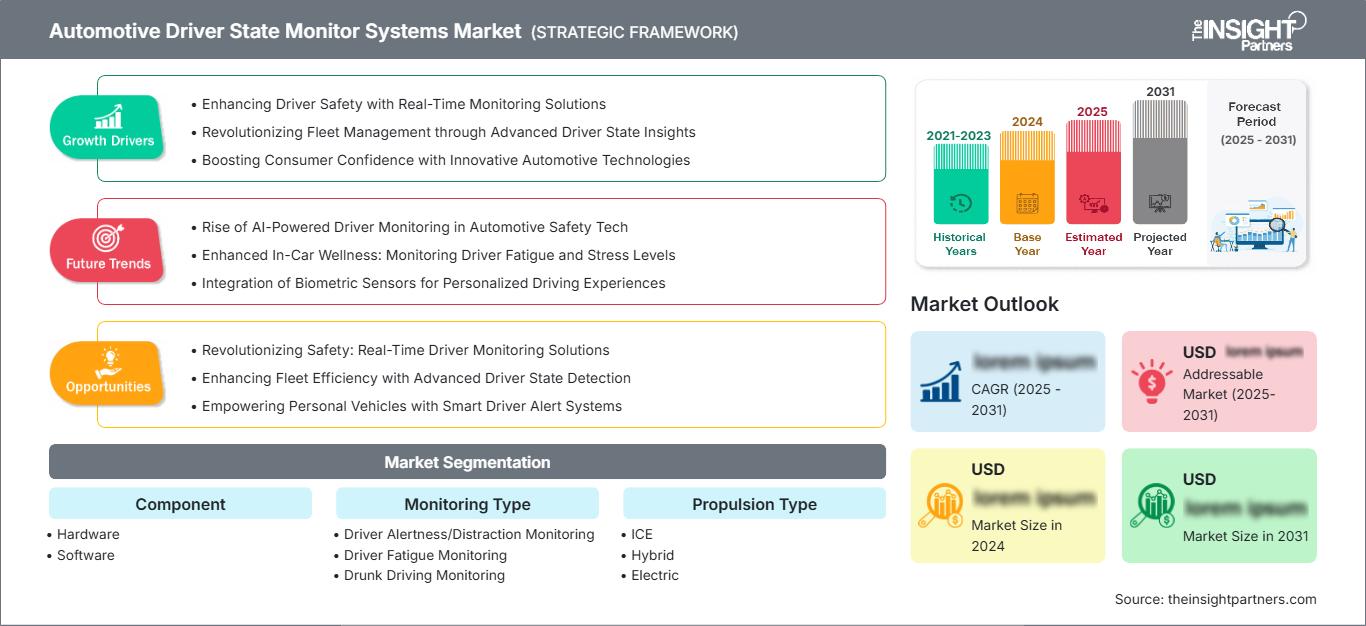
Automotive Driver State Monitor Systems Market: Strategic Insights
Regional Insights
North America automotive driver state monitor systems market
North America accounted for 28–31% automotive driver state monitor systems market share in 2025 and is expected to grow at a CAGR range of 12.4–13.8% through 2034. Demand is supported by ADAS penetration, connected fleet safety programs, and premium vehicle launches using camera-based monitoring.
The region also benefits from autonomous driving investment and insurer interest in risk reduction. U.S. and Canadian fleets are adopting in-cabin systems to detect distraction, fatigue, and policy violations. Passenger vehicles remain the larger base, but commercial operators generate strong aftermarket and telematics-linked demand.
U.S. automotive driver state monitor systems Market
The U.S. represented 79–83% of North America in 2025 and is projected to grow at a CAGR range of 12.7–14.1% during 2026–2034. Automakers are integrating driver monitoring into premium EVs, SUVs, and Level 2 assisted-driving packages.
Supplier presence is strong through Aptiv PLC, Veoneer Inc., semiconductor ecosystems, and software engineering networks. Application trends point to camera-based attention tracking, fleet fatigue alerts, and driver readiness checks for automated lane keeping. Privacy design and false-alert reduction remain key purchase criteria.
Europe automotive driver state monitor systems Market
Europe held 27–30% share in 2025 and is expected to grow at a CAGR range of 13.0–14.4% between 2026–2034. Germany leads because premium OEMs and Tier 1 suppliers are preparing for stricter monitoring protocols.
The UK supports testing and validation through safety assessment ecosystems, while France benefits from Valeo SE and ADAS integration capability. Italy and Spain contribute through vehicle assembly and supplier localization. EU General Safety Regulation and Euro NCAP driver engagement requirements make direct monitoring a mainstream design priority.
APAC automotive driver state monitor systems Market
APAC accounted for 34–38% share in 2025 and is forecast to grow at a CAGR range of 14.0–15.6% through 2034. China leads due to EV adoption, intelligent cockpit programs, and domestic ADAS competition.
Japan and South Korea contribute advanced electronics and safety systems, while India is expanding through connected vehicle software and engineering services. Australia supports fleet and safety demand. Regional growth is reinforced by camera cost reduction and fast model refresh cycles.
Middle East & Africa automotive driver state monitor systems Market
Middle East & Africa is expected to grow at a CAGR range of 10.8–12.2% during 2026–2034. Saudi Arabia and the UAE lead through premium vehicle adoption, fleet digitization, and smart mobility programs.
South Africa and Rest of MEA remain earlier-stage markets, but logistics, mining, and long-distance transport fleets create demand for fatigue monitoring. Adoption depends on vehicle connectivity, camera durability in heat and dust, and operator willingness to invest in safety analytics.
Segmentation Analysis
Component
Component is expected to grow at a CAGR range of 13.1–14.5% during 2026–2034. The automotive driver state monitor systems market scope is widening as OEMs combine dedicated cameras, infrared LEDs, processors, memory, and software models to satisfy regulation, comfort, and automated driving needs. Hardware anchors initial value, while software increasingly controls differentiation.
- Hardware includes cameras, infrared emitters, processors, sensors, and mounting assemblies that must perform reliably across night driving, glare, eyewear, vibration, and long vehicle lifecycles.
- Software interprets gaze, eyelid closure, head pose, impairment cues, and driver readiness. Its strategic importance rises as over-the-air updates improve accuracy and regional compliance.
Monitoring Type
Monitoring Type is expected to grow at a CAGR range of 13.3–14.7% during 2026–2034 as automakers broaden detection from basic drowsiness warnings toward attention, distraction, impairment, and readiness scoring. More advanced systems combine visual behavior with vehicle context to reduce false alerts.
- Driver Alertness/Distraction Monitoring is strategically important because gaze-away events, mobile phone use, and cognitive distraction are central targets for regulatory and safety assessment programs.
- Driver Fatigue Monitoring detects eyelid closure, blink rate, microsleep, yawning, and head nodding, supporting long-distance safety in passenger vehicles and commercial fleets.
- Drunk Driving Monitoring remains emerging, but impairment detection can combine behavioral cues, reaction patterns, and future sensor fusion to support preventive safety interventions.
Propulsion Type
Propulsion Type is expected to grow at a CAGR range of 13.0–14.4% during 2026–2034 as monitoring becomes propulsion-agnostic. ICE vehicles provide installed scale, hybrids add premium safety content, and electric vehicles accelerate intelligent cockpit integration.
- ICE vehicles remain important because large production volumes and regulatory timelines require monitoring systems across conventional passenger cars, SUVs, and commercial fleets.
- Hybrid platforms often pair ADAS packages with higher trim levels, creating strong demand for camera-based driver readiness and distraction detection.
- Electric vehicles support faster adoption because digital cabins, over-the-air updates, and semi-autonomous features make in-cabin monitoring a natural safety layer.
Opportunity Snapshot
| Propulsion Type | Revenue Contribution | Trend Tag | Adoption Stage |
| ICE | High | Regulatory Fit | Scaling |
| Hybrid | Medium | ADAS Bundling | Scaling |
| Electric | Medium | Smart Cabin | Scaling |
Automotive Driver State Monitor Systems Market Growth Drivers and Impact Analysis
Safety Regulation Converts Monitoring Into Standard Equipment
Regulation is the dominant driver in terms of structure, since drowsiness and distraction warning systems will be migrating from an option safety package to being part of homologation and ratings. Europe is leading the way by setting standards with General Safety Regulations and Euro NCAP driver interaction methodologies, which have implications for platforms worldwide. The effect is immediate: Automakers must commit earlier to camera ready architecture; suppliers must demonstrate detection reliability; and software validation is integrated into launch preparedness. Fitment becomes more widespread within the mid-range than restricted to premium brands.
ADAS and Automation Require Driver Readiness Checks
Assistance levels 2 and 3 create a higher demand for verification regarding whether the driver is sufficiently alert to take back control. Torque detection cannot be relied upon as an indicator of eye position or the onset of sleep and cognitive disengagement; direct driver monitoring is critical. This has implications for the entire ADAS system stack as the driver is needed to take over control during braking, lane keeping, and lane changing operations.
Fleet Operators Seek Measurable Risk Reduction
Monitoring systems are being utilized in commercial fleets due to the presence of risk in terms of crash and insurance liabilities due to fatigue, distractions from phone use, and extended driving periods. State of driver data helps fleet owners to deliver immediate alerts to the driver, correct risky behaviors, and comply with regulations. The influence is felt most in logistics, mining, ride sharing, and public transportation sectors, where a single accident can cause downtime and liabilities.
Automotive Driver State Monitor Systems Market Future Trends
Single-Camera Cabin Intelligence Expands
Automotive driver state monitor systems market trends are heading towards a single camera system, which integrates driver monitoring, occupant monitoring, and personalized cabin experience. The wide-angle imaging with visible light and infrared sensors can help cut down the costs and complexities of packaging and also serve various safety purposes. With increased processing power, a single camera module can detect the attention of drivers, occupancy by passengers, behavior of seatbelts, and indications of the presence of children.
Synthetic Data Becomes Validation Infrastructure
Future systems will require larger validation datasets covering lighting, eyewear, headwear, driver posture, skin tones, and rare impairment states. Real-world biometric data is difficult to collect at scale, so synthetic data and simulation will become essential for training and compliance evidence. This trend reduces development bottlenecks and helps OEMs test edge cases before road trials. Suppliers with auditable data pipelines and model governance will gain credibility as regulatory scrutiny increases.
Automotive Driver State Monitor Systems Market Opportunities
Integrated DMS and Occupant Monitoring Platforms
The most attractive opportunity is combining driver monitoring with occupant sensing on shared hardware and software. The automotive driver state monitor systems market Forecasts remain favorable where suppliers can reduce camera count, simplify wiring, and deliver safety, comfort, and personalization functions from one platform. OEMs can use the same architecture for distraction warnings, child presence detection, airbag logic, and cabin experience features. This improves return on investment and supports software-defined vehicle strategies.
Fleet Retrofit and Telematics Integration
Fleet retrofit programs offer a practical growth route because operators can deploy monitoring without waiting for new vehicle cycles. Solutions that combine camera alerts, fatigue scoring, event video, and fleet dashboards create immediate safety and compliance value. This opportunity is strongest in logistics, buses, construction, and long-haul transport. Suppliers that provide privacy controls, low false-alert rates, driver coaching workflows, and telematics integration can convert safety budgets into recurring software revenue.
Frequently Asked Questions

- Comprehensive Market Sizing and Forecast Analysis
- Detailed Segmentation Analysis
- In-Depth Market Dynamics Assessment
- Regional and Country-Level Insights
- Competitive Landscape and Company Benchmarking
- Strategic Business Intelligence
Recent Reports
Testimonials

The Insight Partners' SCADA System Market report is comprehensive, with valuable insights on current trends and future forecasts. The team was highly professional, responsive, and supportive throughout. We are very satisfied and highly recommend their services.
RAN KEDEM Partner, Reali Technologies LTDs
I requested a report on a very specific software market and the team produced the report in a few days. The information was very relevant and well presented. I then requested some changes and additions to the report. The team was again very responsive and I got the final report in less than a week.
JEAN-HERVE JENN Chairman, Future Analytica
We worked with The Insight Partners for an important market study and forecast. They gave us clear insights into opportunities and risks, which helped shape our plans. Their research was easy to use and based on solid data. It helped us make smart, confident decisions. We highly recommend them.
PIYUSH NAGPAL Sr. Vice President, High Beam Global
The Insight Partners delivered insightful, well-structured market research with strong domain expertise. Their team was professional and responsive throughout. The user-friendly website made accessing industry reports seamless. We highly recommend them for reliable, high-quality research services
YUKIHIKO ADACHI CEO, Deep Blue, LLC.
This is the first time I have purchased a market report from The Insight Partners.While I was unsure at first, I visited their web site and felt more comfortable to take the risk and purchase a market report.I am completely satisfied with the quality of the report and customer service. I had several questions and comments with the initial report, but after a couple of dialogs over email with their analyst I believe I have a report that I can use as input to our strategic planning process.Thank you so much for taking the extra time and making this a positive experience.I will definitely recommend your service to others and you will be my first call when we need further market data.
JOHN SUZUKI President and Chief Executive Officer, Board Director, BK Technologies
I wish to appreciate your support and the professionalism you displayed in the course of attending to my request for information regarding to infectious disease IVD market in Nigeria. I appreciate your patience, your guidance, and the fact that you were willing to offer a discount, which eventually made it possible for us to close a deal. I look forward to engaging The Insight Partners in the future, all thanks to the impression you have created in me as a result of this first encounter.
DR CHIJIOKE ONYIA MANAGING DIRECTOR, PineCrest Healthcare Ltd.Reason to Buy
- Informed Decision-Making
- Understanding Market Dynamics
- Competitive Analysis
- Identifying Emerging Markets
- Customer Insights
- Market Forecasts
- Risk Mitigation
- Boosting Operational Efficiency
- Strategic Planning
- Investment Justification
- Tracking Industry Innovations
- Aligning with Regulatory Trends





 Get Free Sample for