
Automotive Engine and Transmission Sensors Market Size, Trends & Growth by 2034
Coverage: By Type (Piezoresistive Pressure Sensor, Capacitive Pressure Sensor, Resonant Pressure Sensor, Optical Pressure Sensor, Other Pressure Sensors); Application (Antilock Braking System, Airbag System, Direct Tire Pressure Monitoring System, Others) , and Geography (North America, Europe, Asia Pacific, and South and Central America)
- Status : Data Released
- Report Code : TIPRE00022358
- Category : Automotive and Transportation
- No. of Pages : 150
- Available Report Formats :


- Last update date : August 12, 2026


2025 Market Size
US$ 29.57 Bn
Base year value
2034 Forecast
US$ 42.51 Bn
Projected by 2034
CAGR 2026-2034
4.64 %
Growth rate
Addressable Market
US$ 336.17 Bn
(2026-2034)
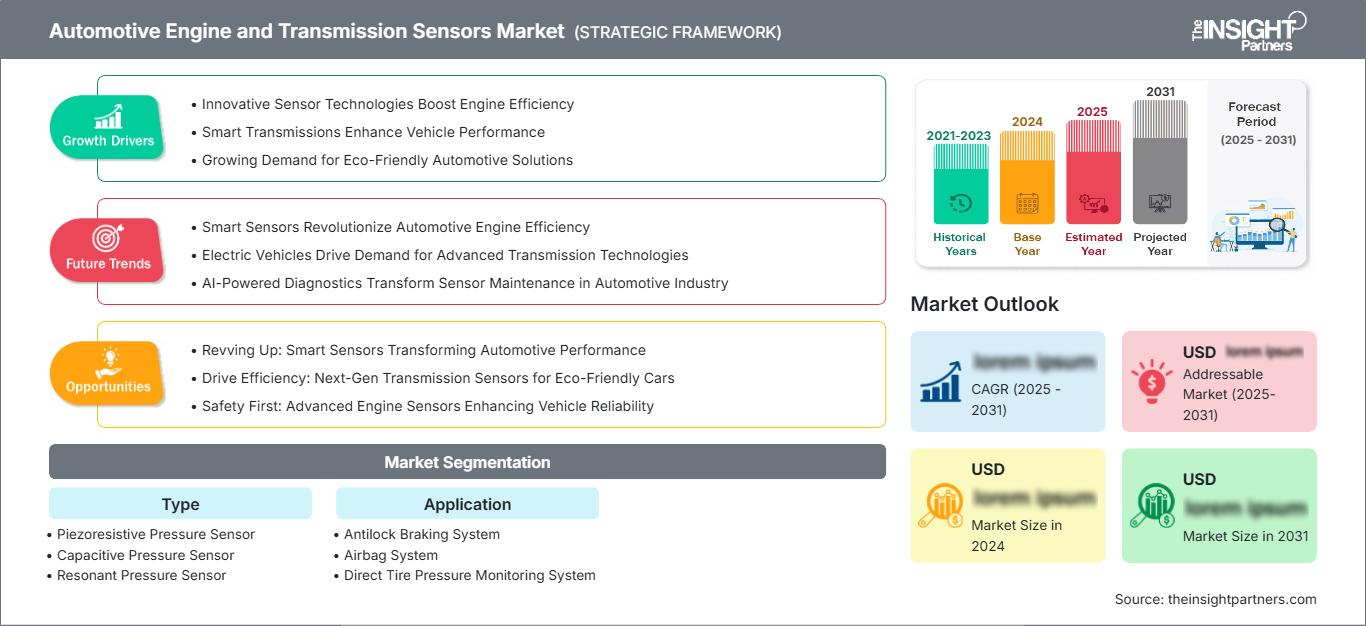
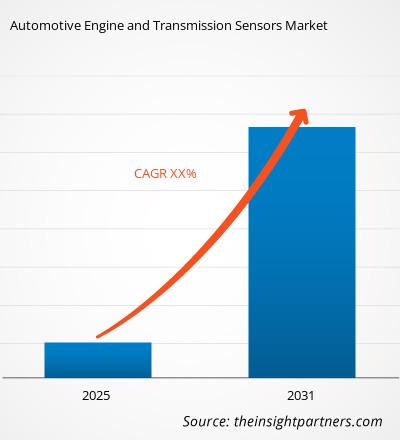
The automotive engine and transmission sensors market is projected to grow from US$ 29.57 Billion in 2025 to US$ 42.51 Billion by 2034, registering a CAGR of 4.64 % during 2026–2034. Growth is supported by rising sensor content in powertrain control, braking safety, airbag deployment, direct tire pressure monitoring, and software-assisted diagnostics across combustion, hybrid, and electric vehicle platforms.
North America remains a high-value region because of mature safety regulations, connected diagnostics, and advanced powertrain calibration support recurring sensor integration. The automotive engine and transmission sensors market size in the region is reinforced by replacement demand, pickup and SUV production, and OEM investment in pressure sensing for braking, fuel, transmission, and occupant protection systems.
Automotive Engine and Transmission Sensors Market Assessment and Insights
- North America: Accounted for an estimated 25–29% share in 2025 and is expected to grow at a CAGR of 4.1–4.8% during 2026–2034, supported by high sensor content per vehicle and regulated safety systems.
- US: Represented nearly 77–81% of North America demand in 2025 and is projected to expand at a CAGR of 4.0–4.7% through 2034.
- Europe: Held an estimated 26–30% share in 2025 and is forecast to grow at 4.2–4.9%, led by Germany, the UK, France, Italy, and Spain.
- Asia Pacific: Captured about 36–40% share in 2025 and is projected to grow at 5.0–5.8%, led by China, Japan, South Korea, India, and Australia.
- Largest Segment: Piezoresistive Pressure Sensor held 42–46% share in 2025 and is expected to expand at 4.3–5.0% during 2026–2034.
- High Growth Segment: Direct Tire Pressure Monitoring System held 24–28% share in 2025 and is expected to grow at 5.2–6.0% through 2034.
- Key companies analyzed in detail: Robert Bosch GmbH; Continental AG; DENSO Corporation; TE Connectivity Ltd.; General Electric Company; Melexis NV; NXP Semiconductors N.V.; Sensata Technologies Holding plc; Infineon Technologies AG; Analog Devices, Inc.
Source: The Insight Partners' analysis based on proprietary research, government publications, company annual reports, investor presentations, industry databases, and expert interviews.
Pressure switch technology is gradually moving away from stand-alone pressure switches towards MEMS-based, capacitive, optical, and resonant sensing systems that supply real-time signals to engine control units, transmission control modules, airbag controllers, anti-lock brake systems, and TPMS receivers. The increasing amount of electronics in cars enhances the precision of measurements and allows faster identification of faults. Production factors will include semiconductor availability, small size of devices, calibration software, and qualification of sensors against temperature, vibrations, moisture, and the life expectancy of vehicles.
Further growth will be driven by APAC car production volumes, European standards on vehicle safety and environmental compliance, and the development of diagnosis capabilities in North America. Pressure sensors are necessary for hybrid propulsion systems due to their involvement in thermal management, braking system integration, and transmission actuation. Investments will be made in miniaturized MEMS, functional safety, local manufacturing, and sensor fusion with powertrain software.
Automotive Engine and Transmission Sensors Market Report Scope
| Report Attribute | Details |
|---|---|
| Market size in 2025 | US$ 29.57 Billion |
| Market Size by 2034 | US$ 42.51 Billion |
| Global CAGR (2026 - 2034) | 4.64% |
| Historical Data | 2021-2024 |
| Forecast period | 2026-2034 |
Automotive Engine and Transmission Sensors Market Analysis
The automotive engine and transmission sensors market growth is driven by the need to monitor pressure, load, acceleration, and system status with higher accuracy. ABS, airbag, and direct tire pressure monitoring applications depend on fast, reliable signals to reduce stopping distance, deploy restraints correctly, and alert drivers to inflation risk. Electrification adds further demand because hybrid vehicles still require powertrain and safety sensors while adding software-driven diagnostics.
These components include silicon wafers, MEMS dies, ceramic substrates, ASICs, housing, connectors, calibrators, ECU software, and Tier-1 integration. Automotive OEMs favor sensor manufacturers who are able to test their products with regard to pressure range, temperature level, vibration, and regulatory issues specific to regions. Market supply is still dependent on the availability of automotive semiconductors and a long qualification period.
Market analysis identifies Robert Bosch GmbH, Continental AG, DENSO Corporation, Sensata Technologies Holding plc, Infineon Technologies AG, and NXP Semiconductors N.V. as players competing with each other due to their deep automotive semiconductor portfolios, relationships with OE companies, and mass-production capacities. TE Connectivity Ltd., Melexis NV, Analog Devices, Inc., and General Electric Company participate in the process due to connectivity, magnetic sensing, analog processing, and measurement.
Investment is moving toward smarter pressure sensors, integrated diagnostics, functional safety compliance, and edge processing close to the measurement point. Suppliers that combine accurate sensing with robust connectors, secure data transfer, and software calibration will be better positioned as vehicles consolidate electrical architectures and require consistent sensor performance across global platforms.
● REPORT CUSTOMIZATION
Tailor This Report To Align With Your Specific Business Requirements
This report can be customized to align precisely with your business objectives, scope, and target markets. Customization options include tailored segmentation, geography, competitive analysis, and strategic insights to support informed decision-making.
Customize This Report →WHAT YOU CAN ADJUST
- ● Segmentations
- ● Geography
- ● Competitive Analysis
- ● Language Preferences
Automotive Engine and Transmission Sensors Market: Strategic Insights
Regional Insights
North America automotive engine and transmission sensors market
North America accounted for 25–29% automotive engine and transmission sensors market share in 2025 and is expected to grow at a 4.1–4.8% CAGR during 2026–2034. Demand is supported by high installation of ABS, airbags, direct tire pressure monitoring, engine management, and transmission control sensors across passenger vehicles, pickups, SUVs, and commercial fleets.
The region benefits from advanced diagnostics, software-defined vehicle programs, and a strong replacement base for pressure and safety sensors. OEM engineering teams require robust calibration for towing, cold starts, high-speed travel, and heavy-duty duty cycles. This supports premium sensor specifications and keeps supplier qualification standards high.
U.S. automotive engine and transmission sensors Market
The US represented 77–81% of North American demand in 2025 and is projected to grow at a 4.0–4.7% CAGR through 2034. Large light truck production, safety compliance, and connected diagnostics make the country the central regional market.
Robert Bosch GmbH, Continental AG, DENSO Corporation, TE Connectivity Ltd., Sensata Technologies Holding plc, Infineon Technologies AG, and Analog Devices, Inc. support regional programs through powertrain, safety, semiconductor, and connectivity portfolios. Direct tire pressure monitoring and ABS service demand also sustain aftermarket replacement opportunities.
Europe automotive engine and transmission sensors Market
Europe held 26–30% share in 2025 and is projected to grow at a 4.2–4.9% CAGR during 2026–2034. Germany leads adoption through premium vehicle engineering, transmission control, powertrain validation, and supplier concentration. The UK supports demand through safety upgrades, motorsport-linked sensor expertise, and fleet diagnostics.
France, Italy, and Spain contribute through passenger car production, commercial vehicle assembly, and urban safety requirements. European platforms increasingly combine pressure sensors with emissions control, braking software, and hybrid system management. Regulatory scrutiny encourages accurate measurement, traceable validation, and durable sensor packaging across long vehicle lifecycles.
APAC automotive engine and transmission sensors Market
APAC held 36–40% share in 2025 and is expected to grow at a 5.0–5.8% CAGR during 2026–2034. China leads through vehicle production scale, EV supply chains, and local semiconductor investment, while Japan and South Korea add advanced sensor design and automotive electronics capability.
India and Australia support growth through safety regulation, vehicle parc expansion, and severe-duty operating conditions. Cost-efficient MEMS production and rising fitment of ABS, airbags, and TPMS in mid-range vehicles will keep the region the fastest-growing market through 2034.
Middle East & Africa automotive engine and transmission sensors Market
The Middle East & Africa is expected to grow at a 3.8–4.6% CAGR during 2026–2034. Saudi Arabia and the UAE lead demand through premium imports, fleet modernization, and high-temperature operating conditions that require durable pressure and safety sensors.
South Africa contributes through assembly, aftermarket servicing, and commercial vehicle maintenance. The rest of MEA adoption is shaped by imported vehicle platforms, used vehicle replacement, and gradual safety-feature penetration. Harsh climates increase demand for validated components with stable readings under heat, dust, vibration, and long service intervals.
Segmentation Analysis
Type
The Type segment is expected to grow at a CAGR of 4.4–5.1% during 2026–2034. automotive engine and transmission sensors market scope includes piezoresistive, capacitive, resonant, optical, and other pressure sensors used to convert pressure variations into reliable electronic signals for powertrain, braking, airbag, and tire-pressure systems.
- Piezoresistive Pressure Sensor remains the largest technology because it combines compact design, mature MEMS manufacturing, broad pressure coverage, and strong suitability for manifold, oil, fuel, brake, and tire-pressure applications.
- Capacitive Pressure Sensor is used where low power, high sensitivity, and stable response support cabin, tire, braking, and selected powertrain measurements that require accuracy under variable environmental conditions.
- Resonant Pressure Sensor serves precision-focused applications where frequency shift measurement can improve stability, repeatability, and resistance to signal drift in demanding automotive control environments.
- Optical Pressure Sensor supports specialized use cases where electromagnetic immunity, isolation, or harsh-condition measurement matters, especially in advanced testing, high-voltage environments, and next-generation vehicle platforms.
Application
The Application segment is expected to grow at a CAGR of 4.5–5.3% during 2026–2034. ABS, airbag, and direct tire pressure monitoring systems drive adoption because regulators and consumers expect safety functions to respond accurately in milliseconds across diverse road, temperature, and loading conditions.
- Antilock Braking System uses pressure and wheel-related signals to support controlled braking, helping prevent wheel lock and maintaining steering authority during sudden stops or low-grip road conditions.
- Airbag System requires rapid pressure and acceleration interpretation so restraint modules can determine crash severity, occupant protection timing, and deployment logic within strict safety windows.
- Direct Tire Pressure Monitoring System is expanding as regulations and consumer awareness increase demand for real-time tire inflation alerts, lower rolling resistance, and reduced tire-related safety risk.
Opportunity Snapshot
| Application | Revenue Contribution | Trend Tag | Adoption Stage |
| Antilock Braking System | High | Brake Safety | Mature |
| Airbag System | High | Crash Sensing | Mature |
| Direct Tire Pressure Monitoring System | Medium | Tire |
Automotive Engine and Transmission Sensors Market Growth Drivers and Impact Analysis
Safety mandates expand pressure sensor installation
The requirement for ABS, airbags, and tire pressure monitoring systems has made pressure and other sensors an essential part of the vehicle architecture. Signals that detect the pressures of brakes, tires, crashes, and diagnostics are critical to car makers; hence, it increases the sensor content in even base model cars. The effect is felt more in developing countries, where the number of safety features installed in cars is still increasing. When regulation makes it mandatory to have such features, there will be a regular need for qualified suppliers.
Hybrid powertrains increase monitoring complexity
The hybrid vehicle uses combustion engines and transmissions along with the electric drive control system. This means that there is an increased need for accurate pressure sensing in terms of fuel injection, oil circulation, braking systems, and transmissions. There are specific requirements of pressure sensors with respect to their ability to operate under high temperatures, vibrations, and fast changes in the operation mode of the hybrid vehicle. The impact on the market will be positive because the hybridization does not eliminate the demand for conventional pressure sensing but introduces additional demand.
Connected diagnostics strengthen replacement demand
Increasingly, connected cars are now constantly monitoring the status of their sensors and reporting any potential problems to workshops ahead of time to avoid situations that could jeopardize the safety and performance of the car. Thus, replacement will be required more often than not in the case of TPMS, ABS, transmission and engine sensors since fault codes can now easily be detected and tied to maintenance processes. Diagnostics help fleet owners avoid any possible disruptions and roadside breakdowns. The commercial angle is that there is more business for distributors and workshops.
Automotive Engine and Transmission Sensors Market Future Trends
MEMS integration with local edge processing
The automotive engine and transmission sensors market trends point toward pressure sensors that combine MEMS elements, signal conditioning, diagnostics, and basic processing in smaller packages. Local edge processing can filter noise, identify abnormal readings, and reduce the burden on centralized ECUs. This trend will be important as vehicles adopt domain controllers and zonal architectures. Suppliers able to deliver compact, low-power, automotive-qualified devices with embedded diagnostics will gain sourcing advantages across braking, TPMS, transmission, and hybrid powertrain platforms.
Higher validation standards for software-defined vehicles
The sensor systems that SDVs need to use will have to be updatable, secure, and produce consistent data over many years of usage. The sourcing considerations for the future will focus on the following aspects: traceability, diagnostics, functional safety, and calibration robustness under evolving software methodologies. Pressure sensors will not just be judged on their physical attributes. They will be judged on how well they perform at a system level with regard to reliability, predictive maintenance, and reporting compliance.
Automotive Engine and Transmission Sensors Market Opportunities
Localized sensor supply for APAC vehicle platforms
The automotive engine and transmission sensors market Forecasts highlight opportunities in localized supply for China, India, Japan, South Korea, and ASEAN-linked production. OEMs need cost-efficient sensors that meet safety requirements without adding excessive platform cost. Suppliers can capture share by localizing MEMS packaging, connectors, testing, and calibration while maintaining global quality standards. This opportunity is strongest in mid-range vehicles, adding ABS, airbags, and direct TPMS, where scale, application coverage, and fast engineering support can influence sourcing decisions.
Aftermarket programs for TPMS and ABS replacement
The presence of TPMS and ABS sensors offers good chances for replacements because various factors, such as battery problems, road hazards, corrosion, wheel maintenance services, and age, can lead to malfunctioning at any point in the car’s life. Service shops require proper information on fitments, programmable sensors, and cross-references in order to avoid mistakes in installation. Suppliers can benefit from this chance by providing service kits, diagnostic tools, and distributor training.
Frequently Asked Questions

- Comprehensive Market Sizing and Forecast Analysis
- Detailed Segmentation Analysis
- In-Depth Market Dynamics Assessment
- Regional and Country-Level Insights
- Competitive Landscape and Company Benchmarking
- Strategic Business Intelligence
Recent Reports
Testimonials

The Insight Partners' SCADA System Market report is comprehensive, with valuable insights on current trends and future forecasts. The team was highly professional, responsive, and supportive throughout. We are very satisfied and highly recommend their services.
RAN KEDEM Partner, Reali Technologies LTDs
I requested a report on a very specific software market and the team produced the report in a few days. The information was very relevant and well presented. I then requested some changes and additions to the report. The team was again very responsive and I got the final report in less than a week.
JEAN-HERVE JENN Chairman, Future Analytica
We worked with The Insight Partners for an important market study and forecast. They gave us clear insights into opportunities and risks, which helped shape our plans. Their research was easy to use and based on solid data. It helped us make smart, confident decisions. We highly recommend them.
PIYUSH NAGPAL Sr. Vice President, High Beam Global
The Insight Partners delivered insightful, well-structured market research with strong domain expertise. Their team was professional and responsive throughout. The user-friendly website made accessing industry reports seamless. We highly recommend them for reliable, high-quality research services
YUKIHIKO ADACHI CEO, Deep Blue, LLC.
This is the first time I have purchased a market report from The Insight Partners.While I was unsure at first, I visited their web site and felt more comfortable to take the risk and purchase a market report.I am completely satisfied with the quality of the report and customer service. I had several questions and comments with the initial report, but after a couple of dialogs over email with their analyst I believe I have a report that I can use as input to our strategic planning process.Thank you so much for taking the extra time and making this a positive experience.I will definitely recommend your service to others and you will be my first call when we need further market data.
JOHN SUZUKI President and Chief Executive Officer, Board Director, BK Technologies
I wish to appreciate your support and the professionalism you displayed in the course of attending to my request for information regarding to infectious disease IVD market in Nigeria. I appreciate your patience, your guidance, and the fact that you were willing to offer a discount, which eventually made it possible for us to close a deal. I look forward to engaging The Insight Partners in the future, all thanks to the impression you have created in me as a result of this first encounter.
DR CHIJIOKE ONYIA MANAGING DIRECTOR, PineCrest Healthcare Ltd.Reason to Buy
- Informed Decision-Making
- Understanding Market Dynamics
- Competitive Analysis
- Identifying Emerging Markets
- Customer Insights
- Market Forecasts
- Risk Mitigation
- Boosting Operational Efficiency
- Strategic Planning
- Investment Justification
- Tracking Industry Innovations
- Aligning with Regulatory Trends





 Get Free Sample for