
Automotive Hydraulics System Market Size, Share & Trends by 2034
Coverage: By Application (Hydraulic Clutch, Hydraulic Suspension, Hydraulic Brakes, Hydraulic Tappets); Vehicle Type (Passenger Cars, Light Commercial Vehicles, Heavy Commercial Vehicles) , and Geography (North America, Europe, Asia Pacific, and South and Central America)
- Status : Data Released
- Report Code : TIPRE00007278
- Category : Automotive and Transportation
- No. of Pages : 150
- Available Report Formats :


- Last update date : August 04, 2026


2025 Market Size
US$ 52.73 Bn
Base year value
2034 Forecast
US$ 65.93 Bn
Projected by 2034
CAGR 2026-2034
2.51 %
Growth rate
Addressable Market
US$ 538.30 Bn
(2026-2034)
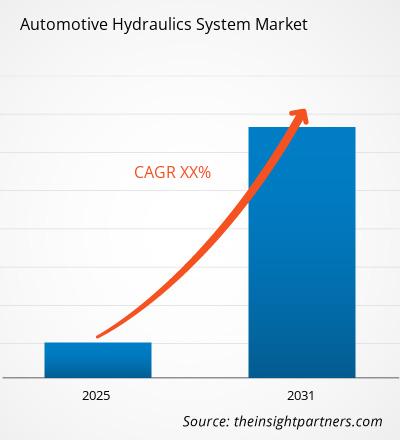
The Automotive Hydraulics System Market is projected to grow from US$ 52.73 Billion in 2025 to US$ 65.93 Billion by 2034, registering a CAGR of 2.51% during 2026–2034. Demand is supported by braking safety requirements, commercial vehicle durability needs, suspension comfort expectations, and the continued use of hydraulic actuation in passenger cars, light commercial vehicles, and heavy commercial vehicles.
North America remains a mature but specification-driven region where Automotive Hydraulics System Market size is supported by fleet replacement, pickup platforms, advanced braking systems, and commercial vehicle uptime priorities. The region is estimated to hold 21–24% share in 2025 and expand at a 2.1–2.5% CAGR during 2026–2034, helped by hydraulic brake service demand and electro-hydraulic control upgrades.
Automotive Hydraulics System Market Assessment and Insights
- North America: Held an estimated 21–24% share in 2025 and is projected to grow at a 2.1–2.5% CAGR during 2026–2034, supported by fleet maintenance, pickup demand, and brake safety compliance.
- US: Represented 78–82% of North America demand in 2025 and is expected to grow at a 2.2–2.6% CAGR, led by commercial fleets and aftermarket hydraulic brake replacement.
- Europe: Accounted for 24–27% share in 2025 and is forecast to grow at a 2.0–2.4% CAGR, with Germany, the UK, France, Italy, and Spain leading adoption.
- Asia Pacific: Represented 41–45% share in 2025 and is projected to grow at a 2.8–3.3% CAGR, led by China, Japan, South Korea, India, and Australia.
- Largest Segment: Hydraulic Brakes held 43–47% market share in 2025 and is projected to grow at a 2.4–2.8% CAGR because braking remains the core hydraulic application.
- High Growth Segment: Hydraulic Suspension held 16–19% share in 2025 and is projected to grow at a 3.0–3.5% CAGR as premium comfort and commercial stability systems expand.
- Key companies analyzed in detail: AISIN Corporation; BorgWarner Inc.; Bosch Rexroth AG; Continental AG; FTE automotive GmbH; GKN Automotive Limited; JTEKT Corporation; Schaeffler AG; ZF Friedrichshafen AG; WABCO Holdings Inc.
Source: The Insight Partners' analysis based on proprietary research, government publications, company annual reports, investor presentations, industry databases, and expert interviews.
Hydraulic systems have evolved from purely mechanical fluid circuits into controlled assemblies that combine sensors, valves, pumps, accumulators, and electronic modulation. The Automotive Hydraulics System Market growth is increasingly shaped by brake-by-wire transition paths, adaptive suspension, and commercial vehicle durability requirements. OEMs still rely on hydraulics where high force density, predictable response, and service familiarity remain critical.
Looking ahead, demand will be steadier than faster-growing electrification markets, but investment will continue in electro-hydraulic controls, lower-viscosity fluids, and compact modules. Asia Pacific will remain the largest production base, while Europe and North America emphasize safety validation, braking standards, and aftermarket reliability. Suppliers with system-level integration capability are positioned to defend value.
Automotive Hydraulics System Market Report Scope
| Report Attribute | Details |
|---|---|
| Market size in 2025 | US$ 52.73 Billion |
| Market Size by 2034 | US$ 65.93 Billion |
| Global CAGR (2026 - 2034) | 2.51% |
| Historical Data | 2021-2024 |
| Forecast period | 2026-2034 |
Automotive Hydraulics System Market Analysis
Safety regulation, vehicle weight, and fleet utilization are central to Automotive Hydraulics System Market growth. Hydraulic brakes remain essential because they provide reliable force transmission and modulation across small cars, SUVs, vans, buses, and trucks. The ecosystem includes hydraulic fluid producers, seal suppliers, cylinder makers, hose manufacturers, valve specialists, electronic control suppliers, Tier 1 integrators, OEM engineering teams, and aftermarket distributors.
Supply dynamics depend on machining capacity, elastomer availability, fluid compatibility, and qualification cycles. The Automotive Hydraulics System Market analysis shows that reliability testing is a major purchasing filter because leakage, contamination, or seal failure can affect braking, clutch actuation, ride control, and warranty exposure. Aftermarket demand also supports stable replacement volumes across aging vehicles.
Competition is led by global systems suppliers that combine mechanical components with electronic control expertise. Continental AG, ZF Friedrichshafen AG, Bosch Rexroth AG, AISIN Corporation, JTEKT Corporation, Schaeffler AG, BorgWarner Inc., GKN Automotive Limited, FTE automotive GmbH, and WABCO Holdings Inc. compete through OEM relationships, component breadth, and platform validation.
Investment is shifting toward electro-hydraulic brakes, active damping, lightweight housings, and fluid systems compatible with hybrid and electric platforms. Strategic positioning favors suppliers that can support safety-critical validation, regional manufacturing, and service networks. Cost pressure remains high, but braking and suspension performance give qualified suppliers durable sourcing relevance.
● REPORT CUSTOMIZATION
Tailor This Report To Align With Your Specific Business Requirements
This report can be customized to align precisely with your business objectives, scope, and target markets. Customization options include tailored segmentation, geography, competitive analysis, and strategic insights to support informed decision-making.
Customize This Report →WHAT YOU CAN ADJUST
- ● Segmentations
- ● Geography
- ● Competitive Analysis
- ● Language Preferences
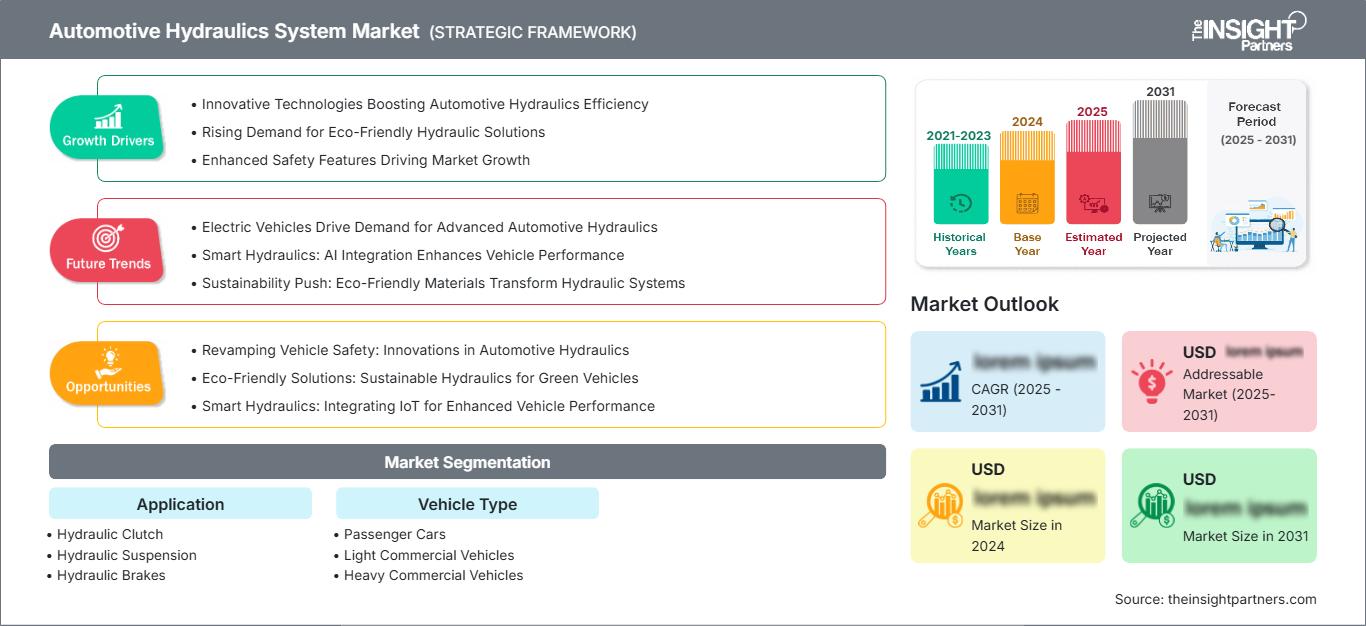
Automotive Hydraulics System Market: Strategic Insights
Regional Insights
North America Automotive Hydraulics System Market
North America accounted for an estimated 21–24% Automotive Hydraulics System Market share in 2025 and is projected to grow at a 2.1–2.5% CAGR during 2026–2034. Demand is concentrated in the US and Mexico, where pickups, SUVs, vans, and commercial fleets require hydraulic brakes, clutch circuits, suspension components, and replacement parts.
The region benefits from high vehicle parc, collision repair activity, and fleet uptime priorities. Mexico supports assembly and component exports, while Canada adds service demand in light trucks and commercial vehicles. EV adoption reduces some hydraulic clutch needs but increases interest in electro-hydraulic braking redundancy and controlled suspension systems.
U.S. Automotive Hydraulics System Market
The US represented 78–82% of North American demand in 2025 and is forecast to grow at a 2.2–2.6% CAGR through 2034. Large pickup, SUV, trailer, and delivery fleet populations sustain replacement demand for master cylinders, calipers, hoses, valves, and brake fluid service.
Continental AG, ZF Friedrichshafen AG, Bosch Rexroth AG, BorgWarner Inc., JTEKT Corporation, and WABCO Holdings Inc. support the country through OEM programs, commercial vehicle systems, and aftermarket channels. Application trends favor advanced hydraulic braking, trailer stability functions, and ride systems that improve fleet safety.
Europe Automotive Hydraulics System Market
Europe held an estimated 24–27% share in 2025 and is expected to grow at a 2.0–2.4% CAGR during 2026–2034. Germany leads regional demand because premium platforms, commercial vehicles, and advanced brake systems require precise hydraulic and electro-hydraulic control. The UK supports aftermarket and performance suspension demand.
France, Italy, and Spain contribute through passenger car assembly, light commercial vehicle production, and component manufacturing. European sourcing emphasizes braking safety, emission-linked efficiency, fluid management, and component recyclability. Continental AG, Bosch Rexroth AG, ZF Friedrichshafen AG, Schaeffler AG, and FTE automotive GmbH support regional validation and systems integration.
APAC Automotive Hydraulics System Market
APAC represented 41–45% share in 2025 and is projected to grow at a 2.8–3.3% CAGR through 2034. China leads due to vehicle production scale, commercial vehicle output, and localized brake component supply. Japan and South Korea contribute precision systems, while India expands volume demand.
Australia adds aftermarket and utility vehicle service demand. Regional growth is supported by safety regulation, logistics expansion, and passenger car production. Hydraulic brakes remain dominant, while hydraulic suspension grows in premium vehicles, buses, and heavy-duty platforms requiring stability and comfort.
Middle East & Africa Automotive Hydraulics System Market
The Middle East & Africa Automotive Hydraulics System Market is expected to grow at a 1.8–2.3% CAGR during 2026–2034. Saudi Arabia and the UAE lead demand through SUV imports, commercial fleets, and harsh-climate service needs. South Africa supports regional assembly and aftermarket hydraulic replacement.
High heat, dust, and long duty cycles increase stress on seals, hoses, brake fluids, and hydraulic cylinders. Rest of MEA demand is linked to used vehicles, mining fleets, logistics, and infrastructure activity. Growth improves where distributors provide durable replacement components and fluid service support.
Segmentation Analysis
Application
Application is projected to grow at a 2.3–2.8% CAGR during 2026–2034. The Automotive Hydraulics System Market scope by application reflects different safety, comfort, and power-transfer needs. Hydraulic brakes dominate because braking remains safety-critical, while suspension, clutch, and tappet systems address ride quality, driveline control, and engine performance.
- Hydraulic Clutch systems support smooth torque transfer, pedal consistency, and packaging flexibility in manual and selected commercial vehicle drivetrains, although electrification and automatic transmissions gradually limit long-term expansion.
- Hydraulic Suspension systems improve ride comfort, load leveling, and vehicle stability, making them strategically important in premium cars, buses, heavy vehicles, and platforms operating under variable payload conditions.
- Hydraulic Brakes remain the largest application because they provide proven force multiplication, modulation compatibility, and service familiarity across passenger cars, light commercial vehicles, and heavy commercial vehicles.
- Hydraulic Tappets support quieter valve operation, automatic lash adjustment, and engine durability in internal combustion powertrains, especially where smooth operation and reduced maintenance remain customer priorities.
Vehicle Type
Vehicle Type is expected to grow at a 2.4–2.9% CAGR during 2026–2034. Passenger cars generate the largest unit volume, while light and heavy commercial vehicles carry higher hydraulic content per vehicle due to braking loads, durability requirements, and service intensity.
- Passenger Cars generate the largest volume because hydraulic brakes, tappets, clutches, and ride systems remain widely used across internal combustion, hybrid, and selected electric vehicle architectures.
- Light Commercial Vehicles require durable brakes, clutch systems, and suspension support for urban delivery, regional logistics, and service fleets that operate with frequent stops and varying payloads.
- Heavy Commercial Vehicles depend on robust hydraulic and electro-hydraulic systems for braking, stability, suspension control, and long duty cycles where failure risk directly affects uptime and safety.
Opportunity Snapshot
| Application | Revenue Contribution | Trend Tag | Adoption Stage |
| Hydraulic Clutch | Medium | Driveline Control | Mature |
| Hydraulic Suspension | Medium | Active Ride | Scaling |
| Hydraulic Brakes | High | Safety Modulation | Mature |
| Hydraulic Tappets | Medium | Engine Refinement | Mature |
Automotive Hydraulics System Market Growth Drivers and Impact Analysis
Brake Safety Mandates Sustain Hydraulic Demand
Hydraulic brakes continue to be key in the area of safety regulations since they ensure consistent transfer of pressure, suitability with the anti-lock brake system, and consistency of brake pedal feel. The promotion of automatic emergency braking systems, electronic stability control systems, and better braking performance means that the use of hydraulics becomes necessary in spite of the ever-increasing usage of electronics. This is particularly true for passenger cars and trucks, where validation and redundancy requirements come into play.
Commercial Vehicle Utilization Raises Replacement Needs
Logistics fleets, buses, construction vehicles, and regional delivery platforms operate under high loads, frequent braking, and long service hours. All these factors speed up the wear and tear of brake cylinders, hoses, seals, hydraulics, and suspension systems. The need for reliable maintenance is important for the fleet since its downtime will affect the route performance. This point proves why this part is important for OEM and aftermarket manufacturers. In North America, India, the Middle East, and Africa, there is a good chance for demand from maintenance cycles.
Ride Comfort Expectations Support Hydraulic Suspension
Consumers and fleet buyers increasingly expect stable ride quality, load leveling, and reduced vibration across premium cars, buses, vans, and heavy vehicles. Hydraulic suspensions provide controlled dampening and load carrying, where purely mechanical spring systems lack the ability to provide reliable performance. This driver is made stronger by the increased cabin lengths, increased weight from batteries, and varying commercial payloads. This is not confined to luxury vehicles, since there are benefits for delivery trucks and buses as well, which require stability and comfort for passengers.
Automotive Hydraulics System Market Future Trends
Electro-Hydraulic Brake Integration
Automotive Hydraulics System Market trends point toward electro-hydraulic braking architectures that combine traditional pressure circuits with electronic actuation, diagnostics, and redundancy. Such technologies enable advanced driver assistance, regenerative braking, and automated driving functionalities while maintaining hydraulic failsafe capabilities. The next generation of vehicles will require small components, quick pressure build-up, and integration with electronic stability control. Their implementation is expected to be most common in high-end, electric, and fleet vehicles due to the high level of validation needed for safety reasons.
Low-Impact Fluids and Lightweight Components
Future hydraulic systems will increasingly use lower-viscosity fluids, improved seals, lightweight housings, and recyclable materials to reduce energy loss and environmental exposure. The review of subsystems by OEMs for efficiency and sustainability involves even hydraulic circuitry, which was not given enough thought in the past. There is going to be a need for component manufacturers to find a compromise between the mass of the components and pressure strength, heat resistance, and sealing capability.
Automotive Hydraulics System Market Opportunities
Electro-Hydraulic Modules for EV Platforms
Automotive Hydraulics System Market Forecasts show opportunity in EV brake and suspension modules that combine hydraulic force with electronic control. Battery-based cars need to have a braking system that is safe in terms of redundancy, regenerative capability, and stability despite the additional weight of batteries. Value can be derived from suppliers who supply small-sized modules that include pumps, valves, and software-ready interfaces. Since electric vehicles will share architectures, there will be value in supplying validated modules.
Aftermarket Service Kits for Aging Fleets
Aftermarket service kits create an actionable opportunity as older vehicles require brake, clutch, suspension, and tappet maintenance. Cylinders, seals, hoses, fluids, and assembly kits can be packaged together in order to minimize time spent on the repairs at workshops. The importance of having consistent parts supplies is that the hydraulic component failure causes operations to stop right away. For suppliers having fitment data and trained sales teams, there is a chance to improve profitability and increase coverage in both mature and developing countries.
Frequently Asked Questions

- Comprehensive Market Sizing and Forecast Analysis
- Detailed Segmentation Analysis
- In-Depth Market Dynamics Assessment
- Regional and Country-Level Insights
- Competitive Landscape and Company Benchmarking
- Strategic Business Intelligence
Recent Reports
Testimonials

The Insight Partners' SCADA System Market report is comprehensive, with valuable insights on current trends and future forecasts. The team was highly professional, responsive, and supportive throughout. We are very satisfied and highly recommend their services.
RAN KEDEM Partner, Reali Technologies LTDs
I requested a report on a very specific software market and the team produced the report in a few days. The information was very relevant and well presented. I then requested some changes and additions to the report. The team was again very responsive and I got the final report in less than a week.
JEAN-HERVE JENN Chairman, Future Analytica
We worked with The Insight Partners for an important market study and forecast. They gave us clear insights into opportunities and risks, which helped shape our plans. Their research was easy to use and based on solid data. It helped us make smart, confident decisions. We highly recommend them.
PIYUSH NAGPAL Sr. Vice President, High Beam Global
The Insight Partners delivered insightful, well-structured market research with strong domain expertise. Their team was professional and responsive throughout. The user-friendly website made accessing industry reports seamless. We highly recommend them for reliable, high-quality research services
YUKIHIKO ADACHI CEO, Deep Blue, LLC.
This is the first time I have purchased a market report from The Insight Partners.While I was unsure at first, I visited their web site and felt more comfortable to take the risk and purchase a market report.I am completely satisfied with the quality of the report and customer service. I had several questions and comments with the initial report, but after a couple of dialogs over email with their analyst I believe I have a report that I can use as input to our strategic planning process.Thank you so much for taking the extra time and making this a positive experience.I will definitely recommend your service to others and you will be my first call when we need further market data.
JOHN SUZUKI President and Chief Executive Officer, Board Director, BK Technologies
I wish to appreciate your support and the professionalism you displayed in the course of attending to my request for information regarding to infectious disease IVD market in Nigeria. I appreciate your patience, your guidance, and the fact that you were willing to offer a discount, which eventually made it possible for us to close a deal. I look forward to engaging The Insight Partners in the future, all thanks to the impression you have created in me as a result of this first encounter.
DR CHIJIOKE ONYIA MANAGING DIRECTOR, PineCrest Healthcare Ltd.Reason to Buy
- Informed Decision-Making
- Understanding Market Dynamics
- Competitive Analysis
- Identifying Emerging Markets
- Customer Insights
- Market Forecasts
- Risk Mitigation
- Boosting Operational Efficiency
- Strategic Planning
- Investment Justification
- Tracking Industry Innovations
- Aligning with Regulatory Trends





 Get Free Sample for