
Automotive Lead Acid Battery Market Analysis, Size, and Share by 2034
Coverage: By Automotive Lead Acid Battery Market Size and Forecast (2021–2034), Global and Regional Share, Trends, and Growth Opportunity Analysis: By Product (SLI and Micro Hybrid Batteries), Type (Flooded, Enhanced Flooded, and VRLA), and End-user (Passenger Car, LCV, and MCV and HCV), and Geography (North America, Europe, Asia Pacific, and South and Central America)
- Status : Data Released
- Report Code : TIPRE00022629
- Category : Electronics and Semiconductor
- No. of Pages : 150
- Available Report Formats :


- Last update date : July 20, 2026


2025 Market Size
US$ 29.44 Bn
Base year value
2034 Forecast
US$ 47.26 Bn
Projected by 2034
CAGR 2026-2034
5.4 %
Growth rate
Addressable Market
US$ 347.84 Bn
(2026-2034)
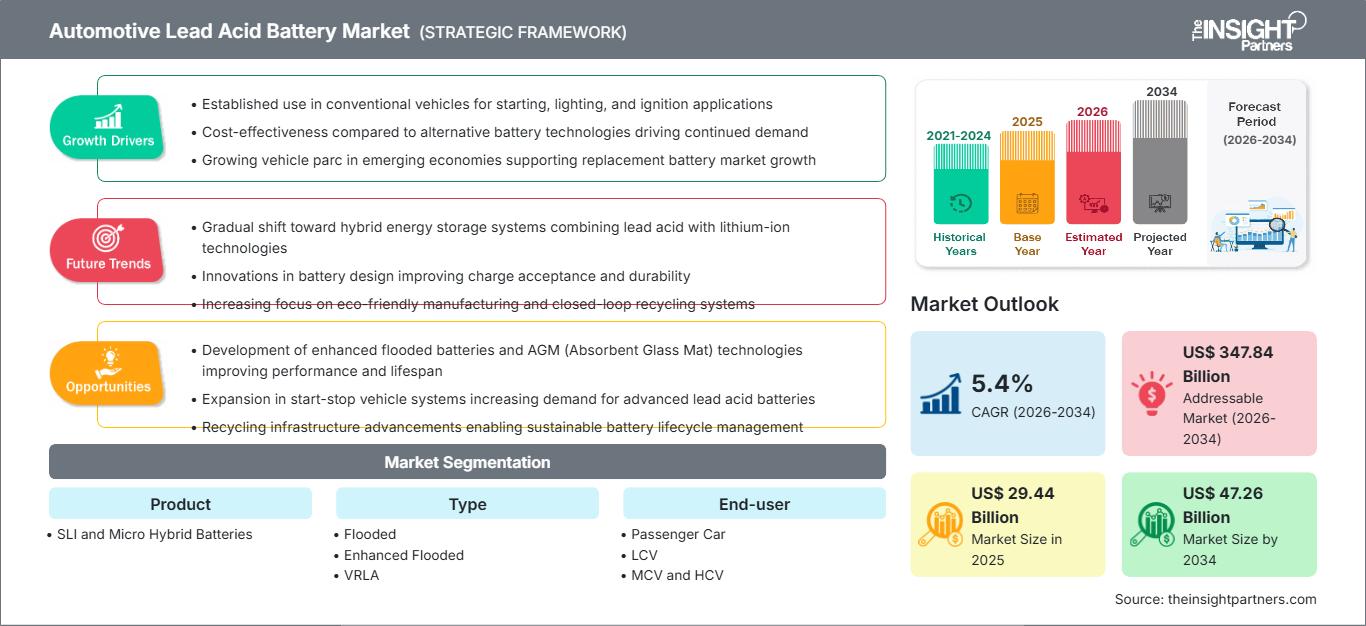
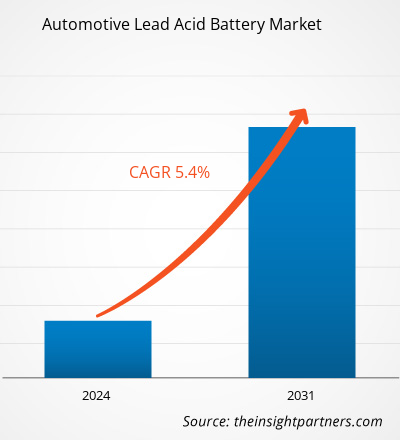
The Automotive Lead Acid Battery Market would register a compound annual growth rate (CAGR) of 5.4% during the forecast period (2026-2034), growing from US$ 29.44 Billion in 2025 to reach US$ 47.26 Billion by 2034. Demand is driven by use cases of starting, lighting, ignition, auxiliary, and low-voltage safety systems applications in passenger and commercial cars where lead acid technology provides cost-effectiveness and high recyclability.
North America would follow a steady growth trajectory, with the Automotive Lead Acid Battery Market size growing at a 2026-2034 CAGR of 4.6-5.0%. Factors such as large mature vehicle fleets, strong replacement activity, cold climate conditions, and growing start-stop technology adoption contribute to growth, while recycling helps secure supply of lead metal.
Automotive Lead Acid Battery Market Assessment and Insights
- North America held 24–27% share in 2025 and is projected to grow at a CAGR range of 4.6–5.0% during 2026–2034, supported by replacement demand, premium vehicles, and recycling capacity.
- US accounted for 76–80% of North America in 2025 and is expected to grow at 4.7–5.1% through 2034, led by aftermarket depth.
- Europe represented 21–24% share in 2025 and may expand at 4.3–4.8%, with Germany, France, the UK, Italy, and Spain driving start-stop and EFB uptake.
- Asia Pacific captured 38–42% share in 2025 and is forecast to grow at 5.8–6.3%, led by China, India, Japan, and South Korea vehicle production.
- Largest Segment SLI batteries held 68–72% market share in 2025 and are expected to grow at 4.8–5.3%, reflecting installed vehicle parc dependence.
- High Growth Segment Micro hybrid batteries held 28–32% share in 2025 and are projected to grow at 6.3–6.8%, benefiting from start-stop systems.
- Key companies analyzed in detail: Clarios International Inc., CSB Energy Technology Co., Ltd., EnerSys, East Penn Manufacturing Company, Exide Industries Limited, GS Yuasa International Ltd., Johnson Controls International plc, Leoch International Technology Limited, Panasonic Holdings Corporation, FIAMM Energy Technology S.p.A.
Source: The Insight Partners' analysis based on proprietary research, government publications, company annual reports, investor presentations, industry databases, and expert interviews.
The battery technologies have developed from simple flooded batteries to EFB, AGM, and VRLA batteries as cars have become electronically advanced and fitted with safety sensors and stop-start systems, among others. There has been growth in the market for Automotive Lead Acid Battery because of localized production as well as closed-loop recycling processes that provide stability in terms of availability of lead. Manufacturers have distinguished themselves through aspects such as charging ability, cycleability, low maintenance design, and compatibility with power management modules.
From 2019 up until 2034, demand will be driven by manufacturing in Asia Pacific production regions, the replacement market in North America, and low-emission vehicles in Europe. Areas of investment will be advanced plate technology, battery management system, recycling lead process, and thermal properties. Regulation focus on circularity, emission reduction, and vehicle durability will ensure continued relevance of lead acid batteries in face of growth of lithium-ion batteries as traction batteries because of the low voltage redundancy requirement.
Automotive Lead Acid Battery Market Report Scope
| Report Attribute | Details |
|---|---|
| Market size in 2025 | US$ 29.44 Billion |
| Market Size by 2034 | US$ 47.26 Billion |
| Global CAGR (2026 - 2034) | 5.4% |
| Historical Data | 2021-2024 |
| Forecast period | 2026-2034 |
Automotive Lead Acid Battery Market Analysis
The market is impacted by vehicle parc growth, replacement cycles of batteries and increasing requirement of low-voltage energy for use in safety features and infotainment systems. The passenger car category accounts for the largest demand base while commercial vehicles offer stable demand due to high costs of downtimes. Efficient recycling ensures cost advantage with lead acid batteries being one of the most recycled industrial products worldwide.
Factors affecting the supply include availability of refined lead, polypropylene battery casings, separators, acids and distribution channels. Original equipment manufacturers' (OEMs') demand varies with production cycles, but aftermarkets compensate during slowdowns in production cycles. The key players of the market include battery manufacturers, recyclers, auto manufacturers, distributors, workshops and fleet owners with serviceability being an important competition parameter.
Competitiveness is seen as highly focused on technology reliability, geographical presence of manufacture, and recyclability of batteries. Companies such as Clarios International Inc., East Penn Manufacturing Company, GS Yuasa International Ltd., Exide Industries Limited, and EnerSys compete in terms of OEM approval, after-market brands, AGM/EFB technology, and cost reduction for Asian players.
The focus of investment is on automation of production, grid energy-efficient formation processes, smelting without emissions, and digital diagnostic tools for batteries. Increasingly, strategic positioning is about combining long-lasting products with circular supply chain management, since car makers and fleet operators consider the lifecycle cost of batteries rather than just the procurement cost.
● REPORT CUSTOMIZATION
Tailor This Report To Align With Your Specific Business Requirements
This report can be customized to align precisely with your business objectives, scope, and target markets. Customization options include tailored segmentation, geography, competitive analysis, and strategic insights to support informed decision-making.
Customize This Report →WHAT YOU CAN ADJUST
- ● Segmentations
- ● Geography
- ● Competitive Analysis
- ● Language Preferences
Automotive Lead Acid Battery Market: Strategic Insights
Regional Insights
North America Automotive Lead Acid Battery Market
Revenue contribution from North America stood at 24-27% during 2025, with the forecasted CAGR of 4.6-5.0% projected until 2034. Demand for replacement batteries is fueled by large numbers of vehicles on the road, extreme seasonal temperatures variation, and widespread presence of pickup trucks, SUVs, and light commercial vehicles that need reliable cold-start capabilities.
The Automotive Lead Acid Battery market share in the region is also driven by efficient retail, dealer service centers, and profitable recycling processes. Electrification of fleets does not eliminate the need for low-voltage batteries, since EVs require auxillary power supply for their operation.
U.S. Automotive Lead Acid Battery Market
The share of the U.S. in North America was 76-80% in 2025 and is expected to grow at 4.7-5.1% in 2026-2034. The market demand is stimulated by high car ownership rates, old cars, wide presence of service networks, and car replacement in areas where heat, cold, and stop & go traffic conditions prevail.
The leading market players include Clarios International Inc., East Penn Manufacturing Company, Johnson Controls International plc, and EnerSys. There is a change in applications, from simple SLI batteries to AGM and EFB technologies, due to the installation of advanced assistance and telematic systems in the vehicles.
Europe Automotive Lead Acid Battery Market
Europe held a market share of 21-24% in 2025, with an anticipated growth of 4.3-4.8% during 2034. Germany will retain its position as the dominant market country. The UK will experience a consistent aftermarket demand due to the presence of old-age automobiles in addition to the need for replacement owing to the use of stop-start technology.
Germany will be able to thrive owing to its engineering capabilities, supplier involvement, and emissions compliance regulations. France, Italy, and Spain will contribute through the replacement of passenger cars, light commercial vehicles, and repairs. The European market is driven by circular economy policies, battery collection policies, and the desire for maintenance-free batteries.
APAC Automotive Lead Acid Battery Market
APAC captured 38%-42% market share in 2025 and is forecast to grow at a 5.8%-6.3% CAGR, making it the fastest-growing region. China is leading due to its manufacturing capability of vehicles, the scale of suppliers, and recycling ability, whereas Japan and South Korea place emphasis on technology and hybrid friendly nature.
Countries like India and Australia contribute to demand with passenger vehicle requirements, logistics fleet vehicles, and harsh duty environments. The industrial policies related to manufacturing, repair network, and cost-conscious vehicle ownership enhance the market in APAC.
Middle East & Africa Automotive Lead Acid Battery Market
The Middle East and Africa market will have a CAGR of 4.9-5.4% till 2034, with Saudi Arabia being the main consumer of this region. The hot climate in this region reduces the battery life, thereby aiding in the sales of replacement batteries, whereas UAE has higher luxury car penetration along with better networked services.
The South African and Rest of MEA regions contribute to the market via commercial transportation, mining transportation and infrastructure development. Requirements of energy security, harsh road conditions, and increasing parts distribution networks are factors that drive demand.
Segmentation Analysis
Product
The Product segment is expected to grow at a 5.2–5.7% CAGR during 2026–2034. The Automotive Lead Acid Battery Market scope across Product is defined by conventional SLI demand and faster micro hybrid adoption, where start-stop duty cycles require stronger charge acceptance, deeper cycling resistance, and better thermal stability.
- SLI batteries remain the installed-base backbone, serving ignition, lighting, and electrical stabilization needs in conventional vehicles. Their broad aftermarket availability and low cost sustain strategic relevance.
- Micro Hybrid Batteries support frequent engine restarts, regenerative braking assistance, and heavier accessory loads. Adoption is strongest where fuel-efficiency rules push start-stop technology into mass-market vehicles.
Type
The Type segment is projected to grow at a 5.1–5.6% CAGR during 2026–2034. Flooded batteries retain volume leadership in cost-sensitive vehicles, while Enhanced Flooded and VRLA products gain share as electrical loads increase. The market benefits from technology choices aligned with vehicle price points and duty cycles.
- Flooded batteries remain dominant in standard vehicles because they offer low acquisition cost, proven serviceability, and broad replacement availability across developed and emerging automotive channels.
- Enhanced Flooded batteries address higher cycling needs in start-stop vehicles, offering improved charge acceptance while remaining more economical than AGM alternatives for mid-range platforms.
- VRLA batteries provide sealed, maintenance-free performance for vehicles requiring spill resistance, flexible installation, and stronger vibration tolerance, especially in premium and commercial applications.
End-user
The End-user segment is expected to grow at a 5.3–5.8% CAGR during 2026–2034. Passenger cars dominate unit demand, but commercial vehicles generate high-value replacement opportunities due to uptime requirements. Fleet operators increasingly evaluate warranty, cold-cranking reliability, and service access when selecting batteries for the Automotive Lead Acid Battery Market.
- Passenger Car demand is shaped by large vehicle parc, rising electronic content, and consumer replacement cycles, making this sub-segment central to both OEM and aftermarket strategies.
- LCV demand reflects delivery, service, and urban logistics fleets that require dependable starting power, predictable maintenance, and fast replacement availability to avoid operational delays.
- MCV and HCV applications prioritize durability, vibration resistance, and high cranking capability, with demand tied to freight, construction, mining, and long-haul transport activity.
Opportunity Snapshot
| End-user | Revenue Contribution | Trend Tag | Adoption Stage |
| Passenger Car | High | Start-Stop | Mature |
| LCV | Medium | Urban Fleet | Scaling |
| MCV and HCV | Medium | Heavy Duty | Scaling |
Automotive Lead Acid Battery Market Growth Drivers and Impact Analysis
Aging Vehicle Parc and Replacement Intensity
Rising average vehicle age increases replacement frequency because batteries deteriorate with heat exposure, cold starts, vibration, and repeated short trips. The market benefits from this installed-base effect even when new vehicle production moderates. Aftermarket distributors, service centers, and retailers capture recurring demand because most consumers replace batteries only after performance failure or diagnostic warnings. Commercial fleets add a stronger impact because downtime directly affects delivery reliability, route utilization, and maintenance cost. Suppliers that combine dense distribution, warranty analytics, and fast fitment support are positioned to convert aging parc into stable revenue.
Start-Stop Systems Expanding Advanced Battery Demand
Start-stop systems require batteries that tolerate frequent engine restarts, partial-state-of-charge operation, and higher cycling stress than conventional SLI designs. This pushes demand toward EFB and VRLA technologies, especially AGM variants in premium and higher-load vehicles. The market gains value as automakers balance fuel-efficiency targets with affordable low-voltage architecture. Replacement complexity also rises because incorrect battery selection can affect power management calibration. Manufacturers with OE validation, diagnostic guidance, and training programs can capture higher-margin demand while reducing service errors across workshops and dealer networks.
Closed-Loop Recycling Strengthening Cost and Compliance
Lead acid batteries retain a strong circularity advantage because lead, polypropylene, and acid can be recovered through established recycling systems. This supports raw material security, reduces environmental exposure, and improves compliance with battery collection rules. The market is therefore less dependent on virgin material sourcing than many competing chemistries. Producers investing in emissions-controlled smelting, collection partnerships, and traceable recycled content can meet automaker sustainability expectations. The impact is practical: recycling efficiency lowers supply risk while reinforcing the chemistry’s relevance in regulated automotive supply chains.
Automotive Lead Acid Battery Market Future Trends
Battery Health Intelligence in Service Networks
Future Automotive Lead Acid Battery Market trends will include wider use of sensor-based diagnostics, state-of-health scoring, and predictive replacement tools across workshops and fleets. Instead of waiting for no-start events, service providers can identify weak batteries during routine inspections and recommend timely replacement. This approach improves customer satisfaction, reduces warranty disputes, and creates data feedback loops for manufacturers. Fleet managers may integrate battery health into maintenance dashboards, especially for logistics vehicles operating multiple daily routes. Over time, diagnostics can shift the market from reactive replacement toward planned lifecycle management.
Advanced Low-Voltage Support for Electrified Vehicles
Electrified vehicles still require dependable low-voltage systems for safety controls, door locks, lighting, communication modules, and emergency functions. This creates a continuing role for lead acid batteries where cost, availability, and service familiarity matter. The market will evolve toward products optimized for auxiliary duty rather than only engine starting. Suppliers may focus on lower self-discharge, improved charge acceptance, and integration with vehicle energy management software. As electrification scales, battery producers that prove reliability in hybrid and EV auxiliary platforms can protect relevance.
Automotive Lead Acid Battery Market Opportunities
Aftermarket Expansion in Emerging Vehicle Fleets
Emerging economies provide attractive Automotive Lead Acid Battery Market Forecasts because rising vehicle ownership creates future replacement pools. Distributors can build value by improving availability, fitment accuracy, and warranty transparency in tier-two and tier-three cities. Localized assembly, dealer partnerships, and digital cataloging can reduce mismatch risk across fragmented workshops. Passenger cars deliver volume, while commercial fleets provide repeat purchase visibility. Companies that combine affordable flooded batteries with upgraded EFB options can serve both first-time owners and professional operators. The opportunity is strongest where road freight, ride-hailing, and last-mile logistics expand together.
Premiumization of Replacement Batteries
Replacement buyers increasingly need batteries matched to start-stop systems, advanced electronics, and climate-specific operating conditions. This opens a margin opportunity for AGM, EFB, and maintenance-free formats positioned on reliability rather than lowest price. The market can benefit from technician education, fitment databases, and diagnostic selling tools that justify premium products. Retailers and service chains can use warranty history and vehicle data to recommend appropriate specifications. Manufacturers that support channel training and clear labeling are likely to reduce returns while improving customer confidence in higher-value replacements.
Recent Developments
- October 2025: Toshiba has introduced a new SCiB 24V battery pack (P25H20-3), a lithium-ion solution engineered for automotive, marine, and heavy equipment sectors, that also offers the advantage of seamless replacement of conventional lead-acid batteries. This innovative product has already been equipped with “e-Float Terrace,” the electric boat from Yamaha Motor Co., Ltd. (Yamaha Motor), which is scheduled to begin offering cruise experiences in Yokohama, Japan, this October.
- November 2025: REPOWERTEK has unveiled its groundbreaking fifth-generation "PRIME Series" regenerator, along with an innovative industrial workshop and platform business model, marking a new milestone in the global battery regeneration industry. The PRIME system restores batteries without generating internal heat or causing damage, extending battery life by 200–300% and providing a safer, more economical alternative to lithium-based energy storage.
- February 2024: Terra Supreme Battery is set to begin production of its Group 31 battery, based on what it describes as a composite grid bipolar AGM lead-acid chemistry, at its US manufacturing facility, according to information obtained by Batteries International.
Frequently Asked Questions

- Comprehensive Market Sizing and Forecast Analysis
- Detailed Segmentation Analysis
- In-Depth Market Dynamics Assessment
- Regional and Country-Level Insights
- Competitive Landscape and Company Benchmarking
- Strategic Business Intelligence
Recent Reports
Testimonials

The Insight Partners provided valuable market intelligence that supported our global go-to-market strategy. Their team was professional, responsive, and attentive to our feedback, providing thoughtful analysis and helpful methodological clarifications throughout the project.
Junmo Kim Chief Financial Officer (CFO), Enertech Co., Ltd.
The Insight Partners' SCADA System Market report is comprehensive, with valuable insights on current trends and future forecasts. The team was highly professional, responsive, and supportive throughout. We are very satisfied and highly recommend their services.
RAN KEDEM Partner, Reali Technologies LTDs
I requested a report on a very specific software market and the team produced the report in a few days. The information was very relevant and well presented. I then requested some changes and additions to the report. The team was again very responsive and I got the final report in less than a week.
JEAN-HERVE JENN Chairman, Future Analytica
We worked with The Insight Partners for an important market study and forecast. They gave us clear insights into opportunities and risks, which helped shape our plans. Their research was easy to use and based on solid data. It helped us make smart, confident decisions. We highly recommend them.
PIYUSH NAGPAL Sr. Vice President, High Beam Global
The Insight Partners delivered insightful, well-structured market research with strong domain expertise. Their team was professional and responsive throughout. The user-friendly website made accessing industry reports seamless. We highly recommend them for reliable, high-quality research services
YUKIHIKO ADACHI CEO, Deep Blue, LLC.
This is the first time I have purchased a market report from The Insight Partners.While I was unsure at first, I visited their web site and felt more comfortable to take the risk and purchase a market report.I am completely satisfied with the quality of the report and customer service. I had several questions and comments with the initial report, but after a couple of dialogs over email with their analyst I believe I have a report that I can use as input to our strategic planning process.Thank you so much for taking the extra time and making this a positive experience.I will definitely recommend your service to others and you will be my first call when we need further market data.
JOHN SUZUKI President and Chief Executive Officer, Board Director, BK Technologies
I wish to appreciate your support and the professionalism you displayed in the course of attending to my request for information regarding to infectious disease IVD market in Nigeria. I appreciate your patience, your guidance, and the fact that you were willing to offer a discount, which eventually made it possible for us to close a deal. I look forward to engaging The Insight Partners in the future, all thanks to the impression you have created in me as a result of this first encounter.
DR CHIJIOKE ONYIA MANAGING DIRECTOR, PineCrest Healthcare Ltd.Reason to Buy
- Informed Decision-Making
- Understanding Market Dynamics
- Competitive Analysis
- Identifying Emerging Markets
- Customer Insights
- Market Forecasts
- Risk Mitigation
- Boosting Operational Efficiency
- Strategic Planning
- Investment Justification
- Tracking Industry Innovations
- Aligning with Regulatory Trends






 Get Free Sample for