
Baggage Handling System Market Growth, Trends & Demand by 2034
Coverage: By Modes of Transport (Airport, Marine, Railway); Solution (Check-In, Screening and Load, Conveying and Sorting, Unload and Reclaim); Tracking Technology (Barcode System, RFID System) , and Geography (North America, Europe, Asia Pacific, and South and Central America)
- Status : Data Released
- Report Code : TIPRE00004032
- Category : Electronics and Semiconductor
- No. of Pages : 150
- Available Report Formats :


- Last update date : July 17, 2026


2025 Market Size
US$ 14.46 Bn
Base year value
2034 Forecast
US$ 24.87 Bn
Projected by 2034
CAGR 2026-2034
6.21 %
Growth rate
Addressable Market
US$ 178.02 Bn
(2026-2034)
The Baggage Handling System Market size was valued at US$ 14.46 Billion in 2025 and is projected to reach US$ 24.87 Billion by 2034; it is expected to register a CAGR of 6.7% from 2026 to 2034. Growth reflects continuing investment in airport automation, transport-terminal modernization, baggage tracking, screening integration, and higher passenger expectations for faster, more transparent luggage movement across airport, marine, and rail environments.
North America remains a core demand center as the Baggage Handling System Market size benefits from airport terminal expansions, carrier punctuality targets, and IATA-led baggage modernization. The region is assessed at 28–32% share in 2025, with a 5.8–6.4% CAGR through 2034. Replacement of aging conveyors, wider self-service check-in, and RFID-enabled accountability are expected to sustain procurement among large hubs and secondary airports.
Baggage Handling System Market Assessment and Insights
- North America accounted for 28–32% of the Baggage Handling System Market share in 2025 and is growing at a CAGR range of 5.8–6.4% during 2026–2034, supported by hub upgrades, RFID compliance, and self-service adoption.
- US represented 72–76% of North America in 2025 and is growing at a CAGR range of 5.9–6.5%, led by airport modernization and airline digital baggage programs.
- Europe held 24–28% share in 2025 and is growing at a CAGR range of 5.6–6.2% during 2026–2034, with the UK, Germany, France, Spain, and Italy leading replacement cycles.
- Asia Pacific captured 26–30% share in 2025 and is growing at a CAGR range of 7.4–8.2% during 2026–2034, led by China, India, Japan, South Korea, and Australia.
- Largest Segment Airport held 82–86% market share in 2025 and is growing at a CAGR range of 6.4–7.0%, as aviation hubs remain the primary automation buyers.
- High Growth Segment Radio Frequency Identification held 18–22% market share in 2025 and is growing at a CAGR range of 8.1–8.9%, driven by baggage visibility mandates.
- Key companies analyzed in detail: BEUMER Group GmbH & Co. KG, Daifuku Co., Ltd., Fives SAS, G&S Airport Conveyor, Glidepath Limited, Logplan LLC, Pteris Global Limited, Siemens AG, SITA, Vanderlande Industries B.V.
Source: The Insight Partners' analysis based on proprietary research, government publications, company annual reports, investor presentations, industry databases, and expert interviews.
The approach to system design has shifted away from linear conveying towards integration, controls, routing via totes, maintenance prediction and identity tracking for bags. Airports are merging screening, sorting, reconciliation, and passenger communications in order to decrease missed connections and human intervention through common operating layers. Terminal operators' requirement for a phased upgrade strategy without shutting down operations makes modular solutions appealing as well. Therefore, the market growth is driven by resilience rather than capacity.
Future procurement activities will increasingly be focused on aviation routes that are emerging, as well as transport hubs and ports of call that offer high volumes of passengers. Investment in connected platforms should be facilitated by public infrastructure projects, biometric passenger processing and increased baggage responsibility regulations. 10-year IATA baggage roadmap is promoting automation, information standards and real-time tracking as key factors of operational importance.
Baggage Handling System Market Report Scope
| Report Attribute | Details |
|---|---|
| Market size in 2025 | US$ 14.46 Billion |
| Market Size by 2034 | US$ 24.87 Billion |
| Global CAGR (2026 - 2034) | 6.21% |
| Historical Data | 2021-2024 |
| Forecast period | 2026-2034 |
Baggage Handling System Market Analysis
Factors influencing demand include record levels of checked baggage, reduced turnaround timeframes, and passenger expectations of mobility of information. SITA indicated that in 2024 global traffic amounted to 5.3 billion passengers, with mishandling reduced to 6.3 per 1,000 passengers, indicating that investments in automation result in tangible efficiency improvements. The supply chain includes equipment manufacturers, IT solutions providers at airports, civil contractors, ground handling organizations, airlines, and systems integration companies specializing in security checks.
Favorable factors influencing supply include the ability to offer integrated solutions of conveyors, sorters, scanners, baggage management systems, and services associated with data analysis in real terminals. Analysis of Baggage Handling System Market report reveals a tendency to favor interoperable architecture, since operators seek solutions involving fewer transitions between systems, shorter periods of downtime and clarity regarding lifecycle costs. In addition, demand involves marine and rail environments where checked baggage, security checks and passenger movement are increasingly organized.
The competitive environment consists of global integrators and specialized baggage handling system providers. Competitors such as BEUMER Group GmbH & Co. KG, Vanderlande Industries B.V., Daifuku Co., Ltd., Siemens AG, and SITA compete in automation solutions, digital control, and worldwide maintenance services; competitors like Fives SAS, G&S Airport Conveyor, Glidepath Limited, Logplan LLC, and Pteris Global Limited enhance their project delivery capabilities and engineering expertise.
Capital is moving towards software-driven baggage handling operations, predictive asset management, and highly accurate identification of luggage. Purchasers are assessing vendors based on retrofitting capabilities, cybersecurity protection, and common use airport systems capability. Strategic positioning requires successful implementation at high volume facilities as airports favor companies that have the potential to lower their operational risk and help meet their airline service level objectives and regulations on baggage tracking.
● REPORT CUSTOMIZATION
Tailor This Report To Align With Your Specific Business Requirements
This report can be customized to align precisely with your business objectives, scope, and target markets. Customization options include tailored segmentation, geography, competitive analysis, and strategic insights to support informed decision-making.
Customize This Report →WHAT YOU CAN ADJUST
- ● Segmentations
- ● Geography
- ● Competitive Analysis
- ● Language Preferences
Baggage Handling System Market: Strategic Insights
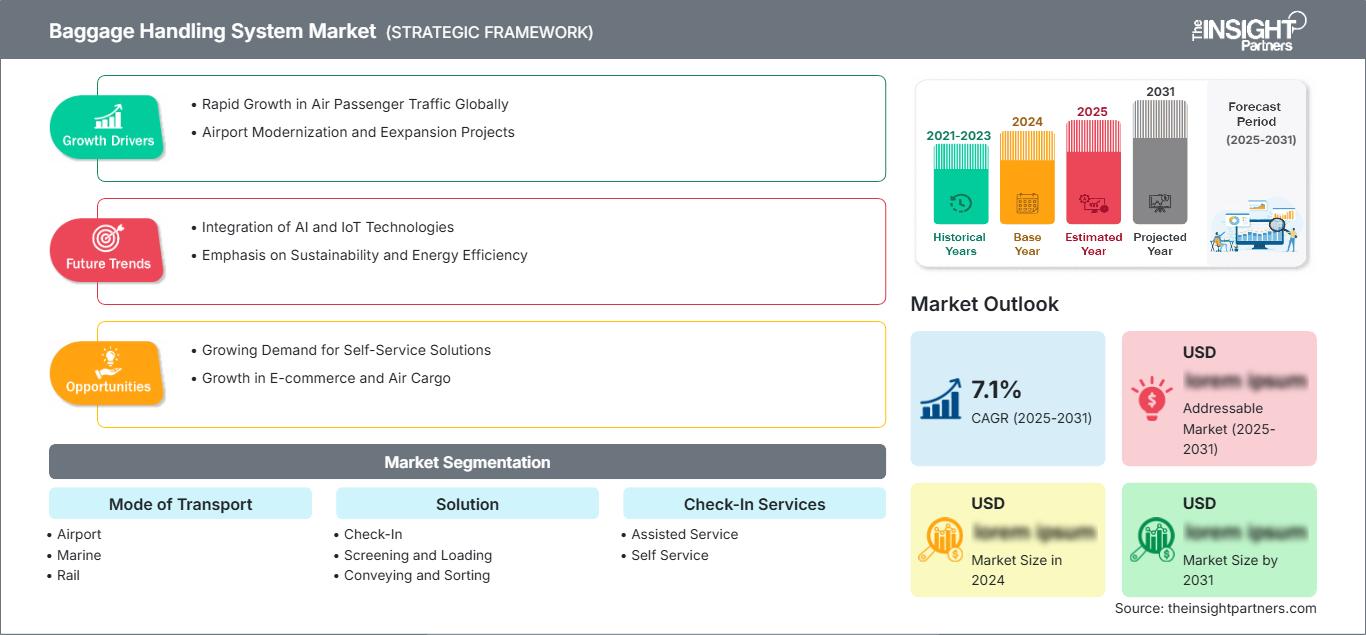
Regional Insights
North America Baggage Handling System Market
North America accounted for 28–32% share in 2025 and is forecast to grow at a 5.8–6.4% CAGR. The Baggage Handling System Market share in the region is supported by extensive airport renewal programs, higher passenger throughput, and replacement of end-of-life conveyor and control systems. Airports are prioritizing systems that lower missed-bag incidents and support airline accountability under baggage-tracking standards.
Procurement is strongest in large hub terminals, but secondary airports are becoming important as they add self-service bag drops and scalable screening lines. Regional spending is also supported by the cost burden of mishandled baggage, which SITA estimated at US$5 billion globally in 2024. These economics make predictive maintenance and RFID-linked reconciliation attractive even where greenfield construction is limited.
U.S. Baggage Handling System Market
The U.S. represented 72–76% of North America in 2025 and is expected to grow at a 5.9–6.5% CAGR. Demand is tied to terminal redevelopment, airline hub concentration, and the need to move bags reliably across transfer-heavy networks. Company presence is broad, with Vanderlande Industries B.V., BEUMER Group GmbH & Co. KG, Daifuku Co., Ltd., Siemens AG, and SITA supporting airport modernization projects.
Application trends emphasize self-service check-in, automated screening integration, and real-time bag status for passengers. U.S. airports also face labor availability constraints, making automated sortation and remote diagnostics more compelling. RFID and barcode systems continue to coexist, but high-value projects increasingly require redundancy, cyber-secure controls, and operational dashboards that help airlines recover disrupted baggage flows faster.
Europe Baggage Handling System Market
Europe held 24–28% share in 2025 and is growing at a 5.6–6.2% CAGR, with the UK and Germany leading investment. The UK benefits from hub refurbishment and capacity optimization, while Germany emphasizes operational reliability and energy-efficient automation. Complex interline transfers and legacy terminal layouts make software-led orchestration central to European procurement decisions.
France, Italy, and Spain add steady demand through tourism-linked passenger flows, seasonal peaks, and airport security upgrades. European operators are also under pressure to reduce mishandling, as regional rates have historically exceeded global averages. This supports investment in early-bag storage, automated loading interfaces, and integrated reconciliation systems that improve punctuality while limiting new terminal footprint requirements.
APAC Baggage Handling System Market
APAC captured 26–30% share in 2025 and is projected to grow at a 7.4–8.2% CAGR, the fastest regional pace. China leads by scale, while India adds strong airport-capacity expansion. Japan, South Korea, and Australia focus on reliability, passenger experience, and automation at constrained terminals.
Policy-backed aviation investment, rising middle-class travel, and smart-airport programs create a favorable project pipeline. APAC also recorded low mishandling rates, reinforcing the value of modern systems. The Baggage Handling System Market benefits as new airports specify RFID readiness, integrated screening, and modular baggage halls from the design stage.
Middle East & Africa Baggage Handling System Market
Middle East & Africa is forecast to grow at a 6.8–7.6% CAGR, with Saudi Arabia and the UAE leading demand. Mega-airport development, tourism diversification, and premium carrier networks require high-throughput baggage halls and reliable transfer handling. South Africa and Rest of MEA add selective demand from airport rehabilitation and security upgrades.
Energy-sector investment and infrastructure diversification support long-term aviation spending across Gulf markets. Operators are specifying systems that can handle peak pilgrimage, tourism, and transit flows while maintaining traceability. The region’s opportunity is strongest where new terminals allow automation to be embedded before civil construction is finalized.
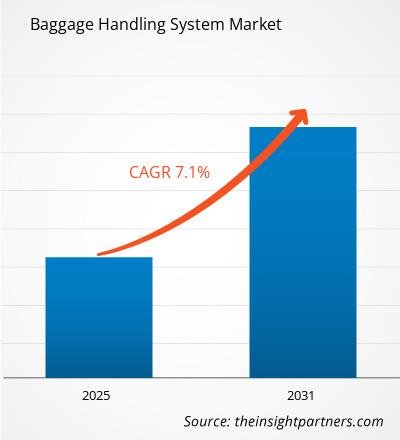
Segmentation Analysis
Mode of Transport
Mode of Transport is expected to grow at a 6.3–7.1% CAGR during 2026–2034. The Baggage Handling System Market forecast across transport modes is led by airports, but marine and rail terminals are adopting structured baggage movement where passenger volumes, security screening, and premium service models justify automation. The segment reflects a gradual shift from aviation-only systems toward intermodal baggage accountability.
- Airport: Airport applications dominate because checked-bag processing, transfer sortation, screening, and reclaim are core operational requirements for hub and regional terminals.
- Marine: Cruise terminals use baggage systems to improve embarkation efficiency, passenger comfort, and security compliance during peak boarding and disembarkation windows.
- Rail: Rail demand remains selective, centered on high-speed, long-distance, and airport-linked stations where checked baggage and security screening are formalized.
Solution
Solution is projected to grow at a 6.5–7.3% CAGR during 2026–2034. Buyers are moving from standalone equipment toward integrated flows that connect passenger check-in, explosive detection screening, automated sortation, loading interfaces, and reclaim. The priority is reducing dwell time, minimizing manual intervention, and preserving baggage visibility through each operational handoff.
- Check-In: Check-in systems are driven by self-service counters, automated bag drops, and digital passenger identity integration across origin terminals.
- Screening and Loading: Screening and loading solutions are strategically important because security compliance and aircraft turnaround performance converge at these operational points.
- Conveying and Sorting: Conveying and sorting remains central to capacity expansion, especially where airports need faster routing without widening existing terminal footprints.
- Unloading and Reclaim: Unloading and reclaim systems support passenger satisfaction by improving arrival predictability, reducing congestion, and enabling faster baggage recovery.
Check-In Services
Check-In Services is expected to grow at a 6.6–7.4% CAGR during 2026–2034. Passenger-facing baggage acceptance is becoming more automated as airports seek shorter queues, lower staffing pressure, and better data capture before bags enter screening. Assisted service remains essential for irregular baggage, accessibility needs, and complex journeys, while self service expands across high-volume terminals.
- Assisted Service: Assisted service retains relevance for special baggage, international documentation issues, and passengers requiring staff support during acceptance and tagging.
- Self Service: Self service is scaling because automated bag drops reduce queue time, improve throughput, and create earlier baggage data for downstream routing.
Tracking
Tracking is forecast to grow at a 7.2–8.0% CAGR during 2026–2034. Tracking has become a strategic control layer because passengers expect real-time visibility and airlines need stronger custody records. Barcode remains cost-effective and widely deployed, while Radio Frequency Identification gains share where airports require higher read accuracy, faster reconciliation, and stronger disruption recovery.
- Barcode: Barcode systems remain widely used because they are inexpensive, standardized, and compatible with existing baggage labels across global airline networks.
- Radio Frequency Identification: Radio Frequency Identification is gaining strategic importance as operators pursue higher read rates, automated custody records, and passenger-facing location updates.
Opportunity Snapshot
| Solution | Revenue Contribution | Trend Tag | Adoption Stage |
| Check-In | High | Bag Drop | Scaling |
| Screening and Loading | High | Secure Flow | Mature |
| Conveying and Sorting | High | Smart Sort | Mature |
| Unloading and Reclaim | Medium | Fast Reclaim | Scaling |
Baggage Handling System Market Growth Drivers and Impact Analysis
Airport Capacity Expansion and Terminal Modernization
Airport authorities are putting money into baggage handling systems since more passengers have returned than many older airports can handle bags when they come in large numbers. Modern check-in areas, combined screening rooms, bag storage, and sorting systems will help alleviate this bottleneck without necessitating additional manual labor from the airlines. This market stands to gain from such investment, especially where an airport wants to increase its on-time departure and connecting performance. In fact, there are more and more lifecycle agreements, so upgrading baggage handling system is attractive not only for the equipment itself but also from the point of view of the supplier.
Real-Time Baggage Visibility and Passenger Expectations
Passengers have come to desire tracking information on their luggage that resembles what is offered with parcel delivery tracking, making for a new set of demands for airlines and airports when it comes to technology. According to a survey by IATA, 81% of passengers require better tracking, 74% desire notifications via their mobile devices, and 67% would like to utilize electronic baggage tags. This puts operators on a path toward using RFID, GPS-based services, and updated baggage messaging. Improved visibility also lowers the load on service centers since both customers and airline representatives will find bags quicker during disruptions.
Automation Economics and Labor Productivity Pressure
Availability of labor, safety issues, and increasing operational expenses have been motivating terminal operations to automate their baggage movement processes. The use of conveyors, sorters, automated handling equipment, and remote diagnostics makes it possible for there to be decreased manual intervention, while at the same time offering increased process reliability. Airlines benefit from the reduction in delays since the mishandling of bags incurs courier, claim, and customer service costs. The financial impact on airlines from baggage mishandling was reported by SITA to be around US$5 billion in 2024.
Baggage Handling System Market Future Trends
API-Based Baggage Data Exchange
The Baggage Handling System Market Trends include switching from the current teletype messaging process to an API-based baggage messaging process. According to IATA, the industry spends about $1 billion each year on teletype messaging which has made the case for modernizing it very evident. Throughout the forecast period, the focus will be on adopting platforms that can facilitate the sharing of information such as the status of baggage, results of screenings, transfers and any other information in a standardized format.
Autonomous and Robotics-Assisted Baggage Movement
Baggage transport using robotics should grow beyond experimental phases to more focused implementations within sorting halls, transfer areas, and load zones. AMRs, AGVs, and robotic loaders can lower ergonomics issues and increase consistency during peak wave processing. Implementation will be partial since there are differences in terminal shape, safety regulations, and airline processes. However, new airports and large airport renovations will plan space and control technologies for autonomous movement, offering an opportunity for vendors who supply hardware along with navigation and safety software and predictive maintenance systems.
Baggage Handling System Market Opportunities
Retrofit Programs for Tier-2 and Secondary Airports
There is huge potential in secondary airports, which tend to operate under increased traffic but with baggage systems installed to cope with lower amounts of passengers. Fast improvement in the system can be achieved without rebuilding the entire terminal by applying specific adjustments to the existing one. The Forecast of the Baggage Handling Systems Market emphasizes importance of modular and staged installations, giving airports an option to enhance control system and install self-service acceptance, along with updating of the conveyors and doing all that without shutting down the airport operations.
RFID-Enabled Passenger Transparency Services
The opportunity for RFID-powered transparency service is beyond installing the equipment. It allows airlines and airports to leverage the benefits of higher read accuracy and give the passenger mobile bag tracking and manual reduction of tracking and transfer accountability. The service vendors can offer scalable solutions consisting of RFID readers, middleware, reconciliation, analytics and integration of these components into the airline’s application. The opportunity is particularly strong in hub airports with highly complex transfer process where the cost of customer service due to baggage loss or delay is incurred.
Recent Developments
- May 2026: The International Air Transport Association (IATA) has developed the Baggage Community System (BCS), a secure digital platform to support the progressive adoption of the Modern Baggage Messaging (BIX) standard. BCS will enable airlines, airports, ground handlers, and solution providers to gain the operational and passenger experience benefits of BIX even while parts of the industry are in transition from legacy Type B messages for baggage handling.
- June 2026: Lifts All is pleased to launch the new, improved e-CLS Launcher, which takes airport baggage handling to the next level with enhanced features for increased ergonomics, ease of use and efficiency. As travel picks up again after the Covid-19 pandemic, airports around the world are facing the challenge of handling large volumes of baggage quickly and safely. e-CLS Launcher is specifically designed to streamline the process and reduce the physical burden on baggage handlers.
- December 2025: ARBOR Technology, in collaboration with DeepX and MemryX, has introduced an AI-powered baggage monitoring solution designed to improve efficiency in airport baggage handling operations. The system combines industrial edge computing, AI vision technology, and accelerated inference capabilities to enable real-time monitoring of baggage flow and faster detection of operational issues.
Frequently Asked Questions

- Comprehensive Market Sizing and Forecast Analysis
- Detailed Segmentation Analysis
- In-Depth Market Dynamics Assessment
- Regional and Country-Level Insights
- Competitive Landscape and Company Benchmarking
- Strategic Business Intelligence
Recent Reports
Testimonials

The Insight Partners' SCADA System Market report is comprehensive, with valuable insights on current trends and future forecasts. The team was highly professional, responsive, and supportive throughout. We are very satisfied and highly recommend their services.
RAN KEDEM Partner, Reali Technologies LTDs
I requested a report on a very specific software market and the team produced the report in a few days. The information was very relevant and well presented. I then requested some changes and additions to the report. The team was again very responsive and I got the final report in less than a week.
JEAN-HERVE JENN Chairman, Future Analytica
We worked with The Insight Partners for an important market study and forecast. They gave us clear insights into opportunities and risks, which helped shape our plans. Their research was easy to use and based on solid data. It helped us make smart, confident decisions. We highly recommend them.
PIYUSH NAGPAL Sr. Vice President, High Beam Global
The Insight Partners delivered insightful, well-structured market research with strong domain expertise. Their team was professional and responsive throughout. The user-friendly website made accessing industry reports seamless. We highly recommend them for reliable, high-quality research services
YUKIHIKO ADACHI CEO, Deep Blue, LLC.
This is the first time I have purchased a market report from The Insight Partners.While I was unsure at first, I visited their web site and felt more comfortable to take the risk and purchase a market report.I am completely satisfied with the quality of the report and customer service. I had several questions and comments with the initial report, but after a couple of dialogs over email with their analyst I believe I have a report that I can use as input to our strategic planning process.Thank you so much for taking the extra time and making this a positive experience.I will definitely recommend your service to others and you will be my first call when we need further market data.
JOHN SUZUKI President and Chief Executive Officer, Board Director, BK Technologies
I wish to appreciate your support and the professionalism you displayed in the course of attending to my request for information regarding to infectious disease IVD market in Nigeria. I appreciate your patience, your guidance, and the fact that you were willing to offer a discount, which eventually made it possible for us to close a deal. I look forward to engaging The Insight Partners in the future, all thanks to the impression you have created in me as a result of this first encounter.
DR CHIJIOKE ONYIA MANAGING DIRECTOR, PineCrest Healthcare Ltd.Reason to Buy
- Informed Decision-Making
- Understanding Market Dynamics
- Competitive Analysis
- Identifying Emerging Markets
- Customer Insights
- Market Forecasts
- Risk Mitigation
- Boosting Operational Efficiency
- Strategic Planning
- Investment Justification
- Tracking Industry Innovations
- Aligning with Regulatory Trends





 Get Free Sample for