
Barcode Label Printer Market Demand, Trends & Forecast by 2034
Coverage: by Type (Industrial, Desktop, Mobile); Technology (Thermal Transfer, Direct Thermal, Inkjet); End user Industry (Manufacturing, Retail, Transportation and Logistics, Healthcare, Government, Entertainment, Others) , and Geography (North America, Europe, Asia Pacific, and South and Central America)
- Status : Data Released
- Report Code : TIPRE00010527
- Category : Electronics and Semiconductor
- No. of Pages : 150
- Available Report Formats :


- Last update date : July 17, 2026


2025 Market Size
US$ 5.84 Bn
Base year value
2034 Forecast
US$ 11.62 Bn
Projected by 2034
CAGR 2026-2034
7.95 %
Growth rate
Addressable Market
US$ 78.56 Bn
(2026-2034)
The Barcode Label Printer Market Size was valued at US$ 5.84 Billion in 2025 and is projected to reach US$ 11.62 Billion by 2034, registering a CAGR of 7.95% during 2026–2034. Demand is growing as there is an increasing use of serialized labeling, visibility of stock and identification infrastructure by manufacturers, retailers, logistic companies, healthcare systems and government organizations.
In North America, the Barcode Label Printer Market is driven by well-established warehouse automation, regulations for healthcare products traceability and large scale replenishment systems of retailers. The region is expected to record a CAGR of 6.8% to 7.4% from 2026 to 2034 with United States being the leader due to omnichannel distribution, medical devices labeling and government procurement system.
Barcode Label Printer Market Assessment and Insights
- North America: The region accounted for 34–36% of the Barcode Label Printer Market share in 2025 and is growing at a CAGR of 6.8–7.4% between 2026–2034, driven by warehouse automation, healthcare identification, and retail replenishment upgrades.
- US: The country represented 78–82% of North America in 2025 and is growing at a CAGR of 6.9–7.5% between 2026–2034.
- Europe: Europe held 24–27% share in 2025 and is growing at a CAGR of 6.2–6.9% between 2026–2034, led by Germany, the UK, France, Italy, and Spain.
- Asia Pacific: Asia Pacific captured 28–31% share in 2025 and is growing at a CAGR of 8.7–9.6% between 2026–2034, led by China, Japan, South Korea, India, and Australia.
- Largest Segment: Industrial printers held 46–50% market share in 2025 and are growing at a CAGR of 7.1–7.8% between 2026–2034.
- High Growth Segment: Mobile printers held 18–22% market share in 2025 and are growing at a CAGR of 9.1–10.2% between 2026–2034.
- Key companies analyzed in detail: Gainscha Technology Group Co., Ltd., GoDEX International Co., Ltd., Honeywell International Inc., Postek Electronics Co., Ltd., SATO Holdings Corporation, Seiko Epson Corporation, Toshiba Tec Corporation, TSC Auto ID Technology Co., Ltd., Wasp Barcode Technologies, and Zebra Technologies Corporation.
Source: The Insight Partners' analysis based on proprietary research, government publications, company annual reports, investor presentations, industry databases, and expert interviews.
From printing stand-alone barcode labels to printing networked, software-based labels through integrated warehouse management, enterprise resource planning, and point-of-care systems, the market has advanced from simple barcode printer solutions to connected label production technologies. Thermal transfer printers play their roles in harsh applications involving abrasion, chemicals, and long product lifespans, whereas direct thermal printers play better in high volume applications such as parcels and retailing. The production trends in the Barcode Label Printer Market have increasingly involved regionalized manufacturing, printhead durability, cloud-based configuration, and optimal consumables.
Demand in the future would be driven by automation in Asia, hospitals' patient safety initiatives, and digitization efforts in the public sector of developing nations. GS1 compliance, airline bag tracking initiatives, and drug traceability would keep on emphasizing label accuracy. Investments in capital equipment are increasingly being made on rugged and wireless mobile printers with low downtime services.
Barcode Label Printer Market Report Scope
| Report Attribute | Details |
|---|---|
| Market size in 2025 | US$ 5.84 Billion |
| Market Size by 2034 | US$ 11.62 Billion |
| Global CAGR (2026 - 2034) | 7.95% |
| Historical Data | 2021-2024 |
| Forecast period | 2026-2034 |
Barcode Label Printer Market Analysis
The Barcode Label Printer market growth include demand from supply chains for higher visibility, increased speed, and lower error rates. E-commerce warehouse operations involve the continuous printing of shipping, returns, shelf and compliance labels, whereas manufacturers utilize serial labeling to link production data with quality control systems. There are healthcare needs to provide accurate medication, specimen, patient, and device labeling in order to eliminate any traceability issues.
Components of the value chain include printheads, ribbons, label media, firmware, management software, distribution channels, and system integrators. Availability of components is important as the printhead and connectivity modules affect uptime and replacement costs. Consumers look at total cost of ownership, power consumption, maintenance access, ribbon usage, and integration with scanning, RFID, and mobility applications.
The Barcode Label Printer Market Report has found that the current market is dominated by global AIDC vendors and specialized Asian producers. Competitors such as Zebra Technologies Corporation, Honeywell International Inc., SATO Holdings Corporation, Toshiba Tec Corporation, and TSC Auto ID Technology Co., Ltd. compete with each other based on their durability, ecosystem, channels of distribution, and after-sales services.
Funding focuses on mobile printers, RFID-capable equipment, cloud-based printer administration, and mini-desktops for SME customers. Seiko Epson Corporation, GoDEX International Co., Ltd., Gainscha Technology Group Co., Ltd., Postek Electronics Co., Ltd., and Wasp Barcode Technologies enhance the market due to their price-quality portfolio, specialized uses, and regional partnerships.
● REPORT CUSTOMIZATION
Tailor This Report To Align With Your Specific Business Requirements
This report can be customized to align precisely with your business objectives, scope, and target markets. Customization options include tailored segmentation, geography, competitive analysis, and strategic insights to support informed decision-making.
Customize This Report →WHAT YOU CAN ADJUST
- ● Segmentations
- ● Geography
- ● Competitive Analysis
- ● Language Preferences
Barcode Label Printer Market: Strategic Insights
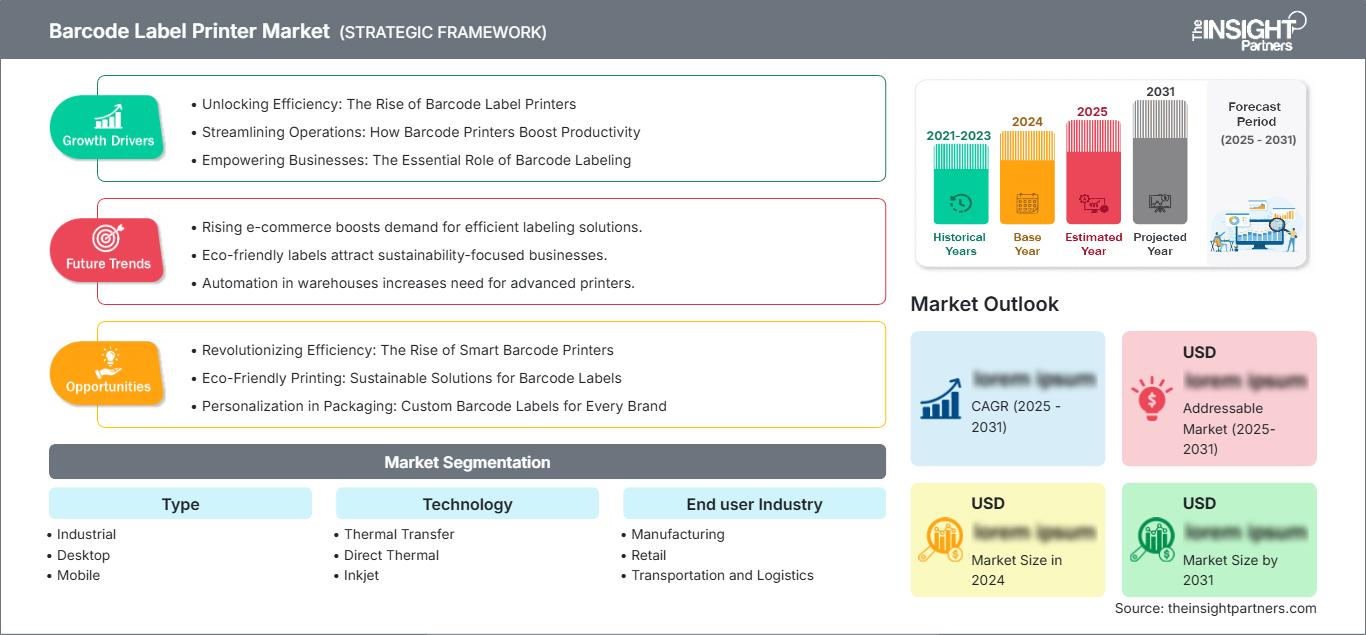
Regional Insights
North America Barcode Label Printer Market
North America held 34–36% of global revenue in 2025, giving the Barcode Label Printer Market share a strong base in retail distribution, parcel logistics, healthcare, and manufacturing automation. The region is expected to grow at a 6.8–7.4% CAGR through 2034 as warehouse operators replace older fixed printers with wireless, centrally managed fleets.
Structural drivers include high e-commerce penetration, hospital barcode medication administration, and airline baggage tracking aligned with IATA Resolution 753 expectations. Demand also benefits from food traceability and cold-chain labeling, where durable thermal transfer labels support compliance. The Barcode Label Printer Market remains mature but resilient because users prioritize uptime, label accuracy, and service response.
U.S. Barcode Label Printer Market
The U.S. accounted for 78–82% of North America in 2025 and is projected to grow at a 6.9–7.5% CAGR. Adoption is concentrated in fulfillment centers, hospital networks, defense contractors, food processors, and retail chains that need reliable labeling across high-throughput workflows and regulated product movement.
Zebra Technologies Corporation and Honeywell International Inc. maintain meaningful domestic presence through enterprise mobility, scanning, and printer ecosystems. Application trends include mobile cart labeling, laboratory specimen identification, pharmacy unit-dose labels, shelf-edge tags, and asset labels for maintenance teams. The Market benefits from replacement cycles tied to cybersecurity, wireless standards, and fleet monitoring software.
Europe Barcode Label Printer Market
Europe represented 24–27% share in 2025 and is expected to expand at a 6.2–6.9% CAGR. Germany is the leading country, supported by automotive, industrial machinery, and pharmaceutical labeling requirements. The UK contributes through retail logistics, National Health Service traceability programs, and parcel automation investments.
France, Italy, and Spain add demand from food processing, fashion retail, healthcare distribution, and public administration modernization. European buyers emphasize energy efficiency, consumable reduction, and label quality because sustainability reporting and regulated traceability influence procurement. The Market is also supported by cross-border logistics, where standardized labeling improves shipment visibility.
APAC Barcode Label Printer Market
Asia Pacific held 28–31% share in 2025 and is forecast to grow at an 8.7–9.6% CAGR, the fastest regional pace. China leads through manufacturing scale, while Japan and South Korea contribute advanced electronics, automotive, and healthcare labeling demand.
India and Australia add momentum through organized retail, logistics parks, pharmaceutical exports, and food safety programs. Industrial policy, warehouse automation, and domestic manufacturing incentives are increasing device deployment. The Market in APAC is also shaped by local specialists offering cost-efficient desktop and industrial printers.
Middle East & Africa Barcode Label Printer Market
Middle East & Africa is projected to grow at a 6.5–7.3% CAGR, with Saudi Arabia leading regional investment. Demand is tied to logistics hubs, energy projects, healthcare expansion, airport infrastructure, and government digitization programs requiring asset, inventory, and compliance labels.
The UAE supports adoption through trade, retail, aviation, and free-zone warehousing, while South Africa anchors demand in retail distribution, healthcare, and mining supply chains. Rest of MEA remains smaller but improving as infrastructure and customs modernization raise the need for standardized labeling.
Segmentation Analysis
Type
The type segment is expected to grow at a 7.4–8.1% CAGR during 2026–2034 as buyers match printer form factors with operating intensity. Barcode Label Printer Market trends are broadening from fixed industrial stations to mobile, cart-mounted, and desktop units that serve smaller warehouses, stores, laboratories, and field service teams.
- Industrial: Industrial printers dominate high-duty environments where speed, rugged construction, large media capacity, and durable output are required for manufacturing lines, logistics hubs, and regulated storage operations.
- Desktop: Desktop printers serve offices, pharmacies, small warehouses, and retail counters where compact footprints, moderate print volumes, and easy maintenance are more important than heavy-duty throughput.
- Mobile: Mobile printers are expanding rapidly because workers can print labels at the point of activity, reducing travel time, picking errors, and bottlenecks in fulfillment workflows.
Technology
The technology segment is forecast to grow at a 7.2–8.0% CAGR during 2026–2034 as label durability, print speed, substrate compatibility, and consumable cost shape procurement. Thermal platforms remain dominant, while inkjet systems serve specialized packaging and color-variable applications that require higher visual differentiation.
- Thermal Transfer: Thermal transfer printers are preferred for long-life labels used in chemicals, healthcare, electronics, and outdoor logistics because ribbon-based printing improves resistance to abrasion and moisture.
- Direct Thermal: Direct thermal printers support shipping, receipts, food rotation, and short-cycle labels where lower consumable complexity and fast output outweigh the need for extended label life.
- Inkjet: Inkjet devices address packaging, color coding, and variable information needs where graphic flexibility, batch differentiation, and substrate versatility are strategically important for brand and compliance uses.
End user Industry
The end user industry segment is projected to grow at a 7.6–8.4% CAGR during 2026–2034 as traceability moves deeper into operational workflows. Adoption is strongest where downtime, misidentification, spoilage, counterfeit risk, or shipment error creates measurable cost, safety, or compliance exposure for enterprises and public institutions.
- Manufacturing: Manufacturers use printers for work-in-progress tracking, quality checkpoints, component identification, and finished goods labeling, making reliability and integration with production systems central purchasing criteria.
- Retail: Retailers require shelf, price, inventory, returns, and fulfillment labels across stores and distribution centers, supporting omnichannel accuracy and faster replenishment execution.
- Transportation and Logistics: Logistics users rely on high-volume shipping labels, route labels, pallet tags, and cross-dock identification to improve scan accuracy and shipment visibility.
- Healthcare: Healthcare adoption centers on patient wristbands, specimen labels, pharmacy labels, device tracking, and inventory control, where identification accuracy directly supports safety and compliance.
- Government: Government users deploy printers for asset management, defense logistics, licensing, public healthcare, records tracking, and infrastructure maintenance where standardized labels improve accountability.
- Entertainment: Entertainment venues use label printers for ticketing, concessions, merchandise, equipment tracking, and temporary access workflows that need fast, reliable labeling during peak attendance periods.
Opportunity Snapshot
| End user Industry | Revenue Contribution | Trend Tag | Adoption Stage |
| Manufacturing | High | Line Traceability | Mature |
| Retail | High | Omnichannel Tags | Scaling |
| Transportation and Logistics | High | Parcel Visibility | Mature |
| Healthcare | Medium | Patient Safety | Scaling |
| Government | Medium | Asset Control | Scaling |
| Entertainment | Low | Venue Access | Emerging |
Barcode Label Printer Market Growth Drivers and Impact Analysis
Warehouse Automation and E-Commerce Fulfillment
The distribution centers are creating more points of label printing due to change in the nature of orders to small basket sizes, quick dispatching time, and increase in returns. For each of the picking, packing, routing, palletizing, and exceptions processes, machine-readable labels are necessary to tie the tangible goods to the warehouse management system. The market gets an advantage because the automation does not remove the need for labels but increases the necessity of accurate labels. Businesses deploying conveyor, sorting machines, robots, and real-time inventory systems have the need for printers that are capable of running non-stop, remotely monitorable, and quickly reconfigurable after changing media.
Healthcare and Life Sciences Traceability
Healthcare organizations such as hospitals, labs, pharmacies, and medical equipment manufacturers need accurate identification within patient care, specimen management, sterilization processes, and product distribution activities. Priorities in patient safety set by WHO and national medication tracing systems make valuable those wristbands, unit-dose labels, and device labels which will stay undamaged throughout clinical operations. This makes the Market benefit from such requirement since the failure to provide durable labels may lead to either safety hazard, recall process complications, or regulatory non-compliance issues. The factors considered while making purchase decisions include print quality, resistance to disinfectants, small desktop printers, and software compatibility.
Standardized Identification Across Global Supply Chains
The global flow of goods relies on uniform identification through suppliers, transportation parties, custom agencies, retail outlets, and final customers. GS1 standards, expectations for baggage tracking by IATA, and initiatives to authenticate goods all highlight the requirement for labels that can be successfully read during several transfers. The Barcode Label Printer Market gets its impetus from these requirements as organizations will have to generate barcode labels according to the format at the source and not at a later point in time. The effect will be seen more in food, pharmaceutical, electronic goods, and aviation-related logistics sectors.
Barcode Label Printer Market Future Trends
Cloud-Managed Printer Fleets
The Barcode Label Printer market trends indicate a move towards cloud-enabled fleets where IT professionals can configure, monitor, protect, and update their printers from warehouses, hospitals, retail stores, and branch offices. This would help organizations to be less dependent on local fixes and minimize downtime via alerts regarding printhead, media, and firmware. The companies which provide hardware along with intelligence, cybersecurity, and analytics platforms will benefit in having better customer retention. For the coming years, fleet visibility will become mandatory for organizations using a large number of distributed printers.
Convergence of Barcode and RFID Printing
Barcoding and RFID encoding will gradually come together in the future due to the need for greater visibility in the absence of the full abandonment of the barcode system. Hybrid printers will be able to print human readable text, barcodes, and encoded labels, thus ensuring that the transition is carried out in stages. The greatest impact of this will be on apparel, pharmaceutical products, aviation components, and valuable inventories. Suppliers who will make it easier for customers to validate, calibrate, and integrate the encoding process will benefit.
Barcode Label Printer Market Opportunities
Mobile Printing for Frontline Operations
There is room for investments in those processes where there is a need to apply labels precisely at the point of action, like picking aisles, bedside care in hospitals, retail shelves, field maintenance, and delivery routes. Barcode Label Printer Market Forecast report that savings from decreased time spent on walking around, minimized re-labeling procedures, and increased accuracy of the first scan could be grounds for expanding fleets. Solution providers need to look for bundle deals combining batteries, durable housing, mobile device connection, management services, and work-flow templates.
Emerging Market Compliance and Retail Formalization
Opportunities exist for emerging economies due to the need for labeling that has been increased by such processes as retail organization, pharmaceutical delivery, food safety management, and customs process automation. Many small and medium businesses continue to use hand tags, basic printing solutions, and external labeling services. There is great potential for relatively inexpensive desktop and mobile solutions. Vendors capable of providing local software, support of the regional language, consumable availability, and services may gain adoption in smaller companies. Funding programs, distributor education, and integration with accounting/inventory systems will play a crucial role in these markets.
Recent Developments
- December 2025: SATO Corporation has launched its next-generation flagship industrial label printers, the CL4-SXR and CL6-SXR, designed to deliver enhanced performance, precision, and reliability for barcode label printing applications. The new industrial printers combine high-speed printing, advanced sensor technology, an improved user interface, and AI-powered predictive maintenance features to support modern labeling operations.
- April 2026: NIIMBOT has officially launched the B1 Pro Smart Label Printer in Singapore, introducing a next-generation portable barcode label printing solution designed for commercial organizations, retail operations, and personal productivity applications. The upgraded printer transforms traditional label printing into a more advanced visual management and collaborative platform with improved performance and connectivity features.
- May 2025: Toshiba has expanded its industrial 4-inch next-generation barcode label printer portfolio with the launch of the BX420D, BX420T, and BX430T flathead printer models. These new additions build on the BX410T industrial printer series and are designed to provide businesses with more flexible labeling solutions across industries including logistics, manufacturing, retail, electronics, and garment care.
Frequently Asked Questions

- Comprehensive Market Sizing and Forecast Analysis
- Detailed Segmentation Analysis
- In-Depth Market Dynamics Assessment
- Regional and Country-Level Insights
- Competitive Landscape and Company Benchmarking
- Strategic Business Intelligence
Recent Reports
Testimonials

The Insight Partners' SCADA System Market report is comprehensive, with valuable insights on current trends and future forecasts. The team was highly professional, responsive, and supportive throughout. We are very satisfied and highly recommend their services.
RAN KEDEM Partner, Reali Technologies LTDs
I requested a report on a very specific software market and the team produced the report in a few days. The information was very relevant and well presented. I then requested some changes and additions to the report. The team was again very responsive and I got the final report in less than a week.
JEAN-HERVE JENN Chairman, Future Analytica
We worked with The Insight Partners for an important market study and forecast. They gave us clear insights into opportunities and risks, which helped shape our plans. Their research was easy to use and based on solid data. It helped us make smart, confident decisions. We highly recommend them.
PIYUSH NAGPAL Sr. Vice President, High Beam Global
The Insight Partners delivered insightful, well-structured market research with strong domain expertise. Their team was professional and responsive throughout. The user-friendly website made accessing industry reports seamless. We highly recommend them for reliable, high-quality research services
YUKIHIKO ADACHI CEO, Deep Blue, LLC.
This is the first time I have purchased a market report from The Insight Partners.While I was unsure at first, I visited their web site and felt more comfortable to take the risk and purchase a market report.I am completely satisfied with the quality of the report and customer service. I had several questions and comments with the initial report, but after a couple of dialogs over email with their analyst I believe I have a report that I can use as input to our strategic planning process.Thank you so much for taking the extra time and making this a positive experience.I will definitely recommend your service to others and you will be my first call when we need further market data.
JOHN SUZUKI President and Chief Executive Officer, Board Director, BK Technologies
I wish to appreciate your support and the professionalism you displayed in the course of attending to my request for information regarding to infectious disease IVD market in Nigeria. I appreciate your patience, your guidance, and the fact that you were willing to offer a discount, which eventually made it possible for us to close a deal. I look forward to engaging The Insight Partners in the future, all thanks to the impression you have created in me as a result of this first encounter.
DR CHIJIOKE ONYIA MANAGING DIRECTOR, PineCrest Healthcare Ltd.Reason to Buy
- Informed Decision-Making
- Understanding Market Dynamics
- Competitive Analysis
- Identifying Emerging Markets
- Customer Insights
- Market Forecasts
- Risk Mitigation
- Boosting Operational Efficiency
- Strategic Planning
- Investment Justification
- Tracking Industry Innovations
- Aligning with Regulatory Trends





 Get Free Sample for