
Barcode Scanner Market Trends, Share & Demand by 2034
Coverage: By Type (Laser Barcode Scanner, Handheld Barcode Scanner, Stationary Barcode Scanner, Mobile Computer Scanner); Industry (Food and Beverages, Healthcare, Manufacturing, Retail, Transport and Logistics, Warehousing, Others) , and Geography (North America, Europe, Asia Pacific, and South and Central America)
- Status : Data Released
- Report Code : TIPTE100000503
- Category : Electronics and Semiconductor
- No. of Pages : 150
- Available Report Formats :


- Last update date : July 21, 2026


2025 Market Size
US$ 8.08 Bn
Base year value
2034 Forecast
US$ 13.63 Bn
Projected by 2034
CAGR 2026-2034
5.99 %
Growth rate
Addressable Market
US$ 98.37 Bn
(2026-2034)
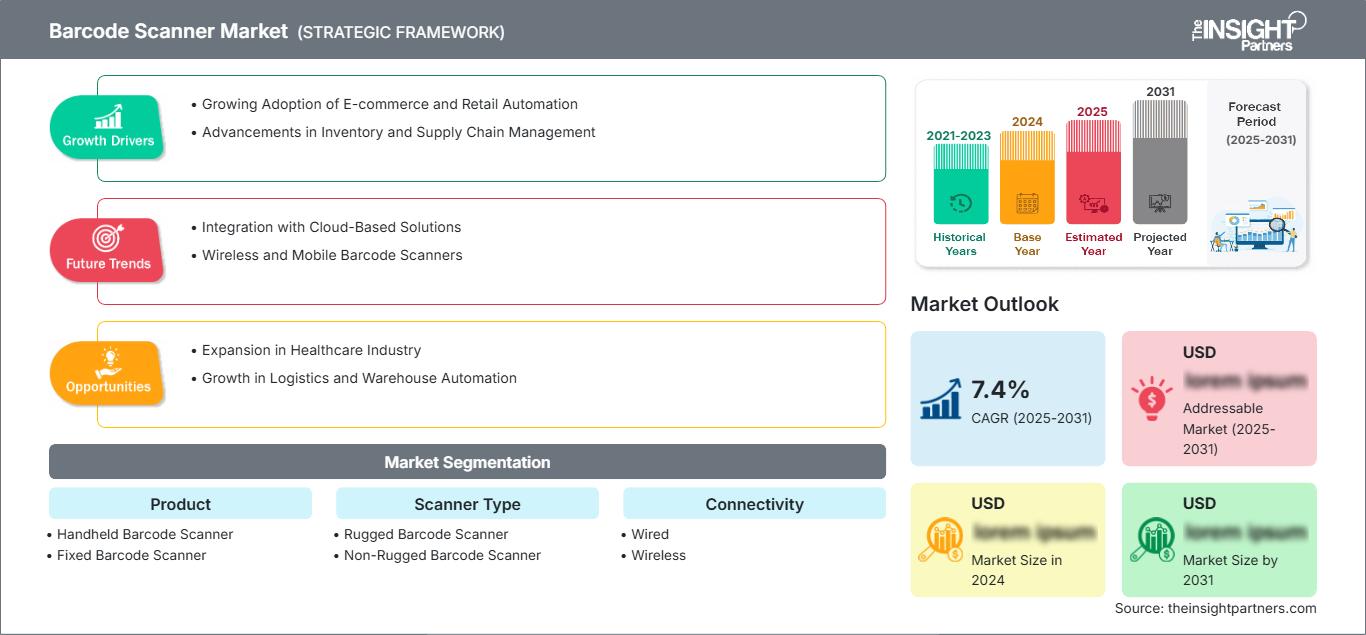
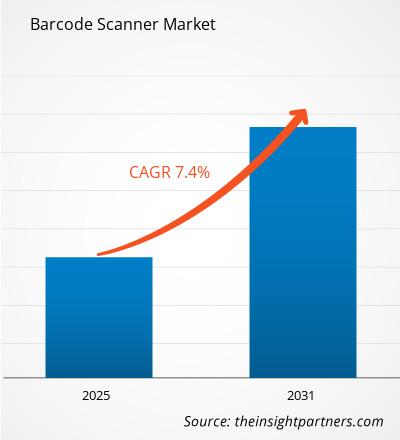
The Barcode Scanner Market size was valued at US$ 8.08 billion in 2025 and will reach up to US$ 13.63 billion by 2034, registering a CAGR of 5.99% during 2026-2034. The market scope involves handheld barcode scanner, fixed barcode scanner, rugged barcode scanner, non-rugged barcode scanner, wired systems, and wireless systems employed in retail, logistics, manufacturing, healthcare, and transportation processes.
In North America, the barcode scanner market value will be driven by investments in omnichannel retailing, automation in warehouse management, and inventory tracking in hospitals. It is forecasted to grow at a CAGR between 5.4% and 5.9% over the period from 2026 to 2034 on account of the adoption of wireless terminals, 2D imagers, and fixed tunnel scanners to replace laser readers.
Barcode Scanner Market Assessment and Insights
- North America: The region accounts for 31–35% share in 2025 and grows at a CAGR range of 5.4–5.9% during 2026–2034, led by retail modernization, warehouse automation, healthcare labeling, and logistics traceability investment.
- US: The country represents 76–80% of North America in 2025 and grows at a CAGR range of 5.5–6.0% during 2026–2034, supported by e-commerce fulfillment and hospital asset tracking.
- Europe: The region holds 24–28% share in 2025 and grows at a CAGR range of 5.1–5.6% during 2026–2034, with Germany, the UK, France, Italy, and Spain leading adoption.
- Asia Pacific: The region holds 29–33% share in 2025 and grows at a CAGR range of 6.5–7.1% during 2026–2034, led by China, Japan, South Korea, India, and Australia.
- Largest Segment: Handheld Barcode Scanner holds 64–68% market share in 2025 and grows at a CAGR range of 5.5–6.1% during 2026–2034 because mobility remains central to enterprise scanning.
- High Growth Segment: Wireless holds 43–47% market share in 2025 and grows at a CAGR range of 6.7–7.3% during 2026–2034 as real-time data capture expands.
- Key companies analyzed in detail: Advantech Co., Ltd.; Cognex Corporation; Datalogic S.p.A.; DENSO WAVE INCORPORATED; Guangzhou NETUM Electronic Technology Co., Ltd.; Honeywell International Inc.; KEYENCE CORPORATION; Scandit AG; Wasp Barcode Technologies; Zebra Technologies Corporation.
Source: The Insight Partners' analysis based on proprietary research, government publications, company annual reports, investor presentations, industry databases, and expert interviews.
From the use of simple laser scanners for point-of-sale operations, the use of barcodes has expanded into imaging scanners and ruggedized, networked solutions integrated in enterprise systems. Trends in manufacturing involve durable housing, decoding algorithms, optics, batteries, wireless capabilities, and integration kits to ensure less downtime. The market is being affected by factors such as 2D barcodes, GS1 standards, warehouse robots, and mobile first inventories.
The future demand will be driven by new retail trends, pharmaceutical tracking, food traceability, and automated parcel handling. Capital is flowing towards wireless fleets, tunnel scanning, industrial fixed readers, and software-driven scanning using mobile devices. Regulatory headwinds from healthcare safety requirements, customs digitization, and supply chain transparency will provide additional impetus for adoption of this technology, and replacement cycles will depend upon batteries and enterprise system compatibility.
Barcode Scanner Market Report Scope
| Report Attribute | Details |
|---|---|
| Market size in 2025 | US$ 8.08 Billion |
| Market Size by 2034 | US$ 13.63 Billion |
| Global CAGR (2026 - 2034) | 5.99% |
| Historical Data | 2021-2024 |
| Forecast period | 2026-2034 |
Barcode Scanner Market Analysis
Market drivers include more transactions per second within retail environments, increased throughput for parcels, and better inventory tracking in manufacturing and healthcare. The trend toward richer data-coding 2D barcodes among GS1 increases the need for imaging devices capable of decoding distorted, small, curved, or even screen-printed symbols. Users are looking for reduced error rates, shorter cycles, and better integration with warehouse management, ERP, and EMR systems.
The value chain encompasses optical engines, barcode decoder software, scanner assembly companies, scanner enclosures, batteries and connectivity solutions, distributors, system integrators, and enterprise software vendors. Supply considerations include sensors, Android enterprise certification, radio regulations, and support networks. End-users pay more attention to total cost of ownership, the ratio of spare devices kept on hand, repair turnaround time, and the deployment of scanners across different sites with consistent configuration management.
The Bar Code Scanner market analysis reveals that the competition covers automated platforms, industrial readers, and software scanning vendors. Zebra Technologies Corporation, Honeywell International Inc., and Datalogic S.p.A. compete on product lines, durability, support, and workflow software. Fixed industrial scanning capabilities are being enhanced by Cognex Corporation and KEYENCE CORPORATION, whereas mobile-first software scanners are being developed by Scandit AG.
Investments will be made in barcode readers that can benefit from AI-based decoding features, self-service technologies, direct part-mark reading using cameras, and wireless fleet management solutions. Industrial solutions will be provided by Advantech Co., Ltd., DENSO WAVE INCORPORATED, Guangzhou NETUM Electronic Technology Co., Ltd., and Wasp Barcode Technologies. Strategic positioning requires the correct combination of hardware and analytics, device management, security updates, and channel marketing.
● REPORT CUSTOMIZATION
Tailor This Report To Align With Your Specific Business Requirements
This report can be customized to align precisely with your business objectives, scope, and target markets. Customization options include tailored segmentation, geography, competitive analysis, and strategic insights to support informed decision-making.
Customize This Report →WHAT YOU CAN ADJUST
- ● Segmentations
- ● Geography
- ● Competitive Analysis
- ● Language Preferences
Barcode Scanner Market: Strategic Insights
Regional Insights
North America Barcode Scanner Market
North America holds 31–35% share in 2025 and is projected to grow at a CAGR range of 5.4–5.9% during 2026–2034. Barcode Scanner Market share in the region is supported by large retail chains, parcel networks, cold-chain logistics, and hospital supply rooms that require accurate item identification.
Adoption is additionally supported by Food and Drug Administration guidelines concerning unique device identification, warehouse worker limitations, and baggage and cargo traceability focus from International Air Transport Association. While stationary scans are increasingly adopted in automated distribution centers, portable handheld units continue to play an essential role in receiving, picking, cycle counting, and final-mile deliveries.
U.S. Barcode Scanner Market
The U.S. represents 76–80% of North America in 2025 and is expected to grow at a CAGR range of 5.5–6.0% during 2026–2034. Zebra Technologies Corporation, Honeywell International Inc., Cognex Corporation, Datalogic S.p.A., and Wasp Barcode Technologies maintain strong channel presence across retail, industrial, logistics, and healthcare accounts.
Application trends center on curbside pickup, micro-fulfillment, returns processing, pharmacy verification, and direct part marking in aerospace and automotive supply chains. Enterprises are replacing legacy laser devices with 2D imagers and wireless Android-based terminals, aiming to reduce mis-picks, accelerate replenishment, and extend scanning into mobile associate workflows.
Europe Barcode Scanner Market
Europe accounts for 24–28% of the share in 2025 and is estimated to record a CAGR in the range of 5.1–5.6% for the period of 2026–2034. This region is led by Germany owing to the automation in industries, automotive component tracking, and effective logistics infrastructure. The United Kingdom focuses on self-checking, parcel deliveries, and health care inventory management, whereas France provides support through pharmacy, food, and transportation labels.
It is followed by Italy and Spain with contributions from manufacturing centers, retail grocery upgrades, and automated warehouse solutions. Europe customers prefer ergonomics, ease of repair, data security, and GS1-compliant 2D barcode decoding. Growth is expected to be modest relative to Asia-Pacific due to mature installations; however, constant replacement demand continues with newer imaging scanners and wireless fleet solutions.
APAC Barcode Scanner Market
Asia-Pacific accounts for 29-33% market share in 2025 and is expected to witness growth at the rate of CAGR between 6.5% and 7.1% during 2026-2034. China leads the market, as e-commerce, manufacturing, and domestic logistics services automate. Japan and South Korea focus on precision manufacturing, India invests in organized retail and warehousing, and Australia invests in high-value logistics services.
Digitalization of supply chain management, export traceability, and health care sector contribute positively in the region. Domestic players thrive on pricing, while foreign companies develop rugged and industrial-grade systems. Demand is highest in regions characterized by high parcel density, labor turnover, and stringent quality inspection criteria, making scanning accuracy vital to operational performance.
Middle East & Africa Barcode Scanner Market
The Middle East & Africa region is expected to exhibit a CAGR growth of 4.6–5.2% between 2026–2034. The UAE dominates through logistics across ports, aviation, retail, and smart government initiatives. Infrastructure development and growth in the healthcare sector contribute to Saudi Arabia's success, and South Africa drives demand from its retail and mining industries.
Demand for rugged and fixed scanners stems from energy infrastructure projects, the establishment of free zones, and warehouse development, though this depends on the financial capacity and sophistication of the system in use. The focus for enterprises is on devices that can operate effectively in dusty and hot environments. Growth will improve with digitization of logistics.
Segmentation Analysis
Product
Product is projected to grow at a CAGR range of 5.6–6.2% during 2026–2034. The Barcode Scanner Market scope by product reflects a balance between mobile work execution and automated identification. Handheld devices dominate because associates need flexible scanning at shelves, docks, bedsides, and production cells, while fixed scanners gain relevance in tunnels, conveyors, kiosks, and self-checkout systems.
- Handheld Barcode Scanner: This sub-segment leads because workers need portable devices for picking, receiving, inventory counts, bedside administration, and store operations across variable layouts and workflows.
- Fixed Barcode Scanner: Fixed scanners are strategically important in automated conveyors, checkout lanes, manufacturing lines, and parcel sortation, where continuous hands-free reading improves throughput and reduces manual intervention.
Scanner Type
Scanner Type is expected to grow at a CAGR range of 5.7–6.3% during 2026–2034. Adoption depends on operating conditions, drop risk, cleaning frequency, and shift intensity. Rugged scanners are favored in warehouses, cold rooms, yards, and manufacturing, while non-rugged scanners serve retail counters, offices, clinics, and light-duty inventory tasks where cost and ergonomics matter more.
- Rugged Barcode Scanner: Rugged devices address high-drop, dusty, wet, and temperature-variable environments, making them essential for warehouses, manufacturing plants, ports, field service, and cold-chain operations.
- Non-Rugged Barcode Scanner: Non-rugged devices serve retail checkout, office inventory, pharmacy counters, and light commercial settings where lower acquisition cost, compact design, and simple deployment are primary requirements.
Connectivity
Connectivity is forecast to grow at a CAGR range of 6.1–6.7% during 2026–2034. Connectivity choices reflect workflow mobility, data latency, security, and maintenance needs. Wired scanners remain relevant for dependable fixed stations and checkout lanes, whereas wireless systems expand in large facilities where workers need real-time confirmation without returning to terminals.
- Wired: Wired scanners remain preferred for fixed workstations, checkout counters, laboratories, and production benches where uninterrupted power, low maintenance, and stable data transfer outweigh mobility needs.
- Wireless: Wireless scanners support mobile picking, cycle counting, dock operations, bedside verification, and store replenishment, enabling real-time data capture while reducing movement back to fixed terminals.
Opportunity Snapshot
| Product | Revenue Contribution | Trend Tag | Adoption Stage |
| Handheld Barcode Scanner | High | Mobile Picking | Mature |
| Fixed Barcode Scanner | Medium | Scan Tunnel | Scaling |
Barcode Scanner Market Growth Drivers and Impact Analysis
Omnichannel Fulfillment Requires Accurate Real-Time Scanning
Order picking has been increasingly complex for retailers and logistics companies. This includes picking from various stores, warehouses, marketplace, and return facilities. Bar code scanning minimizes the chances of mis-picking, ensures lot/serial tracking, and allows for inventory visibility for the management team. In practice, the implication of this on the Barcode Scanner Market is continuous replacement of old scanners with 2D scanners, wireless scanners, and fixed scanners. The scan data helps in determining labor efficiency, identifying areas of inefficiency and even improving replenishment efficiency.
Healthcare and Life Sciences Tighten Traceability Requirements
Identifiers for medicines, samples, implants, and other consumables will be needed in hospitals, pharmacies, laboratories, and equipment suppliers. Barcode scanners will be needed to ensure accuracy and efficiency in processes like drug administration, recall preparation, and unique device identification and serializing systems compliance. In terms of applications, this driver creates opportunities for the development of handheld devices resistant to disinfection, compact fixed reader solutions, and software capable of decoding barcodes on small and irregularly shaped surfaces. This driver is most relevant to situations where patient safety and inventory management intersect, including medication dispensing, blood bank operations, and surgical room stock management.
Industrial Automation Increases Fixed Reader Demand
Barcode scanner technology is being adopted by manufacturing facilities to track components, WIP, tools, boxes, and finished products in automated cell settings. Fixed scanners that are mounted on conveyors, robots, and inspection machines enable data acquisition without halting the process and facilitate quality documentation and traceability. The Barcode Scanner Market is positively influenced by industrial consumers who prefer robust scanners with advanced decoding capabilities, illumination features, and Ethernet connectivity. This growth driver also generates service revenues since there is a need for installation, calibration, and maintenance.
Barcode Scanner Market Future Trends
AI-Assisted Decoding Becomes Standard in Enterprise Devices
The Barcode Scanner Market trends will increasingly revolve around AI-enhanced scanning capabilities for decoding barcodes, which perform better on damaged, poorly contrasted, curved, reflective, or partially occluded labels. In addition to optimizing optics, suppliers will distinguish their products by implementing embedded AI algorithms that can analyze, correct, and guide the user towards successful scans. This way, both retailers, logistics centers, and manufacturing facilities can minimize exceptions without having to invest in further operator training. Additionally, AI-enhanced scanners will facilitate adjacent processes such as taking pictures, verifying labels, and recognizing products.
Software Scanning Expands Alongside Dedicated Hardware
There will be greater use of dedicated scanners, coupled with mobile scanning software, in less-demanding processes. Software scanning is preferred in audits, proof of delivery, field services, and seasonal labor since it eliminates the need for provisioning of devices and enables quick deployment using the mobile fleets already available. Rugged hardware will be needed for high volume, hostile, and mission critical environments. The future direction will be hybrid adoption whereby enterprises use premium scanners for throughput-intensive functions and certified mobile applications for flexible operations.
Barcode Scanner Market Opportunities
Wireless Fleet Upgrades for Distributed Warehouses
Barcode Scanner Market Forecasts support focused investment in wireless fleet upgrades for retailers, third-party logistics providers, and manufacturers with distributed facilities. Many enterprises still operate mixed generations of devices, creating inconsistent scan performance, repair complexity, and security gaps. Vendors can capture opportunity by offering managed deployment, charging infrastructure, device analytics, and trade-in programs that simplify replacement economics. The action priority is to package scanners with configuration tools, service-level agreements, and integration support. This approach helps buyers justify upgrades through lower downtime, better labor utilization, and more accurate inventory visibility.
Fixed Scanning for Automated Parcel and Manufacturing Lines
Fixed scanning offers an attractive opportunity as warehouses, airports, and factories automate item movement. High-speed conveyors and robotic cells need reliable readers that capture barcodes at different orientations, distances, and label conditions. Suppliers should invest in integrated lighting, multi-sided scan tunnels, analytics dashboards, and easy commissioning tools. The commercial upside comes from hardware sales, installation services, and recurring maintenance contracts. Customers benefit when scan accuracy improves without slowing lines, especially in parcel sortation, baggage handling, automotive parts traceability, and food packaging verification where errors create costly exceptions.
Recent Developments
- April 2026: Honeywell has agreed to sell its Productivity Solutions and Services (PSS) business, which includes barcode scanners, mobile computers, printing solutions, and workflow software, to Brady Corporation for US$ 1.4 billion in an all-cash deal. PSS sells barcode scanners, mobile computers, printing solutions, and workflow software to customers across the warehousing, logistics, manufacturing, and retail sectors. The divestiture is part of Honeywell's strategy to streamline its portfolio ahead of its planned corporate restructuring, while Brady expects the acquisition to strengthen its identification and workflow solutions business and generate operational synergies.
- March 2026: Newland AIDC announced an initiative to expand its retail channel presence in North America by inviting RSPA members to become partners for its barcode scanning solutions. The company highlighted its channel-only go-to-market strategy, competitive partner margins, and portfolio of barcode scanners and data capture technologies, aiming to strengthen its presence in the retail technology ecosystem and support solution providers with scalable barcode and QR code scanning solutions.
- October 2025: Socket Mobile introduced CaptureSDK 2.0, a next-generation software development kit designed to support future Bluetooth Low Energy (BLE)-based barcode scanners while maintaining compatibility with its existing scanner portfolio. The unified platform enables developers to upgrade applications once to support both current and upcoming devices, offering faster connections, improved reliability, extended battery life, quicker application integration, and lower-cost hardware support.
Frequently Asked Questions

- Comprehensive Market Sizing and Forecast Analysis
- Detailed Segmentation Analysis
- In-Depth Market Dynamics Assessment
- Regional and Country-Level Insights
- Competitive Landscape and Company Benchmarking
- Strategic Business Intelligence
Recent Reports
Testimonials

The Insight Partners' SCADA System Market report is comprehensive, with valuable insights on current trends and future forecasts. The team was highly professional, responsive, and supportive throughout. We are very satisfied and highly recommend their services.
RAN KEDEM Partner, Reali Technologies LTDs
I requested a report on a very specific software market and the team produced the report in a few days. The information was very relevant and well presented. I then requested some changes and additions to the report. The team was again very responsive and I got the final report in less than a week.
JEAN-HERVE JENN Chairman, Future Analytica
We worked with The Insight Partners for an important market study and forecast. They gave us clear insights into opportunities and risks, which helped shape our plans. Their research was easy to use and based on solid data. It helped us make smart, confident decisions. We highly recommend them.
PIYUSH NAGPAL Sr. Vice President, High Beam Global
The Insight Partners delivered insightful, well-structured market research with strong domain expertise. Their team was professional and responsive throughout. The user-friendly website made accessing industry reports seamless. We highly recommend them for reliable, high-quality research services
YUKIHIKO ADACHI CEO, Deep Blue, LLC.
This is the first time I have purchased a market report from The Insight Partners.While I was unsure at first, I visited their web site and felt more comfortable to take the risk and purchase a market report.I am completely satisfied with the quality of the report and customer service. I had several questions and comments with the initial report, but after a couple of dialogs over email with their analyst I believe I have a report that I can use as input to our strategic planning process.Thank you so much for taking the extra time and making this a positive experience.I will definitely recommend your service to others and you will be my first call when we need further market data.
JOHN SUZUKI President and Chief Executive Officer, Board Director, BK Technologies
I wish to appreciate your support and the professionalism you displayed in the course of attending to my request for information regarding to infectious disease IVD market in Nigeria. I appreciate your patience, your guidance, and the fact that you were willing to offer a discount, which eventually made it possible for us to close a deal. I look forward to engaging The Insight Partners in the future, all thanks to the impression you have created in me as a result of this first encounter.
DR CHIJIOKE ONYIA MANAGING DIRECTOR, PineCrest Healthcare Ltd.Reason to Buy
- Informed Decision-Making
- Understanding Market Dynamics
- Competitive Analysis
- Identifying Emerging Markets
- Customer Insights
- Market Forecasts
- Risk Mitigation
- Boosting Operational Efficiency
- Strategic Planning
- Investment Justification
- Tracking Industry Innovations
- Aligning with Regulatory Trends





 Get Free Sample for