
Battery Discharge Capacity Tester Market Report 2034 by Segments, Geography, Dynamics, Recent Developments, and Strategic Insights
Coverage: by Type (Portable Type, Stationary Type); Application (Motive Battery, Energy Storage/Reserve Battery, Digital and Electrical Products Battery) , and Geography (North America, Europe, Asia Pacific, and South and Central America)
- Status : Data Released
- Report Code : TIPRE00010528
- Category : Electronics and Semiconductor
- No. of Pages : 150
- Available Report Formats :


- Last update date : July 21, 2026


2025 Market Size
US$ 1.38 Bn
Base year value
2034 Forecast
US$ 2.95 Bn
Projected by 2034
CAGR 2026-2034
8.33 %
Growth rate
Addressable Market
US$ 18.93 Bn
(2026-2034)
The Battery Discharge Capacity Tester market was valued at US$ 1.38 Billion in 2025 and is projected to reach US$ 2.95 Billion by 2034, registering a CAGR of 8.33% during 2026–2034. Battery Discharge Capacity Tester demand is rising as electric mobility, stationary storage, backup power, telecom infrastructure, and electronics manufacturers require dependable evidence of battery capacity, discharge behavior, cycle stability, and end-of-life readiness.
Across North America, Battery Discharge Capacity Tester market size expansion is expected to track a CAGR of 7.4–8.8% during 2026–2034, supported by EV battery validation, utility-scale storage commissioning, and strict maintenance practices in data centers and substations. Regional buyers also prioritize portable field instruments, regenerative discharge systems, and traceable test records that improve uptime decisions across reserve-power fleets.
Battery Discharge Capacity Tester Market Assessment and Insights
- North America accounted for 28–32% share in 2025 and is growing at a CAGR of 7.4–8.8% during 2026–2034, led by EV laboratories, UPS maintenance, telecom backup banks, and grid storage commissioning.
- US represented 76–80% of North American revenue in 2025 and is growing at a CAGR of 7.6–9.0% during 2026–2034, driven by battery manufacturing and data-center power reliability.
- Europe held 23–27% share in 2025 and is growing at a CAGR of 7.0–8.3% during 2026–2034, with Germany, the UK, France, Italy, and Spain leading quality assurance and reserve-power testing.
- Asia Pacific held 34–38% share in 2025 and is growing at a CAGR of 8.9–10.4% during 2026–2034, led by China, Japan, South Korea, India, and Australia.
- Largest Segment Stationary Type held 58–62% market share in 2025 and is growing at a CAGR of 7.7–9.1% during 2026–2034 because high-current laboratory and production testing requires fixed systems.
- High Growth Segment Energy Storage/Reserve Battery represented 31–35% market share in 2025 and is growing at a CAGR of 9.2–10.8% during 2026–2034, supported by UPS, grid storage, and telecom backup.
- Key companies analyzed in detail: HIOKI E.E. CORPORATION; Arbin Instruments LLC; DV Power; Fluke Corporation; ITECH Electronic Co., Ltd.; Kanaad Electromation Solutions Pvt. Ltd.; KIKUSUI ELECTRONICS CORPORATION; Megger Group Limited; Tenmars Electronics Co., Ltd.; Xiamen Tmax Battery Equipments Limited.
Source: The Insight Partners' analysis based on proprietary research, government publications, company annual reports, investor presentations, industry databases, and expert interviews.
Battery testing has evolved from manual load-bank verification into automated, software-controlled discharge analysis that records capacity, voltage sag, thermal response, and ageing behavior. Battery Discharge Capacity Tester suppliers now compete on channel density, current accuracy, regenerative energy recovery, safety interlocks, data logging, and chemistry flexibility. Production dynamics are shifting as cell makers, pack assemblers, utilities, and maintenance contractors demand repeatable test evidence across lithium-ion, lead-acid, nickel-based, and emerging sodium-ion systems.
Forward demand will be shaped by gigafactory quality systems, power-grid resiliency programs, battery recycling, and wider adoption of second-life packs. Asia Pacific should remain the fastest expanding region, while North America and Europe emphasize compliance, traceability, and high-reliability service operations. Investment will increasingly flow toward regenerative testers, modular channels, cloud-enabled records, and portable instruments that reduce field downtime without compromising measurement integrity.
Battery Discharge Capacity Tester Market Report Scope
| Report Attribute | Details |
|---|---|
| Market size in 2025 | US$ 1.38 Billion |
| Market Size by 2034 | US$ 2.95 Billion |
| Global CAGR (2026 - 2034) | 8.33% |
| Historical Data | 2021-2024 |
| Forecast period | 2026-2034 |
Battery Discharge Capacity Tester Market Analysis
Battery Discharge Capacity Tester market growth is being driven by the rising number of batteries that must be qualified before deployment and rechecked during service life. The International Energy Agency reported electric car sales above 17 million units in 2024 and expected sales above 20 million in 2025, increasing validation demand for cells, modules, packs, chargers, and storage assets. Utilities are also adding battery energy storage to balance renewable generation, creating more acceptance and maintenance testing needs.
The value chain includes electronic-load designers, power-supply manufacturers, precision measurement specialists, thermal chamber providers, automation integrators, battery laboratories, maintenance contractors, EV OEMs, grid operators, telecom companies, and electronics producers. Supply dynamics depend on high-current semiconductors, calibrated sensors, thermal design, safety relays, software control, and after-sales calibration support. Buyers evaluate accuracy, discharge profile flexibility, operator safety, test throughput, and compatibility with IEC, IEEE, UN38.3, and customer-specific protocols.
Battery Discharge Capacity Tester market analysis indicates a competitive landscape where measurement precision, application coverage, service reach, and software usability define positioning. HIOKI E.E. CORPORATION and KIKUSUI ELECTRONICS CORPORATION strengthen Japan-linked precision capability, while Arbin Instruments LLC and ITECH Electronic Co., Ltd. support scalable laboratory and production systems. Megger Group Limited, Fluke Corporation, DV Power, Tenmars Electronics Co., Ltd., Kanaad Electromation Solutions Pvt. Ltd., and Xiamen Tmax Battery Equipments Limited address field, utility, and industrial niches.
Investment is moving toward regenerative discharge, higher-voltage pack testing, automated channel management, and test-data platforms that support audit trails. Strategic positioning favors vendors that can serve both R&D laboratories and installed-base maintenance teams. Suppliers with calibration networks, rugged portable products, and configurable software can capture recurring revenue from validation, commissioning, preventive maintenance, and battery refurbishment programs.
● REPORT CUSTOMIZATION
Tailor This Report To Align With Your Specific Business Requirements
This report can be customized to align precisely with your business objectives, scope, and target markets. Customization options include tailored segmentation, geography, competitive analysis, and strategic insights to support informed decision-making.
Customize This Report →WHAT YOU CAN ADJUST
- ● Segmentations
- ● Geography
- ● Competitive Analysis
- ● Language Preferences
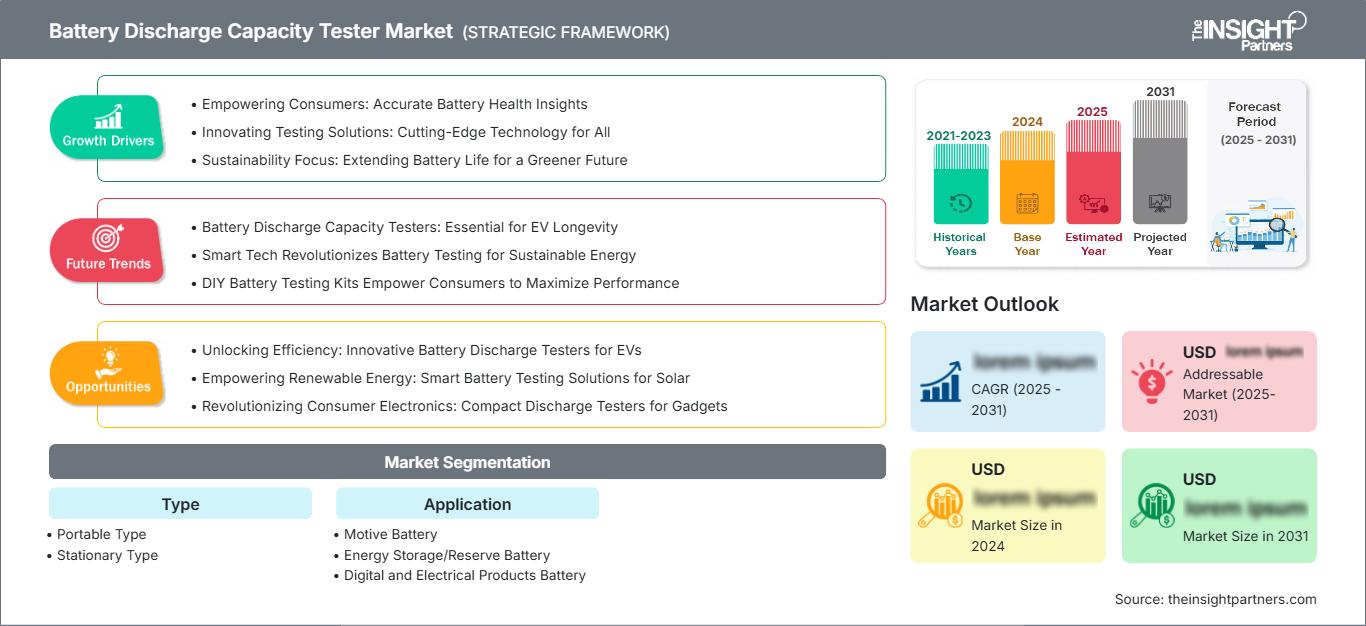
Battery Discharge Capacity Tester Market: Strategic Insights
Regional Insights
North America Battery Discharge Capacity Tester Market
North America accounted for 28–32% of Battery Discharge Capacity Tester market share in 2025 and is projected to grow at a CAGR of 7.4–8.8% during 2026–2034. Demand is supported by EV cell qualification, grid storage commissioning, telecom backup inspection, and UPS maintenance in data centers. The region’s test culture is shaped by reliability expectations, insurance scrutiny, and the need to document capacity before critical assets fail.
Battery laboratories increasingly select stationary systems for cycle-life programs, while utilities and service contractors use portable testers for substations, hospitals, transport hubs, and network rooms. Adoption also benefits from strong standards awareness, skilled maintenance providers, and rising interest in battery reuse. Suppliers that combine accurate discharge control, reporting software, and local calibration support are well positioned.
U.S. Battery Discharge Capacity Tester Market
The U.S. represented 76–80% of North American revenue in 2025 and is expected to grow at a CAGR of 7.6–9.0% during 2026–2034. Company presence is broad, with Arbin Instruments LLC, Fluke Corporation, Megger Group Limited, and distributors for Asian suppliers supporting laboratories, utilities, OEMs, and field-service teams. Application trends favor EV pack validation, UPS capacity verification, and reserve-power audits.
Battery Discharge Capacity Tester procurement is increasingly linked to manufacturing traceability and maintenance risk reduction. Gigafactory investments require repeatable discharge records for cells and modules, while data-center operators need predictable backup capacity under high-load conditions. Federal and state energy-storage projects further increase the need for acceptance testing, warranty evidence, and safe end-of-life decision-making.
Europe Battery Discharge Capacity Tester Market
Europe held 23–27% share in 2025 and is forecast to grow at a CAGR of 7.0–8.3% during 2026–2034. Germany is the leading country because automotive battery programs, industrial automation, and quality-driven manufacturing require precise discharge validation. The UK contributes through data-center resilience, rail backup power, utilities, and service companies that maintain critical battery banks.
France, Italy, and Spain provide additional demand with their renewable storage installations, telecom backup systems upgrades, and growing EV manufacturing infrastructure. European customers place great importance on safety certification, calibration history, and life-cycle tracking in relation to battery legislation. Companies that can produce equipment for stationary manufacturing and portable testing can meet these requirements.
APAC Battery Discharge Capacity Tester Market
Asia Pacific market share is expected to be 34% to 38% in 2025 and to grow at 8.9% to 10.4% during 2026 to 2034. China is at the forefront because of its strong battery production capabilities, electric vehicle (EV) exports, and battery storage systems. In Japan and South Korea, high-precision testing of battery cells is encouraged. India increases demand for telecom back-up, two-wheelers' batteries, and pack assembly.
Australia has a demand for utility-scale energy storage and reserve power at mine sites. Industrial policies and electronics manufacturing, along with battery recycling, ensure a positive future for this market. Customers demand portable testers for scalability and stationary testers for services.
Middle East & Africa Battery Discharge Capacity Tester Market
The Middle East & Africa market is projected to grow at a CAGR of 6.5–7.9% during 2026–2034. Saudi Arabia accounts for the highest sales due to growth in grid extensions, data centers, oil and gas plants, and smart cities, which is driving the need for more backup power. Telecommunication systems, transport infrastructure, and premium storage installations drive the UAE’s acceptance.
The South African region will play an important role in telecommunications, mining, and utilities backup power applications, and other MEA regions will benefit from increased solar hybrid adoption and critical site maintenance. Extreme weather conditions necessitate periodic discharge testing, as high temperatures reduce battery capacity and lifespan.
Segmentation Analysis
Type
Type is projected to grow at a CAGR of 8.0–9.4% during 2026–2034. The Battery Discharge Capacity Tester market scope covers portable instruments used by maintenance teams and stationary systems used in laboratories, factories, and commissioning centers. Selection depends on current range, voltage range, safety control, throughput, data integrity, and whether the buyer prioritizes field mobility or automated multi-channel performance.
- Portable Type serves service technicians, utilities, telecom operators, and facility teams that need practical capacity checks across distributed battery banks without moving assets from the installation site.
- Stationary Type holds the largest position because fixed testers support higher currents, automated cycling, thermal integration, repeatable records, and production-grade validation for cells, modules, and packs.
Application
Application is projected to grow at a CAGR of 8.5–9.9% during 2026–2034. Motive batteries require durability and load-profile testing, reserve batteries need dependable capacity verification, and electronics batteries require compact, repeatable discharge evaluation. Growth is strongest where test evidence influences warranty decisions, commissioning acceptance, safety approvals, or replacement timing.
- Motive Battery demand is tied to electric vehicles, forklifts, automated guided vehicles, and industrial mobility, where discharge profiles help confirm usable energy, acceleration support, and operational endurance.
- Energy Storage/Reserve Battery is strategically important because utilities, telecom networks, hospitals, data centers, and substations need documented backup capacity before outages expose hidden degradation.
- Digital and Electrical Products Battery supports consumer electronics, power tools, medical devices, and small industrial equipment, where repeatable capacity checks protect product quality and user safety.
Opportunity Snapshot
| Application | Revenue Contribution | Trend Tag | Adoption Stage |
| Motive Battery | High | Pack Validation | Scaling |
| Energy Storage/Reserve Battery | High | Backup Reliability | Mature |
| Digital and Electrical Products Battery | Medium | Device Quality | Scaling |
Battery Discharge Capacity Tester Market Growth Drivers and Impact Analysis
Battery energy storage raises acceptance testing requirements
Grid-connected energy storage projects must clearly demonstrate that the installed energy storage units deliver the expected capacity under specific discharge profiles. Developers, utility companies, and investors perform capacity testing to ensure proper commissioning performance, warranty baselines, and operational readiness. From a market perspective, the key point is that each grid-connected storage project needs to purchase a battery tester with sufficient power capacity to perform the required tests. As the penetration rate of renewables increases, energy storage units will cycle more often and require regular health checks.
EV battery manufacturing demands repeatable quality evidence
Consistent grading of the electric vehicle battery cells, module testing, and pack discharge testing are important for the battery production process. The capacity test is used by manufacturers to identify faulty cells, verify energy transfer, minimize liability risk, and make informed decisions about battery formation or aging. The importance of the market goes beyond equipment sales, as large-scale facilities require calibration, software integration, service agreements, and operator training. Suppliers of Battery Discharge Capacity Tester equipment who have scalable channels, current-control capabilities, and plant-level data communication can integrate into production processes.
Critical infrastructure maintenance shifts from voltage checks to capacity proof
The condition of batteries deployed in healthcare facilities, communication tower sites, railways, substations, airports, and data centers cannot be determined solely from float voltage levels. The capacity of batteries may become compromised while the voltage levels stay within acceptable limits in an aged series of batteries subjected to heat exposure, cycling, and unbalanced loading. Market impacts include the growing popularity of discharge testing, impedance trending, and recording plans for battery replacement. The portability of equipment is vital for safe field use. Companies with robust build, pass/fail display, and multiple chemistry support will benefit greatly from this situation.
Battery Discharge Capacity Tester Market Future Trends
Regenerative discharge becomes a mainstream efficiency feature
Battery Discharge Capacity Tester Market trends indicate a growing prevalence of regenerative systems that restore released energy to the grid or the facility’s power bus system rather than dissipating it as heat. This trend improves energy efficiency, reduces demand for cooling systems, and supports the goal of sustainable energy in facilities with heavy laboratory and manufacturing operations. Potential consumers of the testing equipment will evaluate such products not just on their accuracy and voltage capacity but also on how much energy they save and how safely they manage it. The trend should accelerate as battery factories run more cycling programs and utilities require lower-carbon commissioning practices across storage projects.
Connected test records improve lifecycle battery decisions
Future testing procedures would directly correlate capacities with asset history, temperature history, servicing history, and warranty information. Information stored in the cloud would help operators determine which batteries would continue their service life, be rebalanced, enter second-life applications, or enter the recycling process. It will bring software back to its rightful place in an otherwise hardware-dominated industry. Companies capable of offering secure data exports, barcoding or asset tracking, and report generation would have better chances of retaining their customers.
Battery Discharge Capacity Tester Market Opportunities
Second-life battery qualification services
Battery Discharge Capacity Tester Market Forecasts offer an exciting opportunity to qualify second-life batteries as they shift from use in EVs to stationary storage, industrial backup, or recycling. Investors and resellers require reliable capacity information before determining the value of these batteries and their reuse. This opportunity could be addressed by equipment providers through the development of modular discharge equipment, automated testing, and report generation that compares actual capacities with those required for further use. The action to take here is to develop relationships with recyclers, fleet owners, and storage system providers.
Service-led portable testing for distributed reserve power
Backup networks, based on distribution, enable on-demand portable testing kits. For telecom companies, hospitals, commercial establishments, and municipal assets, having battery technicians is not always possible, and yet they require certification that they are ready in the case of an outage. Suppliers can distinguish themselves through offering rentals, certified service partners, and easy reporting for non-technical end users. This business model generates revenue through investment, since service income can supplement revenue from the devices themselves. It also opens access to countries with budget constraints but with a need for reliable reserve power.
Recent Developments
- July 2026: Waters Corp. of Milford, Mass., has introduced a new instrument for battery safety testing, according to a company announcement. The Coin Cell Differential Scanning Calorimeter (DSC) is designed to allow direct testing of fully assembled coin cells, eliminating the need for time-consuming sample preparation steps. The company states that this device is the only commercially available DSC capable of multidimensional data capture, enabling researchers to collect whole-cell thermal data while simultaneously measuring evolved gas and electrochemical performance.
- May 2025: The HT-BCT50A4C four-channel lithium battery capacity tester launched by HELTEC ENERGY, as an upgraded version of the HT-BCT50A, breaks through by expanding the single channel to four independent operating channels. It not only greatly improves testing efficiency, but also becomes a core tool for battery research and development, production, and quality inspection scenarios with high cost-effectiveness advantages.
- May 2025: Heltec Energy has recently launched a cost-effective battery capacity discharge tester - HT-DC50ABP. With its excellent performance and rich features, this battery capacity discharge tester brings a solution to the field of battery testing. HT-DC50ABP has a wide range of adaptability and is perfectly compatible with various types of batteries ranging from 5-120V. Whether it is a small low-voltage battery or a large high-voltage battery pack, the battery capacity discharge tester can accurately test This feature makes its application scenarios extremely wide, covering multiple fields from 3C products to energy storage systems, meeting the needs of different industries for battery testing.
Frequently Asked Questions

- Comprehensive Market Sizing and Forecast Analysis
- Detailed Segmentation Analysis
- In-Depth Market Dynamics Assessment
- Regional and Country-Level Insights
- Competitive Landscape and Company Benchmarking
- Strategic Business Intelligence
Recent Reports
Testimonials

The Insight Partners' SCADA System Market report is comprehensive, with valuable insights on current trends and future forecasts. The team was highly professional, responsive, and supportive throughout. We are very satisfied and highly recommend their services.
RAN KEDEM Partner, Reali Technologies LTDs
I requested a report on a very specific software market and the team produced the report in a few days. The information was very relevant and well presented. I then requested some changes and additions to the report. The team was again very responsive and I got the final report in less than a week.
JEAN-HERVE JENN Chairman, Future Analytica
We worked with The Insight Partners for an important market study and forecast. They gave us clear insights into opportunities and risks, which helped shape our plans. Their research was easy to use and based on solid data. It helped us make smart, confident decisions. We highly recommend them.
PIYUSH NAGPAL Sr. Vice President, High Beam Global
The Insight Partners delivered insightful, well-structured market research with strong domain expertise. Their team was professional and responsive throughout. The user-friendly website made accessing industry reports seamless. We highly recommend them for reliable, high-quality research services
YUKIHIKO ADACHI CEO, Deep Blue, LLC.
This is the first time I have purchased a market report from The Insight Partners.While I was unsure at first, I visited their web site and felt more comfortable to take the risk and purchase a market report.I am completely satisfied with the quality of the report and customer service. I had several questions and comments with the initial report, but after a couple of dialogs over email with their analyst I believe I have a report that I can use as input to our strategic planning process.Thank you so much for taking the extra time and making this a positive experience.I will definitely recommend your service to others and you will be my first call when we need further market data.
JOHN SUZUKI President and Chief Executive Officer, Board Director, BK Technologies
I wish to appreciate your support and the professionalism you displayed in the course of attending to my request for information regarding to infectious disease IVD market in Nigeria. I appreciate your patience, your guidance, and the fact that you were willing to offer a discount, which eventually made it possible for us to close a deal. I look forward to engaging The Insight Partners in the future, all thanks to the impression you have created in me as a result of this first encounter.
DR CHIJIOKE ONYIA MANAGING DIRECTOR, PineCrest Healthcare Ltd.Reason to Buy
- Informed Decision-Making
- Understanding Market Dynamics
- Competitive Analysis
- Identifying Emerging Markets
- Customer Insights
- Market Forecasts
- Risk Mitigation
- Boosting Operational Efficiency
- Strategic Planning
- Investment Justification
- Tracking Industry Innovations
- Aligning with Regulatory Trends





 Get Free Sample for