
Battery Monitoring System Market Share, Size & Demand by 2034
Coverage: By Component (Hardware, Software); Type (Wired, Wireless); Battery Type (Lithium-Ion Based Battery, Lead-Acid Battery, Others); End-User (IT and telecommunication, Energy, Automotive, Manufacturing, Others) , and Geography (North America, Europe, Asia Pacific, and South and Central America)
- Status : Data Released
- Report Code : TIPRE00009068
- Category : Electronics and Semiconductor
- No. of Pages : 150
- Available Report Formats :


- Last update date : July 20, 2026


2025 Market Size
US$ 11.60 Bn
Base year value
2034 Forecast
US$ 56.32 Bn
Projected by 2034
CAGR 2026-2034
19.19 %
Growth rate
Addressable Market
US$ 277.72 Bn
(2026-2034)
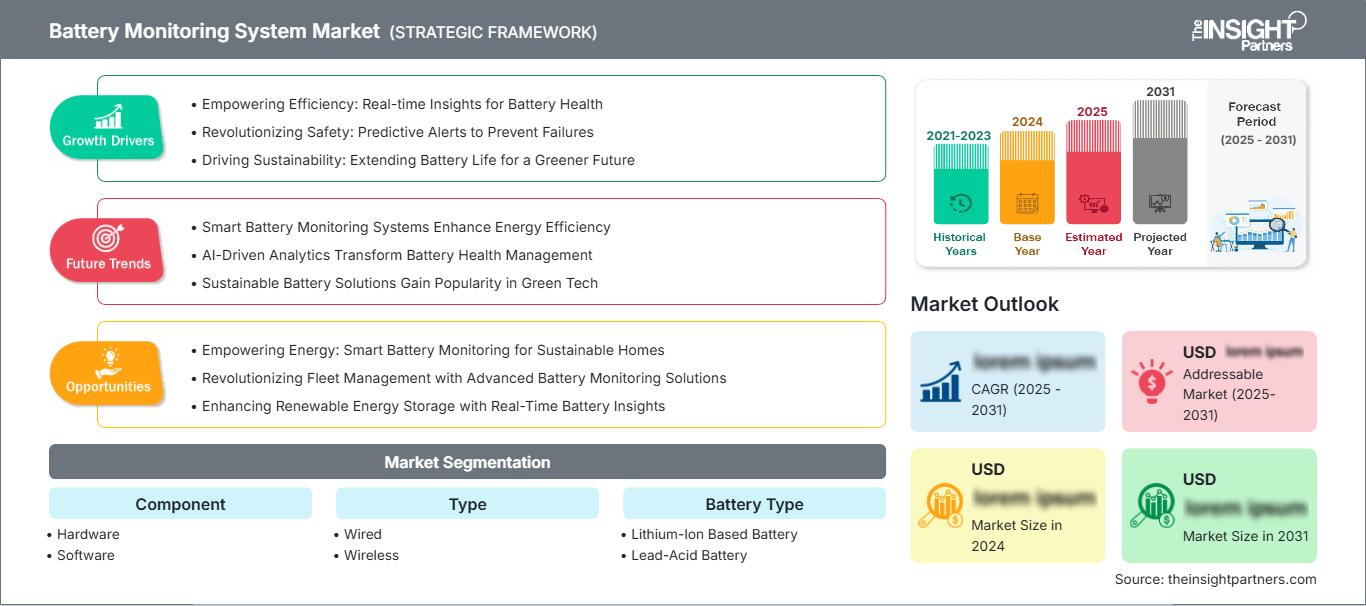
The Battery Monitoring System Market size was valued at US$ 11.60 Billion in 2025 and is projected to reach US$ 56.32 Billion by 2034, growing at a CAGR of 19.19% from 2026 to 2034. Demand is supported by continuous supervision of voltage, current, temperature, internal resistance, state of charge, and state of health across critical power assets, electric vehicles, renewable storage, telecom sites, and industrial backup systems.
Across North America, Battery Monitoring System Market size is expected to expand at 18.2%–19.2% during 2026–2034 as data center capacity, 5G densification, and grid-scale storage increase battery dependency. Adoption is reinforced by uptime requirements in IT and telecommunication networks, broader lithium-ion deployment in UPS rooms, and utility interest in predictive maintenance platforms that reduce outage risk and extend battery asset life.
Battery Monitoring System Market Assessment and Insights
- North America accounted for 29%–33% of the Battery Monitoring System Market share in 2025 and is expected to grow at a CAGR between 18.2%–19.2% during 2026–2034, supported by data centers, telecom backup, and utility storage modernization.
- US represented 78%–83% of North America in 2025 and is projected to grow at a CAGR between 18.4%–19.4% during 2026–2034.
- Europe held 21%–25% share in 2025 and is forecast to grow at a CAGR between 17.1%–18.1% during 2026–2034, led by Germany, the UK, France, Italy, and Spain.
- Asia Pacific captured 34%–38% share in 2025 and is projected to grow at a CAGR between 20.4%–21.4% during 2026–2034, led by China, Japan, South Korea, India, and Australia.
- Largest Segment Hardware held a market share of 57%–61% in 2025, with CAGR range of 18.4%–19.4% between 2026–2034.
- High Growth Segment Wireless held a market share of 36%–40% in 2025, with CAGR range of 21.2%–22.2% between 2026–2034.
- Key companies analyzed in detail: ABB Ltd., BatteryDAQ LLC, BTECH, Inc., Eagle Eye Power Solutions, LLC, HBL Power Systems Limited, NDSL Group Ltd., PowerShield Limited, Storage Battery Systems, LLC, Schneider Electric SE, and Texas Instruments Incorporated.
Source: The Insight Partners' analysis based on proprietary research, government publications, company annual reports, investor presentations, industry databases, and expert interviews.
The Battery Monitoring System market has developed into an integrated diagnostic platform from the traditional voltage check system, which entails sensors, gateways, analytics, alerts, and dashboards based on cloud connectivity. In view of the development in the market, it is clear that the demand for early detection of the state of cell imbalance, temperature change, and degradation of the battery strings is being considered by operators.
Future demand in the market will be driven by developments such as electrification, data infrastructure, renewable integration, and increased expectations of reliability of mission-critical power. Emerging markets are building telecom tower, battery energy storage, and manufacturing plants where a downtime translates to direct financial loss. It is likely that monitoring systems will continue to feature in procurement plans owing to the regulatory pressure in areas of safety, sustainability, and grid resilience.
Battery Monitoring System Market Report Scope
| Report Attribute | Details |
|---|---|
| Market size in 2025 | US$ 11.60 Billion |
| Market Size by 2034 | US$ 56.32 Billion |
| Global CAGR (2026 - 2034) | 19.19% |
| Historical Data | 2021-2024 |
| Forecast period | 2026-2034 |
Battery Monitoring System Market Analysis
Demand is growing due to the shift to continuous monitoring rather than periodic testing in the case of crucial battery packs. Market for Battery Monitoring System will be driven by increasing dependence on UPS, denser telecom towers, electrified mobility, and renewable energy storage resources. Businesses seek early failure diagnosis, fewer truck rolls, enhanced safety measures, and extended replacement intervals especially where a failure of battery packs may impact cloud computing centers, manufacturing facilities, electrical substations, or mobility infrastructures.
Value chain participants are sensor providers, battery manufacturers, semiconductor providers, software providers, power infrastructure solution providers, and services. Supplier landscape favors players who offer solutions that integrate measurement tools, communication technology, firmware development, analysis, and service operations. According to the International Energy Agency, batteries are developing fast along with increasing consumption of electricity due to digital infrastructure.
The competitive environment includes companies dealing with power management, monitoring services, and semiconductors. In the Battery Monitoring System report, interoperability of software, wireless monitoring, cybersecurity, and the level of services for installed base become more significant. Competing in the reliability of power infrastructure solutions, there are ABB Ltd., Schneider Electric SE, Eagle Eye Power Solutions, LLC, and Storage Battery Systems, LLC.
On the other hand, BatteryDAQ LLC, BTECH, Inc., and PowerShield Limited provide string monitoring systems. The direction of investments is oriented on dashboard connected to the cloud, wireless nodes, predictive analytics, and battery management systems. Texas Instruments Incorporated provides services for cell monitoring by advanced analog and embedded techniques, while HBL Power Systems Limited and NDSL Group Ltd. target industrial and backup power solutions.
● REPORT CUSTOMIZATION
Tailor This Report To Align With Your Specific Business Requirements
This report can be customized to align precisely with your business objectives, scope, and target markets. Customization options include tailored segmentation, geography, competitive analysis, and strategic insights to support informed decision-making.
Customize This Report →WHAT YOU CAN ADJUST
- ● Segmentations
- ● Geography
- ● Competitive Analysis
- ● Language Preferences
Battery Monitoring System Market: Strategic Insights
Regional Insights
North America Battery Monitoring System Market
North America held 29%–33% share in 2025 and is expected to grow at 18.2%–19.2% through 2034. The Battery Monitoring System Market share is supported by cloud data centers, telecom backup power, utility storage, and industrial UPS rooms where battery failures create service penalties and safety exposure.
Procurement is concentrated among hyperscale facilities, colocation operators, wireless carriers, utilities, and manufacturing sites. ABB Ltd., Schneider Electric SE, Eagle Eye Power Solutions, LLC, BTECH, Inc., BatteryDAQ LLC, and Storage Battery Systems, LLC benefit from retrofit demand, service networks, and monitoring platforms that support preventive replacement planning.
U.S. Battery Monitoring System Market Market
The U.S. represented 78%–83% of North American demand in 2025 and is projected to grow at 18.4%–19.4%. Demand is anchored in AI data centers, 5G networks, grid resilience programs, EV charging infrastructure, and battery-backed industrial automation where continuous visibility reduces unplanned downtime.
Company presence is strong through domestic monitoring specialists, power equipment suppliers, and semiconductor innovators. Eagle Eye Power Solutions, LLC, BTECH, Inc., BatteryDAQ LLC, Storage Battery Systems, LLC, Schneider Electric SE, ABB Ltd., and Texas Instruments Incorporated support applications including UPS strings, telecom backup, BESS controls, and embedded battery diagnostics.
Europe Battery Monitoring System Market Market
Europe accounted for 21%–25% share in 2025 and is expected to grow at 17.1%–18.1%. Germany leads because automotive electrification, industrial automation, and battery manufacturing require monitored power assets. The UK emphasizes data center resilience and telecom continuity, while France, Italy, and Spain expand renewable storage and infrastructure modernization.
European buyers are sensitive to energy security, safety compliance, and lifecycle documentation. ABB Ltd., Schneider Electric SE, NDSL Group Ltd., PowerShield Limited, and Texas Instruments Incorporated serve different layers of the ecosystem, from power infrastructure and monitoring software to embedded sensing. Adoption is strongest where service continuity and regulatory audits shape purchasing decisions.
APAC Battery Monitoring System Market Market
APAC held 34%–38% share in 2025 and is projected to grow at 20.4%–21.4%. China leads through EV batteries, telecom infrastructure, data centers, and grid storage. Japan and South Korea support advanced electronics, automotive batteries, and high-reliability industrial power applications.
India is gaining scale through digital infrastructure, renewable integration, and manufacturing incentives, while Australia adds demand from mining electrification and storage trials. HBL Power Systems Limited, ABB Ltd., Schneider Electric SE, and Texas Instruments Incorporated benefit from industrial, telecom, and energy projects that need remote monitoring.
Middle East & Africa Battery Monitoring System Market Market
Middle East & Africa is projected to grow at 15.6%–16.6%, with Saudi Arabia and the UAE leading through data centers, telecom expansion, solar-plus-storage, and smart infrastructure. South Africa remains important for mining power systems, telecom backup, and industrial UPS monitoring.
Rest of MEA demand is linked to grid reliability, remote telecom sites, oil and gas facilities, and healthcare backup power. Adoption remains uneven because service networks and budgets vary, but harsh operating environments strengthen the case for temperature monitoring, remote diagnostics, and preventive battery replacement.
Segmentation Analysis
Component
Component is projected to grow at 18.8%–19.8% during 2026–2034. Battery Monitoring System Market scope is defined by integrated hardware and software that collect measurements, issue alarms, visualize trends, and support predictive maintenance. Hardware remains essential for sensing and communications, while software gains importance as operators manage distributed battery fleets.
- Hardware includes sensors, controllers, communication modules, shunts, and gateways that capture operating parameters. It remains the revenue anchor because every monitored string requires installed measurement equipment.
- Software provides dashboards, alarms, historical analytics, predictive maintenance, and integration with building or energy management platforms. Its strategic value rises as customers manage multi-site battery assets remotely.
Type
Type is forecast to grow at 19.3%–20.3% during 2026–2034. Wired systems remain preferred in highly controlled facilities requiring stable connections and proven reliability. Wireless systems are scaling faster because they reduce cabling complexity, support retrofit installations, and improve monitoring feasibility across remote telecom, energy, and industrial sites.
- Wired systems retain strong adoption in data centers, substations, and industrial UPS rooms where fixed infrastructure, secure connections, and low communication uncertainty are prioritized.
- Wireless systems are strategically important for retrofits, distributed sites, and telecom towers because they reduce installation time, cabling cost, and disruption during monitoring upgrades.
Battery Type
Battery Type is expected to grow at 18.6%–19.6% during 2026–2034. Lithium-ion monitoring expands with EVs, data centers, and storage systems because thermal and state-of-health visibility are critical. Lead-acid monitoring remains important in installed UPS, telecom, and industrial backup systems where replacement timing and string imbalance affect reliability.
- Lithium-Ion Based Battery demand is increasing because high-energy installations require thermal tracking, cell balancing visibility, state-of-health analytics, and safety alarms across EV, storage, and UPS applications.
- Lead-Acid Battery monitoring remains essential for telecom towers, UPS strings, substations, and industrial backup systems where aging, sulfation, and string imbalance can trigger unexpected outages.
End-User
End-User is projected to grow at 19.0%–20.0% during 2026–2034. IT and telecommunication facilities lead adoption because battery-backed uptime is directly tied to service continuity. Energy, automotive, and manufacturing users are increasing deployments as electrification, storage integration, and automation raise the need for battery health visibility.
- IT and telecommunication users require monitoring for data centers, network sites, and remote towers where backup power must support uptime commitments and reduce maintenance visits.
- Energy applications include renewable storage, substations, microgrids, and utility backup systems where operators need battery condition data for dispatch confidence and safety planning.
- Automotive adoption is driven by EV platforms, charging infrastructure, and battery production environments that need accurate diagnostics, safety monitoring, and lifecycle intelligence.
- Manufacturing facilities use monitoring for UPS rooms, automation lines, forklifts, and emergency power systems where battery failures can stop production and affect worker safety.
Opportunity Snapshot
| End-User | Revenue Contribution | Trend Tag | Adoption Stage |
| IT and telecommunication | High | Uptime Control | Mature |
| Energy | High | Grid Storage | Scaling |
| Automotive | Medium | EV Diagnostics | Scaling |
| Manufacturing | Medium | Plant Backup | Scaling |
Battery Monitoring System Market Growth Drivers and Impact Analysis
Critical Power Uptime Moves Battery Health into Operations
Organizations have realized that batteries are not just backups but operational resources as well. Data centers, telecommunication systems, hospitals, finance houses, and automated factories cannot afford battery failure since even brief disturbances could affect their operations. Monitoring systems add value by detecting failures, imbalance, temperature changes, and weakening of internal resistance in batteries prior to their failure during the discharge process. This has enabled organizations to base their maintenance on the status of the batteries rather than relying on their age and reducing the number of emergency support calls. The Battery Monitoring System Market stands to gain as a result.
Renewable Storage Raises Requirements for Real-Time Diagnostics
With the growth of renewable storage and microgrids, there will be a greater requirement for battery visibility while in operation. Battery storage owners will have the constant need for information such as temperature, voltage variation, state of charge, and deterioration for dispatch purposes and safety concerns. Monitoring technology will enable utilities to benchmark battery performance against different operating environments. From a commercial standpoint, developers of renewable energy can minimize physical checkups, schedule maintenance services, and defend warranty cases through operational monitoring records.
Lithium-Ion Safety and Lifecycle Economics Shape Procurement
The increased use of lithium-ion cells results in greater monitoring needs since the higher energy density makes the risk factors of temperature variations, imbalance, and improper aging more severe. Consumers have been demanding solutions that gather information about individual cells or strings, provide alarm functions, and input maintenance processes. When it comes to older lead-acid banks, monitoring helps to improve the time of replacement and avoid the situation where one underperforming cell ruins the whole string. Commercially speaking, it contributes to increased implementation in both newly built and retrofitted systems.
Battery Monitoring System Market Future Trends
Predictive Analytics Become Embedded in Battery Operations
Battery Monitoring System Market trends will gradually move toward analytical tools which turn measurement data into maintenance tasks. Operators will demand that their BMS systems detect abnormal impedance drifts, temperature behavior, and string imbalance prior to generating alarms leading to failure events. The future generation of BMS platforms will integrate local sensing, edge computing, and cloud-based dashboards for asset benchmarking between different locations. Thus, the value will be moved from measurement to decision-making, especially for companies running several hundred battery rooms, telecommunications masts, or energy storage containers.
Wireless and Cybersecure Monitoring Architectures Expand
Wireless solutions will transition from an afterthought that facilitates retrofits into a fundamental part of infrastructure designs for quick rollouts on distributed battery systems. Secure communications, device authentication, encryption, and robust gateways will be key considerations in the next purchasing cycle since the battery information is now linked to operations. Where facilities have multiple cabinets, towers, substations, or containers, they can lower cabling impact and still gain visibility. Vendors will have to demonstrate reliability of their wireless signals, strong cybersecurity practices, and firmware support over the long term. The most successful deployments will be those where wired additions are costly or disruptive.
Battery Monitoring System Market Opportunities
Data Center and Telecom Retrofit Programs
The existing large customer base of UPS and telecom backup batteries represents a short-term opportunity for a retrofit. According to Battery Monitoring System Market Forecast, customers could focus on facilities at high risk of outages, old lead-acid string batteries, or those that are due for replacement with lithium-ion batteries. Suppliers would be able to bundle wireless nodes, gateways, dashboards, and maintenance support for phased implementation without significant downtime. The biggest opportunity will lie in situations where enterprises operate several distributed locations that require the same health status on the batteries.
Battery Energy Storage System Service Models
There are some factors that should be considered for monitoring battery energy storage systems including protecting revenues, ensuring safety and warranty support, and assumptions on battery degradation. There lies a good business opportunity for companies providing such services linked with analytics, inspection scheduling, alarm analysis, and performance reporting. Utility-scale customers, independent power producers, and commercial storage owners would likely go for subscriptions when they lack internal experience in batteries management. Differentiation would come from offering field service, software, thermal warning, and benchmarking the whole fleet of batteries. The best prospects will be multi-site customers requiring standard reports and fast actions in case of abnormal battery behavior.
Recent Developments
- June 2026: Texas Instruments (TI) (Nasdaq: TXN) introduced the industry's highest-cell-count battery monitor with an integrated electrochemical impedance spectroscopy (EIS) engine, bringing predictive intelligence, comprehensive data and real-time diagnostics to battery monitoring in electric vehicles (EV) and energy storage system (ESS) applications
- March 2025: Renesas Electronics Corporation (TSE:6723), a premier supplier of advanced semiconductor solutions, today introduced all-in-one solutions for managing lithium-ion battery packs in a wide range of battery-powered consumer products, such as e-bikes, vacuum cleaners, robotics and drones. With pre-validated firmware provided, the R-BMS F (Ready Battery Management System with Fixed Firmware) will significantly reduce the learning curve for developers, enabling rapid designs of safe, power-efficient battery management systems.
- October 2025: NXP Semiconductors N.V. (NASDAQ: NXPI) today announced its industry-first Electrochemical Impedance Spectroscopy (EIS) battery management chipset with hardware-based nanosecond-level synchronization of all devices. The new system solution is designed to enhance safety, longevity, and performance in electric vehicles and energy storage systems. It integrates EIS measurement directly into three battery management system (BMS) chipset units, enabling carmakers to gain deeper insights into battery health and behavior.
Frequently Asked Questions

- Comprehensive Market Sizing and Forecast Analysis
- Detailed Segmentation Analysis
- In-Depth Market Dynamics Assessment
- Regional and Country-Level Insights
- Competitive Landscape and Company Benchmarking
- Strategic Business Intelligence
Recent Reports
Testimonials

The Insight Partners' SCADA System Market report is comprehensive, with valuable insights on current trends and future forecasts. The team was highly professional, responsive, and supportive throughout. We are very satisfied and highly recommend their services.
RAN KEDEM Partner, Reali Technologies LTDs
I requested a report on a very specific software market and the team produced the report in a few days. The information was very relevant and well presented. I then requested some changes and additions to the report. The team was again very responsive and I got the final report in less than a week.
JEAN-HERVE JENN Chairman, Future Analytica
We worked with The Insight Partners for an important market study and forecast. They gave us clear insights into opportunities and risks, which helped shape our plans. Their research was easy to use and based on solid data. It helped us make smart, confident decisions. We highly recommend them.
PIYUSH NAGPAL Sr. Vice President, High Beam Global
The Insight Partners delivered insightful, well-structured market research with strong domain expertise. Their team was professional and responsive throughout. The user-friendly website made accessing industry reports seamless. We highly recommend them for reliable, high-quality research services
YUKIHIKO ADACHI CEO, Deep Blue, LLC.
This is the first time I have purchased a market report from The Insight Partners.While I was unsure at first, I visited their web site and felt more comfortable to take the risk and purchase a market report.I am completely satisfied with the quality of the report and customer service. I had several questions and comments with the initial report, but after a couple of dialogs over email with their analyst I believe I have a report that I can use as input to our strategic planning process.Thank you so much for taking the extra time and making this a positive experience.I will definitely recommend your service to others and you will be my first call when we need further market data.
JOHN SUZUKI President and Chief Executive Officer, Board Director, BK Technologies
I wish to appreciate your support and the professionalism you displayed in the course of attending to my request for information regarding to infectious disease IVD market in Nigeria. I appreciate your patience, your guidance, and the fact that you were willing to offer a discount, which eventually made it possible for us to close a deal. I look forward to engaging The Insight Partners in the future, all thanks to the impression you have created in me as a result of this first encounter.
DR CHIJIOKE ONYIA MANAGING DIRECTOR, PineCrest Healthcare Ltd.Reason to Buy
- Informed Decision-Making
- Understanding Market Dynamics
- Competitive Analysis
- Identifying Emerging Markets
- Customer Insights
- Market Forecasts
- Risk Mitigation
- Boosting Operational Efficiency
- Strategic Planning
- Investment Justification
- Tracking Industry Innovations
- Aligning with Regulatory Trends





 Get Free Sample for