
Beacon Lights Market Size, Share & Demand by 2034
Coverage: by Product (Halogen Light, Xenon Light, and LED Light), Application (Navigation, and Defensive communications), and Geography (North America, Europe, Asia Pacific, and South and Central America)
- Status : Data Released
- Report Code : TIPRE00003107
- Category : Electronics and Semiconductor
- No. of Pages : 150
- Available Report Formats :


- Last update date : July 28, 2026


2025 Market Size
US$ 887.5 Mn
Base year value
2034 Forecast
US$ 1,421.47 Mn
Projected by 2034
CAGR 2026-2034
5.37 %
Growth rate
Addressable Market
US$ 10,470.06 Mn
(2026-2034)
The Beacon Lights Market was valued at US$ 887.5 Million in 2025 and is expected to reach US$ 1,421.47 Million by 2034, growing at a CAGR of 5.37% from 2026 to 2034. The market is witnessing an increasing trend as aerospace, maritime, industry, and defense segments opt for more resilient visual signal solutions as replacements for warning lamps.
The Beacon Lights Market size in North America region will be driven by the needs for airfield upkeep, harbor protection, upgrades to emergency vehicles, and industrial facilities' compliance programs. It is anticipated to register a CAGR between 4.8% and 5.4% in the 2026-2034 period, due to FAA-compliant obstruction marking, coast guard navigation rules, and a higher propensity toward LED-based products.
Beacon Lights Market Assessment and Insights
- North America: The region is estimated to hold 30–34% share in 2025 and grow at a CAGR of 4.8–5.4% during 2026–2034, supported by aviation obstruction lighting, marine aids, emergency vehicles, and industrial safety upgrades.
- US: The country represents 72–76% of North America in 2025 and is projected to grow at a CAGR of 4.9–5.5% during 2026–2034.
- Europe: Europe accounts for 25–29% share in 2025 and is expected to grow at a CAGR of 4.6–5.2% during 2026–2034, led by Germany, the UK, France, Italy, and Spain.
- Asia Pacific: Asia Pacific represents 27–31% share in 2025 and is forecast to grow at a CAGR of 5.8–6.4% during 2026–2034, with China, Japan, South Korea, India, and Australia advancing infrastructure and port safety demand.
- Largest Segment: LED Light held 55–59% of the Beacon Lights market in 2025 and is expected to grow at a CAGR of 6.1–6.8% during 2026–2034.
- High Growth Segment: Defensive communications holds 34–38% market share in 2025 and is expected to grow at a CAGR of 5.9–6.6% during 2026–2034.
- Key companies analyzed in detail: AISALUX S.A.; General Electric Company; ESAFETY LIGHTS; D.G. Controls Limited; CIRCONTROL S.A.; CITEL; Federal Signal Corporation; NSI International, Inc.; WERMA Signaltechnik GmbH + Co. KG; Auer Signal GmbH.
Source: The Insight Partners' analysis based on proprietary research, government publications, company annual reports, investor presentations, industry databases, and expert interviews.
The industry trend is that beacons have evolved from rotating lights powered by halogen and xenon lamps to sealed systems using LEDs with multicolor display capabilities, enhanced ingress protection, and customizable flash modes. Production aspects are increasingly focused on efficient cooling, lens performance, vibrations tolerance, electromagnetic interference, and modular design. The growth of Beacon Lights Market is also driven by replacement opportunities, as users want to change lamps less frequently, minimize the downtime, and ensure visibility during bad weather, marine reflections, and noisy conditions.
Demand factors will include airport development, offshore energy exploration, smart factory projects, ports’ automation, military fleet modernization, and road safety improvements. Emerging countries start using beacons first for construction vehicle fleets, ports, railway yards, mining operations, and logistics hubs as visual warnings can decrease the incidents. The regulatory tailwind is anticipated to come from improved practices in machinery safety, aviation obstruction marking, marine navigation aids, and workplace visibility.
Beacon Lights Market Report Scope
| Report Attribute | Details |
|---|---|
| Market size in 2025 | US$ 887.5 Million |
| Market Size by 2034 | US$ 1,421.47 Million |
| Global CAGR (2026 - 2034) | 5.37% |
| Historical Data | 2021-2024 |
| Forecast period | 2026-2034 |
Beacon Lights Market Analysis
The factors driving demand include safety regulation adherence, reliability in navigation, and the need for visual indicators that are clear and unmistakable in all types of vehicles, machinery, ships, aircraft ground support equipment, and military installations. The supply chain covers LED chip manufacturers, optics companies, enclosure makers, electronics driver makers, testing firms, distributors, systems integrators, fleet managers, and municipalities that have performance, color, mounting, and durability specifications.
While there is consistency in the supply factors as beacon assemblies employ proven technologies, differentiation in the product offering has increased on account of rugged electronics, IP66 to IP69K ratings, IO-Link capability, solar-powered products, and low current LED technology. According to Beacon Lights Market research, buyers place a premium on total cost of ownership versus individual unit pricing in the aviation, marine, mining, and process sectors.
The competitive scenario includes extensive industrial signaling product offerings as well as application experts. The companies Federal Signal Corporation, WERMA Signaltechnik GmbH + Co. KG, and Auer Signal GmbH rely on broad product lines and global distribution. D.G. Controls Limited, AISALUX S.A., CIRCONTROL S.A., CITEL, NSI International, Inc., ESAFETY LIGHTS, and General Electric Company are responding to market demand through dedicated emergency, electrical, aviation, and infrastructure sales channels.
In terms of investment strategy, there is a preference for compact LED-based solutions, customizable warning devices, connected status indicators, and harsh-environment-certified products. Increasingly, the strategic position is based on certifications, distributors' presence, customization capability, and compatibility with existing products. Suppliers offering modular product designs will be able to address various industry sectors without having to modify each warning light, while specialists will be able to protect their niches through high optical output, hazardous-area certification, and mounting options.
● REPORT CUSTOMIZATION
Tailor This Report To Align With Your Specific Business Requirements
This report can be customized to align precisely with your business objectives, scope, and target markets. Customization options include tailored segmentation, geography, competitive analysis, and strategic insights to support informed decision-making.
Customize This Report →WHAT YOU CAN ADJUST
- ● Segmentations
- ● Geography
- ● Competitive Analysis
- ● Language Preferences
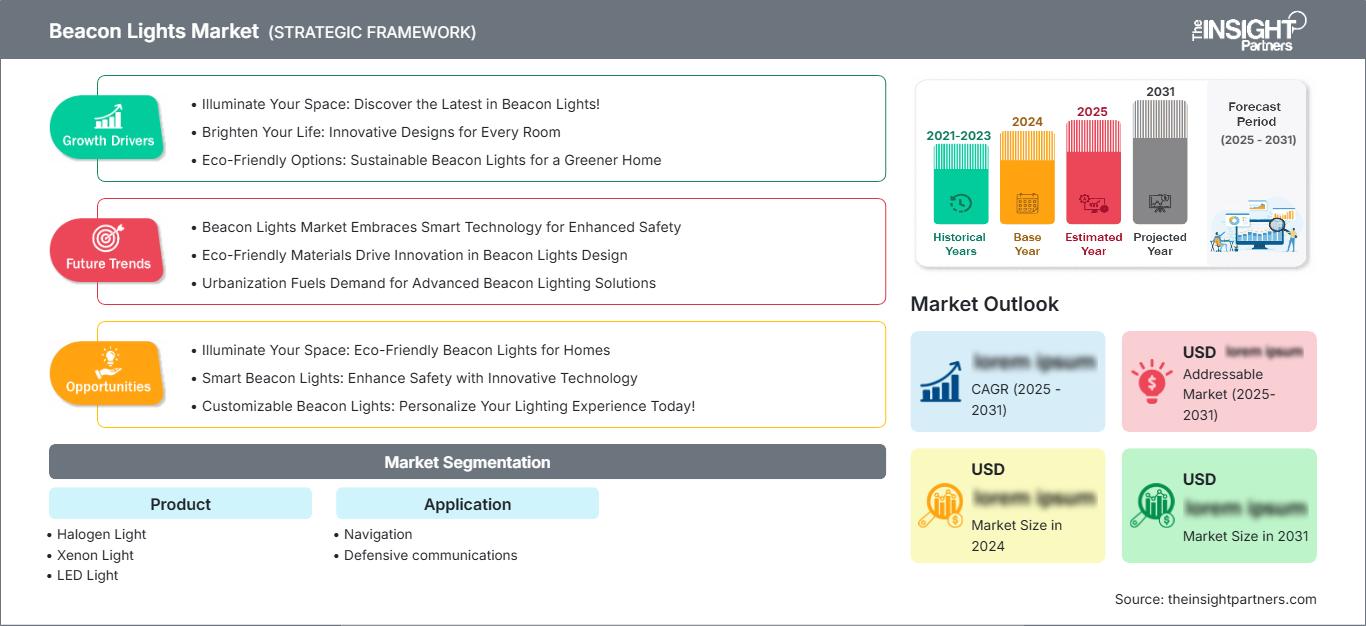
Beacon Lights Market: Strategic Insights
Regional Insights
North America Beacon Lights Market
North America holds 30–34% share in 2025 and is projected to expand at a CAGR of 4.8–5.4% during 2026–2034. Beacon Lights Market share is supported by airport obstruction lighting, port and inland waterway safety, emergency response fleets, work trucks, utility maintenance vehicles, and industrial facilities that require visible status indication under OSHA-influenced safety practices.
Local sourcing prefers LED beacons as the users can save on lamp changes, battery weight, and maintenance calls due to their widespread locations. Federal Signal Corporation and General Electric Company increase the presence of local sourcing, while the distributors assist the European experts in the manufacture and automation accounts. It is projected that the demand will be driven by replacements and will have infrastructure upgrades, public safety fleets, ports, warehouses, and aviation ground operations linked with them.
U.S. Beacon Lights Market
The US represents 72-76% of North American demand in 2025 and forecasted to grow at a CAGR of 4.9-5.5% from 2026 to 2034. The industry application trends involve use in airport runway and tower obstruction markers, marine aids to navigation, lighting systems for emergency vehicles, road maintenance fleet, warehouse automation, and warning lights for oil and gas utility work sites.
Market presence by companies includes Federal Signal Corporation, General Electric Company, NSI International, Inc., and distribution channels of WERMA Signaltechnik GmbH + Co. KG, and Auer Signal GmbH. Customers normally ask for color, flashing speed, light intensity (candela), operating voltage, mounting method, and environmental rating. Fleet replacement and safety audits of facilities will be the major sources of demand, while defense communications will increase due to demand from military bases and vehicles.
Europe Beacon Lights Market
The Europe region accounts for 25-29% share in 2025 and is expected to grow at a CAGR of 4.6-5.2% during 2026-2034. Germany dominates due to the availability of automation systems, machine safeguarding, and export-oriented industrial signaling systems. The United Kingdom creates demand for industrial signaling equipment by means of its marine sector, emergency vehicles, and maintenance of infrastructure.
France, Italy, and Spain create demand via their ports, manufacturing facilities, road safety fleet, and energy infrastructure projects. Customers in Europe usually demand CE-marked equipment, high ingress protection, and distinct marking of machines. Companies like WERMA Signaltechnik GmbH + Co. KG, Auer Signal GmbH, AISALUX S.A., D.G. Controls Limited, and CITEL benefit from being closer to their industrial clients.
APAC Beacon Lights Market
The APAC region holds a market share of 27%-31% in 2025 and is estimated to witness a CAGR of 5.8%-6.4% from 2026-2034. China leads in the market due to manufacturing, ports, construction machines, and renewable energy infrastructure. Japan and South Korea prefer quality-based industrial signals. India and Australia contribute with mining, transportation, and marine segments.
Drivers in the region include automation in factories, airport development, safety investment in ports, improvement in railways, and initiatives to decrease workplace accidents. The local electronics manufacturing industry is supportive of highly competitive LED assembly products, but marine and aviation products need specialized suppliers only. Adoption of Beacon Lights Market will be quick when infrastructure investments come together with visual warning systems.
Middle East & Africa Beacon Lights Market
Middle East & Africa is projected to grow at a CAGR of 4.7–5.3% during 2026–2034. The UAE is the leading country because airports, seaports, logistics zones, and smart-city projects require reliable warning and navigation lights. Saudi Arabia supports demand through energy, transport, and industrial infrastructure, while South Africa adds mining and utility applications.
Energy and infrastructure contexts favor beacons that tolerate heat, dust, vibration, and outdoor exposure. Rest of MEA adoption remains project-led, especially for ports, oil and gas sites, airports, emergency services, and guarded industrial facilities. Suppliers that offer ruggedized housings, solar options, and fast local replacement support can improve specification rates.
Segmentation Analysis
Product
The Product segment is projected to grow at a CAGR of 5.5–6.1% during 2026–2034 as users shift toward efficient, sealed, and configurable lighting platforms. Beacon Lights Market scope covers legacy replacement, new equipment integration, and harsh-environment signaling. Buyers compare light intensity, service life, color availability, voltage compatibility, mounting style, certification, and resistance to water, dust, salt spray, and vibration.
- Halogen Light remains relevant in cost-sensitive replacements and simple rotating beacon applications where installed bases, familiar maintenance practices, and low acquisition cost matter more than energy efficiency.
- Xenon Light serves high-intensity strobe requirements where sharp flashes, long-distance visibility, and rapid attention capture are needed in industrial, emergency, marine, and obstruction warning applications.
- LED Light leads adoption because long service life, low current consumption, compact electronics, multi-color capability, and programmable signaling improve lifecycle economics across vehicles, machinery, infrastructure, and defense installations.
Application
The Application segment is estimated to grow at a CAGR of 5.2–5.8% during 2026–2034 because visual signaling is essential for route identification, hazard recognition, and operational coordination. Navigation remains the larger application, while defensive communications is gaining importance as bases, vehicles, vessels, and protected sites require coded visual alerts, status indication, and low-ambiguity warning systems.
- Navigation uses beacons to mark routes, hazards, obstacles, vessels, airfield structures, and work zones, making visibility, color consistency, weather resistance, and regulatory conformity critical purchasing criteria.
- Defensive communications relies on beacon signals for identification, perimeter status, convoy movement, alert escalation, and secure facility coordination where ruggedness, controlled visibility, and dependable operation are strategically important.
Opportunity Snapshot
| Application | Revenue Contribution | Trend Tag | Adoption Stage |
| Navigation | High | Route Safety | Mature |
| Defensive communications | Medium | Coded Alerts | Scaling |
Beacon Lights Market Growth Drivers and Impact Analysis
LED Retrofit Economics Across Safety-Critical Assets
Replacement of halogen and xenon beacons with LED units is one of the clearest drivers because it addresses energy consumption, service access, and downtime together. Airports, ports, factories, emergency fleets, and construction operators often manage hundreds of visual warning points, so fewer lamp changes can reduce maintenance hours and improve asset availability. LED units also support compact electronics, multi-voltage operation, and selectable flash patterns, allowing one product family to cover several use cases. The impact is strongest in remote towers, offshore assets, high-mounted obstruction lights, and mobile fleets where access is costly or safety-critical. As lifecycle procurement becomes more common, Beacon Lights Market suppliers with documented durability, certified optics, and replacement compatibility will gain specification advantages.
Regulated Navigation and Obstruction Marking Requirements
Aviation, marine, rail, and road infrastructure depend on beacon visibility to identify obstacles, guide movement, and reduce collision risk. Compliance expectations from aviation authorities, maritime safety bodies, and workplace regulators keep replacement demand steady even when capital budgets are cautious. Airports require obstruction and ground-support signaling, ports need navigational aids, and industrial yards use beacons to communicate machine states or vehicle movement. The real-world impact is a recurring demand base linked to inspection cycles and asset renewal rather than only new construction. Products with clear color output, robust lenses, and tested environmental performance are favored because failure can create operational stoppages, safety incidents, or regulatory exposure for operators.
Industrial Automation and Connected Signaling Adoption
Factories, warehouses, logistics centers, and process plants are expanding visual signaling from simple alarms to integrated status communication. Beacons now indicate machine readiness, access control, maintenance states, automated guided vehicle movement, and production bottlenecks. Connected signaling, IO-Link-enabled devices, and configurable LED modules help maintenance teams standardize equipment while reducing wiring complexity. This driver is commercially important because industrial buyers often replicate approved components across multiple lines or facilities. Vendors that offer modular mounting, software configuration, diagnostics, and strong protection ratings can win platform-level approvals. The impact extends beyond safety because visible status indication supports productivity, faster response, and clearer coordination between people and automated systems.
Beacon Lights Market Future Trends
Smart Multi-Color Beacons for Machine-Level Communication
Beacon Lights Market trends will increasingly favor smart multi-color devices that replace several single-function lights with one configurable unit. Industrial users will select beacons that display operating status, warning escalation, maintenance priority, and access permission through programmable colors and flash patterns. Integration with IO-Link, fieldbus gateways, and edge controllers will allow maintenance teams to modify signaling logic without replacing hardware. This trend supports leaner inventories, faster commissioning, and improved diagnostics in automated environments. Over the forecast period, manufacturers that combine optical intensity with intuitive configuration software will be better positioned for machine builders, intralogistics operators, and food or pharmaceutical facilities requiring hygienic, high-protection signaling.
Solar and Low-Power Beacons for Remote Infrastructure
Remote infrastructure will drive demand for solar-assisted and low-power beacon systems used on marine markers, temporary road works, towers, rural rail assets, perimeter posts, and utility sites. These deployments need dependable visibility without frequent battery replacement or grid wiring. LED efficiency, charge controllers, weatherproof housings, and remote condition monitoring will become stronger purchasing criteria. The trend is particularly relevant in emerging regions where infrastructure is expanding faster than grid access or maintenance capacity. Suppliers that package beacon optics, power management, mounting hardware, and field-service documentation together can reduce installation risk for contractors and public agencies managing geographically dispersed safety assets.
Beacon Lights Market Opportunities
Port, Airport, and Offshore Infrastructure Upgrades
Beacon Lights Market Forecasts indicate strong opportunity in ports, airports, offshore energy platforms, and coastal infrastructure where signaling assets must operate in corrosive, windy, and low-visibility conditions. Investment should target certified obstruction lights, marine navigation beacons, tower warning systems, and rugged visual alarms for service vehicles. Buyers in these environments value lifecycle reliability, spare-part availability, and compliance documentation because outages can disrupt operations or trigger safety reviews. Suppliers can strengthen positioning by offering corrosion-resistant housings, LED retrofit kits, solar options, and installation support. The opportunity is especially attractive in regions expanding airport capacity, offshore wind, LNG terminals, and container logistics corridors.
Defense Bases and Secure Mobility Signaling
Defense applications create an actionable opportunity for beacons used in convoy identification, perimeter control, aircraft ground operations, temporary landing zones, vehicle status indication, and secure-site alerts. Procurement teams require rugged products that withstand vibration, dust, temperature swings, and electromagnetic interference while supporting controlled visibility and clear color coding. Suppliers should prioritize modular platforms that can be adapted for vehicles, masts, shelters, and fixed installations. The opportunity differs from commercial navigation because mission environments require predictable operation under stress and rapid replacement logistics. Companies that align products with military maintenance practices, documentation needs, and local assembly preferences can build longer-term program relationships.
Recent Developments
- June 2026: Lighting New York announced that its AI-powered Beacon Image Light Finder was recognized by Newsweek’s AI Impact Awards in the AI Brand & Retail category for Best Outcomes, Customer Experience. Powered by Lighting New York’s internal AI platform, Light Visions, Beacon allows customers to upload images of lighting fixtures and find visually similar products from the company’s catalog, simplifying product discovery through image-based search rather than traditional keyword searches. The technology has improved the customer shopping experience, with users of Beacon achieving higher conversion rates and increased revenue per user compared with traditional site search users.
- November 2025: The Designers Lighting Forum of New York (DLFNY) announced the winners of the 2025 Beacon Awards, recognizing outstanding achievements in architectural lighting and product design. The awards honored projects across categories including commercial interiors, cultural institutions, hospitality, residential, retail, experiential lighting, and architectural product design, while also presenting ICON Awards to the founders of Fisher Marantz Stone for their long-standing contributions to the lighting industry.
- April 2024: Carat, a dentsu company, renewed its partnership with Beacon Lighting, extending its media agency relationship for an additional three years. Under the renewed agreement, Carat Victoria will continue to manage Beacon Lighting’s paid media strategy, planning, buying, brand campaigns, performance marketing, and programmatic advertising, building on a partnership that began in 2018 and expanded in 2021. The renewal reflects Beacon Lighting’s continued investment in data-driven media strategies and long-term marketing partnerships to strengthen brand growth and customer engagement across the Australian retail lighting market.
Frequently Asked Questions

- Comprehensive Market Sizing and Forecast Analysis
- Detailed Segmentation Analysis
- In-Depth Market Dynamics Assessment
- Regional and Country-Level Insights
- Competitive Landscape and Company Benchmarking
- Strategic Business Intelligence
Recent Reports
Testimonials

The Insight Partners provided valuable market intelligence that supported our global go-to-market strategy. Their team was professional, responsive, and attentive to our feedback, providing thoughtful analysis and helpful methodological clarifications throughout the project.
Junmo Kim Chief Financial Officer (CFO), Enertech Co., Ltd.
The Insight Partners' SCADA System Market report is comprehensive, with valuable insights on current trends and future forecasts. The team was highly professional, responsive, and supportive throughout. We are very satisfied and highly recommend their services.
RAN KEDEM Partner, Reali Technologies LTDs
I requested a report on a very specific software market and the team produced the report in a few days. The information was very relevant and well presented. I then requested some changes and additions to the report. The team was again very responsive and I got the final report in less than a week.
JEAN-HERVE JENN Chairman, Future Analytica
We worked with The Insight Partners for an important market study and forecast. They gave us clear insights into opportunities and risks, which helped shape our plans. Their research was easy to use and based on solid data. It helped us make smart, confident decisions. We highly recommend them.
PIYUSH NAGPAL Sr. Vice President, High Beam Global
The Insight Partners delivered insightful, well-structured market research with strong domain expertise. Their team was professional and responsive throughout. The user-friendly website made accessing industry reports seamless. We highly recommend them for reliable, high-quality research services
YUKIHIKO ADACHI CEO, Deep Blue, LLC.
This is the first time I have purchased a market report from The Insight Partners.While I was unsure at first, I visited their web site and felt more comfortable to take the risk and purchase a market report.I am completely satisfied with the quality of the report and customer service. I had several questions and comments with the initial report, but after a couple of dialogs over email with their analyst I believe I have a report that I can use as input to our strategic planning process.Thank you so much for taking the extra time and making this a positive experience.I will definitely recommend your service to others and you will be my first call when we need further market data.
JOHN SUZUKI President and Chief Executive Officer, Board Director, BK Technologies
I wish to appreciate your support and the professionalism you displayed in the course of attending to my request for information regarding to infectious disease IVD market in Nigeria. I appreciate your patience, your guidance, and the fact that you were willing to offer a discount, which eventually made it possible for us to close a deal. I look forward to engaging The Insight Partners in the future, all thanks to the impression you have created in me as a result of this first encounter.
DR CHIJIOKE ONYIA MANAGING DIRECTOR, PineCrest Healthcare Ltd.Reason to Buy
- Informed Decision-Making
- Understanding Market Dynamics
- Competitive Analysis
- Identifying Emerging Markets
- Customer Insights
- Market Forecasts
- Risk Mitigation
- Boosting Operational Efficiency
- Strategic Planning
- Investment Justification
- Tracking Industry Innovations
- Aligning with Regulatory Trends





 Get Free Sample for