
Behavior Analytics Market Growth, Size & Forecast by 2034
Behavior Analytics Market Size and Forecasts (2021 - 2034), Global and Regional Share, Trends, and Growth Opportunity Analysis Report Coverage : By Component (Solution, Services); Deployment (Cloud, On Premises); Industry (BFSI, IT and Telecom, Healthcare, Retail, Others)
- Status : Data Released
- Report Code : TIPRE00039748
- Category : Technology, Media and Telecommunications
- No. of Pages : 150
- Available Report Formats :


- Last update date : July 28, 2026


2025 Market Size
US$ 5.49 Bn
Base year value
2034 Forecast
US$ 43.43 Bn
Projected by 2034
CAGR 2026-2034
25.84 %
Growth rate
Addressable Market
US$ 184.84 Bn
(2026-2034)
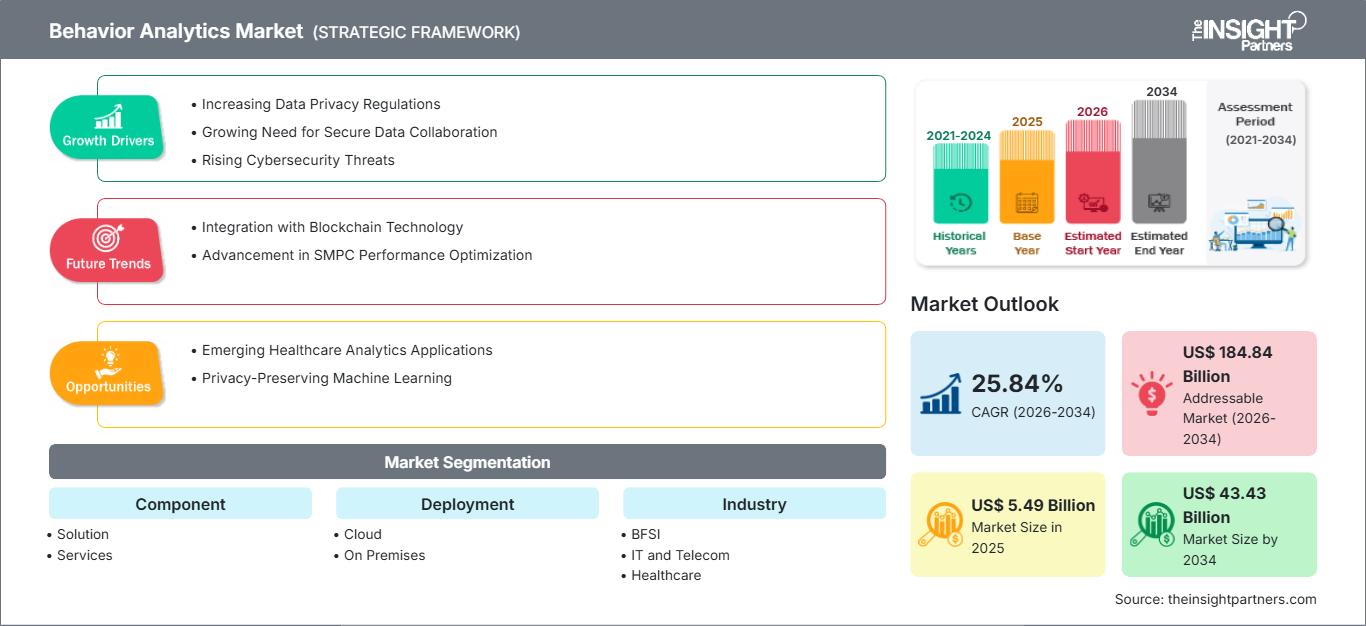
The global behavior analytics market is entering a phase of accelerated commercial adoption as enterprises lean on AI-driven pattern recognition to secure digital operations. Valued at US$ 5.49 Billion in 2025, the market is projected to reach US$ 43.43 Billion by 2034, expanding at a CAGR of 25.84% between 2026 and 2034, reflecting rising investment in insider-threat detection, fraud prevention, and customer intelligence platforms across industries worldwide.
The behavior analytics market size in North America is expanding at an estimated CAGR of 24–27% through 2034, propelled by dense concentrations of cloud-native enterprises, stringent data-protection mandates, and early adoption of AI-augmented security operations centers. Sustained venture funding into cybersecurity startups and aggressive modernization of legacy SIEM infrastructure across BFSI and healthcare further reinforce the region's position as a proving ground for advanced behavioral detection technologies.
Behavior Analytics Market Assessment and Insights
- North America: North America held an estimated 34–38% share of the behavior analytics market in 2025 and is projected to grow at a CAGR of 24–27% between 2026–2034, supported by mature cloud infrastructure, regulatory pressure, and heavy enterprise security spending.
- US: The United States commanded 82–86% share within North America in 2025, growing at a CAGR of 24–26% between 2026–2034, anchored by dense fintech, healthcare, and federal cybersecurity procurement activity.
- Europe: Europe accounted for an estimated 24–28% share in 2025 and is forecast to grow at a CAGR of 23–26% between 2026–2034, with the United Kingdom, Germany, and France leading regional deployment through GDPR-aligned compliance investment.
- Asia Pacific: Asia Pacific held an estimated 20–24% share in 2025, expanding at a CAGR of 27–30% between 2026–2034, led by China, Japan, and India amid rapid digital banking and telecom network expansion.
- Largest Segment: Cloud deployment led the behavior analytics market with an estimated 58–62% share in 2025 and is projected to grow at a CAGR of 26–29% between 2026–2034, driven by scalability and lower upfront infrastructure costs.
- High Growth Segment: The healthcare industry vertical is the fastest-growing segment, holding an estimated 12–15% share in 2025 and advancing at a CAGR of 29–32% between 2026–2034 amid rising ransomware exposure.
- Key companies analyzed in detail: TIBCO Software Inc., Splunk Inc., NTT Data Corporation, Varonis Systems Inc., Exabeam, IBM Corporation, Niara Inc., Microsoft Corporation, Oracle Corporation, SAP SE.
Source: The Insight Partners' analysis based on proprietary research, government publications, company annual reports, investor presentations, industry databases, and expert interviews.
The use of behavioral analytics by enterprises has undergone various stages of development. Initially, there was the use of rule-based anomaly detection, followed by continuous user profiling using machine learning to baseline users, devices, and applications. The initial deployments were in the realm of fraud detection in banking, but things changed once vendors developed models that could process large volumes of unstructured log files using unsupervised learning, allowing security professionals to lower false positives without having to add analysts to support hybrid, multi-cloud, and edge deployments.
Going forward, vendors will be looking to take their platforms to new geographies via localized data residency capabilities and partnerships with regional systems integration firms, especially in Southeast Asia, Gulf Cooperation Council countries, and Latin America. Regulators are pushing midmarket companies to adopt managed behavior analytic solutions with an expanded data protection framework and mandatory breach disclosure laws, while private equity firm-fueled mergers and acquisitions activity is seeing platform consolidation among SIEM, UEBA, and identity security solutions.
Behavior Analytics Market Report Scope
| Report Attribute | Details |
|---|---|
| Market size in 2025 | US$ 5.49 Billion |
| Market Size by 2034 | US$ 43.43 Billion |
| Global CAGR (2026 - 2034) | 25.84% |
| Historical Data | 2021-2024 |
| Forecast period | 2026-2034 |
Behavior Analytics Market Analysis
Demand for behavior analytics is being shaped by the convergence of insider-risk management, customer-experience personalization, and regulatory compliance mandates that require continuous monitoring rather than periodic audits. According to the Behavior Analytics Market Report, there is an increasing realization among CISOs that static, signature-based security measures will be unable to match the pace of credential-based attacks and hence, there will have to be a reallocation of budget towards behavior-first monitoring solutions that will enable correlation of identity, network, and application-level events in real time.
The ecosystem includes companies that provide data ingestion capabilities, companies that provide machine learning models and companies providing managed detection and response services that overlay analysis on top of the raw telemetry. The supply dynamic in favor of companies providing ready-to-use connectors from cloud, identity, and endpoints is that integration challenges are the number one challenge in rolling out the technology in enterprises.
Competitive intensity within the Behavior Analytics Market Forecast reflects a bifurcated landscape of diversified technology conglomerates and specialized point-solution vendors. IBM Corporation and Microsoft Corporation continue embedding behavioral baselining directly into broader security operations suites, while Varonis Systems Inc. and Exabeam maintain differentiated positioning around data-centric and identity-centric detection, respectively. TIBCO Software Inc., Oracle Corporation, and SAP SE leverage existing enterprise-software footprints to cross-sell analytics modules into installed customer bases.
Investment in these ventures is still vibrant, with the use of private equity funding for platform consolidation, evidenced by mergers of companies with SIEM and UEBA functionalities into one organization. Splunk Inc., under the umbrella of Cisco's security solutions, and NTT Data Corporation are developing their managed services to cater to firms that want pricing based on results rather than heavy investments in building infrastructure in-house, as seen in Niara Inc.'s old technologies.
● REPORT CUSTOMIZATION
Tailor This Report To Align With Your Specific Business Requirements
This report can be customized to align precisely with your business objectives, scope, and target markets. Customization options include tailored segmentation, geography, competitive analysis, and strategic insights to support informed decision-making.
Customize This Report →WHAT YOU CAN ADJUST
- ● Segmentations
- ● Geography
- ● Competitive Analysis
- ● Language Preferences
Behavior Analytics Market: Strategic Insights
Regional Insights
North America Behavior Analytics Market
North America anchors global demand for behavior analytics, supported by a CAGR of 24–27% between 2026 and 2034. Advantages within this market consist of clusters of cloud native companies, well-developed ecosystems for managed security services, and a high frequency of replacements for legacy SIEM solutions. Procurement leaders come from the finance and healthcare segments due to their heavy exposure to regulation and value-added data sets needing behavioral analysis.
Structural advantages consist of venture funding within cybersecurity, growing cyber insurance needs requiring the use of behavioral analysis controls, and federal agencies implementing zero-trust architecture through modernization projects. Demand in Canada is being created due to the compliance needs of the financial sector within that country, and harmonization of data protection legislation within both the United States and Canada ensures consistent platform selection.
U.S. Behavior Analytics Market
The United States represents approximately 82–86% of North America's behavior analytics market share in 2025, expanding at a CAGR of 24–26% between 2026 and 2034. Highly concentrated demand is due to the presence of large enterprise rollouts in financial services, health care, and technology segments, along with the procurement driven by government mandates and programs to modernize cybersecurity and continuous diagnostics and mitigation programs.
High presence of the company is due to companies like IBM Corporation, Microsoft Corporation, Varonis Systems Inc., and Exabeam that have strong domestic engineering capabilities and a go-to-market strategy in place. The trend for applications involves cloud-based platforms combined with identity governance solutions, which indicates the trend of an integrated security stack in enterprises.
Europe Behavior Analytics Market
Europe accounted for an estimated 24–28% share of the global behavior analytics market in 2025, expanding at a CAGR of 23–26% through 2034, led by the United Kingdom.
The United Kingdom enjoys dominance in regional deployments, thanks to a clustered financial services industry and strict enforcement of data protection laws, with organizations focusing on behavioral analysis to meet the requirements of the Financial Conduct Authority on operational resilience and fraud detection through digital banking channels.
Germany comes second, with manufacturing and automobile companies incorporating behavior analytics in their industrial control systems in addition to corporate IT, due to cybersecurity requirements of the supply chain and increasing ransomware attacks on operational technology networks.
France, Italy, and Spain are experiencing increased adoption levels as the enforcement of GDPR strengthens, along with expanding incident reporting requirements by cybersecurity authorities of these countries, compelling mid-size enterprises from banking, retail, and telecom sectors to deploy behavior analytics solutions.
APAC Behavior Analytics Market
Asia Pacific held an estimated 20–24% share of the behavior analytics market in 2025, expanding at a CAGR of 27–30% between 2026 and 2034, the fastest among major regions. China leads regional demand, driven by large-scale digital banking expansion, while Japan, South Korea, India, and Australia contribute through fintech growth and telecom modernization.
Policy drivers include expanding national cybersecurity frameworks across India and South Korea, alongside industrial digitization programs in China and Japan that mandate continuous monitoring of critical infrastructure. Rising smartphone-based financial services penetration is accelerating fraud analytics adoption across retail banking, positioning the region as a long-term growth engine for global vendors.
Middle East & Africa Behavior Analytics Market
The Middle East and Africa region is an emerging contributor to the behavior analytics market, led by Saudi Arabia amid national digital-transformation programs tied to Vision 2030 and expanding financial-sector cybersecurity mandates. The UAE follows closely, supported by banking-sector modernization and smart-city infrastructure investment across Dubai and Abu Dhabi.
South Africa and the Rest of MEA are recording a gradual uptake as telecom operators and financial institutions strengthen fraud-monitoring capabilities. Energy-sector infrastructure investment and expanding critical-infrastructure protection requirements are reinforcing demand, positioning the region for accelerated adoption through the forecast period.
Segmentation Analysis
Deployment
The Deployment segment scope spans Cloud and On Premises models, with Cloud deployment projected to grow at a CAGR of 26–29% between 2026 and 2034. Enterprises are migrating toward cloud-delivered behavior analytics to reduce infrastructure overhead, accelerate model updates, and support distributed workforces, while on-premises deployment retains relevance among regulated industries requiring strict data residency and latency control.
- Cloud: Cloud-based behavior analytics platforms dominate new enterprise deployments, favored for rapid scalability, continuous model retraining, and lower total cost of ownership across distributed, multi-cloud enterprise environments globally.
- On Premises: On-premises deployment remains strategically important for defense, government, and select financial institutions requiring complete data sovereignty and isolation from shared cloud infrastructure environments.
Industry
The Industry segment includes BFSI, IT and Telecom, Healthcare, and Retail, with BFSI commanding the largest share and Healthcare recording the fastest CAGR of 29–32% between 2026 and 2034. Escalating ransomware exposure, expanding telehealth infrastructure, and regulatory mandates around patient-data protection are driving healthcare organizations toward continuous behavioral monitoring at an accelerated pace.
- BFSI: Banking and financial services institutions remain the largest adopters, leveraging behavior analytics for fraud detection, insider-risk monitoring, and continuous transaction surveillance across digital banking channels.
- IT and Telecom: Telecom operators deploy behavior analytics to secure network infrastructure, detect account-takeover fraud, and monitor privileged-access activity across sprawling, distributed technology environments.
- Healthcare: Healthcare providers are rapidly adopting behavior analytics to protect electronic health records, detect insider misuse, and satisfy expanding patient-data protection compliance obligations.
- Retail: Retailers apply behavior analytics to combat payment fraud, protect customer data across omnichannel platforms, and monitor employee access to sensitive transaction systems.
Opportunity Snapshot
| Industry Vertical | Revenue Contribution | Trend Tag | Adoption Stage |
| BFSI | High | Fraud Surveillance | Mature |
| IT and Telecom | Medium | Network Anomaly | Scaling |
| Healthcare | Medium | Insider Misuse | Scaling |
| Retail | Low | Payment Fraud | Emerging |
Behavior Analytics Market Growth Drivers and Impact Analysis
Rising Insider Threat Incidents Across Regulated Industries
Insider-related security breaches are occurring more frequently in banks, healthcare providers, and governmental organizations, including credential abuse and data theft by insiders with elevated privileges. Behavior-based solutions solve this problem because they provide continuous baseline profiling of legitimate user behavior and detect anomalies in real time, compared to periodic audit-based approaches and static privilege review processes. This is especially important nowadays because the number of remote privileged users working in hybrid environments has been growing. Organizations are therefore starting to allocate their budget resources in favor of behavior detection products that are seamlessly integrated into identity governance systems and provide a shorter time period for threat investigations, as well as reduce dwell time, which further justifies the need for such behavior-based capabilities.
Expansion of Cloud Infrastructure and Distributed Workforces
The increasing move towards cloud native infrastructure and hybrid work models in perpetuity has increased the attack surface that needs to be monitored, resulting in investments made by enterprises in behavior analytics that are able to correlate activity between identity, endpoints, and applications. In contrast to perimeter-based security solutions, behavioral security platforms are able to adapt according to changes in access patterns and differentiate legitimate remote activities from abnormal behavior associated with credential compromise. Furthermore, cloud-based behavioral analysis decreases implementation complexity, enabling mid-size companies without security engineers to leverage advanced monitoring technology via a managed or subscription service model.
Regulatory Pressure Mandating Continuous Compliance Monitoring
The growth of data protection regulation in North America, Europe, and Asia Pacific regions has been increasingly focused on continuous monitoring capability as opposed to periodic assessment, thereby contributing directly to behavior analytics adoption. Breach disclosure windows are being tightened by regulators, as well as documentation of the capability to detect anomalies ahead of time, thus forcing compliance and security departments to work together in acquiring systems that will create an auditable trail. This is especially true in the financial services and healthcare industries, where failure to comply comes with heavy consequences both financially and reputationally. In essence, behavior analytics systems are becoming mandatory due to enforcement from regulators all over the world.
Behavior Analytics Market Future Trends
Convergence of Behavior Analytics with Identity Security Platforms
Vendors are increasingly merging behavior analytics engines with identity-governance and privileged-access-management platforms to deliver unified risk scoring across both human and machine identities. This convergence reflects growing recognition that behavioral context, rather than static access policy alone, provides the most reliable signal for detecting compromised accounts. The behavior analytics market trends indicate accelerating platform consolidation, as enterprises seek single-pane visibility spanning authentication events, entitlement changes, and activity anomalies. Over the coming years, expect tighter integration between behavioral engines and non-human identity monitoring, particularly as machine-to-machine authentication volumes expand alongside broader automation and agentic-software adoption across enterprise environments.
AI-Driven Explainability Becoming a Competitive Differentiator
With the increased complexity of behavioral models, businesses are requiring more insight into the process behind the calculation of anomaly scores and risk classifications, especially where audits are required. This is prompting vendors to build in an explanation layer, converting statistical anomalies into readable behavioral stories to save time for analysts and build trust in automatic alarms. It is changing the game in terms of competition, with the platforms providing transparent reasoning getting favored over scoring systems. Expect explanation to soon be part of the procurement process, especially when regulators start looking at automated decision-making tools used in the field of security and compliance.
Behavior Analytics Market Opportunities
Managed Behavior Analytics Services for Mid-Market Enterprises
Mid-market organizations increasingly recognize the value of behavioral monitoring but often lack dedicated security-engineering resources to operate sophisticated platforms independently, creating substantial opportunity for managed-service delivery models. Vendors offering outcome-based, subscription-priced behavior analytics forecast strong uptake among this underserved segment, particularly when bundled with broader managed-detection-and-response capabilities. Systems integrators and regional managed-security-service providers are well-positioned to capture this demand through channel partnerships with established analytics vendors. Continued investment in simplified onboarding, pre-built industry-specific detection templates, and transparent pricing structures will be critical to converting mid-market interest into sustained subscription revenue, particularly across retail, healthcare, and regional financial institutions navigating expanding compliance obligations without proportional security budget growth.
Behavioral Analytics for Non-Human and Machine Identities
The rapid proliferation of service accounts, APIs, and autonomous software agents across enterprise environments is creating a substantial opportunity for behavior analytics vendors to extend baselining capabilities beyond human users toward machine identities. Traditional identity-security tools were not designed to monitor the volume and velocity of machine-to-machine interactions now common in cloud-native architectures. Vendors that successfully adapt behavioral modeling techniques to non-human entities stand to capture early-mover advantage in a rapidly expanding category, particularly as enterprises deploy increasing numbers of automated agents requiring continuous oversight. Strategic investment in this capability represents a meaningful long-term growth avenue, with financial-services and technology-sector buyers likely to serve as the earliest adopters given their advanced automation maturity and elevated regulatory scrutiny.
Frequently Asked Questions

- Comprehensive Market Sizing and Forecast Analysis
- Detailed Segmentation Analysis
- In-Depth Market Dynamics Assessment
- Regional and Country-Level Insights
- Competitive Landscape and Company Benchmarking
- Strategic Business Intelligence
Recent Reports
Testimonials

The Insight Partners' SCADA System Market report is comprehensive, with valuable insights on current trends and future forecasts. The team was highly professional, responsive, and supportive throughout. We are very satisfied and highly recommend their services.
RAN KEDEM Partner, Reali Technologies LTDs
I requested a report on a very specific software market and the team produced the report in a few days. The information was very relevant and well presented. I then requested some changes and additions to the report. The team was again very responsive and I got the final report in less than a week.
JEAN-HERVE JENN Chairman, Future Analytica
We worked with The Insight Partners for an important market study and forecast. They gave us clear insights into opportunities and risks, which helped shape our plans. Their research was easy to use and based on solid data. It helped us make smart, confident decisions. We highly recommend them.
PIYUSH NAGPAL Sr. Vice President, High Beam Global
The Insight Partners delivered insightful, well-structured market research with strong domain expertise. Their team was professional and responsive throughout. The user-friendly website made accessing industry reports seamless. We highly recommend them for reliable, high-quality research services
YUKIHIKO ADACHI CEO, Deep Blue, LLC.
This is the first time I have purchased a market report from The Insight Partners.While I was unsure at first, I visited their web site and felt more comfortable to take the risk and purchase a market report.I am completely satisfied with the quality of the report and customer service. I had several questions and comments with the initial report, but after a couple of dialogs over email with their analyst I believe I have a report that I can use as input to our strategic planning process.Thank you so much for taking the extra time and making this a positive experience.I will definitely recommend your service to others and you will be my first call when we need further market data.
JOHN SUZUKI President and Chief Executive Officer, Board Director, BK Technologies
I wish to appreciate your support and the professionalism you displayed in the course of attending to my request for information regarding to infectious disease IVD market in Nigeria. I appreciate your patience, your guidance, and the fact that you were willing to offer a discount, which eventually made it possible for us to close a deal. I look forward to engaging The Insight Partners in the future, all thanks to the impression you have created in me as a result of this first encounter.
DR CHIJIOKE ONYIA MANAGING DIRECTOR, PineCrest Healthcare Ltd.Reason to Buy
- Informed Decision-Making
- Understanding Market Dynamics
- Competitive Analysis
- Identifying Emerging Markets
- Customer Insights
- Market Forecasts
- Risk Mitigation
- Boosting Operational Efficiency
- Strategic Planning
- Investment Justification
- Tracking Industry Innovations
- Aligning with Regulatory Trends





 Get Free Sample for