Biodecontamination Market Size & Overview
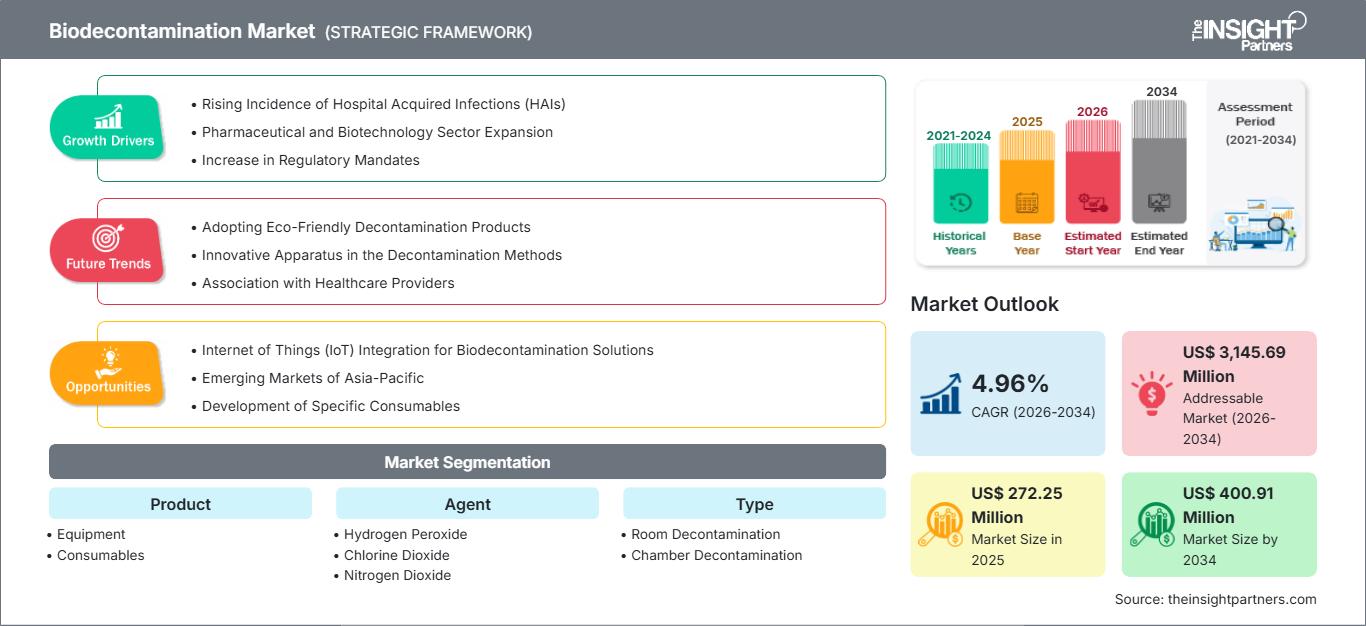
The biodecontamination market was valued at US$ 272.25 Million in 2025 and is expected to reach US$ 400.91 Million by 2034, registering a CAGR of 4.39% during 2026–2034. Growth is supported by tighter contamination-control requirements, expanding sterile manufacturing, infection-prevention programs, and rising use of automated room and chamber decontamination. Demand increasingly favors validated systems that deliver repeatable microbial reduction while limiting residue, equipment exposure, downtime, and dependence on manual disinfection.
Across North America, the biodecontamination market size is projected to expand at approximately ~4% CAGR through 2034. The region benefits from extensive hospital infrastructure, regulated pharmaceutical and biotechnology production, biosafety laboratories, and established infection-control practices. Facilities are investing in portable generators, permanently integrated systems, cycle-monitoring software, and qualified consumables to improve process reproducibility, reduce room turnaround times, and strengthen electronic documentation.
Biodecontamination market growth is influenced by the desire to reduce the level of viable microorganisms within controlled rooms, chambers, laboratories, production rooms, and healthcare facilities. The value chain includes processes of formulating agents, engineering equipment, distribution modeling, installation, development of the cycles, qualification, monitoring, maintenance, and requalification. Factors influencing the demand include the level of microorganisms to be reduced, geometry of the space, the material involved, and the turnaround of the rooms. Conditions for supply favor firms which can provide uniform distribution, reliable concentration control, broad material compatibility, and aerating. The facilities consider factors such as the cycle time, residues, safety of the operator, cost of consumables, portability, room sealing, servicing, and compatibility with electronics. Technical support is very important as it is possible that a change in load, room geometry, airflow, and surfaces will call for reconsideration of the cycle.
Competitors include infection prevention service providers, sterilization technology firms, and cleanroom technology suppliers. STERIS plc and Ecolab Inc. have an edge due to their wide connections in the healthcare and life science industries. Competitors such as Fedegari Autoclavi S.p.A., Howorth Air Technology Limited, JCE Biotechnology, and Zhejiang TAILIN Bioengineering Co., Ltd. differentiate themselves by offering integrated cleanrooms and chambers along with pharmaceutical processing. Competition for ClorDiSys Solutions, Inc., Noxilizer, Inc., TOMI Environmental Solutions, Inc., and Amira S.r.l. lies in offering specialized technologies in the field of agent delivery or environmental control. Future investments will focus on developing systems that will integrate themselves with remote diagnostics and automated reporting capabilities with low residue processes and cycles optimized for sensitive biologics or combination products.
Biodecontamination Market Assessment and Insights
Regional Outlook
- North America: ~38% of the global market in 2025 | ~4% CAGR through 2034. Market position: North America leads through developed healthcare infrastructure, regulated life-science manufacturing, mature infection-prevention programs, and broad availability of automated vapor, aerosol, and gas-based decontamination systems.
- US: ~87% of North American market revenue in 2025 | ~4% CAGR through 2034. Market position: The US anchors regional demand through large hospital networks, pharmaceutical facilities, biosafety laboratories, research institutions, and early adoption of validated automated environmental decontamination technologies.
- Europe: ~31% of the global market in 2025 | ~4% CAGR through 2034. Market position: Europe combines mature pharmaceutical production with structured contamination-control requirements. Germany leads within Europe, while the UK, France, Italy, and Spain support demand across healthcare and cleanroom applications.
- Asia Pacific: ~23% of the global market in 2025 | ~6% CAGR through 2034. Market position: Asia Pacific is the fastest-growing region as sterile manufacturing, hospital capacity, laboratory investment, and localized equipment production expand. China leads within Asia Pacific, followed by Japan, India, South Korea, and Australia.
Segment Outlook
- Product: ~36% Share in 2025 | ~4% CAGR through 2034. Market position: Product leads because installations require capital equipment, recurring chemical consumables, monitoring accessories, replacement components, validation materials, maintenance, and application-specific delivery configurations.
- Type: ~24% Share in 2025 | ~6% CAGR through 2034. Market position: Type has the highest growth outlook as hospitals and controlled manufacturing facilities expand automated room decontamination and validated chamber-based processing for sensitive equipment, materials, and transfer workflows.
Competitive Coverage
Amira S.r.l., ClorDiSys Solutions, Inc., Ecolab Inc., Fedegari Autoclavi S.p.A., Howorth Air Technology Limited, JCE Biotechnology, Noxilizer, Inc., STERIS plc, TOMI Environmental Solutions, Inc., Zhejiang TAILIN Bioengineering Co., Ltd.
Methodology
The Insight Partners follows Data Collection & Secondary Research, Primary Research, Data Analysis, and Data Triangulation & Final Review to validate market estimates and insights.
Source: The Insight Partners' analysis based on proprietary research, government publications, company annual reports, investor presentations, industry databases, and expert interviews.
Biodecontamination Market Trends
Connected Systems with Automated Cycle Verification
The biodecontamination market trends indicate increasing deployment of connected equipment that controls agent delivery, monitors environmental conditions, confirms exposure, and records aeration endpoints. Future systems will integrate with building management and manufacturing execution platforms to coordinate ventilation, room pressure, doors, alarms, and access. Remote diagnostics can identify sensor drift, dosing problems, or maintenance requirements before cycle failure. Electronic records should simplify review and requalification, but cybersecurity, access control, backup procedures, and data integrity will become more important. Adoption will be strongest in regulated facilities seeking repeatable multiroom operations and centralized process oversight.
Greater Use of Alternative Low-Temperature Agents
Hydrogen peroxide will remain important, but facilities will increasingly assess chlorine dioxide and nitrogen dioxide where process residues, material compatibility, penetration, or aeration affect application suitability. ClorDiSys positions ambient-temperature chlorine dioxide for complex devices and temperature-sensitive pharmaceutical materials, while Noxilizer applies low-pressure nitrogen dioxide to combination products and prefilled syringes. Future procurement will become more application-specific, with organizations selecting agents through validated compatibility and total-cycle economics rather than adopting one chemistry across every environment.
Biodecontamination Market Growth Factors
Stricter Contamination Control in Sterile Manufacturing
Pharmaceutical, biotechnology, and advanced therapy facilities must control contamination across cleanrooms, isolators, transfer hatches, and production equipment. Manual disinfection may leave variability related to operator technique, access, contact time, and surface coverage. Automated biodecontamination delivers a monitored agent concentration across a defined space and creates electronic cycle records. Its market impact extends from new facility installations to requalification, shutdown recovery, and corrective action after microbial excursions. Demand is strongest where product value and contamination consequences justify validated automated control. Manufacturers that integrate equipment with ventilation, doors, pressure systems, and production software can address facility-wide contamination strategies rather than isolated decontamination events.
Hospital Focus on High-Risk Environmental Contamination
Healthcare facilities use automated environmental decontamination to supplement physical cleaning in isolation rooms, operating areas, pharmacies, and spaces associated with difficult pathogens or outbreaks. The technology can reach exposed surfaces that may be missed during manual application, although pre-cleaning remains necessary because organic soil can reduce effectiveness. Commercial impact depends on room turnaround, portability, staffing, and evidence that the system fits established infection-prevention protocols. Hospitals favor equipment with simple setup, verifiable cycle completion, rapid aeration, and safe re-entry. Service-based deployment can lower initial investment for facilities requiring intermittent rather than daily use.
Growth of Biologics and Advanced Therapy Facilities
Biologics, cell therapies, gene therapies, and vaccines require tightly controlled manufacturing environments because contamination can compromise high-value batches and patient safety. New facilities often incorporate automated biodecontamination during design rather than adding it after commissioning. Integrated systems can decontaminate cleanrooms, isolators, material airlocks, incubators, and process equipment through standardized recipes. The market benefits from recurring consumables, qualification, maintenance, and periodic revalidation. Cell and gene therapy suites represent a particularly demanding application because production may involve open manipulations, small batches, and rapid changeover. Vendors must provide material-compatibility evidence and cycles that protect sensitive laboratory instruments.
Biodecontamination Market Opportunities
Integrated Decontamination for Advanced Therapy Manufacturing
Cell and gene therapy manufacturers offer an opportunity for vendors to provide compact, automated systems supporting isolators, cleanrooms, incubators, and material-transfer workflows. Suppliers should invest in facility-design partnerships, recipe development, rapid aeration, electronic batch records, and material-compatibility databases. Modular installations are particularly relevant for facilities that add production suites incrementally. Commercial models can combine equipment with qualified agents, biological indicators, validation, maintenance, and remote support. Early collaboration with engineering firms and equipment manufacturers can embed decontamination capability before commissioning and reduce later integration costs.
Managed Decontamination Services for Hospitals
The biodecontamination market Forecasts support service-based opportunities for hospitals that need outbreak response or periodic treatment but cannot justify purchasing and maintaining dedicated equipment. Providers can offer site assessment, sealing, agent delivery, cycle monitoring, aeration, documentation, and post-treatment verification under a single contract. Regional service networks can improve response times and equipment utilization across multiple facilities. Investment priorities include mobile fleets, trained technicians, standardized protocols, digital scheduling, and documentation compatible with hospital infection-control systems. Recurring agreements may generate steadier revenue than emergency deployment alone.
Segmentation Analysis
Product
The biodecontamination market scope by Product encompasses delivery equipment and recurring materials required to generate, distribute, monitor, and verify a validated process. Buyer priorities include system capacity, portability, cycle automation, agent consumption, serviceability, documentation, and compatibility with target spaces. Consumables are projected to expand at approximately ~5% CAGR during 2026–2034 because each cycle requires qualified agents, indicators, filters, cartridges, or monitoring materials.
- Equipment: Mobile generators, integrated delivery systems, chambers, vaporizers, sensors, dosing controls, aeration modules, and software establish the operational platform. Capital purchases depend on room volume, deployment frequency, automation, validation requirements, and service availability.
- Consumables: Chemical agents, cartridges, biological indicators, chemical indicators, filters, neutralizers, and sampling materials create recurring demand. Their consistency influences concentration delivery, process verification, safety, residue management, and compliance documentation.
Agent
Agent selection in the biodecontamination market depends on microbial target, room or chamber configuration, material sensitivity, residue tolerance, cycle duration, aeration requirements, and occupational controls. Hydrogen Peroxide is projected to grow at approximately ~4% CAGR through 2034 because it supports broad-spectrum decontamination and decomposes into water and oxygen when correctly applied. Alternative gases remain strategically relevant for temperature-sensitive and difficult-to-penetrate applications.
- Hydrogen Peroxide: Vaporized or ionized hydrogen peroxide is used across cleanrooms, isolators, chambers, laboratories, and healthcare spaces. Its adoption reflects broad antimicrobial activity, established validation approaches, and availability of mobile and integrated delivery systems.
- Chlorine Dioxide: Chlorine dioxide gas offers distribution through complex spaces and can support ambient-temperature treatment of sensitive devices and pharmaceutical materials. Deployment requires controlled generation, concentration monitoring, sealing, and effective clearance before re-entry.
- Nitrogen Dioxide: Nitrogen dioxide enables low-temperature, low-pressure treatment for selected medical devices and combination products. Its strategic value lies in short cycles, limited need for off-gassing, and compatibility with certain moisture- or heat-sensitive products.
Type
Type determines system scale, distribution strategy, validation complexity, turnaround time, load configuration, and facility integration. Room processes address large environmental spaces, while chambers provide controlled treatment of defined materials and equipment. Chamber Decontamination is projected to register approximately ~6% CAGR through 2034 as pharmaceutical facilities adopt pass-through systems and controlled processing for heat-sensitive items entering classified areas.
- Room Decontamination: Room-scale treatment addresses patient areas, laboratories, cleanrooms, production suites, and animal facilities. Performance depends on enclosure integrity, airflow management, distribution studies, environmental conditions, cycle monitoring, and aeration.
- Chamber Decontamination: Chambers provide a controlled volume for treating equipment, components, and materials. Their repeatable geometry supports shorter qualification, standardized loading, integrated monitoring, and transfer into clean or sterile environments.
End User
End User adoption in the biodecontamination market reflects infection risk, facility scale, room turnover, regulatory oversight, and available environmental-services staffing. Hospital & Healthcare facilities are projected to expand at approximately ~5% CAGR through 2034 as providers strengthen outbreak preparedness and environmental controls in operating rooms, isolation areas, pharmacies, and other high-risk spaces. Procurement increasingly considers workflow disruption, training, service responsiveness, and total cycle economics.
- Hospital & Healthcare facilities: Hospitals use automated biodecontamination as an adjunct to manual cleaning in selected high-risk spaces. Demand is influenced by infection-prevention policy, outbreak response, bed availability, room turnaround, facility design, and evidence supporting environmental microbial reduction.
Opportunity Snapshot
| End User | Revenue Contribution | Trend Tag | Adoption Stage |
| Hospital & Healthcare facilities | High | Terminal Decontamination | Scaling |
Regional Insights
North America biodecontamination market
North America contributed around ~38% of the total global revenue in 2025 and is estimated to grow at ~4% CAGR during 2025-2034. North America's share in the biodecontamination market comes from its robust healthcare infrastructure, pharmaceutical and biotech manufacturing, biosafety labs, animal research labs, and existing infection prevention requirements. Requirements range from regular cleanroom management, facility shutdowns, outbreaks, commissioning, and post-maintenance biodecontamination services.
Canada offers regulated facilities in the healthcare and life science industry, and the US offers the major regional installed base. Buyers are looking at total cycle time, room availability, residues, process documentation, and fast service response times. Mobile systems cater to flexibility, while integrated systems are used for repetitive cycles. Companies providing services such as site surveys, distribution studies, qualification, biological indicators, operator training, and preventive maintenance may benefit from long-term business opportunities.
U.S. biodecontamination market
The US represented approximately ~87% of North American revenue in 2025 and is expected to expand at ~4% CAGR through 2034. Its regional leadership is supported by large hospital systems, regulated pharmaceutical production, biomedical research, biosafety facilities, and established procurement for infection-control equipment and services.
US facilities that matter for the purpose include Ecolab Inc., ClorDiSys Solutions, Inc., Noxilizer, Inc., STERIS plc, and TOMI Environmental Solutions, Inc. The demand from the healthcare industry is related to patient rooms, operating rooms, isolation units, pharmacies, and other highly critical clinical areas. On the other hand, life science industry customers care about cleanrooms, isolators, pass-through chambers, and manufacturing equipment. Validation is more elaborate in production than in emergency healthcare use and results in different business models for the vendors.
Europe biodecontamination market
Europe was responsible for ~31% of global revenue in 2025 and is estimated to register ~4% CAGR during 2034. This region has the advantage of being mature in terms of pharmaceutical manufacturing, medical device manufacturing, research labs, and formal contamination control techniques. Germany is the top nation in Europe because of its life science industry, hospital sector, engineering capabilities, and investments in validated cleanroom systems.
The UK offers research in pharmaceuticals, advanced therapy manufacture, high containment labs, and hospital infection control demands. France encourages adoption due to biologics facilities and public health care organizations. Italy offers pharmaceutical equipment manufacturing and sterile manufacturing experience, while Spain adds to demand from hospitals, biotechnology facilities, and contract manufacturers.
Fedegari Autoclavi S.p.A., Howorth Air Technology Limited, JCE Biotechnology, and Amira S.r.l. add to the supplier capability in Europe. Buyers are looking for systems that can interface with building management, ventilation, isolator, and manufacturing control system. Hydrogen peroxide continues to dominate, while chlorine dioxide and other agents are used in situations where different penetration, materials, and residues are required. Growth depends on replacement demand, cleanroom purchases, advanced therapies and the demonstration that automated cycles offer more reproducibility than manual cycles.
APAC biodecontamination market
Asia Pacific accounted for approximately ~23% of global revenue in 2025 and is projected to register the fastest regional CAGR of ~6% through 2034. China is the leading country in Asia Pacific, supported by pharmaceutical manufacturing, hospital construction, laboratory expansion, and domestic equipment suppliers such as Zhejiang TAILIN Bioengineering Co., Ltd.
Japan brings experience in pharmaceutical quality systems, and South Korea is developing capabilities in biologic/biosimilar products. India provides demand with vaccines, sterile drug products, hospitals, and contract manufacturing. Australia provides high containment labs and healthcare applications. Adoption of the technology will be dependent upon training, servicing, validation, and supply of qualified reagents and monitoring materials.
Middle East & Africa biodecontamination market
The Middle East & Africa biodecontamination market share is projected to grow at approximately ~4% CAGR through 2034. Saudi Arabia is the leading country in the Middle East & Africa, supported by hospital investment, pharmaceutical localization, and laboratory infrastructure. The UAE contributes premium healthcare facilities, research programs, and pharmaceutical free-zone development.
South Africa is best placed for life science and hospitals in Sub-Saharan Africa, but RoMEA will be limited by the capital budget, technical manpower, and maintenance. Energy supply, room ventilation, room sealing, chemical storage, and skilled personnel are critical requirements. Portability of devices and outsourcing services could become important where the infrastructure does not justify a fixed installation.
Biodecontamination Market Report Scope
| Report Attribute | Details |
|---|---|
| Market size in 2025 | US$ 272.25 Million |
| Market Size by 2034 | US$ 400.91 Million |
| Global CAGR (2026 - 2034) | 4.39% |
| Historical Data | 2021-2024 |
| Forecast period | 2026-2034 |
| Segments Covered | Product, Agent, Type, End User |
| Region scope | North America, Europe, Asia-Pacific, South and Central America, Middle East and Africa |
Recent Developments
- September 2025: Noxilizer, Inc. announced US$ 30 million in growth capital to expand commercial-scale nitrogen dioxide terminal sterilization capacity. The company stated that the financing would support broader global adoption of its low-temperature platform for biopharmaceutical and medical-device products, following regulatory progress that included authorization involving a prefilled syringe application.
- December 2025: TOMI Environmental Solutions, Inc. reported the 2025 launch of its SteraMist Integrated System - Standalone, expanding customer options for automated decontamination. The company also highlighted growing demand for custom engineered and integrated systems across life-science facilities, including cell and gene therapy environments, and deeper engagement with original equipment manufacturers.
- November 2025: ClorDiSys Solutions, Inc. expanded the commercial positioning of its Pure CD chlorine dioxide technology for difficult medical devices and pharmaceutical applications requiring ambient-temperature processing, material compatibility, and limited residual concerns. The platform supports contract sterilization and validated applications involving electronics, APIs, combination products, and temperature-sensitive materials.
Frequently Asked Questions

Recent Reports






