
Bioactive Glass Market Growth, Trends & Forecast by 2034
Coverage: By Type (Silicate Glass (45S5), Glass Ceramics (S53P4), Others); Application (Cosmetic, Healthcare, Others) , and Geography (North America, Europe, Asia Pacific, and South and Central America)
- Status : Data Released
- Report Code : TIPRE00025657
- Category : Chemicals and Materials
- No. of Pages : 150
- Available Report Formats :


- Last update date : August 27, 2026


2025 Market Size
US$ 1.35 Bn
Base year value
2034 Forecast
US$ 2.22 Bn
Projected by 2034
CAGR 2026-2034
6.41 %
Growth rate
Addressable Market
US$ 16.79 Bn
(2026-2034)
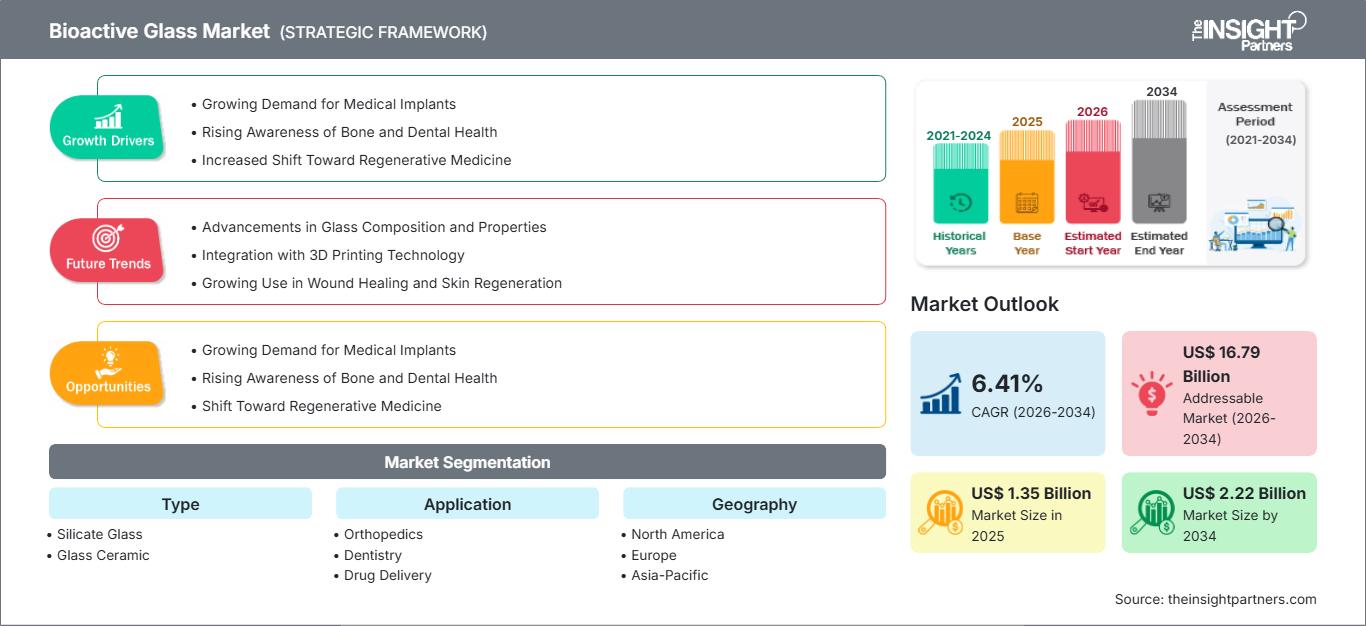
The Bioactive Glass Market was valued at US$ 1.35 Billion in 2025 and is projected to reach US$ 2.22 Billion by 2034, registering a CAGR of 6.41% during 2026–2034. The growth of market shares has been made possible due to an increasing incorporation of bioactive substances in bone regeneration, dentistry applications, wound treatment, and modern biomedical systems. Composition design, ion delivery mechanisms, porosity, and manufacturing processes are making applications of such materials applicable beyond traditional bone grafting materials.
North America will remain a key market segment for its strong orthopedic and dental devices industry, application of artificial bone grafts, and further investments in the regenerative medicine space. The Bioactive Glass Market Size is driven by rising preference for minimally invasive surgeries, growing need for reconstruction using biomaterials, and development of new formulations.
Bioactive Glass Market Assessment and Insights
- North America: North America is expected to account for a 34–38% share in 2025 and grow at a CAGR of 6.6–7.2% during 2026–2034, supported by orthopedic reconstruction, dental applications, and established medical-device manufacturing capabilities.
- U.S.: The U.S. represents approximately 78–82% of North American demand in 2025 and is expected to grow at a CAGR of 6.7–7.3%, driven by synthetic bone graft adoption and advanced surgical products.
- Europe: Europe is estimated to hold a 25–29% share in 2025 and grow at a CAGR of 6.1–6.8%, with Germany, France, Italy, and the UK supporting clinical adoption through established biomaterials and medical-device industries.
- Asia Pacific: Asia Pacific is projected to represent a 24–28% share in 2025 and expand at a CAGR of 7.0–7.7%, led by China, Japan, South Korea, and India as healthcare infrastructure and advanced biomaterial manufacturing develop.
- Largest Segment: Silicate Glass is estimated to hold a 68–72% market share in 2025 and expand at a CAGR of 6.2–6.8%, supported by established clinical use and material familiarity.
- High Growth Segment: Drug Delivery is estimated to represent an 8–12% market share in 2025 and grow at a CAGR of 8.0–9.0%, reflecting interest in controlled therapeutic-ion and drug release.
- Key companies analyzed in detail: Johnson & Johnson MedTech, Ferro Corporation, Mo-Sci Corporation, NORAKER, Merck KGaA, MatTek Corporation, SCHOTT AG, Synergy Biomedical, LLC, Stryker Corporation, Bonalive Biomaterials Ltd.
Source: The Insight Partners' analysis based on proprietary research, government publications, company annual reports, investor presentations, industry databases, and expert interviews.
The Bioactive Glass is moving towards the development of engineered material from the traditional particulate bone grafting material. In terms of the sol-gel process, mesoporous material, additive manufacturing, and composition modification, control over the degradation rate, crystallization, mechanical properties, and therapeutic ion release is becoming possible. The latest research has shown significant differences between 45S5, S53P4, and 13-93 compositions in terms of network connectivity, viscosity, crystallization tendency, and aqueous reactivity.
Future growth will be increasingly determined by clinical studies, reproducibility in the manufacturing process, regulatory clearance, and scale up of application-oriented compositions. The opportunities for the future are mainly in minimally invasive orthopedic surgery, dental regenerations, antibacterial application, and therapeutic systems. Regulatory requirements for the Class III medical device, the need for clinical studies, and hospital purchase policy will affect the pace of commercialization, whereas the Asia Pacific region will see investments.
Bioactive Glass Market Report Scope
| Report Attribute | Details |
|---|---|
| Market size in 2025 | US$ 1.35 Billion |
| Market Size by 2034 | US$ 2.22 Billion |
| Global CAGR (2026 - 2034) | 6.41% |
| Historical Data | 2021-2024 |
| Forecast period | 2026-2034 |
Bioactive Glass Market Analysis
Bioactive Glass Market growth is highly dependent on the need for synthetic bone substitute materials for promoting tissue regeneration in cases where autografts and allografts are not the sole options. The supply chain starts with silica, calcium, sodium, phosphorous, boron, and other specific components of bioactive glass compositions. After that comes the process of melting or sol-gel manufacturing, as well as particle formation, shaping, sterilization, and incorporation in medical devices. Products differentiation is carried out via particle size and geometry, porosity, surface properties, degradation rates, and handling capabilities.
The supply chain varies according to composition and application of the product. Standard silicate composition materials can be produced using well-known production technologies, whereas borate, mesoporous, and ion-doped glass need more controlled process parameters. Bioactive glass suppliers like Mo-Sci Corporation deliver powder and granule form materials, as well as specialized compositions. Downstream suppliers use this material to manufacture bioactive glass bone grafts, scaffolds, coating materials, and composites.
Competitive positioning is defined by proprietary formulations, clinical studies, regulatory approvals, delivery vehicles, and manufacturing capabilities. According to the Bioactive Glass Market Report, the industry is comprised of large players in the medical devices segment together with specialist biomaterial producers. Stryker Corporation uses the bioactive glass in synthetic bone grafting, and Synergy Biomedical, LLC specializes in manufactured spherical 45S5 particles and delivery vehicles. NORAKER's core products include synthetic and resorbable bone regeneration devices and differentiation through product design.
Development is increasingly geared towards minimally invasive delivery, porous designs, injection systems, and innovative scaffold designs. Bonalive Biomaterials Ltd. provides S53P4-containing products for orthopedic and bone infection purposes, while Mo-Sci Corporation has developed the wide-ranging specialty glass development platform. Johnson & Johnson MedTech and Stryker Corporation will capitalize on their distribution channels in the surgical segment, while specialist firms can differentiate themselves through niche clinical indication, innovative biomaterials, and rapid development cycle.
● REPORT CUSTOMIZATION
Tailor This Report To Align With Your Specific Business Requirements
This report can be customized to align precisely with your business objectives, scope, and target markets. Customization options include tailored segmentation, geography, competitive analysis, and strategic insights to support informed decision-making.
Customize This Report →WHAT YOU CAN ADJUST
- ● Segmentations
- ● Geography
- ● Competitive Analysis
- ● Language Preferences
Bioactive Glass Market: Strategic Insights
Regional Insights
North America Bioactive Glass Market
North America is estimated to have a 34–38% of Bioactive Glass Market share in 2025, with a 6.6–7.2% CAGR through 2034. The U.S. dominates regional demand because orthopedic surgery, dental reconstruction, trauma care, and synthetic bone graft procurement are supported by sophisticated clinical infrastructure. Canada contributes through specialized dental and regenerative-medicine applications.
Hospitals, ambulatory surgery centers, dentistry clinics, and manufacturers of medical devices constitute the main ecosystem of demand. There is a presence of well-established clinical research facilities and regulatory routes for the development of biomaterials in the region. There is a change in the demand pattern to include injectable putty, granulated materials, and composite scaffolds. Stryker Corporation and Johnson & Johnson MedTech enhance regional commercialization through their surgical portfolios, while Synergy Biomedical, LLC and niche developers compete through biomaterial platforms.
U.S. Bioactive Glass Market
U.S. makes up 78-82% of North American market in 2025 and is projected to experience CAGR of 6.7-7.3% to 2034. Applications include orthopedic bone grafting, spinal fusion, dental and trauma reconstruction, while R&D focuses on controlled ion release and multifunctional scaffolds.
There is a well-established regulatory, clinical and distribution framework for domestic companies. Stryker Corporation applies bioactive glass in synthetic bone graft systems, Synergy Biomedical, LLC produces 45S5-based spherical particles and putties. Usage of products depends on handling needs of surgeons, clinical effectiveness, reimbursement policies and compatibility with minimally invasive techniques. Future demand will expand with development of more application specific products with controlled resorption and enhanced biological performance.
Europe Bioactive Glass Market
The Europe region commands a 25–29% share and is expected to expand with a CAGR of 6.1–6.8%. Germany is a key market for the industry due to the presence of sophisticated technologies for manufacturing of medical devices, scientific research centers, and biomaterial engineering. The UK, France, Italy, and Spain are driving demand through orthopedic, dental, and regenerative applications.
The UK sustains demand owing to its sophisticated clinical research and dental applications, whereas Germany integrates industrial materials technology with sophisticated medical devices manufacturing technology. France enjoys a specialist base owing to the presence of companies such as NORAKER that focus on synthetic bone and tissue regeneration. Italy and Spain have been driving demand for regenerative medicines in orthopedic and dental applications.
APAC Bioactive Glass Market
APAC is forecasted to have a share of 24-28% of the world’s demand in 2025 and is forecasted to grow at a CAGR of 7.0-7.7%. The market leaders include China, Japan, South Korea, India, and Australia. The growth drivers include increasing medical infrastructure, local medical devices production, and research in biomaterials.
China is supported by its manufacturing base and increasing orthopedics demand; Japan relies on its advanced technologies in biomaterials and medicine; South Korea develops its regenerative medicine technologies; India expands its orthopedic and dental infrastructure. Australia makes its contribution to the market development through research-oriented healthcare applications. Policy support for domestic medical devices production and advanced healthcare technologies is expected to develop regional supply capacities.
Middle East & Africa Bioactive Glass Market
The Middle East and Africa demand is lower but is anticipated to grow at a CAGR of 5.4 to 6.1% through 2034. Saudi Arabia will be the frontrunner in the adoption of biomaterials, followed by the UAE and South Africa. Modern hospitals, medical tourism, orthopedic surgeries, and dental practices drive procurement decisions.
Saudi Arabia and the UAE have been developing advanced healthcare facilities to facilitate demand for biomaterials. South Africa offers a niche market for orthopedic and dental applications, and the rest of MEA is dependent on healthcare infrastructure development. The energy economy in the Gulf countries provides the financial capability to develop medical infrastructure, even if regulatory approval and procurement fragmentation are critical market factors..
Segmentation Analysis
Type
Type comprises Silicate Glass and Glass Ceramic. Silicate Glass remains the leading category, with an estimated 6.2–6.8% CAGR from 2026–2034, supported by established compositions and broad clinical familiarity. Glass Ceramic provides opportunities where mechanical stability, controlled crystallinity, and application-specific structural characteristics are important. The Bioactive Glass Market scope, therefore, spans established silicate materials and engineered ceramic structures with different performance characteristics.
- Silicate Glass: Silicate Glass maintains the dominant market position because established compositions such as 45S5 and S53P4 support orthopedic, dental, and regenerative applications. Manufacturers continue optimizing particle size, porosity, degradation, and ion-release behavior.
- Glass Ceramic: Glass Ceramic serves applications requiring greater structural stability and controlled crystalline phases. Its strategic importance increases where mechanical performance must be balanced with bioactivity, particularly in engineered scaffolds and specialized implant-related systems.
Application
The application comprises Orthopedics, Dentistry, Drug Delivery, and Cosmeceutical Products. The segment is expected to expand at a CAGR of 6.8–7.4% through 2034. Orthopedics remains the principal application, while drug delivery represents a faster-developing niche because composition and porosity can support localized therapeutic release.
- Orthopedics: Orthopedics remains the largest application because bioactive glass can support bone regeneration and is available in granules, putties, and composite graft configurations for defect filling and reconstruction.
- Dentistry: Dentistry benefits from bioactive materials that interact with mineralized tissues. Applications include periodontal defects, implant-related materials, remineralization systems, and restorative formulations requiring localized mineral formation.
- Drug Delivery: Drug Delivery is strategically important for controlled local release, where porous or ion-modified glass structures can serve as carriers for therapeutic agents while supporting tissue regeneration.
- Cosmeceutical Products: Cosmeceutical Products represent an emerging application area where mineral-rich and ion-releasing materials can be incorporated into formulations targeting skin-care and regenerative cosmetic concepts.
Opportunity Snapshot
| Application | Revenue Contribution | Trend Tag | Adoption Stage |
|---|---|---|---|
| Orthopedics | High | Bone Regeneration | Mature |
| Dentistry | Medium | Dental Repair | Scaling |
| Drug Delivery | Medium | Controlled Release | Emerging |
| Cosmeceutical Products | Low | Mineral Bioactivity | Emerging |
Bioactive Glass Market Growth Drivers and Impact Analysis
Increasing Use of Synthetic Bone Graft Substitutes
There is rising demand for bone graft substitute materials with the capacity to minimize reliance on autografting and provide predictable defect treatment. Bone grafting using bioactive glass provides reaction at the surface level to enable the development of calcium phosphate layers as well as bone-tissue interaction. Commercial products show the capability to offer delivery of materials using granules, putty, and minimally invasive techniques. Clinical importance is especially significant in orthopedic trauma, spine surgery, craniofacial repair and bone cavity procedures. Rising incidences of these procedures increase the size of the addressable market for engineering of compositions. Companies that develop materials combining bioactivity and cohesion along with controlled resorption will be able to cater better to the needs of surgeons.
Growing Demand for Minimally Invasive Regenerative Procedures
The drive toward minimally invasive surgeries creates a need for biomaterials which are deliverable through smaller openings while retaining accuracy of placement and structural stability. Putties and injectable bioactive glasses are relevant to such a trend since their physical properties can be tailored to allow for such an application. The business implication of such a development goes beyond the materials themselves but also involves development of devices of delivery, packaging, sterilization, and designing products for specific procedures. Nowadays, there is a trend of differentiation by means of deliverability rather than composition. Such a development may add to the value of material being sold since customized formulas and delivery systems are more difficult to produce. Such a development promotes cooperation between biomaterial producers and medical device designers.
Expansion of Dental and Regenerative Medicine Applications
Dental regeneration offers another valuable area for demand since bioactive substances have the ability to interact directly with mineralized tissues and facilitate local mineral deposition. Bioactive glass-based products are currently under investigation for use in periodontal defects, dental restorations, implant-related procedures, and remineralization treatments. Meanwhile, regenerative medicine is driving interest in ion-releasing products that can affect cellular response, angiogenesis, antimicrobial activity, and tissue formation. This increases the applicability of the technology outside the realm of bone grafting. The most significant commercial opportunity exists where there is clinical proof of the added value of a certain procedure along with the ability to comply with relevant regulatory standards. Manufacturers have an incentive to create formulations that have predictable ion release behavior, desirable particle properties, and are compatible with current dental or surgical practice.
Bioactive Glass Market Future Trends
Shift Toward Ion-Engineered and Multifunctional Compositions
Bioactive Glass Market trends are moving toward compositions engineered to release specific therapeutic ions rather than relying solely on conventional silica-calcium-phosphorus systems. Researchers are investigating borate, mesoporous, and doped structures that can provide more controllable degradation and biological responses. Ion selection may be tailored toward antimicrobial, angiogenic, osteogenic, or anti-inflammatory effects, creating materials designed around defined clinical objectives. The trend will encourage closer integration between materials science and clinical development because composition changes can alter dissolution, mechanical stability, and biological performance simultaneously. Manufacturers that establish reproducible relationships between composition, processing, ion release, and clinical outcomes can create differentiated platforms. Over time, multifunctional formulations could support combination products in which regeneration and localized therapeutic delivery occur within a single material system.
Integration of Advanced Manufacturing and Personalized Scaffolds
Advanced manufacturing is expected to influence future biomaterial design by enabling complex architectures that are difficult to produce through conventional particle processing. Three-dimensional printing, controlled porosity, nanoscale structuring, and computer-assisted design can create scaffolds with application-specific geometry and interconnected channels. These architectures may improve vascularization, nutrient transport, and tissue integration while allowing composition to vary across a structure. The commercial challenge is achieving consistent production, sterilization, mechanical performance, and regulatory reproducibility at scale. Consequently, future investment is likely to favor manufacturing platforms that connect digital design with validated biomaterial processing. Personalized scaffolds could initially target complex orthopedic and craniofacial defects where conventional graft geometries provide limited conformity. Successful commercialization will depend on balancing customization with manufacturing economics and regulatory control.
Bioactive Glass Market Opportunities
Development of Application-Specific Injectable Biomaterials
The development of application-specific injectable materials offers an investment opportunity because hospitals increasingly require products that simplify placement while retaining biological performance. Companies can differentiate formulations according to defect size, anatomical location, resorption profile, particle geometry, and handling characteristics. Injectable putties may be particularly attractive for minimally invasive orthopedic, spine, craniofacial, and dental procedures. Product developers can strengthen commercialization by integrating preclinical testing, clinical evidence, sterilization validation, and delivery-device compatibility into a single development pathway. This approach can create higher-value products than selling raw glass powders alone. Strategic partnerships with medical-device manufacturers, surgical centers, and research institutions can accelerate clinical validation. The opportunity is strongest for suppliers capable of maintaining composition consistency while adapting physical characteristics to procedure-specific requirements.
Expansion of Controlled Therapeutic Delivery Platforms
Bioactive Glass Market Forecasts indicate a potential shift toward higher-value therapeutic platforms as researchers combine regenerative properties with localized drug or ion delivery. Mesoporous structures can provide high surface area and tunable pore characteristics, creating opportunities for controlled release of antibiotics, growth factors, or other therapeutic agents. Commercial development requires careful evaluation of release kinetics, toxicity, degradation, sterilization, and interactions between the glass matrix and active compounds. Investors and manufacturers can prioritize indications where localized delivery provides a clear advantage over systemic treatment. Partnerships between biomaterial developers and pharmaceutical or medical-device companies can distribute development risk and improve access to regulatory expertise. This opportunity could eventually expand the addressable market from structural regeneration toward integrated therapeutic systems.
Recent Developments
- August 2026: Isto Biologics acquired NovaBone Products LLC from Halma plc to strengthen its bone-graft-substitute platform. The transaction adds NovaBone's portfolio of synthetic bone-graft products based on proprietary bioactive glass technology to Isto's orthobiologics business. NovaBone's portfolio expands Isto's range of regenerative products and strengthens its positioning in synthetic bone grafting and bone-healing applications.
- February 2026: OSSIO Inc. was highlighted for developing bio-integrative orthopedic implants intended to replace permanent metal hardware in selected bone-repair procedures. Its OSSIOfiber technology uses a bio-integrative material designed to support bone healing while avoiding the need for permanent metal implants. The company was expanding applications across sports injuries, bunion correction, and hand procedures, with products initially focused on the U.S. market.
Frequently Asked Questions

- Comprehensive Market Sizing and Forecast Analysis
- Detailed Segmentation Analysis
- In-Depth Market Dynamics Assessment
- Regional and Country-Level Insights
- Competitive Landscape and Company Benchmarking
- Strategic Business Intelligence
Recent Reports
Testimonials

The Insight Partners' SCADA System Market report is comprehensive, with valuable insights on current trends and future forecasts. The team was highly professional, responsive, and supportive throughout. We are very satisfied and highly recommend their services.
RAN KEDEM Partner, Reali Technologies LTDs
I requested a report on a very specific software market and the team produced the report in a few days. The information was very relevant and well presented. I then requested some changes and additions to the report. The team was again very responsive and I got the final report in less than a week.
JEAN-HERVE JENN Chairman, Future Analytica
We worked with The Insight Partners for an important market study and forecast. They gave us clear insights into opportunities and risks, which helped shape our plans. Their research was easy to use and based on solid data. It helped us make smart, confident decisions. We highly recommend them.
PIYUSH NAGPAL Sr. Vice President, High Beam Global
The Insight Partners delivered insightful, well-structured market research with strong domain expertise. Their team was professional and responsive throughout. The user-friendly website made accessing industry reports seamless. We highly recommend them for reliable, high-quality research services
YUKIHIKO ADACHI CEO, Deep Blue, LLC.
This is the first time I have purchased a market report from The Insight Partners.While I was unsure at first, I visited their web site and felt more comfortable to take the risk and purchase a market report.I am completely satisfied with the quality of the report and customer service. I had several questions and comments with the initial report, but after a couple of dialogs over email with their analyst I believe I have a report that I can use as input to our strategic planning process.Thank you so much for taking the extra time and making this a positive experience.I will definitely recommend your service to others and you will be my first call when we need further market data.
JOHN SUZUKI President and Chief Executive Officer, Board Director, BK Technologies
I wish to appreciate your support and the professionalism you displayed in the course of attending to my request for information regarding to infectious disease IVD market in Nigeria. I appreciate your patience, your guidance, and the fact that you were willing to offer a discount, which eventually made it possible for us to close a deal. I look forward to engaging The Insight Partners in the future, all thanks to the impression you have created in me as a result of this first encounter.
DR CHIJIOKE ONYIA MANAGING DIRECTOR, PineCrest Healthcare Ltd.Reason to Buy
- Informed Decision-Making
- Understanding Market Dynamics
- Competitive Analysis
- Identifying Emerging Markets
- Customer Insights
- Market Forecasts
- Risk Mitigation
- Boosting Operational Efficiency
- Strategic Planning
- Investment Justification
- Tracking Industry Innovations
- Aligning with Regulatory Trends





 Get Free Sample for