
Biometric Access Control Systems Market Growth, Demand & Size by 2034
Coverage: by Technology (Voice Recognition, Fingerprint Recognition, Iris Recognition, Palm Geometry Recognition, Face Recognition, Others); End-user (BFSI, Government and Defense, Healthcare, Educational Institutes, Industrial, Others) , and Geography (North America, Europe, Asia Pacific, and South and Central America)
- Status : Data Released
- Report Code : TIPRE00006552
- Category : Electronics and Semiconductor
- No. of Pages : 150
- Available Report Formats :


- Last update date : July 20, 2026


2025 Market Size
US$ 24.73 Bn
Base year value
2034 Forecast
US$ 60.09 Bn
Projected by 2034
CAGR 2026-2034
11.74 %
Growth rate
Addressable Market
US$ 403.83 Bn
(2026-2034)
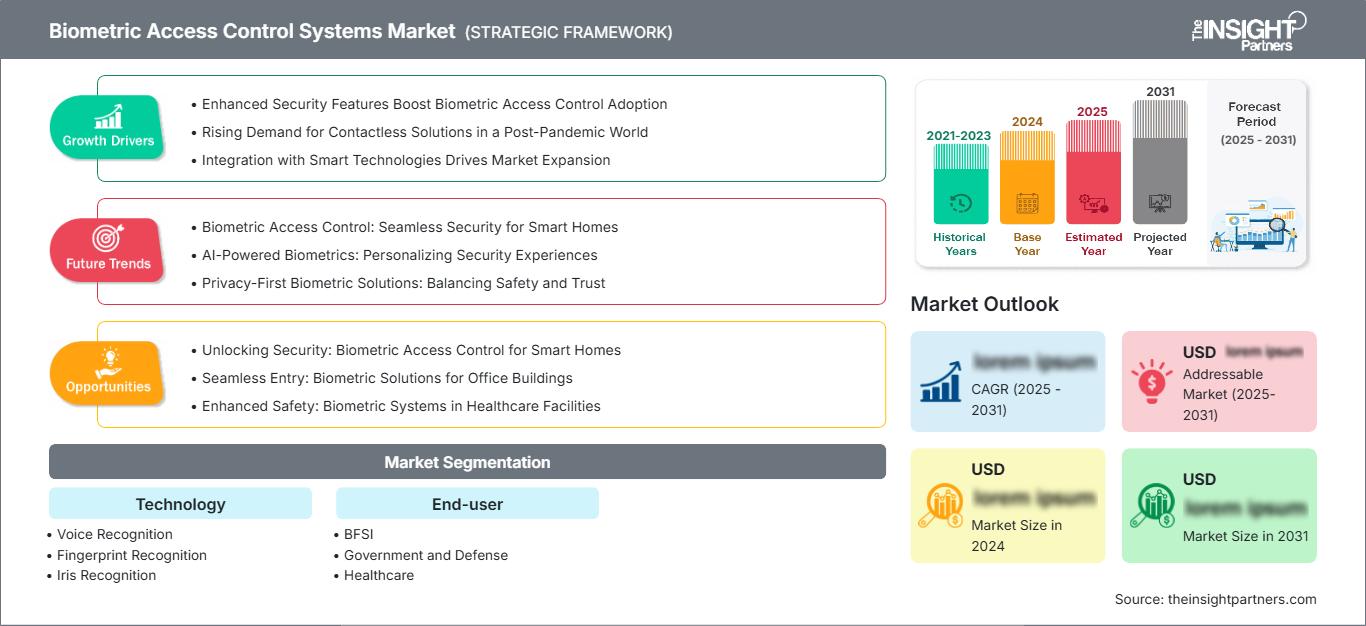
The Biometric Access Control Systems Market was valued at US$ 24.73 Billion in 2025 and is expected to reach US$ 60.09 Billion by 2034, registering a CAGR of 11.74% from 2026 to 2034. The market is moving beyond standalone fingerprint readers toward multimodal authentication platforms that combine face, iris, palm, voice, credential, and software-based identity orchestration for higher assurance physical and logical access control.
North America remains a high-value adoption cluster as enterprises, airports, government agencies, and healthcare networks modernize legacy card-based access systems. The Biometric Access Control Systems Market size in the region is supported by identity-first security architecture, zero-trust facility policies, and stronger demand for contactless entry. The region is estimated to grow at a CAGR range of 10.8–11.6% during 2026–2034, led by cloud-connected readers and AI-enabled facial authentication.
Biometric Access Control Systems Market Assessment and Insights
- North America held 34–36% share in 2025, growing at a CAGR range of 10.8–11.6% during 2026–2034, supported by federal identity programs, enterprise zero-trust migration, and airport modernization.
- US accounted for 78–82% of North America in 2025 and is projected to grow at a CAGR range of 10.6–11.4% through 2034.
- Europe represented 24–26% share in 2025, expanding at a CAGR range of 9.8–10.6%, led by the UK, Germany, and France as privacy-aligned deployments increase.
- Asia Pacific captured 27–29% share in 2025 and is projected to grow at a CAGR range of 12.8–13.6%, led by China, India, Japan, and South Korea.
- Largest Segment Fingerprint Recognition held 40–44% market share in 2025, growing at a CAGR range of 9.6–10.4% due to established cost advantages.
- High Growth Segment Face Recognition held 18–22% market share in 2025, growing at a CAGR range of 14.2–15.0% as contactless authentication scales.
- Key companies analyzed in detail: 3M Cogent, Inc.; Anviz Global Inc.; Fujitsu Limited; HID Global Corporation; Hitachi, Ltd.; Honeywell International Inc.; M2SYS Technology; NEC Corporation; IDEMIA Group; Johnson Controls International plc.
Source: The Insight Partners' analysis based on proprietary research, government publications, company annual reports, investor presentations, industry databases, and expert interviews.
The access control paradigm has evolved from being perimeter-focused and device-dominated to an identity-driven approach involving sensor technology, encryption, template creation, and policy and analytics capabilities. There is a shift in production dynamics through the incorporation of edge computing, liveness detection capabilities, and cloud administration on readers instead of offering standalone devices. This trend ensures that the upgrade cycles within banks, industries, government institutions, and hospitals are enhanced as auditability, fast enrolment, and minimal credential sharing are now essential purchase criteria.
Going forward, there will be growth in applications within emerging smart cities, airport terminals, defense facilities, and other institutional campuses. Investments in public identity programs, data protection regulations, and infrastructure modernization indicate that solutions incorporating biometric matching and consent management with credentialing are going to dominate the market in the future. The vendors with expertise in regional regulations, software scalability, and channel partnerships are likely to benefit from replacements in the market.
Biometric Access Control Systems Market Report Scope
| Report Attribute | Details |
|---|---|
| Market size in 2025 | US$ 24.73 Billion |
| Market Size by 2034 | US$ 60.09 Billion |
| Global CAGR (2026 - 2034) | 11.74% |
| Historical Data | 2021-2024 |
| Forecast period | 2026-2034 |
Biometric Access Control Systems Market Analysis
Biometric Access Control Systems Market growth is driven by rising identity fraud exposure, increasing critical-infrastructure protection, and the need to replace shared credentials with person-bound authentication. Airports are implementing biometric gates to ease congestion in the queue, while BFSI organizations deploy multimodal entry control at branches, vaults, and data centers. Biometric access is also being implemented in healthcare organizations in medicine stores, laboratories, and patient information environments.
The ecosystem includes sensor providers, access readers, identity solutions, cloud management, system integration, and compliance. The dynamics in the supply chain have changed, and it has become important to have vendors with the capability for incorporating AI-based spoof detection, template encryption, and remote device management into their solutions. Today, procurement teams consider lifecycle costs, false acceptance rates, interoperability with existing controllers, and privacy, which means that vendors must provide modular systems.
The Biometric Access Control Systems Market analysis indicates a competitive field shaped by specialists and diversified security groups.HID Global Corporation and NEC Corporation have enhanced their multimodal capabilities, and Honeywell International Inc. and Johnson Controls International plc leverage their existing installation bases of building management systems. Fujitsu Limited, Hitachi, Ltd., Anviz Global Inc., M2SYS Technology, IDEMIA Group, and 3M Cogent, Inc. compete via their authentication engines, vertical applications, and levels of integration.
There is a trend towards investments in cloud-native access administration, mobile credentials, and biometric readers for demanding industrial or governmental environments. Positioning is no longer limited to recognition performance alone; buyers also assess privacy-by-design features, audit logging, security hardening, and deployment capabilities. Hence, partnerships among software and hardware providers are now key for large-scale deployments in enterprises, border control, and public safety.
● REPORT CUSTOMIZATION
Tailor This Report To Align With Your Specific Business Requirements
This report can be customized to align precisely with your business objectives, scope, and target markets. Customization options include tailored segmentation, geography, competitive analysis, and strategic insights to support informed decision-making.
Customize This Report →WHAT YOU CAN ADJUST
- ● Segmentations
- ● Geography
- ● Competitive Analysis
- ● Language Preferences
Biometric Access Control Systems Market: Strategic Insights
Regional Insights
North America Biometric Access Control Systems Market
North America accounted for 34–36% of global revenue in 2025 and is forecast to expand at a CAGR range of 10.8–11.6% during 2026–2034. The Biometric Access Control Systems Market share in the region is reinforced by corporate campus upgrades, airport identity programs, and government security modernization. From using badges only, companies are moving towards using facial recognition, fingerprint scanning, and mobile-based authentication to ensure there is no abuse of credentials.
Regulated industries have been dictating trends regarding this. BFSI premises have vault, data center, and branch-based authentication as their priority, whereas healthcare has used access logs for controlling access to the premises. Public sector enterprises have also been expanding the use of biometrics in mission-critical facilities.
U.S. Biometric Access Control Systems Market
The U.S. represented 78–82% of North America revenue in 2025 and is projected to grow at a CAGR range of 10.6–11.4% through 2034. Demand is supported by federal facilities, airports, defense contractors, data centers, and healthcare campuses that require auditable identity controls. Adoption is particularly visible in high-traffic buildings where contactless facial recognition reduces entry friction.
Company presence strengthens local execution. HID Global Corporation, Honeywell International Inc., Johnson Controls International plc, NEC Corporation, and M2SYS Technology support deployments through partner networks, software platforms, and public-sector relationships. Application trends include biometric visitor management, workforce entry, critical-room access, and convergence between physical access readers and digital identity credentials.
Europe Biometric Access Control Systems Market
Europe held 24–26% share in 2025 and is expected to grow at a CAGR range of 9.8–10.6%. The UK leads adoption across airports, offices, and financial infrastructure as organizations balance security modernization with privacy governance. Germany follows with strong industrial and automotive-site demand, where rugged readers and role-based access controls protect manufacturing zones.
France, Italy, and Spain are advancing projects in healthcare, education, public buildings, and transport-linked facilities. GDPR-driven scrutiny encourages deployment of consent-aware systems, minimized biometric templates, and strong audit controls. European buyers often prefer interoperable solutions that integrate with existing building systems, creating opportunities for vendors with compliance documentation and regional service capability.
APAC Biometric Access Control Systems Market
APAC accounted for 27–29% share in 2025 and is forecast to grow at a CAGR range of 12.8–13.6%, the fastest among major regions. China leads volume deployment across public infrastructure, factories, and transport facilities, while Japan and South Korea emphasize high-accuracy, contactless systems in commercial and institutional buildings.
India and Australia add momentum through government facilities, education campuses, airports, and enterprise security upgrades. Industrial digitization, smart-city programs, and domestic electronics manufacturing are improving affordability and channel reach. Demand is strongest where biometric access is tied to workforce management, visitor control, and compliance reporting.
Middle East & Africa Biometric Access Control Systems Market
The Middle East & Africa is projected to grow at a CAGR range of 11.2–12.0% during 2026–2034. Saudi Arabia and the UAE lead adoption through airport expansion, smart-city projects, oil and gas facilities, and premium commercial developments that require secure, high-throughput access.
South Africa and the Rest of MEA show selective demand in mining, banking, education, and government buildings. Energy infrastructure and data-center investments are encouraging biometric controls for restricted areas. Buyers value rugged devices, multilingual software, and integration with surveillance and workforce systems.
Segmentation Analysis
Technology
Technology is projected to grow at a CAGR range of 11.0–11.8% during 2026–2034 as buyers move from single-factor readers to multimodal, AI-supported systems. The Biometric Access Control Systems Market scope across technology includes mature fingerprint deployments, fast-rising facial recognition, and specialized iris, palm, and voice systems selected for risk level, user throughput, environmental conditions, and privacy requirements.
- Voice Recognition supports hands-free access and remote identity verification, especially where call-center, mobile, or assisted-entry use cases require convenient authentication without dependence on cards or PINs.
- Fingerprint Recognition remains the largest technology because readers are affordable, enrollment is familiar, and accuracy is sufficient for offices, factories, banks, schools, and controlled healthcare areas.
- Iris Recognition serves high-security environments requiring strong uniqueness and low false acceptance, including defense, border, laboratories, and restricted infrastructure, where user volume is manageable.
- Palm Geometry Recognition appeals to facilities needing hygienic, durable, and moderately contactless verification, particularly industrial sites where gloves, dust, or moisture can limit fingerprint performance.
- Face Recognition is gaining strategic importance in high-throughput access points because contactless operation, liveness detection, and camera-based infrastructure align with airports, campuses, and corporate lobbies.
End-user
End-user demand is expected to grow at a CAGR range of 11.4–12.2% during 2026–2034 as regulated industries link access control with identity governance, safety, and compliance. Adoption varies by risk exposure: BFSI and government require high assurance, healthcare needs controlled-area accountability, education prioritizes campus safety, and industrial users focus on workforce authentication in sensitive operating zones.
- BFSI uses biometric access for branches, vaults, trading floors, and data centers, reducing credential sharing while improving audit trails for sensitive cash, records, and digital infrastructure.
- Government and Defense remain a strategic buyer due to secure facility requirements, personnel verification, border-linked identity infrastructure, and demand for multimodal systems in mission-critical environments.
- Healthcare adoption is rising for pharmacies, laboratories, operating areas, and patient-data rooms where access logs support safety, compliance, and accountability across shift-based workforces.
- Educational Institutes deploy biometric systems for restricted labs, dormitories, libraries, and administrative offices, combining campus safety with attendance, visitor, and emergency management requirements.
- Industrial users prioritize rugged readers for factories, utilities, warehouses, and energy sites where access control must align with worker safety, equipment protection, and operational continuity.
Opportunity Snapshot
| End-user | Revenue Contribution | Trend Tag | Adoption Stage |
| BFSI | High | Vault Access | Mature |
| Government and Defense | High | Secure ID | Scaling |
| Healthcare | Medium | Clinical Zones | Scaling |
| Educational Institutes | Medium | Campus Safety | Emerging |
| Industrial | High | Site Security | Scaling |
Biometric Access Control Systems Market Growth Drivers and Impact Analysis
Rising Need for Identity-Bound Physical Security
The reason organizations have switched from transferable badges, common PINs, and manual guard checks to identity-based access controls lies in the inability to track the abuse of credentials after incidents. Since biometric entry systems provide access based on identity and not a physical token, they help prevent internal fraud and tailgating and also prevent people from entering restricted areas without authorization. The highest effect of the market is seen in sectors such as BFSI, defense, data centers, and healthcare, where one incident may lead to a number of consequences.
Contactless Authentication Across High-Traffic Facilities
The facilities that have high footfall traffic will be moving towards contactless biometrics access technology for faster authentication without compromising on the safety aspect. It is necessary that airports, corporate buildings, universities, hospitals, and other facilities that are linked to the stadiums should authenticate their users at entrances without reducing their speed and having them touch the badges again and again. The facial and iris recognition technologies are very fast to authenticate people, and the liveness detection technology will help prevent any fraud activity.
Regulatory Pressure for Auditable Access Governance
Regulated sectors have started needing proof of who accessed sensitive locations, when the access was made, and if the authorization matched the role-based policy. This need can be met through biometric access control through the creation of more robust audit trails compared to badge-only access control systems, particularly when combined with encryption of templates and centralized monitoring of events. Privacy rules in health care, financial regulations, standards for critical infrastructure, and security policies in the public sector have all emphasized this driver. The result is increased investments in platforms, professional services, and compliance reporting.
Biometric Access Control Systems Market Future Trends
Multimodal Readers Becoming the Default Architecture
Biometric Access Control Systems Market trends point toward multimodal readers that combine face, fingerprint, palm, iris, mobile credential, and PIN fallback within one device. The architecture is more resilient because access can still be achieved even if limitations such as lighting conditions, gloves, masks, preference, and disability restrictions make one modality inaccessible. In the long run, the procurement criteria for the device will be for one that can support policy-based authentication instead of being tied to a single method reader. This approach also enables privacy-driven implementations because an organization will be able to give options in different modalities but maintain assurance.
Edge AI and Privacy-Preserving Template Management
Biometric matching for future installations will move closer towards processing at the edge to cut down on latency and the need for data transmission. Edge AI will allow for more advanced liveness checks, anomaly detection, and adaptable authentication that does not rely on transferring biometric images to centralized servers. Privacy-conscious template management will set apart providers, particularly in Europe and in government-led initiatives where procurement is influenced by factors such as consent and data retention. Service providers will have to document their data handling processes, use encryption, and be able to configure the deletion of information.
Biometric Access Control Systems Market Opportunities
Cloud-Managed Access for Distributed Enterprises
Distributed enterprises offer a clear investment opportunity as banks, hospital networks, manufacturers, and education groups manage hundreds of access points across sites. Biometric Access Control Systems Market Forecasts indicate stronger demand for cloud-administered platforms that standardize enrollment, revoke credentials quickly, and monitor device health remotely. Bundling of reader, software subscriptions, cybersecurity support, and integration services offers value to vendors. There is great potential in areas where facility management and IT security are combined under one roof. Channel partners with local installation capabilities and understanding of industry vertical compliance requirements will speed up the adoption process and mitigate risks.
Biometric Access in Smart Infrastructure Projects
Smart infrastructure initiatives present opportunities for building biometric-based access systems at airports, metro stations, public facilities, energy facilities, and digital government campuses from the outset of their design. Early adoption reduces costs associated with retrofitting and helps integrate access controls with surveillance, visitor management, emergency management, and workforce management. Suppliers may leverage differentiation through support for open standards, data residency policies, and rugged equipment for outdoor or industrial settings. Public/private partnerships in Asia Pacific and the Middle East region are especially important since new infrastructure investments make it possible to adopt a biometrics platform as the basis of security.
Recent Developments
- September 2025: NEC Corporation of America announced a strategic alliance with HID to combine NEC SmartScan software with HID biometric capture hardware for public safety, civil enrollment, background checks, rapid identity verification, and multimodal capture covering fingerprints, palmprints, facial images, and irises.
- September 2025: HID Global Corporation — showcased HID Vento SCA and HID Amico at FSIE 2025 in India, highlighting a SCOSTA-CL reader for government projects and a biometric facial recognition reader with liveness detection, RFID, mobile access, QR, and PIN.
- May 2026: Suprema, a global leader in AI-powered access control and security solutions, announced the launch of BioStation 3 Max, the company's new flagship AI biometric terminal. Built around a single conviction—trust engineered into every door—BioStation 3 Max consolidates Suprema's full range of authentication methods: face and fingerprint biometrics at the core, with RFID, mobile, QR, and PIN.
Frequently Asked Questions

- Comprehensive Market Sizing and Forecast Analysis
- Detailed Segmentation Analysis
- In-Depth Market Dynamics Assessment
- Regional and Country-Level Insights
- Competitive Landscape and Company Benchmarking
- Strategic Business Intelligence
Recent Reports
Testimonials

The Insight Partners' SCADA System Market report is comprehensive, with valuable insights on current trends and future forecasts. The team was highly professional, responsive, and supportive throughout. We are very satisfied and highly recommend their services.
RAN KEDEM Partner, Reali Technologies LTDs
I requested a report on a very specific software market and the team produced the report in a few days. The information was very relevant and well presented. I then requested some changes and additions to the report. The team was again very responsive and I got the final report in less than a week.
JEAN-HERVE JENN Chairman, Future Analytica
We worked with The Insight Partners for an important market study and forecast. They gave us clear insights into opportunities and risks, which helped shape our plans. Their research was easy to use and based on solid data. It helped us make smart, confident decisions. We highly recommend them.
PIYUSH NAGPAL Sr. Vice President, High Beam Global
The Insight Partners delivered insightful, well-structured market research with strong domain expertise. Their team was professional and responsive throughout. The user-friendly website made accessing industry reports seamless. We highly recommend them for reliable, high-quality research services
YUKIHIKO ADACHI CEO, Deep Blue, LLC.
This is the first time I have purchased a market report from The Insight Partners.While I was unsure at first, I visited their web site and felt more comfortable to take the risk and purchase a market report.I am completely satisfied with the quality of the report and customer service. I had several questions and comments with the initial report, but after a couple of dialogs over email with their analyst I believe I have a report that I can use as input to our strategic planning process.Thank you so much for taking the extra time and making this a positive experience.I will definitely recommend your service to others and you will be my first call when we need further market data.
JOHN SUZUKI President and Chief Executive Officer, Board Director, BK Technologies
I wish to appreciate your support and the professionalism you displayed in the course of attending to my request for information regarding to infectious disease IVD market in Nigeria. I appreciate your patience, your guidance, and the fact that you were willing to offer a discount, which eventually made it possible for us to close a deal. I look forward to engaging The Insight Partners in the future, all thanks to the impression you have created in me as a result of this first encounter.
DR CHIJIOKE ONYIA MANAGING DIRECTOR, PineCrest Healthcare Ltd.Reason to Buy
- Informed Decision-Making
- Understanding Market Dynamics
- Competitive Analysis
- Identifying Emerging Markets
- Customer Insights
- Market Forecasts
- Risk Mitigation
- Boosting Operational Efficiency
- Strategic Planning
- Investment Justification
- Tracking Industry Innovations
- Aligning with Regulatory Trends





 Get Free Sample for