
BLE Beacons Market Size, Share & Trends by 2034
Coverage: by Type (IBeacon, Eddystone); Application (Retail, Healthcare, Manufacturing, Media and Entertainment, Travel and Tourism, Education) , and Geography (North America, Europe, Asia Pacific, and South and Central America)
- Status : Data Released
- Report Code : TIPRE00009366
- Category : Electronics and Semiconductor
- No. of Pages : 150
- Available Report Formats :


- Last update date : July 17, 2026


2025 Market Size
US$ 2.23 Bn
Base year value
2034 Forecast
US$ 13.8 Bn
Projected by 2034
CAGR 2026-2034
22.45 %
Growth rate
Addressable Market
US$ 63.12 Bn
(2026-2034)
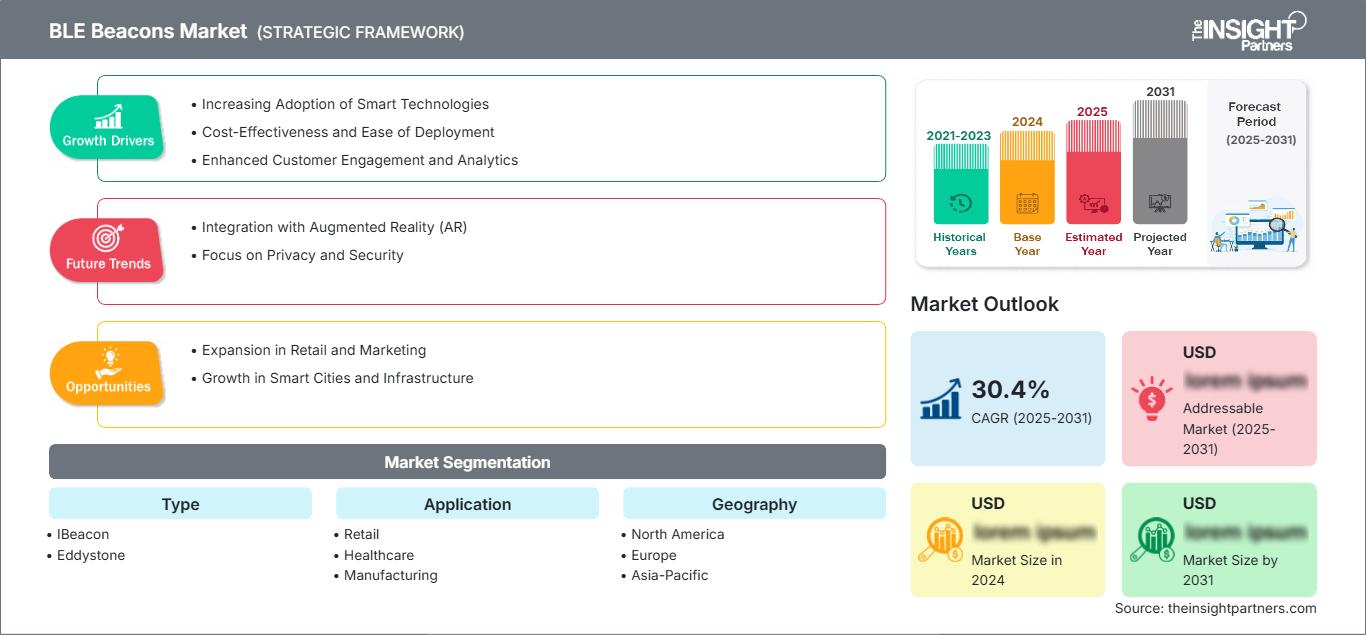
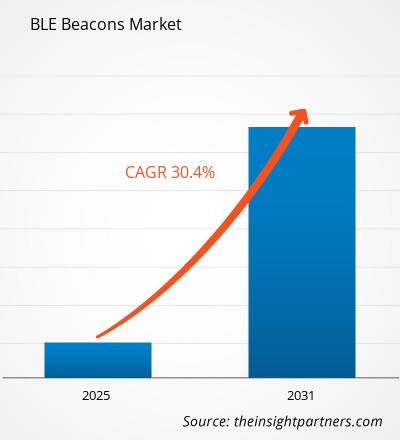
The BLE Beacons market size was valued at US$ 2.23 Billion in 2025 and is projected to reach US$ 13.8 Billion by 2034, registering a CAGR of 22.45% during 2026–2034. The market for BLE Beacons is growing as the Bluetooth Low Energy technology allows for proximity interaction, indoor positioning, real-time asset tracking, contextual notifications, and light-weighted IoT architecture for retail, health care, manufacturing, travel, media, entertainment, and educational industries.
In North America, BLE Beacons are anticipated to grow with the CAGR ranging from 20.8% to 22.6% over 2026-2034 on account of the high maturity level of smartphone usage, digital transformation of hospitals, omnichannel programs for retail, and the need of enterprises to know the location of rooms. The region boasts the dense wireless network, consent-driven mobile applications, cloud computing, and investments in facilities allowing converting beacons' signals to business insight.
BLE Beacons Market Assessment and Insights
- North America held 32–36% of the BLE Beacon Market share in 2025 and is growing at a CAGR of 20.8–22.6% during 2026–2034, supported by healthcare RTLS, retail analytics, campus navigation, and enterprise IoT upgrades.
- US represented 80–84% of North American revenue in 2025 and is growing at a CAGR of 21.0–22.8% during 2026–2034, led by hospitals, retailers, airports, and smart buildings.
- Europe accounted for 24–28% share in 2025 and is growing at a CAGR of 19.6–21.4% during 2026–2034, with the UK, Germany, France, Italy, and Spain leading deployments.
- Asia Pacific held 27–31% share in 2025 and is growing at a CAGR of 23.8–25.6% during 2026–2034, led by China, Japan, South Korea, India, and Australia.
- Largest Segment iBeacon held 58–62% market share in 2025 and is growing at a CAGR of 21.4–23.0% during 2026–2034 due to broad iOS compatibility and retail adoption.
- High Growth Segment Healthcare represented 18–22% market share in 2025 and is growing at a CAGR of 25.2–27.0% during 2026–2034 as hospitals scale asset tracking and patient-flow systems.
- Key companies analyzed in detail: Accent Advanced Systems, SLU; Apple Inc.; BlueCats; Estimote, Inc.; Hewlett Packard Enterprise Development LP; HID Global Corporation; Kartographers Technologies Pvt. Ltd. (UFO Beacons); Kontakt.io, Inc.; MobStac, Inc.; Proximity Solutions.
Source: The Insight Partners' analysis based on proprietary research, government publications, company annual reports, investor presentations, industry databases, and expert interviews.
Deployment patterns have transitioned from standalone event triggers to networks of managed location intelligence systems that are linked to smartphone applications, cloud-based dashboards, and enterprise processes. Hardware considerations have moved toward long-lasting batteries, durable casings, configurable transmission frequencies, and sensors that track temperature, movement, and occupancy rates. The production process now is determined by access to Bluetooth chipsets, secure firmware, device management tools, and strategic partners that have the ability to map buildings and configure signals.
Future demand trends will be driven by smart hospitals, autonomous factories, airports, universities, and retail estates that require inexpensive location intelligence without the use of expensive UWB technologies. Geographies that are still emerging will likely take up beacons through mobile first retail, tourism optimization, and public infrastructure projects. Tailwinds with respect to regulatory issues like patient safety, inventory tracking, and building efficiencies should support beacons where consent management, anonymous analysis, and cyber security governance are designed in.
BLE Beacons Market Report Scope
| Report Attribute | Details |
|---|---|
| Market size in 2025 | US$ 2.23 Billion |
| Market Size by 2034 | US$ 13.8 Billion |
| Global CAGR (2026 - 2034) | 22.45% |
| Historical Data | 2021-2024 |
| Forecast period | 2026-2034 |
BLE Beacons Market Analysis
The BLE Beacon market growth is due to organizations looking for an indoor location solution that works where GPS fails and Wi-Fi positioning does not have enough accuracy. Beacons are transmitting low-energy identifiers to mobile devices, gateways, or other beacons which help in store navigation, queue analysis, asset search, equipment monitoring, and venue interaction. Bluetooth SIG recommendations continue to place Bluetooth Low Energy as an important component in IoT technology due to low power consumption, wide range of device support, and proximity capabilities.
The value chain consists of semiconductors, enclosures, firmware, cloud location platform, mobile app, system integration, managed service, and vertical solution providers. The supply chain is affected by battery technology, antenna design, interference handling, device provisioning, and monitoring fleet capabilities. Customers start to think about their total cost of ownership including cost of installation, battery changes, calibration, license fee for analytics, and security maintenance.
A BLE Beacon Market report highlights competition landscape analysis reveals competition among platform owners, specialist hardware companies, and vertical solutions suppliers. Apple Inc. is the leader in influencing the iBeacon technology platform, whereas Kontakt.io, Inc., Estimote, Inc., BlueCats, and Accent Advanced Systems, SLU are competing by providing enterprise-oriented hardware and software. Hewlett Packard Enterprise Development LP and HID Global Corporation are strengthening the building and network distribution channel, and Kartographers Technologies Pvt. Ltd. (UFO Beacons), MobStac, Inc., and Proximity Solutions cover regional and application-specific deployments.
The current investment trend is focusing on health care RTLS, smarter facility analytics, Bluetooth Channel Sounding preparation, API integrations, and managed deployments. Strategic positioning requires demonstrating clear benefits in the form of decreased device search times, increased campaign conversion rates, faster wayfinding, or room/asset utilization. Providers that have trustworthy dashboards, privacy-conscious handling of data, and capability of integrating with enterprise-level solutions will have more success transforming pilot implementations into enterprise-wide projects.
● REPORT CUSTOMIZATION
Tailor This Report To Align With Your Specific Business Requirements
This report can be customized to align precisely with your business objectives, scope, and target markets. Customization options include tailored segmentation, geography, competitive analysis, and strategic insights to support informed decision-making.
Customize This Report →WHAT YOU CAN ADJUST
- ● Segmentations
- ● Geography
- ● Competitive Analysis
- ● Language Preferences
BLE Beacons Market: Strategic Insights
Regional Insights
North America BLE Beacon Market
North America accounted for 32–36% of BLE Beacon share in 2025 and is projected to grow at a CAGR of 20.8–22.6% during 2026–2034. Demand is sustained by hospital RTLS programs, large retail estates, connected campuses, sports venues, and airports using beacon signals for navigation, asset visibility, targeted engagement, and operational analytics.
Structural drivers include high smartphone usage, mature cloud adoption, strong enterprise software budgets, and wider acceptance of indoor location services when privacy controls are clear. Kontakt.io, Inc., Apple Inc., BlueCats, Hewlett Packard Enterprise Development LP, and HID Global Corporation benefit from regional channel depth, while healthcare and manufacturing buyers increasingly request service-level support for calibration, uptime, and battery planning.
U.S. BLE Beacon Market
The U.S. represented 80–84% of North American revenue in 2025 and is forecast to expand at a CAGR of 21.0–22.8% during 2026–2034. Application demand is strongest in healthcare, retail, manufacturing, and travel locations where indoor positioning improves asset utilization, staff workflows, customer engagement, and safety alerts across large facilities.
Company presence is reinforced by Apple Inc., Kontakt.io, Inc., BlueCats, HID Global Corporation, and Hewlett Packard Enterprise Development LP. U.S. hospitals use beacon-enabled workflows to reduce equipment search time, while retailers connect proximity signals with loyalty apps and consented customer journeys. Airports, museums, and university campuses add wayfinding and occupancy analytics, supporting recurring software revenue for platform providers.
Europe BLE Beacon Market
Europe held 24–28% share in 2025 and is expected to grow at a CAGR of 19.6–21.4% during 2026–2034. The UK leads through retail modernization, transport hubs, and healthcare digitization. Germany contributes strong industrial and logistics demand, using beacons for tools, pallets, production cells, and worker-zone awareness in smart factories.
France, Italy, and Spain add tourism, cultural venues, hospitals, and shopping centers where indoor navigation and visitor engagement remain practical use cases. Europe’s privacy environment encourages consent-led deployments, anonymized analytics, and clear retention policies. Accent Advanced Systems, SLU and Kontakt.io, Inc. strengthen regional visibility, while Apple Inc. and HID Global Corporation support protocol and access-related ecosystems.
APAC BLE Beacon Market
Asia Pacific accounted for 27–31% share in 2025 and is forecast to grow at a CAGR of 23.8–25.6% during 2026–2034. China leads through smart retail, factories, logistics parks, and dense urban infrastructure.
Japan and South Korea add high electronics maturity, while India and Australia support growth through hospitals, campuses, malls, and tourism assets. Policy focus on smart cities, digital public services, and manufacturing efficiency improves the adoption base. Kartographers Technologies Pvt. Ltd. (UFO Beacons) and Proximity Solutions benefit from local deployments that require cost-sensitive hardware and integration support.
Middle East & Africa BLE Beacon Market
The Middle East & Africa market is projected to grow at a CAGR of 18.2–20.0% during 2026–2034. The UAE leads through airports, malls, hospitals, hotels, and event venues that value indoor navigation and visitor engagement.
Saudi Arabia is improving digital infrastructure under major tourism and smart-city programs, while South Africa contributes through retail, healthcare, and education deployments. Rest of MEA demand remains concentrated in urban hubs where integrators can maintain devices and gateways. Energy, infrastructure, and facility-management projects create opportunities for asset tracking, workforce alerts, and maintenance visibility.
Segmentation Analysis
Type
Type is projected to grow at a CAGR of 21.8–23.4% during 2026–2034. The BLE Beacon scope covers IBeacon and Eddystone, with purchasing decisions shaped by mobile operating-system compatibility, app strategy, data format, fleet configuration, and developer support. iBeacon retains stronger enterprise familiarity in iOS-heavy environments, while Eddystone remains relevant where URL broadcasting, Android coverage, or multi-format flexibility supports mixed-device engagement.
- IBeacon leads deployments because iOS compatibility, stable app behavior, and established developer understanding make it suitable for retail engagement, museums, healthcare workflows, and campus navigation.
- Eddystone remains strategically useful for mixed-device environments, URL-based experiences, and flexible telemetry designs where organizations want Android reach, simpler discovery, or multi-protocol broadcasting.
Application
Application is forecast to grow at a CAGR of 22.2–24.0% during 2026–2034. Retail contributes scale through proximity messaging and shopper analytics, while healthcare generates high-value projects through asset tracking, patient flow, staff safety, and temperature monitoring. Manufacturing, travel and tourism, media and entertainment, and education adopt beacons where indoor location context improves utilization, navigation, engagement, and operational response.
- Retail uses beacons for opt-in promotions, in-store navigation, loyalty engagement, shelf analytics, and queue insights, making deployment success dependent on app adoption and consent clarity.
- Healthcare prioritizes equipment visibility, patient-flow support, staff duress alerts, room utilization, and temperature-sensitive inventory monitoring, creating strong value when integrated with hospital operations platforms.
- Manufacturing applies beacons to tool tracking, work-in-process visibility, restricted-zone alerts, maintenance triggers, and asset utilization, especially where low-cost location coverage is preferred.
- Media and Entertainment venues use beacon signals for visitor routing, exhibit interaction, seat-area messaging, crowd flow insights, and sponsor engagement during concerts, stadium events, and museums.
- Travel and Tourism adoption centers on airport wayfinding, hotel engagement, destination trails, multilingual content, and luggage or equipment visibility across complex visitor environments.
- Education institutions use beacons for campus navigation, attendance support, library interaction, equipment tracking, safety alerts, and space utilization across classrooms, labs, dormitories, and event areas.
Opportunity Snapshot
| Application | Revenue Contribution | Trend Tag | Adoption Stage |
| Retail | High | Proximity Commerce | Scaling |
| Healthcare | High | Care Flow | Scaling |
| Manufacturing | Medium | Asset Visibility | Emerging |
| Media and Entertainment | Medium | Venue Routing | Scaling |
| Travel and Tourism | Medium | Indoor Wayfinding | Scaling |
| Education | Low | Campus Safety | Emerging |
BLE Beacons Market Growth Drivers and Impact Analysis
Hospital RTLS adoption improves asset and patient workflows
Beacon networks have been used by hospitals to find infusion pumps, wheelchairs, beds, chilled items, and places for assistance from staff. Market effects will be realistic since the delays caused by searching for equipment result in operational costs. BLE technology allows for installation of beacons on a room/zone level with reduced energy consumption compared to many other systems. Beacons will help monitor patient flow, hand washing compliance, temperatures, and asset utilization when integrated with nurse work flow and supply chain dashboard. This driver will favor those beacon solution providers who offer hardware, gateways, analytics, and domain knowledge in addition to transmitters.
Retailers connect store traffic with loyalty applications
Visibility into shopping journeys will be important for physical retailers with the rise of e-commerce driving personalization and measurement. Beacons allow retailers to connect opted-in mobile applications with departments, displays, queues, and collection points in order to enable personalized offers, navigation, product discovery, and time spent measurements. It will work best when retailers have loyalty schemes, mobile wallets, and click and collect systems in place. It enables retailers to run more relevant campaigns without having to invest in costly camera systems, but needs consent, mobile application adoption, and strong data governance.
Industrial IoT projects require low-cost location layers
There is an increasing need for context-based information regarding tools, containers, forklifts, stations, and even temporary equipment on the side of manufacturers and logistics companies. The use of BLE beacons is cost-efficient for proximity-related activities such as the detection of zones and automatic checking when centimeter precision is not required. There will be more stringent control of the inventory, quicker reaction to issues and less manual scanning in warehouses or manufacturing plants due to the beacon market. Furthermore, the beacons can be used together with the technologies such as RFID, Wi-Fi, and UWB depending on the required precision.
BLE Beacons Market Future Trends
Precision proximity features reshape location intelligence
The BLE Beacon Market trends indicates better ranging, enhanced authentication, and increased indoor context capabilities with the development of Bluetooth specifications. Channel Sounding and enhanced device discovery capabilities could lead to better accuracy and security when used in proximity-based applications like digital key management, lost object tracking, access processes, and facility analysis. Future implementations would probably involve integration of beacons along with gateways, mobile sensors, and AI systems capable of detecting movement patterns without revealing personal identification. The vendors should ensure that accuracy, interference, and privacy issues are discussed adequately. Multi-protocol capabilities and upgradability by firmware would still be desirable for the buyers.
Managed beacon fleets become software-led services
Beacon purchasers are transitioning from purchases based on hardware alone to managed services incorporating planning, installation, calibration, battery management, firmware updates, and analysis support. The result is expected to minimize the cases of failed installations owing to poor positioning, app consistency issues, or lack of maintenance. This will also mean a reorientation of margins towards cloud dashboards, APIs, industry templates, and performance reporting. Service-level agreements will be favored in healthcare, education, and travel settings where downtime will have implications for the business. Vendor expertise lies in providing reliable life-cycle costs, security provisions, remote diagnostics, and industry templates to speed up implementation.
BLE Beacons Market Opportunities
Healthcare workflow automation beyond equipment tracking
BLE Beacon Market Forecast enable investments into workflow automation in healthcare that go beyond asset tracking. The potential is compelling since healthcare facilities are constantly seeking improvements in their operations in terms of increased productivity and resiliency, despite continuing workforce pressure. Integrations of beacons with electronic health record systems, preventive maintenance management systems, and logistics platforms should be a priority for suppliers, while maintaining a low profile when it comes to patient data. Successful business cases will combine beacons, gateways, analytics, alerting capabilities, and implementation guidelines that prove ROI in one or two budget cycles.
Smart tourism and venue navigation in emerging cities
Tourism bodies, airports, museums, universities, and other venues could use beacons to enhance visitors' navigation, language localization, crowds movement, and accessibility assistance. The biggest potential exists in newly developing cities that plan to develop their airports, conference centers, heritage trails, and e-services. In terms of costs, beacons provide a more economical solution than camera-based or Ultra Wideband technology-based solutions, particularly when the need for high levels of location accuracy is zone-specific. Beacon vendors need to bundle together mapping and content systems, SDKs, and services with the aim of serving small operators.
Recent Developments
- February 2026: Blecon announced the launch of the Blecon Agent, a new software solution that transforms Zebra Technologies’ frontline devices into an autonomous Bluetooth tracking network. By deploying the Blecon Agent across Zebra’s existing device ecosystem, logistics providers can immediately enable continuous asset visibility using the hardware already in the hands of their frontline workforce.
- April 2025: TENNA, the construction technology platform powering equipment fleet operations, announces the launch of its latest innovation: TennaBLE Steel Puck 2 (SP2). This next-generation Bluetooth Low Energy (BLE) beacon expands Tenna’s robust suite of asset tracking solutions with a device specifically engineered for the construction industry’s most rugged asset classes.
- June 2023: e-peas and InPlay have joined forces to introduce a groundbreaking development kit in the IoT landscape: an autonomous, maintenance-free, low BoM BLE Sensor Beacon powered by energy harvesting. This collaboration aims to revolutionize IoT technology by providing a sustainable and efficient solution for sensor beacons.
Frequently Asked Questions

- Comprehensive Market Sizing and Forecast Analysis
- Detailed Segmentation Analysis
- In-Depth Market Dynamics Assessment
- Regional and Country-Level Insights
- Competitive Landscape and Company Benchmarking
- Strategic Business Intelligence
Recent Reports
Testimonials

The Insight Partners' SCADA System Market report is comprehensive, with valuable insights on current trends and future forecasts. The team was highly professional, responsive, and supportive throughout. We are very satisfied and highly recommend their services.
RAN KEDEM Partner, Reali Technologies LTDs
I requested a report on a very specific software market and the team produced the report in a few days. The information was very relevant and well presented. I then requested some changes and additions to the report. The team was again very responsive and I got the final report in less than a week.
JEAN-HERVE JENN Chairman, Future Analytica
We worked with The Insight Partners for an important market study and forecast. They gave us clear insights into opportunities and risks, which helped shape our plans. Their research was easy to use and based on solid data. It helped us make smart, confident decisions. We highly recommend them.
PIYUSH NAGPAL Sr. Vice President, High Beam Global
The Insight Partners delivered insightful, well-structured market research with strong domain expertise. Their team was professional and responsive throughout. The user-friendly website made accessing industry reports seamless. We highly recommend them for reliable, high-quality research services
YUKIHIKO ADACHI CEO, Deep Blue, LLC.
This is the first time I have purchased a market report from The Insight Partners.While I was unsure at first, I visited their web site and felt more comfortable to take the risk and purchase a market report.I am completely satisfied with the quality of the report and customer service. I had several questions and comments with the initial report, but after a couple of dialogs over email with their analyst I believe I have a report that I can use as input to our strategic planning process.Thank you so much for taking the extra time and making this a positive experience.I will definitely recommend your service to others and you will be my first call when we need further market data.
JOHN SUZUKI President and Chief Executive Officer, Board Director, BK Technologies
I wish to appreciate your support and the professionalism you displayed in the course of attending to my request for information regarding to infectious disease IVD market in Nigeria. I appreciate your patience, your guidance, and the fact that you were willing to offer a discount, which eventually made it possible for us to close a deal. I look forward to engaging The Insight Partners in the future, all thanks to the impression you have created in me as a result of this first encounter.
DR CHIJIOKE ONYIA MANAGING DIRECTOR, PineCrest Healthcare Ltd.Reason to Buy
- Informed Decision-Making
- Understanding Market Dynamics
- Competitive Analysis
- Identifying Emerging Markets
- Customer Insights
- Market Forecasts
- Risk Mitigation
- Boosting Operational Efficiency
- Strategic Planning
- Investment Justification
- Tracking Industry Innovations
- Aligning with Regulatory Trends





 Get Free Sample for