
Blockchain Security Market Demand, Trends & Top Players Analysis by 2034
Blockchain Security Market Size and Forecasts (2021 - 2034), Global and Regional Share, Trends, and Growth Opportunity Analysis Report Coverage : By Component (Solution, Services); Deployment (Cloud, On Premises); Organization Size (SMEs, Large Enterprises); Vertical (Manufacturing, Healthcare & Lifesciences, BFSI, IT & Telecom, Retail & eCommerce, Government, Others)
- Status : Data Released
- Report Code : TIPRE00039754
- Category : Technology, Media and Telecommunications
- No. of Pages : 150
- Available Report Formats :


- Last update date : August 04, 2026


2025 Market Size
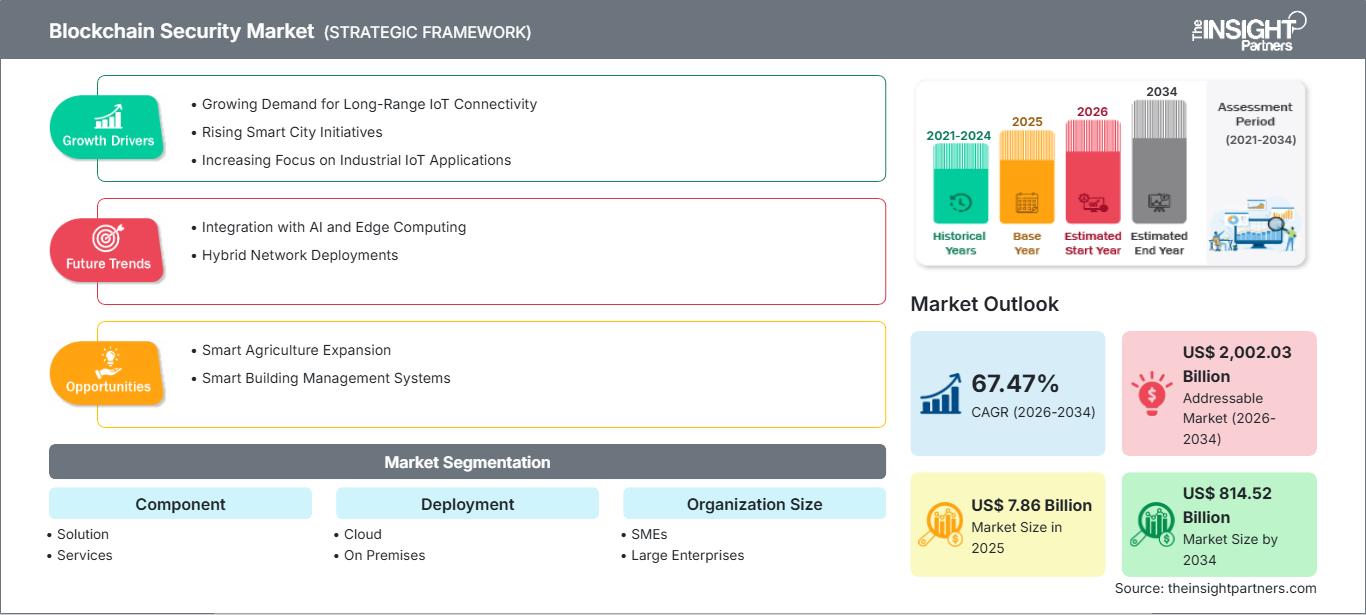
US$ 7.86 Bn
Base year value
2034 Forecast
US$ 814.52 Bn
Projected by 2034
CAGR 2026-2034
67.47 %
Growth rate
Addressable Market
US$ 2,002.03 Bn
(2026-2034)
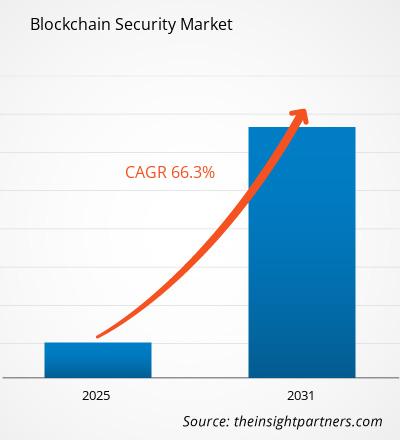
The blockchain security market was valued at US$ 7.86 Billion in 2025 and is projected to reach US$ 814.52 Billion by 2034, registering a CAGR of 67.47% during 2026–2034 as organizations harden decentralized infrastructures and digital asset ecosystems against rising cyber risks. Growing deployment of permissioned and public blockchains across financial services, supply chains, identity management, and Web3 applications is sharpening focus on secure key management, node hardening, and smart contract assurance to protect high‑value digital transactions.
Across North America, the blockchain security market is expected to expand at an estimated CAGR range of 30–35% during 2026–2034, supported by rapid enterprise blockchain pilots maturing into production deployments and robust venture funding into Web3 infrastructure. Increased regulatory scrutiny around digital assets, combined with stringent data protection requirements in banking and capital markets, is pushing enterprises to adopt specialized security platforms that embed compliance, monitoring, and incident response into blockchain workflows. As a result, the blockchain security market size in the region is set to rise steadily as adoption broadens across financial institutions and technology‑driven enterprises.
Blockchain Security Market Assessment and Insights
- North America: Accounted for an estimated 32–36% share in 2025 and is projected to grow at a CAGR between 30–34% during 2026–2034, driven by strong adoption of blockchain in banking, capital markets, and regulated digital asset platforms across the US and Canada.
- US: Represented approximately 22–26% of global revenues in 2025 and is expected to expand at a CAGR of 31–35% through 2034, underpinned by extensive enterprise blockchain initiatives and cybersecurity investments by large financial and technology companies.
- Europe: Captured around 26–30% share in 2025 and is anticipated to grow at a CAGR range of 27–31% during 2026–2034, with Germany, the UK, and France leading adoption in regulated finance, supply chain traceability, and digital identity programs.
- Asia Pacific: Accounted for roughly 24–28% of revenues in 2025 and is forecast to grow at a CAGR between 32–36% from 2026 to 2034, led by China, Japan, India, South Korea, and Singapore deploying blockchain in payments, trade finance, and logistics.
- Largest Segment: The Solution segment held about 60–64% market share in 2025 and is expected to expand at a CAGR of 29–33% during 2026–2034, reflecting demand for integrated platforms that combine key management, node security, and smart contract assurance.
- High Growth Segment: The Cloud deployment segment accounted for 36–40% share in 2025 and is projected to grow at a CAGR of 34–38% through 2034, supported by scalable adoption among enterprises seeking managed blockchain security services.
- Key companies analyzed in detail: International Business Machines Corporation (IBM), Amazon Web Services Inc, Thales Group, Oracle Corporation, Infosys Limited, Infineon Technologies AG, Kaspersky Lab Limited, Consensys Software Inc, Utimaco IS GmbH, CryptoSec, Palo Alto Networks Inc, Check Point Software Technologies Ltd.
Source: The Insight Partners' analysis based on proprietary research, government publications, company annual reports, investor presentations, industry databases, and expert interviews.
The blockchain security market has progressed from early experimental deployments securing cryptocurrency exchanges to a broader focus on enterprise‑grade protections for multi‑chain ecosystems that support payments, tokenized assets, and supply chain traceability. There is a movement away from key management systems toward platforms that provide a combination of identity, encryption, policy enforcement, and runtime security for decentralized applications. The adoption of the zero trust model is now being applied to blockchain nodes via the use of secure enclaves, hardware security modules, and tamper-proof chips to ensure the integrity of transactions and consensus mechanisms in complex distributed architectures.
The outlook looks very promising owing to the growing level of investments being made in digital currency, tokenized assets, and cross-border payment solutions, particularly in developing countries, where there is a greater emphasis on financial inclusion and efficiencies. The regulatory push in the form of digital asset custodial services, anti-money laundering tools, and data sovereignty regulations will compel firms to adopt a more structured approach toward blockchain security than an informal one. In view of the government's initiative to adopt central bank digital currencies and blockchain pilots in the public sector, interoperability and security will become necessary in the future, according to the Blockchain Security Market report.
Blockchain Security Market Report Scope
| Report Attribute | Details |
|---|---|
| Market size in 2025 | US$ 7.86 Billion |
| Market Size by 2034 | US$ 814.52 Billion |
| Global CAGR (2026 - 2034) | 67.47% |
| Historical Data | 2021-2024 |
| Forecast period | 2026-2034 |
Blockchain Security Market Analysis
The blockchain security market growth is being propelled by the convergence of rising crypto‑related cybercrime, expanding enterprise blockchain deployments, and the need to secure multi‑party workflows across borders. Security vendors address a complex value chain that spans hardware‑based key storage, secure node infrastructure, smart contract assurance, threat monitoring, and incident response tailored to immutable ledger architectures. On the supply side, hyperscale cloud providers and cybersecurity firms increasingly bundle blockchain‑specific controls into broader security stacks, while specialist vendors focus on code analysis, forensics, and protocol‑level defenses for decentralized finance platforms.
Across industries, adoption is uneven but accelerating as stakeholders recognize that misconfigured wallets, exposed private keys, and insecure smart contracts can cause material financial losses and compliance breaches. Financial institutions, technology providers, and manufacturing firms are moving from pilot projects to production networks, creating demand for repeatable security patterns and certified tools. As part of this blockchain security market analysis, ecosystem collaboration between regulators, standards bodies, and technology consortia is playing a significant role in aligning best practices for governance, auditing, and resilience.
Competitive dynamics in the Blockchain Security Market reflect a mix of large diversified technology players and focused security specialists building capabilities for specific blockchain stacks and industry use cases. IBM and Oracle, for example, embed blockchain security features within broader enterprise platforms, while Amazon Web Services, Inc. provides managed services and reference architectures for secure blockchain deployments on its cloud infrastructure. Thales, Infineon Technologies AG, and Utimaco IS GmbH leverage their hardware security expertise to provide secure key storage and cryptographic acceleration for blockchain nodes and wallets.
While some organizations, including Kaspersky Lab Limited, Palo Alto Networks Inc., and Check Point Software Technologies Ltd., include blockchain threat intelligence in their network and endpoint security platforms to tackle new attack vectors, firms like Consensys Software Inc. and CryptoSec specialize in auditing smart contracts, assessing vulnerabilities, and tools that help Ethereum developers eliminate exploitable weaknesses. Trends in investments point to growing venture capital flows toward new ventures in areas such as decentralized identity management, cross-chain security, and on-chain analysis.
● REPORT CUSTOMIZATION
Tailor This Report To Align With Your Specific Business Requirements
This report can be customized to align precisely with your business objectives, scope, and target markets. Customization options include tailored segmentation, geography, competitive analysis, and strategic insights to support informed decision-making.
Customize This Report →WHAT YOU CAN ADJUST
- ● Segmentations
- ● Geography
- ● Competitive Analysis
- ● Language Preferences
Blockchain Security Market: Strategic Insights
Regional Insights
North America blockchain security market
North America remains the leading region, accounting for an estimated 32–36% share of the blockchain security market in 2025, supported by mature technology ecosystems and high digital asset adoption among enterprises and financial institutions. The regional market is projected to expand at a CAGR of 30–34% from 2026 to 2034, underpinned by demand for secure custody, transaction monitoring, and governance frameworks across public and permissioned blockchains.
In the US and Canada, regulatory scrutiny of digital asset service providers and capital markets infrastructure is reinforcing investments in blockchain monitoring, compliance automation, and zero‑trust architectures. Cloud providers and cybersecurity vendors headquartered in the region collaborate closely with banks, fintechs, and technology startups to design security reference architectures, further boosting blockchain security market share within financial and technology‑intensive sectors.
U.S. blockchain security market Market
The U.S. dominates North American demand in the Blockchain Security Market, contributing roughly 68–72% of the region’s revenues in 2025 as enterprises scale blockchain projects across payments, trade finance, identity, and tokenization use cases. The U.S. market is expected to grow at a CAGR of 31–35% through 2034, supported by extensive venture funding, a dense ecosystem of Web3 startups, and early adoption by major banks and asset managers.
Among the most prominent players in security and cloud services like International Business Machines Corporation, Amazon Web Services Inc., Palo Alto Networks Inc., and Check Point Software Technologies Ltd., there is a significant presence in the US market, thus allowing for alignment with customer security demands. Some applications that are currently gaining traction include smart contract audit, key management service, and on-chain analytics solutions that assist companies in detecting any fraudulent behavior on the blockchain.
Europe blockchain security market Market
Europe accounted for approximately 26–30% of global blockchain security revenues in the Blockchain Security Market in 2025, reflecting strong activity in regulated financial services, cross-border payments, and trade digitization initiatives. Regional growth is projected at a CAGR of 27–31% between 2026 and 2034, with the UK and Germany emerging as leading adopters, while France, Italy, and Spain build capacity through pilot programs and policy support.
The UK and Germany, with their financial centers in London and Frankfurt, have early use cases for blockchains as a means of post-trade processing, collateral management, and digital identity verification, and thus increasing the need for cybersecurity solutions and compliance automation. Meanwhile, France, Italy, and Spain are now considering blockchain for supply chain transparency and government operations, leading to secure nodes and hardware-based cryptography being considered.
APAC blockchain security market Market
APAC held an estimated 24–28% share of the global blockchain security market in 2025 and is forecast to register a CAGR of 32–36% between 2026 and 2034, making it one of the fastest‑growing regions. China, Japan, South Korea, India, and Australia are at the forefront, leveraging blockchain for cross‑border payments, trade finance, logistics, and digital identity initiatives.
The digital asset exchange and supply chain finance industries in China and South Korea are leading the charge when it comes to big initiatives, but India and Australia are focusing on secure blockchain technology for governmental use and financial inclusion programs. These regional policies aimed at digital transformation, coupled with robust manufacturing and exporting industries, enable investments in security technologies that ensure the safety of multi-party blockchain networks.
Middle East & Africa blockchain security market Market
The Middle East & Africa blockchain security market is smaller in absolute size but growing steadily, with a projected CAGR of 24–28% from 2026 to 2034 as energy exporters and financial centers experiment with blockchain applications. Saudi Arabia, the UAE, and South Africa are pioneers in adopting the technology, with the help of national digital transformation initiatives and regulatory frameworks that favor innovation.
In the Gulf region, blockchain technology has gained momentum due to its application in the areas of trade documentation, energy trading platforms, and cross-border payments; hence, the need for reliable digital identity and transaction monitoring systems. South Africa and other African countries are looking into blockchain technology for offering inclusive financial services and land registry, requiring collaboration with cybersecurity vendors.
Segmentation Analysis
Component
The Component segment in the Blockchain Security Market divides the market into Solutions and Services, with overall demand for component offerings expected to grow at a CAGR of 28–32% during 2026–2034 as enterprises formalize blockchain security architectures. Solutions currently dominate deployments, while services help organizations design, implement, and maintain secure multi-chain environments that align with industry-specific compliance requirements. Vendors increasingly deliver packaged offerings that combine software, hardware, and consulting, especially for highly regulated customers.
- Solution: This sub‑segment represents integrated platforms for key management, node security, smart contract assurance, and monitoring, addressing end‑to‑end lifecycle needs from development through operations for enterprises deploying blockchain networks in production environments.
- Services: Encompassing consulting, integration, training, and managed security services, this sub‑segment supports organizations in designing architectures, conducting risk assessments, and running 24x7 blockchain security operations tailored to specific industry and regulatory contexts.
Deployment
The Deployment segment, comprising Cloud and On Premises, is anticipated to expand at a CAGR of 30–34% between 2026 and 2034 as organizations balance flexibility with control in blockchain security implementations. Cloud deployment is gaining momentum for its scalability and managed services, while on‑premises models remain important where data residency, latency, or regulatory constraints require tight infrastructure control.
- Cloud: This sub‑segment covers security solutions delivered via public or hybrid clouds, offering rapid provisioning, managed key services, and integrated monitoring, particularly appealing to startups, fintechs, and enterprises experimenting with cross‑border blockchain applications.
- On Premises: Focused on organizations that require strict control over infrastructure, this sub‑segment enables deployment of blockchain security tools within private data centers, often integrating with existing hardware security modules and internal security operations centers.
Organization Size
The Organization Size segment, split between SMEs and Large Enterprises, is projected to grow at a CAGR of 27–31% from 2026 to 2034 as organizations of varying scale adopt blockchain technologies for different purposes. Large enterprises currently dominate spend, though SMEs increasingly adopt cloud‑based security offerings for niche applications and ecosystem participation. Vendors tailor pricing and deployment models accordingly to capture both customer groups.
- SMEs: Smaller organizations typically leverage blockchain security solutions for focused use cases such as supply chain traceability or digital asset issuance, favoring subscription‑based, cloud‑delivered tools that minimize upfront investments and complexity.
- Large Enterprises: This sub‑segment spans banks, manufacturers, telecom operators, and technology firms implementing multi‑region blockchain networks, requiring sophisticated security architectures, integration with legacy systems, and cross‑functional governance mechanisms.
Vertical
The Vertical segment, which includes Manufacturing, Healthcare & Lifesciences, BFSI, IT & Telecom, Retail & eCommerce, and Government, is expected to record a CAGR of 29–33% between 2026 and 2034 as sector‑specific blockchain initiatives move from pilot to scale. This breadth illustrates the blockchain security market scope, with each vertical driving distinct security requirements based on regulatory, operational, and data‑sensitivity factors.
- Manufacturing: Manufacturers adopt blockchain security to protect supply chain provenance data, intellectual property, and machine telemetry, emphasizing secure onboarding of partners and devices within complex industrial ecosystems.
- Healthcare & Lifesciences: This sub‑segment focuses on safeguarding patient records, clinical trial data, and pharmaceutical supply chains, requiring stringent encryption, access controls, and auditability to meet privacy and compliance standards.
- BFSI: Banks and financial institutions drive sophisticated use cases in payments, trade finance, and securities, necessitating robust custody, transaction monitoring, and smart contract assurance solutions to manage financial and compliance risks.
- IT & Telecom: Technology and telecom providers secure blockchain‑enabled network management, identity, and service provisioning platforms, leveraging their infrastructure footprint to deliver secure, scalable solutions to enterprise customers.
- Retail & eCommerce: Retailers apply blockchain for traceability, loyalty programs, and digital assets, requiring secure customer identity management and fraud prevention across online and in‑store channels.
- Government: Public sector organizations secure blockchain‑based registries, voting systems, and digital identity services, prioritizing resilience, transparency, and data sovereignty in collaboration with domestic and international partners.
Opportunity Snapshot
| Vertical | Revenue Contribution (High/Medium/Low) | Trend Tag | Adoption Stage |
| BFSI | High | Tokenized assets | Scaling |
| Manufacturing | Medium | Supply traceability | Emerging |
| Healthcare & Lifesciences | Medium | Data integrity | Emerging |
| IT & Telecom | Medium | Network automation | Scaling |
| Retail & eCommerce | Low | Loyalty tokens | Emerging |
| Government | Medium | Digital identity | Emerging |
Blockchain Security Market Growth Drivers and Impact Analysis
Rising cyber threats to digital assets
A growing number of cyber attacks on crypto exchanges, DeFi networks, and digital wallets is one of the main reasons behind the growing demand for blockchain security tools in various regions. Major security breaches that involve loss of private keys, hack attacks on smart contracts, and node hijacking have shown that current security measures in place are insufficient and that users’ trust in them is waning. In light of the rising number of transactions and high value of assets that use blockchain technology, it has become necessary for regulators and investors to implement additional security measures such as hardware protection of private keys, multi-signature transactions, and network monitoring.
Enterprise blockchain adoption across industries
The increasing use of blockchain technology in various industries, including banking, manufacturing, logistics, and government, is driving the market opportunity for security solution providers who can tailor their offerings to the unique requirements of these industries. Enterprises are leveraging permissioned and public blockchains for optimizing complex processes such as international payments and supply chain tracking, which brings in issues related to multi-stakeholder governance and compliance. As organizations want to manage the risk from both an operational and regulatory perspective, there is a need for solutions offering identity management, encryption, policy management, and incident response within the existing security operation centers.
Regulatory clarity and compliance pressures
The emergence of regulatory guidelines governing digital currencies, data privacy, and financial crimes is driving enterprises to formulate blockchain security policies. Regulators in major markets are laying down guidelines on custodian, anti-money laundering, and consumer protection issues, which demand that transactions, identities, and data flows comply with the relevant laws, and this is only possible through audit-proof controls and monitoring of the blockchain network in real time. Companies implementing blockchain must ensure compliance with regulations, which could be different in several jurisdictions.
Blockchain Security Market Future Trends
Integration of AI with blockchain security tools
A key trend in blockchain security market trends is the integration of artificial intelligence and machine learning into monitoring and analytics tools that detect anomalous on‑chain behavior. Vendors are developing models that analyze transaction patterns, smart contract interactions, and network metrics in real time to identify potential fraud, exploits, or compliance breaches before they cause major losses. AI‑driven insights help security teams prioritize alerts, investigate complex multi‑chain incidents, and automate incident response workflows, particularly in high‑volume environments like exchanges and DeFi platforms. Over time, these capabilities are expected to become standard features in blockchain security platforms, improving resilience and operational efficiency.
Convergence of blockchain and confidential computing
Another developing trend that has gained attention in recent years is the combination of blockchain technology with confidential computing, whereby computations involving sensitive data are carried out inside secure enclaves in the hardware to ensure privacy and data integrity. Through integrating trusted execution environments and distributed ledgers, smart contracts and analytics on encrypted data can be performed without revealing anything of the computations to unauthorized entities and maintaining reliable audit trails. Vendors of hardware and cloud providers are partnering with various blockchain platforms to facilitate the use of such systems, ensuring better protection from any insider attack or advanced persistent threat.
Blockchain Security Market Opportunities
Expansion into emerging markets and financial inclusion
Significant blockchain security market Forecasts relate to expansion into emerging markets where blockchain can enhance financial inclusion, remittances, and trade financing. Many developing economies lack robust legacy infrastructure, making them receptive to digital solutions that reduce transaction costs and improve transparency. As local fintechs and banks roll out blockchain‑based services, they require security solutions that align with regional regulatory capacities and connectivity constraints. Vendors able to provide cost‑effective, scalable platforms and training can capture long‑term growth opportunities while contributing to more secure digital financial ecosystems in these markets.
Standardization and certification of blockchain security
Furthermore, there are business opportunities in developing standardized models and certification processes for blockchain security that can allow organizations to measure how mature and resilient their solutions are. Industry groups and technology alliances are starting to develop guidelines for best practices in key management, smart contract design, and network governance. Companies that get involved in such processes and make sure that their products adhere to industry-standard benchmarks are able to set themselves apart from the competition and decrease barriers to adoption for conservative clients. Eventually, standardization may enable a number of new service offerings in areas like auditing and compliance.
Frequently Asked Questions

- Comprehensive Market Sizing and Forecast Analysis
- Detailed Segmentation Analysis
- In-Depth Market Dynamics Assessment
- Regional and Country-Level Insights
- Competitive Landscape and Company Benchmarking
- Strategic Business Intelligence
Recent Reports
Testimonials

The Insight Partners' SCADA System Market report is comprehensive, with valuable insights on current trends and future forecasts. The team was highly professional, responsive, and supportive throughout. We are very satisfied and highly recommend their services.
RAN KEDEM Partner, Reali Technologies LTDs
I requested a report on a very specific software market and the team produced the report in a few days. The information was very relevant and well presented. I then requested some changes and additions to the report. The team was again very responsive and I got the final report in less than a week.
JEAN-HERVE JENN Chairman, Future Analytica
We worked with The Insight Partners for an important market study and forecast. They gave us clear insights into opportunities and risks, which helped shape our plans. Their research was easy to use and based on solid data. It helped us make smart, confident decisions. We highly recommend them.
PIYUSH NAGPAL Sr. Vice President, High Beam Global
The Insight Partners delivered insightful, well-structured market research with strong domain expertise. Their team was professional and responsive throughout. The user-friendly website made accessing industry reports seamless. We highly recommend them for reliable, high-quality research services
YUKIHIKO ADACHI CEO, Deep Blue, LLC.
This is the first time I have purchased a market report from The Insight Partners.While I was unsure at first, I visited their web site and felt more comfortable to take the risk and purchase a market report.I am completely satisfied with the quality of the report and customer service. I had several questions and comments with the initial report, but after a couple of dialogs over email with their analyst I believe I have a report that I can use as input to our strategic planning process.Thank you so much for taking the extra time and making this a positive experience.I will definitely recommend your service to others and you will be my first call when we need further market data.
JOHN SUZUKI President and Chief Executive Officer, Board Director, BK Technologies
I wish to appreciate your support and the professionalism you displayed in the course of attending to my request for information regarding to infectious disease IVD market in Nigeria. I appreciate your patience, your guidance, and the fact that you were willing to offer a discount, which eventually made it possible for us to close a deal. I look forward to engaging The Insight Partners in the future, all thanks to the impression you have created in me as a result of this first encounter.
DR CHIJIOKE ONYIA MANAGING DIRECTOR, PineCrest Healthcare Ltd.Reason to Buy
- Informed Decision-Making
- Understanding Market Dynamics
- Competitive Analysis
- Identifying Emerging Markets
- Customer Insights
- Market Forecasts
- Risk Mitigation
- Boosting Operational Efficiency
- Strategic Planning
- Investment Justification
- Tracking Industry Innovations
- Aligning with Regulatory Trends





 Get Free Sample for