
Blood Processing Devices Market Share, Demand & Growth by 2034
Coverage: By Product Type (Blood Bank Refrigerators and Freezers, Grouping Analyzers, Warmers, Hematocrit Centrifuges, Cell Processors); End User (Hospitals and clinics, Blood Banks Diagnostic Laboratories, Others.) , and Geography (North America, Europe, Asia Pacific, and South and Central America)
- Status : Data Released
- Report Code : TIPRE00022293
- Category : Life Sciences
- No. of Pages : 150
- Available Report Formats :


- Last update date : July 29, 2026


2025 Market Size
US$ 13.09 Bn
Base year value
2034 Forecast
US$ 27.68 Bn
Projected by 2034
CAGR 2026-2034
9.81 %
Growth rate
Addressable Market
US$ 193.64 Bn
(2026-2034)
The Blood Processing Devices Market size is expected to witness growth from US$ 13.09 Billion in 2025 to US$ 27.68 Billion by 2034, growing at a CAGR of 9.81% during 2026-2034. The market will transition away from the traditional model of storage and centrifugation to a more integrated system where efficiency will be enhanced with regards to blood component separation, handling of donor samples, typing and temperature control.
The North American region is a high value market for adoption due to the fact that the size of the Blood Processing Devices Market is influenced by advanced transfusion systems, platelet management systems and the replacement of old equipment. The region is anticipated to grow at a CAGR range of 8.8-9.4% during 2026-2034.
Blood Processing Devices Market Assessment and Insights
- North America: Share in 2025 is estimated at 38–41%, growing at a CAGR of 8.8–9.4% during 2026–2034. Demand is anchored by automated processing platforms, high transfusion volumes, and strong blood center modernization programs.
- US: Share in 2025 is estimated at 78–82% of North America, growing at a CAGR of 8.6–9.2% during 2026–2034, driven by platelet automation and high hospital-based testing intensity.
- Europe: Share in 2025 is estimated at 27–30%, growing at a CAGR of 8.1–8.7% during 2026–2034. Germany, the UK, and France lead adoption through compliance-led storage upgrades and automated grouping workflows.
- Asia Pacific: Share in 2025 is estimated at 22–25%, growing at a CAGR of 11.1–12.0% during 2026–2034. China, India, Japan, South Korea, and Australia are increasing blood bank capacity and diagnostics infrastructure.
- Largest Segment: Cell Processors hold a market share of 31–34% in 2025 and are expected to grow at a CAGR of 10.0–10.6% during 2026–2034, supported by automated component preparation.
- High Growth Segment: Grouping Analyzers account for 16–18% Blood Processing Devices Market share in 2025 and are expected to grow at a CAGR of 11.4–12.2% during 2026–2034, reflecting demand for faster compatibility testing.
- Key companies analyzed in detail: bioMérieux SA, Abbott Laboratories, Bio-Rad Laboratories, Inc., Becton, Dickinson and Company, Roche Holding AG, Danaher Corporation, Immucor, Inc., ThermoGenesis Holdings, Inc., Grifols, S.A., Terumo Corporation.
Source: The Insight Partners' analysis based on proprietary research, government publications, company annual reports, investor presentations, industry databases, and expert interviews.
The adoption of process automation has transformed the Blood Processing Devices market through the shift in blood banks from manual processing, manual documentation, and single refrigerators to automated platforms with built-in sensors, audit trails, and work flows per component. Manufacturing processes are changing as well, where manufacturers design their centrifuge machines, analyzers, consumables, and software in such a way to complement the centralized blood banks which serve several hospitals. The trend toward the greater adoption of cell processors is bringing down variations, while grouping analyzers are improving the turn around time in compatibility testing.
Moving forward, the development of new healthcare ecosystems in the Asia Pacific and the Middle East will affect buying patterns due to new blood bank centers, expanded hospital capacity, and national blood safety programs. Favorable regulations will be coming from greater cold chain management, improved hemovigilance, and increased demand for consistent blood component quality.
Blood Processing Devices Market Report Scope
| Report Attribute | Details |
|---|---|
| Market size in 2025 | US$ 13.09 Billion |
| Market Size by 2034 | US$ 27.68 Billion |
| Global CAGR (2026 - 2034) | 9.81% |
| Historical Data | 2021-2024 |
| Forecast period | 2026-2034 |
Blood Processing Devices Market Analysis
Increased number of surgeries, cancer treatments, trauma care, and chronic diseases related to hematology are boosting the market for Blood Processing Devices. These markets involve stakeholders like medical device manufacturers, blood collection organizations, reagents suppliers, diagnostic labs, maintenance service providers, and regulatory authorities. Maximum demand comes from locations where blood centers need to keep track of the shelf life of platelets, red cells, and plasma with minimal human resource.
Supply side has been changing towards complete platforms including machines, disposables, calibrations, and digitized quality controls. According to World Health Organization, annual global blood donations have exceeded 120 million units, but there is an inequality in the access of people belonging to different financial classes.
Automatization level, installed base, regulatory credibility, and service responsiveness are some of the features characterizing competition. In the Blood Processing Devices Market, Terumo Corporation and Grifols, S.A. are competitive due to their products’ relevance to blood center processes, while Becton, Dickinson and Company, and Abbott Laboratories add value through diagnostic and collection equipment. Bio-Rad Laboratories, Inc., Immucor, Inc., Roche Holding AG, Danaher Corporation, bioMérieux SA, and ThermoGenesis Holdings, Inc. are competitors due to their involvement in immunohematology testing and specialized processing procedures.
Current trends among investors are related to modularity and scalability in regional blood networks. Increasingly, strategic positioning requires proof of throughput optimization, reagent compatibility, connectivity to laboratory information systems, and total cost of ownership. Buyers have focused on vendors who can provide validation, installation, training, preventive maintenance, and consistent performance across multiple sites.
● REPORT CUSTOMIZATION
Tailor This Report To Align With Your Specific Business Requirements
This report can be customized to align precisely with your business objectives, scope, and target markets. Customization options include tailored segmentation, geography, competitive analysis, and strategic insights to support informed decision-making.
Customize This Report →WHAT YOU CAN ADJUST
- ● Segmentations
- ● Geography
- ● Competitive Analysis
- ● Language Preferences
Blood Processing Devices Market: Strategic Insights
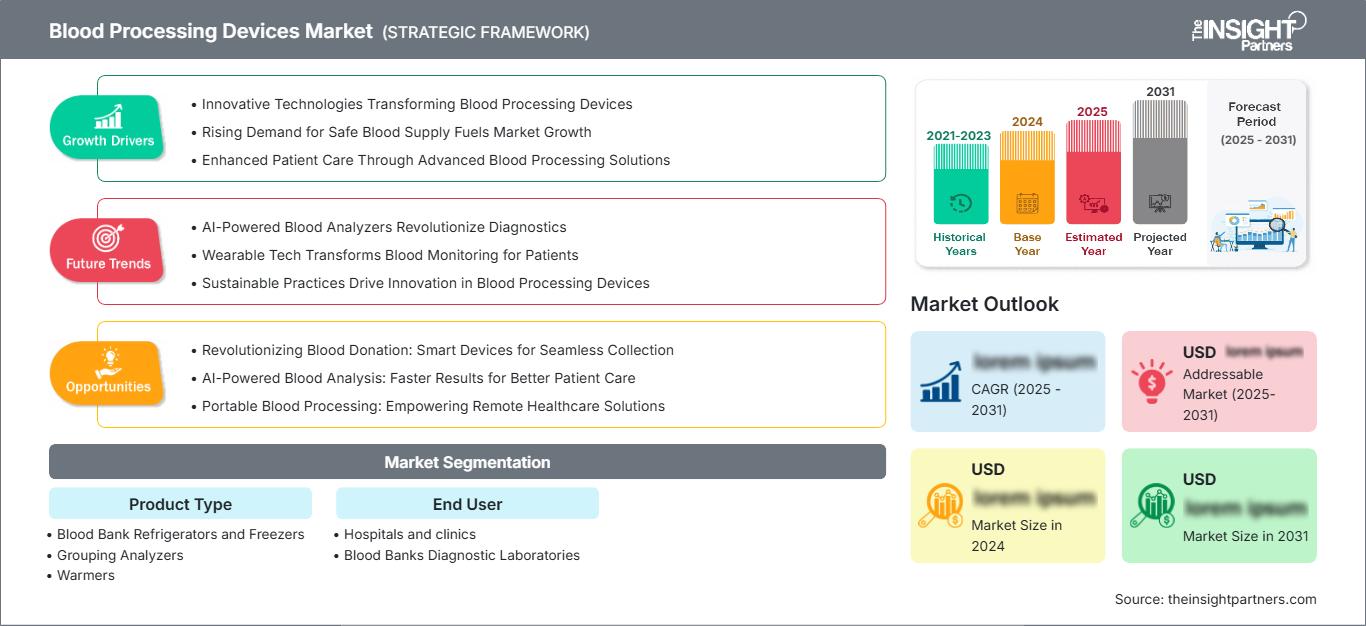
Regional Insights
North America Blood Processing Devices Market
In North America, the market share was recorded at an estimated 38-41% in 2025, and growth rate is expected at a CAGR of 8.8-9.4% in 2026-2034. The factors driving the Blood Processing Devices Market include the presence of high transfusion intensity, clinical diagnostic facilities, and investments in automated component separation technology. The supply of platelets is the key priority in blood centers as platelets need to be handled with short shelf life handling requirements and regular processing.
The market share in the region is driven by hospital mergers & acquisitions and laboratory networks where standard equipment needs to be acquired. Whole blood processing automation, refrigeration of blood banks, and grouping analyzers are common purchases in the market. Traceability, validation, and cold chain monitoring add to the regulatory pressures on adoption of connected devices.
U.S. Blood Processing Devices Market
The U.S. is estimated to account for 78-82% of North America in 2025 and is forecasted to grow at a CAGR of 8.6-9.2% over 2026-2034. The demand will be driven by large blood center networks, hospital transfusion departments, volume of treatments in oncology, and preparedness in emergencies. The market players include Terumo Corporation, Becton, Dickinson and Company, Immucor, Inc., Bio-Rad Laboratories, Inc., Abbott Laboratories, and Danaher Corporation.
The application trends involve automated platelet and component processing, compatibility testing, and refrigerator monitoring. In the U.S., there will be faster adoption of automation platforms cleared by FDA under conditions when labor limitations and platelet shortage put pressure on the work process. The procurement committees are paying more attention to factors such as processing speed, labor savings, consumable dependency, and integration with laboratory information system.
Europe Blood Processing Devices Market
The Europe region accounted for 27%–30% market share in 2025 and is expected to record a CAGR of 8.1%–8.7% from 2026 to 2034. The major countries in the region include Germany, driven by well-established transfusion medicine practice, automated hospital laboratories, and centralized quality systems; the United Kingdom, focusing on improving its blood storing, grouping, and processing systems to make it more resilient.
Germany has advantages of high procedural volume and adoption of blood technology, while the UK is focusing on process standardization and efficiency. Other major markets in Europe include France, Italy, and Spain, which have consistent demand due to investment in public hospitals, screening of donors, and updating of blood bank refrigeration equipment. Procurement decisions in Europe are highly dependent on CE certification, contract services, and energy efficiency.
APAC Blood Processing Devices Market
APAC region contributed a 22-25% market share in 2025 and is expected to experience a 11.1-12.0% CAGR growth rate in the period from 2026 to 2034. China is the biggest country in the region due to its growing hospital network, increasing diagnostics capabilities, and efforts to make blood supply safe. Premium automation is promoted by the need for blood banks in Japan and South Korea; India increases capacity through upgrading both public and private blood banks.
Australia is one of the technologically advanced regions where there are high compliance requirements. The industrial drivers here consist of local production of diagnostics, cold chain developments, and purchasing of analyzers and centrifuges. The policy drivers consist of voluntary donation and infection screening.
Middle East & Africa Blood Processing Devices Market
The Middle East & Africa is expected to grow at a CAGR of 7.5–8.4% during 2026–2034. Saudi Arabia is the leading country, supported by tertiary hospital expansion, national health transformation programs, and investment in laboratory infrastructure. The UAE follows with private hospital growth and demand for high-quality transfusion services.
South Africa anchors sub-Saharan adoption through established blood services and reference laboratories. Rest of MEA demand is uneven but improving as hospitals invest in cold chain devices, basic centrifugation, and donor testing capacity. Energy reliability and infrastructure quality remain important purchasing considerations for equipment uptime.
Segmentation Analysis
Product Type
Product Type is expected to register a CAGR of 9.5–10.2% during 2026–2034. The Blood Processing Devices Market scope under this segment includes equipment used for storage, separation, warming, typing, and cellular processing. Demand is shaped by component quality, faster turnaround, lower manual handling, and growing preference for platforms that integrate with traceability and quality management systems.
- Blood Bank Refrigerators and Freezers: These devices remain essential for compliant storage of red cells, plasma, and reagents, with demand tied to temperature stability, alarm systems, energy efficiency, and validated cold chain performance.
- Grouping Analyzers: Adoption is increasing in hospitals and diagnostic laboratories that need faster blood typing, antibody screening, and compatibility testing while reducing manual interpretation and sample handling errors.
- Warmers: Blood warmers serve operating rooms, emergency departments, and intensive care units where rapid transfusion and temperature control are critical for trauma, surgery, and neonatal care.
- Hematocrit Centrifuges: These systems continue to support routine laboratory workflows, especially in smaller facilities, by offering reliable packed cell volume measurement and simple processing at comparatively low operating cost.
- Cell Processors: Cell processors represent the largest product opportunity because they automate separation and component preparation, improving yield consistency, reducing operator variability, and supporting higher-throughput blood center operations.
End User
End User is expected to register a CAGR of 8.9–9.6% during 2026–2034. Hospitals, clinics, blood banks, and diagnostic laboratories are expanding procurement to address clinical demand, regulatory documentation, and productivity pressures. Purchasing behavior differs by setting, with blood banks prioritizing throughput and component quality, while hospitals emphasize emergency readiness, compatibility testing, and decentralized storage control.
- Hospitals and clinics: Hospitals and clinics require devices for transfusion support, emergency care, surgery, oncology, obstetrics, and intensive care, making reliability and rapid availability central to equipment selection.
- Blood Banks Diagnostic Laboratories: Blood banks diagnostic laboratories are strategic buyers of analyzers, centrifuges, refrigerators, and cell processors because their operations depend on standardized testing, component preparation, inventory control, and quality documentation.
Opportunity Snapshot
| Segment Name | Revenue Contribution (High/Medium/Low) | Trend Tag (MAX 2 words, specific) | Adoption Stage (Emerging/Scaling/Mature) |
| Hospitals and clinics | High | Emergency Care | Mature |
| Blood Banks Diagnostic Laboratories | High | Component Automation | Scaling |
Blood Processing Devices Market Growth Drivers and Impact Analysis
Automation of Blood Component Preparation
Automation will be an emerging buying driver in the context of shortages of skilled labor, inventory considerations, and requirement for standardization of component processing among shifts. Automation helps reduce the number of repetitive tasks that would otherwise have been performed manually, provides reproducibility during the process of separation, and allows staffs to handle more donations without necessarily adding more people to the workforce. Automation is a market factor, as buyers can easily make the case for capital investment in the form of reduced variance, higher productivity, and increased availability of platelets and plasma. Automation is particularly important in the markets where blood centers serve several hospitals at once.
Rising Demand for Safe and Traceable Transfusion Workflows
Stronger emphasis on transfusion safety is increasing demand for equipment that supports documentation, validation, and audit readiness. Hospitals and blood banks need refrigerators with alarm records, analyzers with reliable result traceability, and processors that limit human error during component preparation. The market impact is visible in replacement cycles, as older stand-alone devices struggle to meet modern quality system expectations. Buyers are also responding to hemovigilance programs and infection screening requirements that elevate the importance of standardized workflows. This driver supports both developed and emerging markets because traceability reduces clinical risk, improves confidence in blood availability, and strengthens regulatory compliance across transfusion networks.
Expansion of Hospital and Diagnostic Laboratory Infrastructure
New hospitals, specialty clinics, cancer centers, and diagnostic laboratories are expanding the installed base for blood processing equipment. Growth is strongest where governments and private providers are adding tertiary care capacity, surgical services, and emergency medicine networks. Each new high-acuity facility requires storage, warming, typing, and processing capability, either on-site or through a connected blood center. The market impact is cumulative because infrastructure expansion creates initial equipment demand and recurring needs for consumables, service, calibration, and replacement. Manufacturers with regional service teams and scalable product portfolios are well positioned to capture these projects as healthcare systems formalize blood safety and laboratory quality standards.
Blood Processing Devices Market Future Trends
Connected Quality Management Platforms
A major forward trend is the shift from device-level automation to connected quality management ecosystems. Blood Processing Devices Market trends indicate that future purchasing will favor platforms able to transmit temperature records, processing data, maintenance alerts, user logs, and batch information into laboratory information systems. This will reduce manual documentation and help supervisors detect deviations earlier. The trend will also support predictive maintenance, which is important for blood banks operating around the clock. Vendors that combine hardware reliability with cybersecurity, interoperability, and analytics will gain relevance as transfusion networks become more digitally governed and performance measured.
Decentralized Blood Support for Critical Care Networks
Critical care networks are expected to adopt more decentralized blood support capabilities, particularly in trauma centers, ambulatory surgery units, and regional hospitals. This does not eliminate centralized blood banks, but it changes device requirements at the clinical edge. Compact warmers, monitored storage units, and rapid compatibility tools will become more important where time-to-transfusion affects outcomes. The trend will encourage manufacturers to design smaller, easier-to-validate systems that fit distributed care models. It also creates service opportunities because decentralized devices require consistent calibration, software updates, and compliance documentation across many facilities rather than one central laboratory.
Blood Processing Devices Market Opportunities
Modernization of Emerging-Market Blood Banks
Emerging-market blood banks offer a strong investment opportunity as national programs move toward safer collection, component separation, and storage practices. Blood Processing Devices Market Forecasts point to sustained demand for refrigerators, centrifuges, analyzers, and cell processors where existing capacity is fragmented or heavily manual. Suppliers can capture value by offering phased modernization packages that combine equipment, operator training, validation protocols, and service contracts. The most attractive strategies will be localized, with financing flexibility and rugged devices suited to variable power conditions. Partnerships with public health agencies and hospital systems can accelerate adoption while improving blood availability and clinical reliability.
Lifecycle Services and Consumable-Led Revenue Models
Lifecycle service models are becoming a practical opportunity as customers seek uptime, compliance support, and predictable operating costs. Blood centers and hospitals increasingly prefer vendors that provide preventive maintenance, calibration, software updates, operator training, and guaranteed response times. This opportunity extends beyond equipment sales because installed devices create recurring demand for disposables, reagents, accessories, validation support, and replacement parts. Companies that build service density in high-growth regions can improve customer retention while reducing procurement risk for hospitals. Over time, service-led models can also provide manufacturers with operational data that informs product improvement and targeted upgrades.
Recent Developments
- October 2025: Terumo Blood and Cell Technologies, Inc. - The Blood Center in New Orleans became the second U.S. blood center to implement the Reveos Automated Blood Processing System and Lumia Software Platform. The deployment supports platelet supply expansion, whole blood automation, and workflow efficiency after earlier FDA clearance of the system for U.S. commercial use.
- August 2025: Canadian Blood Services detailed its agreement with Grifols to manufacture immunoglobulins for Canadian patients using plasma collected in Canada. The arrangement supports a domestic supply chain for plasma-derived medicines and reinforces Grifols’ role across plasma collection, processing, and transfusion-related healthcare infrastructure.
- March 2025: BD and Babson Diagnostics announced study results showing that selected blood tests using BD MiniDraw capillary blood collection technology were clinically equivalent to higher-volume venous draws. The findings support broader use of low-volume blood collection, sample preparation, and decentralized testing workflows.
Frequently Asked Questions

- Comprehensive Market Sizing and Forecast Analysis
- Detailed Segmentation Analysis
- In-Depth Market Dynamics Assessment
- Regional and Country-Level Insights
- Competitive Landscape and Company Benchmarking
- Strategic Business Intelligence
Recent Reports
Testimonials

The Insight Partners' SCADA System Market report is comprehensive, with valuable insights on current trends and future forecasts. The team was highly professional, responsive, and supportive throughout. We are very satisfied and highly recommend their services.
RAN KEDEM Partner, Reali Technologies LTDs
I requested a report on a very specific software market and the team produced the report in a few days. The information was very relevant and well presented. I then requested some changes and additions to the report. The team was again very responsive and I got the final report in less than a week.
JEAN-HERVE JENN Chairman, Future Analytica
We worked with The Insight Partners for an important market study and forecast. They gave us clear insights into opportunities and risks, which helped shape our plans. Their research was easy to use and based on solid data. It helped us make smart, confident decisions. We highly recommend them.
PIYUSH NAGPAL Sr. Vice President, High Beam Global
The Insight Partners delivered insightful, well-structured market research with strong domain expertise. Their team was professional and responsive throughout. The user-friendly website made accessing industry reports seamless. We highly recommend them for reliable, high-quality research services
YUKIHIKO ADACHI CEO, Deep Blue, LLC.
This is the first time I have purchased a market report from The Insight Partners.While I was unsure at first, I visited their web site and felt more comfortable to take the risk and purchase a market report.I am completely satisfied with the quality of the report and customer service. I had several questions and comments with the initial report, but after a couple of dialogs over email with their analyst I believe I have a report that I can use as input to our strategic planning process.Thank you so much for taking the extra time and making this a positive experience.I will definitely recommend your service to others and you will be my first call when we need further market data.
JOHN SUZUKI President and Chief Executive Officer, Board Director, BK Technologies
I wish to appreciate your support and the professionalism you displayed in the course of attending to my request for information regarding to infectious disease IVD market in Nigeria. I appreciate your patience, your guidance, and the fact that you were willing to offer a discount, which eventually made it possible for us to close a deal. I look forward to engaging The Insight Partners in the future, all thanks to the impression you have created in me as a result of this first encounter.
DR CHIJIOKE ONYIA MANAGING DIRECTOR, PineCrest Healthcare Ltd.Reason to Buy
- Informed Decision-Making
- Understanding Market Dynamics
- Competitive Analysis
- Identifying Emerging Markets
- Customer Insights
- Market Forecasts
- Risk Mitigation
- Boosting Operational Efficiency
- Strategic Planning
- Investment Justification
- Tracking Industry Innovations
- Aligning with Regulatory Trends





 Get Free Sample for