
Bluetooth Smart and Smart Ready Market Size, Trends & Demand by 2034
Coverage: By Technology (Bluetooth Smart, Bluetooth Smart Ready, Bluetooth 5.0); Application (Automotive, Consumer Electronics, Wearable Electronics, Healthcare, Building and Retail, Others), and Geography (North America, Europe, Asia Pacific, and South and Central America)
- Status : Data Released
- Report Code : TIPRE00015320
- Category : Electronics and Semiconductor
- No. of Pages : 150
- Available Report Formats :


- Last update date : July 17, 2026


2025 Market Size
US$ 5.66 Bn
Base year value
2034 Forecast
US$ 6.81 Bn
Projected by 2034
CAGR 2026-2034
2.08 %
Growth rate
Addressable Market
US$ 56.54 Bn
(2026-2034)
Bluetooth Smart and Smart Ready market was valued at US$ 5.66 Billion in 2025 and is projected to reach US$ 6.81 Billion by 2034, registering a CAGR of 2.08% during 2026–2034. The Bluetooth Smart and Smart Ready technology offers efficient wireless connectivity between connected devices for sensing, data transfer, audio, location, and control purposes in a variety of industries including consumers, automobiles, health care, wearables, buildings, and retail sectors.
In North America, the Bluetooth Smart and Smart Ready Market Size is anticipated to experience growth with a CAGR of 1.8-2.4% from 2026 to 2034, owing to advanced maturity of smartphones and continued upgrading of existing short-range modules. Demand for this market will be fueled by connected car systems, smart building upgrades, health care monitors, and consumer electronics upgrades.
Bluetooth Smart and Smart Ready Market Assessment and Insights
- North America held 29–33% of the Bluetooth Smart and Smart Ready market share in 2025 and is growing at a CAGR of 1.8–2.4% during 2026–2034, supported by automotive connectivity, smart homes, and healthcare monitoring.
- US represented 78–82% of North American revenue in 2025 and is growing at a CAGR of 1.9–2.5% during 2026–2034, led by device OEMs, hospitals, retailers, and vehicle electronics.
- Europe accounted for 23–27% share in 2025 and is growing at a CAGR of 1.6–2.2% during 2026–2034, with Germany, the UK, France, Italy, and Spain leading adoption.
- Asia Pacific held 34–38% share in 2025 and is growing at a CAGR of 2.3–3.0% during 2026–2034, led by China, Japan, South Korea, India, and Taiwan-centered electronics supply chains.
- Largest Segment Consumer Electronics held 38–42% market share in 2025 and is growing at a CAGR of 1.7–2.3% during 2026–2034 as Bluetooth remains embedded in personal devices.
- High Growth Segment Healthcare represented 10–14% market share in 2025 and is growing at a CAGR of 2.8–3.5% during 2026–2034 as remote monitoring and connected diagnostics expand.
- Key companies analyzed in detail: Broadcom Inc.; Infineon Technologies AG; Renesas Electronics Corporation; Marvell Technology, Inc.; Microchip Technology Inc.; Murata Manufacturing Co., Ltd.; Nordic Semiconductor ASA; Qualcomm Technologies, Inc.; Texas Instruments Incorporated; Silicon Laboratories Inc.
Source: The Insight Partners' analysis based on proprietary research, government publications, company annual reports, investor presentations, industry databases, and expert interviews.
The technology has gone from being an option in connectivity to a design layer for small electronics, automobile cabin applications, industrial sensing, medical applications, and smart buildings. The manufacturing environment is now driven by systems on chip platforms, radio frequency design, firmware security, certification, modules, and software development kits. Bluetooth 5.0 and its successors have increased the range, broadcast capability, and large scale IoT network capabilities without increasing power consumption.
Future demand will depend upon device replacements and not adoptions as the vast majority of today's smartphones, tablets, computers, and wearable technologies already incorporate Bluetooth. Future gains will be derived from developing markets, medical wearables, connected cars, smart buildings and retail infrastructure where low-power connectivity remains economical. Investments will be focused upon multiprotocol ICs, on-boarding, over-the-air updates, and combination of Bluetooth with Wi-Fi, Thread, Zigbee, and cellular gateways.
Bluetooth Smart and Smart Ready Market Report Scope
| Report Attribute | Details |
|---|---|
| Market size in 2025 | US$ 5.66 Billion |
| Market Size by 2034 | US$ 6.81 Billion |
| Global CAGR (2026 - 2034) | 2.08% |
| Historical Data | 2021-2024 |
| Forecast period | 2026-2034 |
Bluetooth Smart and Smart Ready Market Analysis
The Bluetooth Smart and Smart Ready Market growth will be driven by the requirement for short-range, low power connectivity in mass market connected products. The ecosystem will have the advantage of good compatibility with smartphones, well-established certification process, and the work being done by Bluetooth SIG in the specification. By 2025, annual shipments of Bluetooth devices are estimated to be more than 5.3 billion and close to 8 billion by 2029.
The value chain consists of IP providers, semiconductor companies, module companies, contract manufacturers, device manufacturers, software developers, certification houses, distributors, and cloud applications providers. Supply dynamics reward suppliers who provide good radio performance in terms of power consumption, security, reference designs, and development kits. Buyers look at the amount of energy consumption, interoperability, firmware support, bill of materials cost, and antenna performance among others.
The Competitive Environment of Bluetooth Smart and Bluetooth Smart Ready Market Report reveals that competition is driven by size of semiconductor scale, software capabilities and ecosystem reach. Among others, Broadcom Inc., Qualcomm Technologies, Inc., Texas Instruments Incorporated, Nordic Semiconductor ASA, Microchip Technology Inc., Murata Manufacturing Co., Ltd., Renesas Electronics Corporation, Infineon Technologies AG, Marvell Technology, Inc., and Silicon Laboratories Inc. compete in terms of radio integrated solutions, reference designs, qualification for automobiles, multiprotocol operation, and long lifecycle.
Key areas of investment include Bluetooth 5.0 and beyond systems, LE Audio capable platforms, Channel Sounding, automotive digital keying, body sensors, and industrial IoT modules. Key success factors include supporting OEMs in reducing development cycle and addressing security, power consumption and compliance requirements. Distributors, design services and experience in firmware updates increase chances of succeeding in repeat programs in consumer electronic devices, medical devices and building automation products.
● REPORT CUSTOMIZATION
Tailor This Report To Align With Your Specific Business Requirements
This report can be customized to align precisely with your business objectives, scope, and target markets. Customization options include tailored segmentation, geography, competitive analysis, and strategic insights to support informed decision-making.
Customize This Report →WHAT YOU CAN ADJUST
- ● Segmentations
- ● Geography
- ● Competitive Analysis
- ● Language Preferences
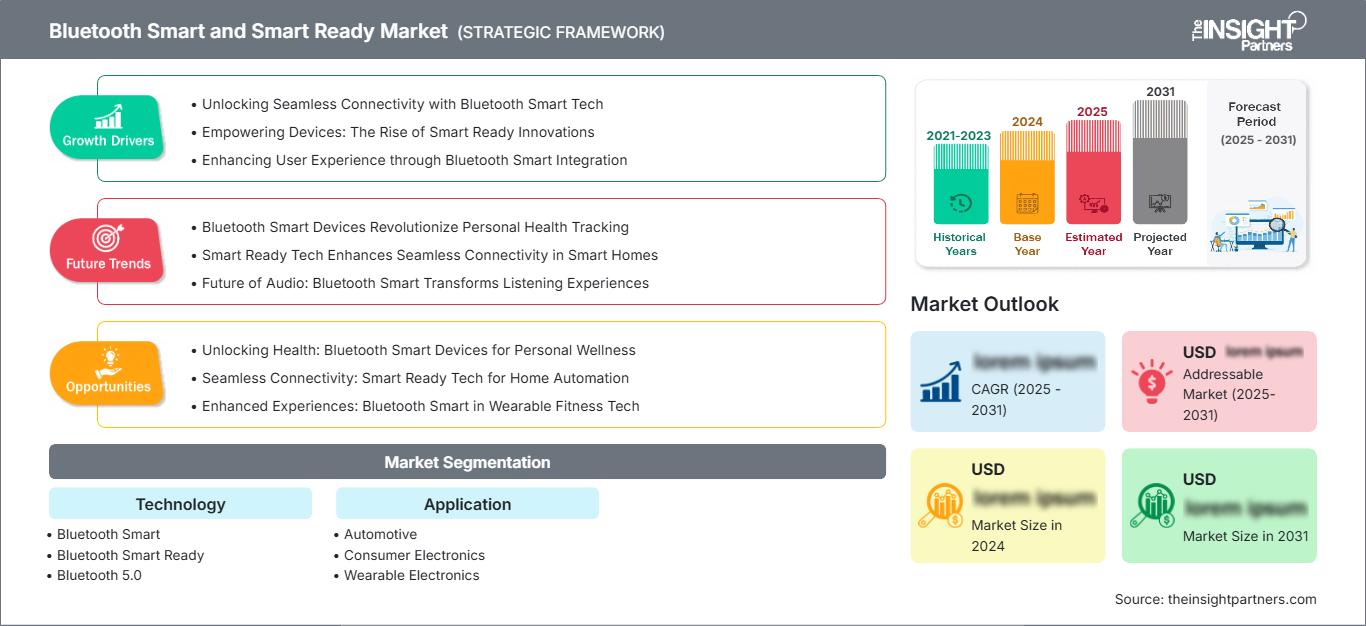
Bluetooth Smart and Smart Ready Market: Strategic Insights
Regional Insights
North America Bluetooth Smart and Smart Ready Market
North America accounted for 29–33% of Bluetooth Smart and Smart Ready Market share in 2025 and is projected to grow at a CAGR of 1.8–2.4% during 2026–2034. Demand is anchored by consumer electronics replacement, connected vehicles, smart access systems, healthcare wearables, and enterprise building controls. The region’s installed smartphone base supports rapid pairing, app integration, and accessory adoption across homes, hospitals, offices, and retail stores.
Structural drivers include high cloud adoption, advanced medical-device commercialization, strong automotive electronics content, and continued investment in smart facilities. Qualcomm Technologies, Inc., Broadcom Inc., Texas Instruments Incorporated, Microchip Technology Inc., and Silicon Laboratories Inc. maintain strong regional engineering and channel presence. Growth remains moderate because penetration is mature, but premium devices create demand for more secure, lower-power, and multi-radio chipsets.
U.S. Bluetooth Smart and Smart Ready Market
The U.S. represented 78–82% of North American revenue in 2025 and is forecast to expand at a CAGR of 1.9–2.5% during 2026–2034. Application demand is concentrated in smartphones, PCs, audio accessories, smart home devices, vehicles, hospital monitoring equipment, and retail infrastructure. Domestic design activity remains important even where production is outsourced to Asian manufacturing partners.
Company presence is reinforced by Qualcomm Technologies, Inc., Broadcom Inc., Texas Instruments Incorporated, Microchip Technology Inc., and Silicon Laboratories Inc. U.S. medical-device makers use Bluetooth links for patient monitoring and home diagnostics, while automakers add phone-as-key, infotainment, and cabin sensing features. Retailers deploy connected labels, payment peripherals, and beacons where Bluetooth Smart and Smart Ready improves customer and inventory workflows.
Europe Bluetooth Smart and Smart Ready Market
Europe held 23–27% share in 2025 and is expected to grow at a CAGR of 1.6–2.2% during 2026–2034. Germany leads through automotive electronics, industrial automation, and medical engineering, with Bluetooth Smart and Smart Ready supporting digital keys, sensor nodes, production tools, and connected patient devices. The UK adds strong demand from smart homes, retail, universities, and consumer technology brands.
France, Italy, and Spain contribute through healthcare modernization, building automation, tourism venues, and electronics distribution. Europe’s regulatory environment encourages secure pairing, data minimization, and long-term device support, which influences supplier selection. Infineon Technologies AG and Nordic Semiconductor ASA strengthen regional credibility, while Murata Manufacturing Co., Ltd., Renesas Electronics Corporation, and Microchip Technology Inc. support module and component availability.
APAC Bluetooth Smart and Smart Ready Market
Asia Pacific accounted for 34–38% share in 2025 and is forecast to grow at a CAGR of 2.3–3.0% during 2026–2034. China leads through electronics manufacturing, smartphones, wearables, smart home devices, and connected appliances, while Japan and South Korea add automotive, audio, and premium consumer electronics demand.
India and Australia support growth through rising device ownership, healthcare digitization, retail technology, and building systems. Industrial policy, export manufacturing, and smart-city programs reinforce adoption. Murata Manufacturing Co., Ltd., Renesas Electronics Corporation, Nordic Semiconductor ASA, and Qualcomm Technologies, Inc. benefit from strong OEM relationships and design-in activity across regional supply chains.
Middle East & Africa Bluetooth Smart and Smart Ready Market
The Middle East & Africa market is projected to grow at a CAGR of 1.5–2.1% during 2026–2034. The UAE leads through smart buildings, airports, hospitality, retail, and connected infrastructure, while Saudi Arabia expands adoption through healthcare investment, tourism assets, and large urban development programs.
South Africa contributes through retail, medical devices, education, and industrial automation, while Rest of MEA demand remains concentrated in urban centers. Energy and infrastructure projects create use cases for sensors, access control, and workforce devices. Growth depends on device affordability, integrator capability, and availability of modules that tolerate heat, power variation, and maintenance constraints.
Segmentation Analysis
Technology
Technology is projected to grow at a CAGR of 1.9–2.5% during 2026–2034. The Bluetooth Smart and Smart Ready Market scope covers Bluetooth Smart, Bluetooth Smart Ready, and Bluetooth 5.0, with adoption shaped by power budgets, backward compatibility, range, throughput, security, and certification timing. Mature devices use established Bluetooth Smart profiles, while new designs increasingly adopt Bluetooth 5.0 and later capabilities for broadcast, mesh, and richer IoT performance.
- Bluetooth Smart remains important for battery-powered sensors, wearables, medical devices, and accessories where low-energy operation, small data packets, and broad smartphone compatibility are essential.
- Bluetooth Smart Ready supports host devices such as smartphones, tablets, PCs, and gateways that connect with both classic Bluetooth and low-energy peripherals across mixed device ecosystems.
- Bluetooth 5.0 adds stronger strategic value through longer range, higher speed options, improved advertising capacity, and support for larger IoT deployments in buildings and industrial sites.
Application
Application is forecast to grow at a CAGR of 2.0–2.7% during 2026–2034. Consumer electronics generates the largest revenue base, while automotive, wearable electronics, healthcare, and building and retail create more specialized requirements. Bluetooth Smart and Smart Ready Market is selected when product teams need reliable pairing, low energy use, small form factors, and interoperability with phones, gateways, or cloud-linked companion applications.
- Automotive uses Bluetooth for infotainment, phone-as-key, tire monitoring, diagnostics, cabin accessories, and service tools, making qualification, security, and lifecycle supply critical for design wins.
- Consumer Electronics leads demand through smartphones, PCs, audio devices, remotes, gaming accessories, cameras, and smart home hubs that require fast pairing and broad interoperability.
- Wearable Electronics prioritizes ultra-low power, compact modules, secure pairing, and stable app synchronization for watches, fitness bands, hearing devices, trackers, and personal wellness products.
- Healthcare adoption centers on connected diagnostics, remote patient monitoring, medication devices, hospital sensors, and wellness equipment where data reliability and patient privacy are central.
- Building and Retail uses Bluetooth for access control, occupancy sensing, smart labels, beacons, lighting controls, payments, and inventory workflows across stores, offices, hotels, and public venues.
Opportunity Snapshot
| Application | Revenue Contribution | Trend Tag | Adoption Stage |
| Automotive | Medium | Digital Key | Scaling |
| Consumer Electronics | High | Device Refresh | Mature |
| Wearable Electronics | High | Wellness Sync | Scaling |
| Healthcare | Medium | Remote Care | Scaling |
| Building and Retail | Medium | Smart Spaces | Emerging |
Bluetooth Smart and Smart Ready Market Growth Drivers and Impact Analysis
Connected device replacement sustains chipset demand
Device upgrades make for the most persistent driver due to the constant upgrade of the Bluetooth functionality, which takes place each time there is an update of smartphones, headphones, wearables, remotes, PCs, gateways, and home appliances. The use of Bluetooth Smart and Smart Ready makes it possible to keep compatibility while improving power consumption, sound quality, connection speed, and data security. The effect on the market comes in the form of consistent chip demand without sudden unit growth, which corresponds to the moderate CAGR in the world. Suppliers that offer certified reference designs, small form factor modules, and software stacks ensure faster engineering processes for device manufacturers.
Healthcare monitoring shifts connectivity closer to patients
Adoption of healthcare is increasing as the tracking technology shifts from hospitals to homes and clinics and even wearables. Blood pressure trackers, blood sugar monitors, pulse oximeter, patches, accessories, and rehab aids are examples of medical products which will require energy-efficient connectivity solutions that will connect efficiently with smart phones or gateways. Bluetooth Smart and Smart Ready Market have proven themselves through their pairing capability and efficient power usage which allows them to enable patient engagement without the need for any complicated infrastructures. The economic implication is high revenue per design due to the fact that medical products require secure firmware, robust documentation, regulatory help, and long-lasting products.
Automotive and building systems expand low-power use cases
Automobiles and structures are equipping themselves with Bluetooth connectivity to facilitate access, sensing, diagnostics, controls, lighting, assets tracking, and user interface. Automotive companies find smartphone-based access, cabin customization, tire sensing, and diagnostic useful whereas building operators find the applications like occupancy, smart locks, beacons, and lighting applications useful through Bluetooth. The market impact is the larger design opportunity for long lifecycle platforms; however, the qualification criteria are higher compared to consumer electronics industry. Bluetooth Smart and Bluetooth Smart Ready companies need to offer capabilities for handling temperature variations, Wi-Fi, and cellular network co-existence, security, and reliable availability.
Bluetooth Smart and Smart Ready Market Future Trends
Channel Sounding improves secure distance awareness
Bluetooth Smart and Smart Ready Market trends point toward more accurate and secure distance measurement as Bluetooth Channel Sounding moves into commercial devices. This capability can strengthen digital keys, item finding, access control, warehouse positioning, and industrial safety by reducing reliance on rough signal strength estimates. Future adoption will depend on chip availability, firmware maturity, and ecosystem testing across phones, tags, vehicles, and gateways. Vendors will need to explain accuracy limits, interference behavior, and battery trade-offs clearly. Designs that support secure ranging through software upgrade paths should appeal to OEMs seeking differentiated features without replacing the broader Bluetooth ecosystem.
Multiprotocol chips become default IoT building blocks
In future IoT solutions, the use of chips based on combinations of Bluetooth, Thread, Zigbee, Wi-Fi or sub-GHz radios will be required. This way, product designers will be able to leverage the ability of smartphones to onboard via Bluetooth but utilize mesh or gateway networks for automation and internet connectivity purposes. This trend will move competition from the single radio capabilities to software ecosystems, firmware security updates, and quality of development tools. The development trend is likely to benefit module providers that can assist small OEMs in dealing with certification issues. Bluetooth Smart and Smart Ready will be the universal interface for the user in most multiprotocol devices.
Bluetooth Smart and Smart Ready Market Opportunities
Medical wearables and home diagnostics create premium design wins
Bluetooth Smart and Smart Ready Market Forecast support investment in medical wearables and home diagnostics because healthcare systems need lower-cost monitoring outside hospitals. Suppliers can target patches, connected inhalers, rehabilitation devices, glucose monitors, thermometers, and multi-parameter wellness products. The opportunity is attractive where OEMs require validated reference designs, secure provisioning, mobile app interoperability, and stable supply over long product cycles. Semiconductor and module vendors should package documentation, coexistence testing, encryption support, and developer tools that reduce regulatory risk. Partnerships with device manufacturers and digital health platforms can convert Bluetooth connectivity from a basic feature into a trusted clinical data pathway.
Smart building retrofits need economical wireless sensing
Existing buildings create a practical opportunity because wired sensing retrofits are expensive and disruptive. Bluetooth sensors, tags, locks, lighting controls, and gateways can support occupancy analytics, energy management, indoor guidance, access control, and maintenance workflows with lower installation effort. The opportunity is strongest in offices, hotels, hospitals, universities, malls, and public venues that want phased digitization. Vendors should offer interoperable modules, gateway software, battery planning, and integration with building-management platforms. Success will depend on cybersecurity, device lifecycle management, and proof that wireless sensing improves utilization, service response, or energy efficiency within acceptable payback periods.
Recent Developments
- April 2026: Minew, a global leader in wireless IoT hardware, spearheaded critical dialogues on the future of industrial intelligence at Bluetooth Asia 2026. During a high-level executive panel, Minew Co-founder and General Manager Johnson Zhang detailed the company’s strategic roadmap for converging Bluetooth connectivity with Artificial Intelligence (AI) to catalyze the next phase of Industry 4.0.
- March 2026: Nordic Semiconductor, a global leader in low-power wireless connectivity solutions, unveils its new entry-level, ultra-low-power Bluetooth Low Energy (LE) Systems-on-Chip (SoCs) – the nRF54LS05A and nRF54LS05B. Both can serve as the main wireless SoC in single-chip systems, or operate as Bluetooth LE companion devices in multi-chip systems, benefiting from Nordic’s market-leading Bluetooth LE technology.
- May 2024: System designers face many barriers when adding Bluetooth® functionality to their products, from skill and resource limitations to budget constraints to time-to-market pressures to challenging performance and integration requirements. Microchip Technology (Nasdaq: MCHP) has expanded its Bluetooth Low Energy portfolio with 12 new products, aimed at providing designers with an extensive array of choices to tackle their unique challenges, effectively lowering barriers across designs spanning from the simplest to the most advanced. These additions include the RF-ready WBZ350 module and the PIC32CX-BZ3 SoC that offers the lowest entry point available for integrating a Bluetooth Low Energy microcontroller (MCU) into product designs.
Frequently Asked Questions

- Comprehensive Market Sizing and Forecast Analysis
- Detailed Segmentation Analysis
- In-Depth Market Dynamics Assessment
- Regional and Country-Level Insights
- Competitive Landscape and Company Benchmarking
- Strategic Business Intelligence
Recent Reports
Testimonials

The Insight Partners' SCADA System Market report is comprehensive, with valuable insights on current trends and future forecasts. The team was highly professional, responsive, and supportive throughout. We are very satisfied and highly recommend their services.
RAN KEDEM Partner, Reali Technologies LTDs
I requested a report on a very specific software market and the team produced the report in a few days. The information was very relevant and well presented. I then requested some changes and additions to the report. The team was again very responsive and I got the final report in less than a week.
JEAN-HERVE JENN Chairman, Future Analytica
We worked with The Insight Partners for an important market study and forecast. They gave us clear insights into opportunities and risks, which helped shape our plans. Their research was easy to use and based on solid data. It helped us make smart, confident decisions. We highly recommend them.
PIYUSH NAGPAL Sr. Vice President, High Beam Global
The Insight Partners delivered insightful, well-structured market research with strong domain expertise. Their team was professional and responsive throughout. The user-friendly website made accessing industry reports seamless. We highly recommend them for reliable, high-quality research services
YUKIHIKO ADACHI CEO, Deep Blue, LLC.
This is the first time I have purchased a market report from The Insight Partners.While I was unsure at first, I visited their web site and felt more comfortable to take the risk and purchase a market report.I am completely satisfied with the quality of the report and customer service. I had several questions and comments with the initial report, but after a couple of dialogs over email with their analyst I believe I have a report that I can use as input to our strategic planning process.Thank you so much for taking the extra time and making this a positive experience.I will definitely recommend your service to others and you will be my first call when we need further market data.
JOHN SUZUKI President and Chief Executive Officer, Board Director, BK Technologies
I wish to appreciate your support and the professionalism you displayed in the course of attending to my request for information regarding to infectious disease IVD market in Nigeria. I appreciate your patience, your guidance, and the fact that you were willing to offer a discount, which eventually made it possible for us to close a deal. I look forward to engaging The Insight Partners in the future, all thanks to the impression you have created in me as a result of this first encounter.
DR CHIJIOKE ONYIA MANAGING DIRECTOR, PineCrest Healthcare Ltd.Reason to Buy
- Informed Decision-Making
- Understanding Market Dynamics
- Competitive Analysis
- Identifying Emerging Markets
- Customer Insights
- Market Forecasts
- Risk Mitigation
- Boosting Operational Efficiency
- Strategic Planning
- Investment Justification
- Tracking Industry Innovations
- Aligning with Regulatory Trends





 Get Free Sample for