
Body Temperature Trend Indicator Market Size, Growth & Demand by 2034
Coverage: by Product Type (Digital, Infrared); Application (Hospital, Clinic, Home), and Geography (North America, Europe, Asia Pacific, and South and Central America)
- Status : Data Released
- Report Code : TIPRE00011638
- Category : Life Sciences
- No. of Pages : 150
- Available Report Formats :


- Last update date : July 29, 2026


2025 Market Size
US$ 2.64 Bn
Base year value
2034 Forecast
US$ 4.01 Bn
Projected by 2034
CAGR 2026-2034
5.36 %
Growth rate
Addressable Market
US$ 31.13 Bn
(2026-2034)
The Body Temperature Trend Indicator Market size is predicted to rise from US$ 2.64 Billion in 2025 to US$ 4.01 Billion by 2034, at a CAGR of 5.36% during 2026–2034. This demand is driven by real-time tracking of vital signs, fever detection, remote care services, and infection control processes in hospitals, medical clinics, and homes.
North America’s market size is propelled by the modernization of hospitals, widespread use of home health care services, and acquisition of connected vital sign devices. It is estimated to generate a CAGR range of 4.8–5.2% during 2026-2034, where the demand will be led by emergency care facilities, pediatric assessment centers, long-term care centers, and consumers' preference for rapid and clean body temperature measurement devices.
Body Temperature Trend Indicator Market Assessment and Insights
- North America accounted for 36–38% share in 2025 and is expected to grow at a CAGR between 2026–2034 of 4.8–5.2%, supported by high installed bases of hospital monitors, ambulatory care expansion, and home-based chronic care programs.
- US represented 79–82% of North America share in 2025 and is projected to grow at a CAGR between 2026–2034 of 4.6–5.0%, driven by hospital replacement cycles and consumer digital health uptake.
- Europe held 25–27% share in 2025 and is expected to grow at a CAGR between 2026–2034 of 4.6–5.0%, with Germany, the UK, and France leading adoption through standardized clinical thermometry protocols.
- Asia Pacific accounted for 24–26% share in 2025 and is projected to grow at a CAGR between 2026–2034 of 6.1–6.7%, led by China, Japan, India, South Korea, and Australia.
- Largest Segment Digital products held 61–64% market share in 2025 and are expected to grow at a CAGR between 2026–2034 of 4.9–5.3%, owing to affordability, reliability, and broad clinical use.
- High Growth Segment Infrared products held 36–39% market share in 2025 and are expected to grow at a CAGR between 2026–2034 of 5.9–6.5%, supported by non-contact measurement demand.
- Key companies analyzed in detail: Koninklijke Philips N.V., NOVAMED USA, Sharn Anesthesia Inc., Biosynergy Inc., Baxter International Inc., OMRON Healthcare Co. Ltd., Beurer GmbH, Microlife Corporation, Kaz USA Inc., Terumo Corporation, Exergen Corporation, iHealth Labs Inc., and Masimo Corporation.
Source: The Insight Partners' analysis based on proprietary research, government publications, company annual reports, investor presentations, industry databases, and expert interviews.
Migration of technology is redefining the market, as the traditional mercury thermometer and analog models are being phased out in favor of more electronic, infrared and connected versions. Manufacturers are perfecting sensor technologies, algorithms, probes, displays and Bluetooth-enabled processes in the manufacturing process that is becoming increasingly split between lower-cost assembly in Asia and tightly regulated distribution in North American and European clinical markets. Hospitals will require calibration, infection prevention and interoperability, while individuals want simplicity and quickness.
The forecast period will see growing demand in emerging care environments, which include primary clinics, retail health outlets and home monitoring services. The regulatory push for accurate devices, digital health payment and pandemic preparedness planning is driving growth. Future investment will probably focus on connected infrared devices, pediatric versions and thermometers embedded within vital signs monitoring systems.
Body Temperature Trend Indicator Market Report Scope
| Report Attribute | Details |
|---|---|
| Market size in 2025 | US$ 2.64 Billion |
| Market Size by 2034 | US$ 4.01 Billion |
| Global CAGR (2026 - 2034) | 5.36% |
| Historical Data | 2021-2024 |
| Forecast period | 2026-2034 |
Body Temperature Trend Indicator Market Analysis
The Body Temperature Trend Indicator Market Growth Pathway is linked with the transition in general from sporadic to continuous monitoring of vital signs. Hospitals need consistent measurements in operating rooms, intensive care units, emergency departments, and recovery rooms; at the same time, clinics demand high flow rates and minimal contamination. Domestic demand will stay robust since fever is one of the first signs that caregivers, children, and senior citizens look for.
The value chain encompasses sensor producers, plastics and probe cover producers, electronics assemblies manufacturers, calibration services, distributors, group purchasing organizations, pharmacies, eCommerce channels, and hospital buyers. The supply trends become affected more and more by semiconductor supply, quality management systems, and regional inventories. The infrared devices should be highlighted where time is essential, while the digital devices remain strong due to price and reliability.
Moderate level of competitive intensity notwithstanding, the market analysis exhibits differentiation among clinical and consumer suppliers. Koninklijke Philips N.V. and Baxter International Inc. are favored by the presence of an ecosystem for monitoring in hospitals, whereas OMRON Healthcare Co. Ltd., Beurer GmbH, Microlife Corporation, Kaz USA Inc., and iHealth Labs Inc. thrive in the home and pharmacy market segments.
The specialist players in the market, like Exergen Corporation, Sharn Anesthesia Inc., Biosynergy Inc., NOVAMED USA, Terumo Corporation, and Masimo Corporation emphasize differentiation through specific measurement types, surgical devices, or monitoring solutions. Strategic positioning in the Body Temperature Trend Indicator Market is increasingly determined by validation, procurement, regulatory compliance, infection control, and bundling of thermometry into vital signs and remote patient monitoring systems.
● REPORT CUSTOMIZATION
Tailor This Report To Align With Your Specific Business Requirements
This report can be customized to align precisely with your business objectives, scope, and target markets. Customization options include tailored segmentation, geography, competitive analysis, and strategic insights to support informed decision-making.
Customize This Report →WHAT YOU CAN ADJUST
- ● Segmentations
- ● Geography
- ● Competitive Analysis
- ● Language Preferences
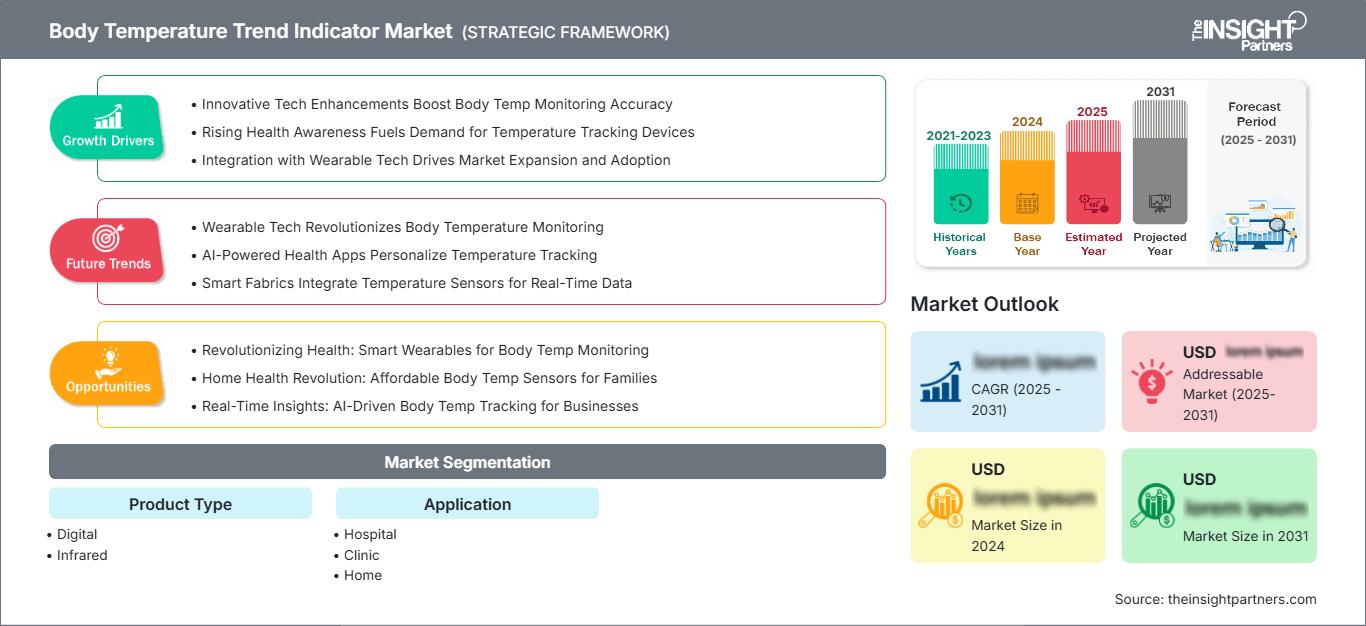
Body Temperature Trend Indicator Market: Strategic Insights
Regional Insights
North America Body Temperature Trend Indicator Market
North America led with 36–38% share in 2025 and is projected to expand at a CAGR of 4.8–5.2% during 2026–2034. The Body Temperature Trend Indicator Market share in the region reflects advanced hospital infrastructure, strong outpatient utilization, and rapid replacement of conventional devices with digital and infrared systems. Demand is also supported by long-term care facilities and urgent care networks.
Procurement decisions increasingly emphasize accuracy standards, cleanability, probe-cover availability, and integration with electronic medical records. Hospitals prefer validated brands for multi-department use, while households favor no-touch and fast-read devices through pharmacy and online channels. Broader chronic disease management and remote monitoring programs support recurring demand for temperature tracking as part of vital-sign routines.
U.S. Body Temperature Trend Indicator Market
In 2025, the U.S. occupied 79–82% share of North America and is projected to record CAGR of 4.6–5.0% between 2026 and 2034. Hospital chains, ambulatory surgery centers, children’s clinics, and retail clinics sustain constant need for thermometers. Trends in use are prevalent in hospital triage, anesthesia support, at-home fever measurement, and remote care kits.
Presence of companies is extensive; Baxter International Inc., Koninklijke Philips N.V., Exergen Corporation, iHealth Labs Inc., Masimo Corporation, and Kaz USA Inc. operate in both clinical and consumer market segments. Among others, it provides opportunities for specialized accessories manufacturers such as Sharn Anesthesia Inc. and Biosynergy Inc. Thermometer replacement preference shifts towards infrared, connected, and workflow-friendly devices to save on staff time during multiple measurements.
Europe Body Temperature Trend Indicator Market
Europe held 25–27% share in 2025 and is forecast to grow at a CAGR of 4.6–5.0% during 2026–2034. Germany is the leading country, supported by well-funded hospitals, strict device quality expectations, and acceptance of certified digital thermometry in clinical environments.
There is continued growth in the UK due to NHS procurement practices, expansion of community care services, and use of standardized fever tests in primary care facilities. Germany enjoys excellent medical device distribution networks, need for chronic condition monitoring devices, and preference for tested home healthcare devices by regional manufacturers like Beurer GmbH and Microlife Corporation.
The countries of France, Italy, and Spain play their part by improving hospital facilities, increased private clinic development, and customer preference for pediatric and elderly devices. Price sensitivity is more prevalent in Southern Europe although pharmacy-based sales continue to withstand the trend.
APAC Body Temperature Trend Indicator Market
APAC accounted for 24–26% share in 2025 and is expected to grow at a CAGR of 6.1–6.7% during 2026–2034. China is the leading country, supported by large-scale hospital procurement, electronics manufacturing capacity, and rising household health-monitoring awareness.
Japan and South Korea favor high-quality clinical and home devices, while India is expanding through private hospitals, diagnostic chains, and e-commerce retail. Australia contributes through remote care and aged-care monitoring. Policy investment in primary care, domestic device manufacturing, and infection-readiness infrastructure supports sustained adoption across the region.
Middle East & Africa Body Temperature Trend Indicator Market
The Middle East & Africa market is expected to register a CAGR of 5.7–6.3% during 2026–2034. Saudi Arabia is the leading country, supported by healthcare infrastructure investment, hospital capacity expansion, and regulatory pathways for advanced medical devices.
The UAE shows demand from private hospitals, clinics, and medical tourism facilities, while South Africa leads sub-Saharan uptake through tertiary care and pharmacy channels. Energy revenues in Gulf countries support public healthcare spending, and infrastructure projects create demand for connected vital-sign systems. Rest of MEA remains more price-sensitive, favouring durable digital products.
Segmentation Analysis
Product Type
Product Type is expected to grow at a CAGR of 5.1–5.7% during 2026–2034. The Body Temperature Trend Indicator Market scope across product types is defined by the transition from basic readout devices to faster, safer, and more connected thermometry systems. Digital products dominate installed volume, while infrared devices capture incremental demand in infection-control-sensitive settings, pediatrics, screening points, and home care.
- Digital products remain the largest category because they offer dependable accuracy, lower unit cost, and established use across hospitals, clinics, and households where repeat measurement and affordability are critical.
- Infrared products are gaining strategic importance through no-contact or low-contact use, faster readings, and suitability for pediatric, emergency, and high-throughput settings requiring hygienic workflow.
Application
Application is expected to grow at a CAGR of 5.0–5.6% during 2026–2034. Market adoption differs by care setting, with hospitals prioritizing accuracy, documentation, and infection prevention, while clinics emphasize speed and throughput. Home users increasingly purchase infrared and digital devices as routine wellness tools, particularly for children, older adults, and respiratory infection monitoring.
- Hospital applications contribute high revenue through multi-unit procurement, replacement cycles, calibration needs, and use across intensive care, emergency, anesthesia, recovery, and inpatient monitoring departments.
- Clinic applications show consistent demand as primary care, urgent care, pediatric practices, and diagnostic centers require fast, durable, and easy-to-clean thermometry devices.
- Home applications are scaling as caregivers adopt simple, quick-reading devices for fever tracking, post-discharge observation, chronic care support, and seasonal infection management.
Opportunity Snapshot
| Segment Name | Revenue Contribution | Trend Tag | Adoption Stage |
| Hospital | High | Connected Vitals | Mature |
| Clinic | Medium | Rapid Triage | Scaling |
| Home | Medium | Fever Tracking | Scaling |
Body Temperature Trend Indicator Market Growth Drivers and Impact Analysis
Shift Toward Connected Vital-Sign Workflows
The connected workflow will become a key area of growth, as temperature measurement becomes an integral component of the broader patient status dataset rather than a standalone parameter. Hospitals are making acquisitions that allow for better documentation, less manual transcriptions, and improved visibility in their wards. Connectivity favors thermometry suppliers who manufacture monitoring equipment, Bluetooth devices, and other accessories that work with currently available bedside equipment. The practical effect becomes visible in intensive care units, where regular temperature measurement gives information about infection, surgical recovery, and drug reactions. Connectivity can help procurement departments perform audits, increase efficiency, and monitor equipment usage.
Rising Preference for Non-Contact Measurement
Non-contact and low-contact measurement demand continues to rise because infection prevention remains embedded in clinical and household behaviour. Infrared thermometers reduce the need for disposable probe covers in some settings, shorten measurement time, and improve comfort for pediatric and geriatric users. Hospitals use these advantages in triage, outpatient queues, and isolation areas, while households value quick readings during night-time fever checks. The impact is not limited to pandemic response, as respiratory infection seasons and hospital-acquired infection controls keep hygienic workflows relevant. Manufacturers that combine infrared speed with strong accuracy validation can move beyond commodity screening devices and compete for clinical placement in emergency departments, clinics, and remote monitoring programs.
Expansion of Home-Based Care and Aging Populations
The trend toward more at-home care is driving up the need for a quality temperature indicator because patients are being cared for at home in the aftermath of surgical operations, as well as in cases of chronic diseases and through telehealth programs. The aging demographic needs devices that are easy to read, maintain, and operate without any professional training. Temperature readings are especially valuable in combination with the patient’s oxygen saturation, blood pressure, and symptom descriptions, making room for bundled health care packages. This driver works positively for both types of products, but it offers an extra advantage to the connected devices due to the requirement from doctors for remote monitoring.
Body Temperature Trend Indicator Market Future Trends
AI-Assisted Fever Pattern Interpretation
AI-assisted temperature interpretation will move the Body Temperature Trend Indicator Market trends beyond faster readings toward clinically meaningful patterns. It is anticipated that future devices and applications will match repeat measurements with age of the individual, timing of medication, symptoms, and variability. It will make it possible for caregivers to recognize a fever that persists, rebounds, or recovers abnormally sooner. Similarly, hospitals can leverage such analysis to give priority to nurses in caring for patients whose temperature measurements are coupled with other measurements like breathing rate, heart beat, and blood oxygen saturation. The trend should be adopted carefully because interpretation of fever requires context.
Miniaturized Wearable Temperature Monitoring
Wearable temperature monitoring is expected to mature as sensors become smaller, more comfortable, and better integrated with remote patient monitoring platforms. Unlike intermittent thermometers, wearable devices can capture continuous changes during post-operative recovery, infectious disease observation, fertility tracking, and elderly care. Adoption will depend on battery life, adhesive tolerance, data reliability, and reimbursement fit. Hospitals may initially deploy wearables for selected high-risk patients, while home care programs may use them for early warning and virtual ward models. The main strategic shift is from single readings to longitudinal monitoring, creating space for premium products and subscription-enabled data services.
Body Temperature Trend Indicator Market Opportunities
Clinical-Grade Infrared Devices for Emerging Care Networks
Emerging care networks offer strong investment potential for suppliers that can deliver clinically validated infrared devices at mid-range prices. Private hospitals, urgent care clinics, pediatric centers, and diagnostic chains in Asia, the Middle East, and Latin America are expanding standardized triage processes. Body Temperature Trend Indicator Market Forecasts suggest that these buyers will prioritize speed, hygiene, and durability while remaining price conscious. Companies can capture this opportunity through regional distributors, localized regulatory approvals, and service packages that include calibration support. Strategic partnerships with hospital groups and pharmacy chains can also improve product visibility. Winning suppliers will balance accuracy documentation with practical features such as easy cleaning, replaceable batteries, and multilingual instructions.
Bundled Home Monitoring Kits for Post-Discharge Care
Bundled home monitoring kits represent a practical opportunity as hospitals seek safer discharge pathways and payers encourage virtual care. Temperature indicators can be packaged with pulse oximeters, blood pressure monitors, symptom apps, and clinician dashboards for respiratory illness, surgery recovery, and elderly care. This approach raises average selling value and shifts competition away from single-device pricing. Companies with consumer-friendly design, app integration, and distribution through pharmacies or telehealth providers are well positioned. The opportunity is strongest where healthcare systems face bed pressure and need early warning signals at home. Suppliers must support data privacy, simple onboarding, and dependable customer service to sustain adoption.
Recent Developments
- March 2026: Exergen Corporation announced support for the Golden Hour Initiative for children with cancer in Latin America, emphasizing rapid temperature measurement as part of early fever response. The initiative strengthened Exergen’s visibility in pediatric and oncology-adjacent care settings where timely fever detection can influence escalation decisions and clinical safety protocols.
- June 2025: iHealth Labs Inc. announced Amazon Prime Day 2025 savings across selected health and wellness products, including its no-touch thermometer. The campaign reinforced consumer-channel demand for infrared temperature monitoring and highlighted the role of e-commerce pricing, bundled offers, and household preparedness in maintaining thermometer sales after pandemic-driven purchasing normalized.
- August 2024: Koninklijke Philips N.V. introduced the IntelliVue Patient Monitoring 6000 Series, designed to support monitoring across operating rooms, intensive care, step-down units, general wards, and intra-hospital transport. The platform’s modular architecture and compatibility with measurement modules strengthened Philips’ position in connected patient monitoring environments that include continuous temperature assessment.
Frequently Asked Questions

- Comprehensive Market Sizing and Forecast Analysis
- Detailed Segmentation Analysis
- In-Depth Market Dynamics Assessment
- Regional and Country-Level Insights
- Competitive Landscape and Company Benchmarking
- Strategic Business Intelligence
Recent Reports
Testimonials

The Insight Partners' SCADA System Market report is comprehensive, with valuable insights on current trends and future forecasts. The team was highly professional, responsive, and supportive throughout. We are very satisfied and highly recommend their services.
RAN KEDEM Partner, Reali Technologies LTDs
I requested a report on a very specific software market and the team produced the report in a few days. The information was very relevant and well presented. I then requested some changes and additions to the report. The team was again very responsive and I got the final report in less than a week.
JEAN-HERVE JENN Chairman, Future Analytica
We worked with The Insight Partners for an important market study and forecast. They gave us clear insights into opportunities and risks, which helped shape our plans. Their research was easy to use and based on solid data. It helped us make smart, confident decisions. We highly recommend them.
PIYUSH NAGPAL Sr. Vice President, High Beam Global
The Insight Partners delivered insightful, well-structured market research with strong domain expertise. Their team was professional and responsive throughout. The user-friendly website made accessing industry reports seamless. We highly recommend them for reliable, high-quality research services
YUKIHIKO ADACHI CEO, Deep Blue, LLC.
This is the first time I have purchased a market report from The Insight Partners.While I was unsure at first, I visited their web site and felt more comfortable to take the risk and purchase a market report.I am completely satisfied with the quality of the report and customer service. I had several questions and comments with the initial report, but after a couple of dialogs over email with their analyst I believe I have a report that I can use as input to our strategic planning process.Thank you so much for taking the extra time and making this a positive experience.I will definitely recommend your service to others and you will be my first call when we need further market data.
JOHN SUZUKI President and Chief Executive Officer, Board Director, BK Technologies
I wish to appreciate your support and the professionalism you displayed in the course of attending to my request for information regarding to infectious disease IVD market in Nigeria. I appreciate your patience, your guidance, and the fact that you were willing to offer a discount, which eventually made it possible for us to close a deal. I look forward to engaging The Insight Partners in the future, all thanks to the impression you have created in me as a result of this first encounter.
DR CHIJIOKE ONYIA MANAGING DIRECTOR, PineCrest Healthcare Ltd.Reason to Buy
- Informed Decision-Making
- Understanding Market Dynamics
- Competitive Analysis
- Identifying Emerging Markets
- Customer Insights
- Market Forecasts
- Risk Mitigation
- Boosting Operational Efficiency
- Strategic Planning
- Investment Justification
- Tracking Industry Innovations
- Aligning with Regulatory Trends





 Get Free Sample for