
Body-Worn Camera Market Share, Demand & Growth by 2034
Coverage: By Type (Recording, Live Streaming); Resolution (Full HD, HD, 4K, Others); End User (Military, Transportation, Sports and Leisure, Others) , and Geography (North America, Europe, Asia Pacific, and South and Central America)
- Status : Data Released
- Report Code : TIPRE00021725
- Category : Electronics and Semiconductor
- No. of Pages : 150
- Available Report Formats :


- Last update date : July 17, 2026


2025 Market Size
US$ 2. Bn
Base year value
2034 Forecast
US$ 5.67 Bn
Projected by 2034
CAGR 2026-2034
12.28 %
Growth rate
Addressable Market
US$ 33.58 Bn
(2026-2034)
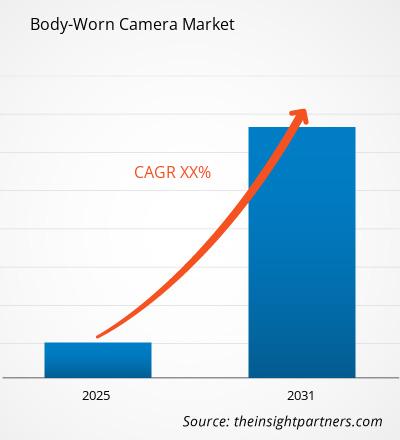
The Body-Worn Camera market was valued at US$ 2 billion in 2025 and is expected to reach US$ 5.67 billion by 2034; it is estimated to record a CAGR of 12.28% during 2026-2034.
Body-Worn Camera Market Assessment and Insights
- North America: Dominated the Body-Worn Camera Market share of 35–40% in 2025, driven by strong law enforcement adoption and supportive government policies. The region is projected to grow at a CAGR of 12–14% during 2026–2034, fueled by ongoing technology upgrades and integration with AI-powered analytics platforms.
- U.S.: Accounted for approximately 80–85% of North America's Body-Worn Camera Market share in 2025, supported by federal funding programs and state-level mandates for police body cameras. The U.S. market is estimated to grow at a CAGR of 11–13% through 2034, driven by continuous procurement cycles and technological innovation.
- Europe: Represented a 25–30% share of the global Body-Worn Camera Market in 2025, with the U.K., Germany, and France as key contributors. The region is expected to grow at a CAGR of 12–15%, supported by rising adoption in law enforcement, transportation security, and private security sectors.
- Asia Pacific: Accounted for a 22–27% share in 2025 and is projected to be the fastest-growing region with a CAGR of 15–18% during 2026–2034. China, Japan, India, and Australia are leading contributors, driven by increasing public safety investments and expanding military modernization programs.
- Largest Segment: Body-mounted cameras held the largest share of the market in 2025, accounting for approximately 35–40% of total revenue. This segment is projected to grow at a CAGR of 12–15% through 2034, driven by extensive deployments in law enforcement and security applications.
- High Growth Segment: Live streaming cameras emerged as the high-growth segment in 2025, with a market share of approximately 20–25%. This segment is expected to register a CAGR of 15–18% during 2026–2034, fueled by demand for real-time situational awareness in military and security operations.
- Key companies analyzed in detail: Axon Enterprise, Inc., Panasonic Corporation, GoPro, Inc., Transcend Information, Inc., WatchGuard Technologies, Inc., Reveal Media Limited, Digital Ally, Inc., Pinnacle Response, Ltd., Coban Technologies, Inc., and Motorola Solutions.
Source: The Insight Partners' analysis based on proprietary research, government publications, company annual reports, investor presentations, industry databases, and expert interviews.
The Body-Worn Camera Market has changed its form from simple recording devices to highly advanced ones which incorporate artificial intelligence technology, cloud storage, and analysis. This change has been motivated by the need for law enforcement agencies to collect objective evidence and the increased need for police accountability and transparency. Large amounts of funds are being set aside for the acquisition and maintenance of body-worn cameras in most countries around the world, leading to consistent and strong demand for the product. Developments in the areas of battery life, storage capacity, and video quality have widened the uses of these devices to other sectors apart from law enforcement, namely transportation, military, and sports.
Prospects of the Body-Worn Camera Market are bright as more emerging economies invest in public safety infrastructure. Artificial intelligence-enabled video analytics, live video streaming abilities, and security-focused cloud storage solutions will make body-worn cameras transition from simple recorders into full-fledged evidence management solutions. There has been increased activity in the market in terms of mergers and acquisitions among the industry leaders. Regulatory support and government initiatives promoting body-worn camera adoption across multiple sectors are expected to sustain market momentum throughout the forecast period.
Body-Worn Camera Market Report Scope
| Report Attribute | Details |
|---|---|
| Market size in 2025 | US$ 2. Billion |
| Market Size by 2034 | US$ 5.67 Billion |
| Global CAGR (2026 - 2034) | 12.28% |
| Historical Data | 2021-2024 |
| Forecast period | 2026-2034 |
Body-Worn Camera Market Analysis
The Body-Worn Camera Market Trends is mainly propelled by the growing need for accountability and transparency in law enforcement agencies. The use of such cameras by police departments and various governments around the world helps in increasing the level of trust from the public, reducing complaints and providing an unbiased source of evidence in court cases. The value chain includes the manufacturers of components, device assembly, software, cloud, and systems integration companies to provide complete solutions rather than mere devices. There is strategic collaboration between technology suppliers and law enforcement agencies, which includes integration of evidence management solutions with hardware, software, and cloud services provided by them.
The Body-Worn Camera Market Report highlights a strong competition among the existing and emerging companies. While Axon Enterprise continues to be the market leader with its ecosystem of cameras, software and cloud solutions for law enforcement agencies, other companies such as Panasonic and Motorola Solutions utilize their wide portfolio in technology for public safety. Investment trends show a lot of investment in AI-driven video analytics and streaming solutions. Companies are focusing on developing lightweight, durable cameras with extended battery life and high-resolution recording capabilities to meet diverse operational requirements across law enforcement, military, and transportation sectors.
● REPORT CUSTOMIZATION
Tailor This Report To Align With Your Specific Business Requirements
This report can be customized to align precisely with your business objectives, scope, and target markets. Customization options include tailored segmentation, geography, competitive analysis, and strategic insights to support informed decision-making.
Customize This Report →WHAT YOU CAN ADJUST
- ● Segmentations
- ● Geography
- ● Competitive Analysis
- ● Language Preferences
Body-Worn Camera Market: Strategic Insights
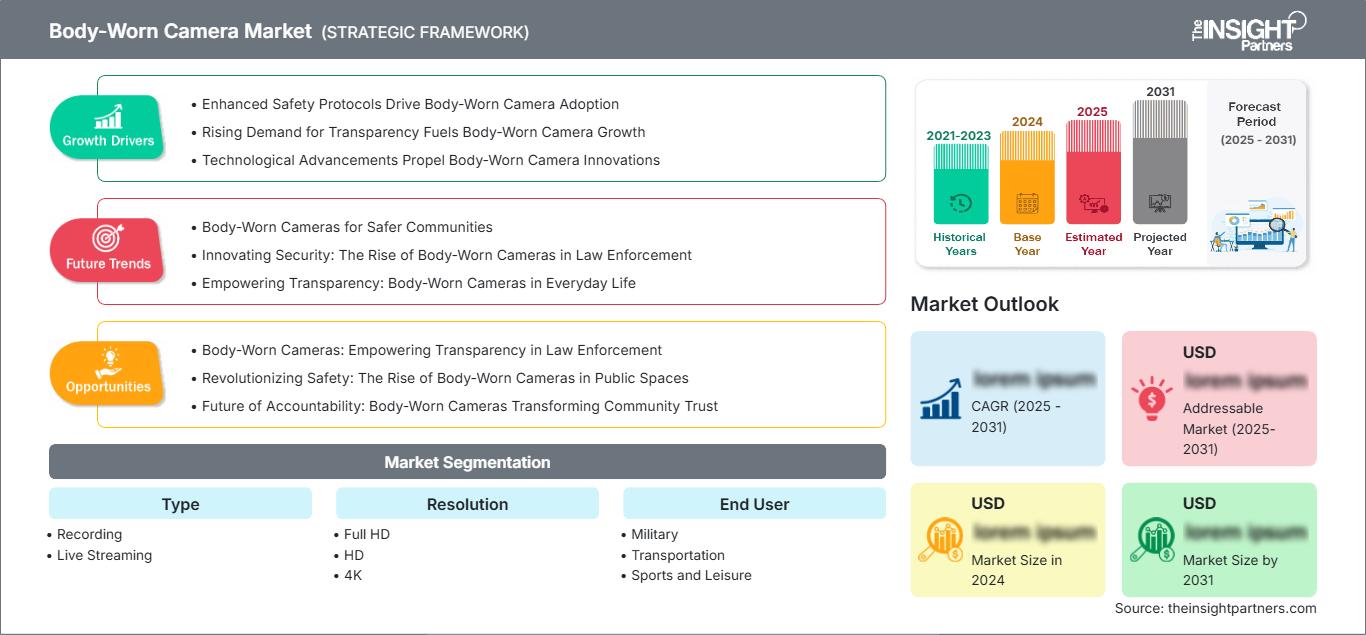
Regional Insights
North America Body-Worn Camera Market
North America dominated the global Body-Worn Camera Market with a 35–40% share in 2025, driven by widespread law enforcement adoption and substantial government funding programs. The region is estimated to grow at a CAGR of 12–14% during the forecast period, supported by continuous technological upgrades and integration with cloud-based evidence management platforms. The U.S. has been at the forefront of body-worn camera deployment, with federal and state-level mandates driving procurement across police departments. Canada has also witnessed increasing adoption, particularly in major metropolitan areas, as part of broader public safety and transparency initiatives.
U.S. Body-Worn Camera Market
The United States represents the largest national market for body-worn cameras, accounting for approximately 80–85% of North America's market share in 2025. The U.S. market is projected to grow at a CAGR of 11–13% through 2034, sustained by ongoing procurement programs and technological innovation. Major police departments across the country have implemented body-worn camera programs, creating a mature market with significant replacement and upgrade cycles. The presence of key players such as Axon Enterprise and Motorola Solutions, coupled with strong R&D infrastructure, supports continuous product innovation. Integration of AI analytics and real-time streaming capabilities is emerging as a key trend in the U.S. market.
Europe Body-Worn Camera Market
Europe accounted for a 25–30% share of the Body-Worn Camera Market in 2025, with the U.K., Germany, and France emerging as the leading national markets. The region is estimated to grow at a CAGR of 12–15% during the forecast period, driven by rising adoption across law enforcement, transportation security, and private security sectors. The U.K. has been a pioneer in body-worn camera deployment, with extensive use by police forces and the Transport for London network. Germany is witnessing growing adoption driven by federal and state-level initiatives for police modernization and digitalization. France and other European countries are increasingly deploying body-worn cameras to enhance public safety and officer accountability.
APAC Body-Worn Camera Market
Asia Pacific is expected to be the fastest-growing region in the Body-Worn Camera Market, with a projected CAGR of 15–18% during 2026–2034. The region accounted for a 22–27% share of the global market in 2025, driven by increasing public safety investments and expanding military modernization programs. China leads the APAC market, supported by significant government spending on security infrastructure and the presence of domestic manufacturing capabilities. India and Australia are also witnessing strong growth, driven by law enforcement modernization and rising security concerns. Japan and South Korea are focusing on advanced body-worn camera solutions with AI integration for public safety applications.
Middle East & Africa Body-Worn Camera Market
The Middle East and Africa market for body-worn cameras is estimated to grow at a CAGR of 13–16% through 2034, driven by increasing investments in public safety and security infrastructure. Saudi Arabia and the UAE are leading the market, supported by government initiatives for smart city development and public safety modernization. South Africa represents a key market in Africa, with growing adoption of body-worn cameras for law enforcement and private security applications. The region's growth is supported by infrastructure development projects and rising awareness of the benefits of body-worn cameras in enhancing accountability and security operations.
Segmentation Analysis
Type
The Type segment is bifurcated into Recording and Live Streaming. The Recording segment accounted for the larger market share in 2025, driven by traditional evidence collection and documentation needs across law enforcement and security applications. This segment is projected to grow at a CAGR of 12–15% during the forecast period. The Live Streaming segment is emerging as the high-growth category, fueled by demand for real-time situational awareness and remote monitoring capabilities in military and security operations. The adoption of live streaming cameras is increasing across law enforcement agencies seeking instant access to video feeds for tactical decision-making.
- Recording Cameras: These devices capture video content for later viewing, analysis, and evidentiary purposes. They dominate the market due to widespread adoption in law enforcement for incident documentation and accountability. Recording cameras are preferred for their simplicity, reliability, and compliance with evidence chain-of-custody requirements.
- Live Streaming Cameras: These cameras enable real-time video transmission, providing remote monitoring and tactical decision-making capabilities. The growing demand for situational awareness in military and security operations is driving adoption. Live streaming capabilities are increasingly integrated with AI-powered analytics for enhanced operational effectiveness.
Resolution
The Resolution segment is categorized into Full HD, HD, and 4K. The Full HD segment accounted for a significant share of the market in 2025, driven by the optimal balance between video quality, storage requirements, and processing power. This segment is projected to grow at a CAGR of 12–14% during the forecast period. The 4K segment is emerging as the high-growth category, fueled by increasing demand for superior video quality in evidentiary applications and the declining cost of high-resolution components. HD cameras continue to serve cost-sensitive applications where basic video quality is sufficient.
- Full HD: Offering a resolution of 1920x1080 pixels, Full HD cameras provide excellent video quality while maintaining reasonable storage and processing requirements. They are widely adopted in law enforcement, security, and transportation applications where detailed evidence capture is essential.
- HD: High-definition cameras with 1280x720 pixel resolution serve cost-sensitive applications. They remain popular in budget-conscious deployments where basic video evidence is required without premium storage costs.
- 4K: Ultra-high-definition cameras with 3840x2160 pixel resolution deliver exceptional video detail and clarity. The 4K segment is gaining traction in military and premium law enforcement applications where detailed facial recognition and scene analysis are critical.
End User
The End User segment comprises Military, Transportation, and Sports and Leisure. The Military segment accounted for a significant share of the global market in 2025, driven by increasing defense modernization programs and the need for after-action review and training documentation. This segment is projected to grow at a CAGR of 14–16% during the forecast period. The Transportation segment is witnessing strong growth, driven by body-worn camera adoption for public transit security and logistics operations. Sports and Leisure applications are growing steadily, supported by consumer demand for action cameras and adventure tourism.
- Military: Body-worn cameras are used for training documentation, mission debriefing, and after-action review in military operations. Growing defense modernization budgets and the emphasis on soldier safety and accountability are driving adoption in this segment.
- Transportation: Transit authorities and logistics companies are deploying body-worn cameras for security monitoring and incident documentation. The growing focus on passenger safety and operational transparency is driving adoption in public transportation and commercial logistics.
- Sports and Leisure: Action cameras and body-worn recording devices are used by adventure enthusiasts, athletes, and outdoor recreation participants. Consumer demand for high-quality video capture and social media content creation is driving growth in this segment.
Opportunity Snapshot
| Segment Name | Revenue Contribution | Trend Tag | Adoption Stage |
|---|---|---|---|
| Military | High | Tactical Recording | Scaling |
| Transportation | Medium | Transit Security | Scaling |
| Sports and Leisure | Medium | Action Capture | Mature |
Body-Worn Camera Market Growth Drivers and Impact Analysis
Rising Demand for Law Enforcement Accountability and Transparency
Increased police accountability and transparency requirements have become the major force driving the Body-Worn Camera Market Forecast. Police authorities around the world are implementing body-worn cameras to create transparency, cut down complaints and serve as evidence in court cases. It has been proven that the implementation of body-worn cameras has been associated with substantial decreases in use-of-force incidences and citizens' complaints. Governments have started issuing policies to implement body-worn cameras among police personnel. As a result, a constant demand has been created in both developed and emerging countries.
Technological Advancements in Video Resolution and Connectivity
Improvements made to such parameters as video quality, battery life, storage space, and connectivity are broadening the scope of use of body cameras. Improvement in video quality has seen the evolution of video resolution from HD, through Full HD, to 4K. In addition, live streaming technology has been improved making real-time surveillance possible. Moreover, improved connectivity technologies include connecting the device to the cloud for effective management of evidence collected. Manufacturers are increasingly improving the design of body cameras to make them more user friendly.
Increasing Deployment in Military, Transportation, and Commercial Sectors
The use of body-worn cameras is also increasing outside of traditional law enforcement in other areas such as military, transportation, and commerce. Military forces have been equipping body-worn cameras to record training and missions and for safety purposes. Body-worn cameras are used in transportation for the safety and security of passengers and for documentation. Commercial transport organizations have been using body-worn cameras for liability and safety issues for drivers. Body-worn cameras are gaining importance in various industries for the documentation and training process as well as reducing risks.
Body-Worn Camera Market Future Trends
Integration of AI-Powered Video Analytics and Edge Computing
Combining AI capabilities with edge computing has been revolutionizing the traditional recording role of the body-worn cameras by converting them into an intelligent video management platform. The ability to carry out video analytics through AI will allow the system to detect objects and faces and carry out behavior analysis in order to increase the importance of recorded videos. The combination of edge computing will also enable processing of the video data at the device end without needing much bandwidth and giving out alerts regarding any critical event.
Transition to Cloud-Based Evidence Management and Real-Time Streaming
Transitioning to evidence management solutions that use cloud computing as opposed to on-premise storage for video evidence is becoming increasingly common. Cloud-based technologies make it easier to upload and store videos. In addition, cloud computing makes it easy to retrieve video evidence in real time. Real-time streaming is becoming a significant requirement for operational activities because it allows the incident commander to have access to real-time video evidence captured through the body-worn camera. Body-worn camera systems are being integrated into other components within the public safety ecosystem.
Body-Worn Camera Market Opportunities
Expanding Adoption in Emerging Economies and New Application Sectors
Emerging economies present a huge opportunity for body worn camera makers due to investments made in modernizing public safety and equipping law enforcement departments with modern technologies. The countries from Asia Pacific, Latin America, and the Middle East are starting to understand the benefits of having body worn cameras to improve policing efficiency. In addition to law enforcement departments, there are also emerging application sectors that have a great potential to use body worn cameras. Such application sectors include healthcare, hospitality, and retail among others.
Development of Integrated Solutions Combining Hardware, Software, and Services
The market is moving away from simple sale of cameras towards provision of a more integrated solution encompassing cameras, software, data storage, and analytics services. Companies providing a more integrated solution such as camera solutions, cloud storage, artificial intelligence analytics and case management software are poised to reap more value from the market. Collaboration between camera vendors and technology companies will see the creation of an integrated solution catering to the whole workflow of evidence acquisition, management, analysis and distribution.
Recent Developments
- May 2026: Canon India, a leading provider of digital imaging and surveillance solutions, announced an exclusive strategic partnership with Wavesight, a specialist in integrated video communication technologies and evidence management platforms. Through this alliance, Canon India will distribute Wavesight’s “HawkEye” body-worn cameras across the country, offering Law Enforcement Bodies, Defense, Paramilitary Forces & Enterprise Customers a secure, connected, and field-ready platform for real-time video, mission-critical communication, and digital evidence management.
- September 2025: Axon (Nasdaq: AXON), the global leader in public safety technology, unveils Axon Body Workforce Mini (ABW Mini), the newest addition to its enterprise-focused body camera line, purpose-built for retail, healthcare, and other frontline workers to better protect people and property. At under 100 grams, ABW Mini is 25% smaller and lighter than current Axon cameras, yet just as durable and packed with powerful capabilities. These include enhanced communications, extended battery life, and a front-facing LED matrix display for added transparency.
- January 2025: Motorola Solutions (NYSE: MSI) unveiled the V200, a body camera designed specifically to help protect frontline workers in stores, hospitals, hotels, schools and stadiums. Workers in these settings regularly face safety concerns -- from unwelcome behavior to theft and medical emergencies -- and the V200, with its GoLive Audio safety feature, offers a direct connection to help.
Frequently Asked Questions

- Comprehensive Market Sizing and Forecast Analysis
- Detailed Segmentation Analysis
- In-Depth Market Dynamics Assessment
- Regional and Country-Level Insights
- Competitive Landscape and Company Benchmarking
- Strategic Business Intelligence
Recent Reports
Testimonials

The Insight Partners' SCADA System Market report is comprehensive, with valuable insights on current trends and future forecasts. The team was highly professional, responsive, and supportive throughout. We are very satisfied and highly recommend their services.
RAN KEDEM Partner, Reali Technologies LTDs
I requested a report on a very specific software market and the team produced the report in a few days. The information was very relevant and well presented. I then requested some changes and additions to the report. The team was again very responsive and I got the final report in less than a week.
JEAN-HERVE JENN Chairman, Future Analytica
We worked with The Insight Partners for an important market study and forecast. They gave us clear insights into opportunities and risks, which helped shape our plans. Their research was easy to use and based on solid data. It helped us make smart, confident decisions. We highly recommend them.
PIYUSH NAGPAL Sr. Vice President, High Beam Global
The Insight Partners delivered insightful, well-structured market research with strong domain expertise. Their team was professional and responsive throughout. The user-friendly website made accessing industry reports seamless. We highly recommend them for reliable, high-quality research services
YUKIHIKO ADACHI CEO, Deep Blue, LLC.
This is the first time I have purchased a market report from The Insight Partners.While I was unsure at first, I visited their web site and felt more comfortable to take the risk and purchase a market report.I am completely satisfied with the quality of the report and customer service. I had several questions and comments with the initial report, but after a couple of dialogs over email with their analyst I believe I have a report that I can use as input to our strategic planning process.Thank you so much for taking the extra time and making this a positive experience.I will definitely recommend your service to others and you will be my first call when we need further market data.
JOHN SUZUKI President and Chief Executive Officer, Board Director, BK Technologies
I wish to appreciate your support and the professionalism you displayed in the course of attending to my request for information regarding to infectious disease IVD market in Nigeria. I appreciate your patience, your guidance, and the fact that you were willing to offer a discount, which eventually made it possible for us to close a deal. I look forward to engaging The Insight Partners in the future, all thanks to the impression you have created in me as a result of this first encounter.
DR CHIJIOKE ONYIA MANAGING DIRECTOR, PineCrest Healthcare Ltd.Reason to Buy
- Informed Decision-Making
- Understanding Market Dynamics
- Competitive Analysis
- Identifying Emerging Markets
- Customer Insights
- Market Forecasts
- Risk Mitigation
- Boosting Operational Efficiency
- Strategic Planning
- Investment Justification
- Tracking Industry Innovations
- Aligning with Regulatory Trends





 Get Free Sample for