
Bone Density Test Market Regional Share, Global Size, Trends, and Forecast by 2034
Coverage: By Type ( Central Dual-Energy X-Ray Absorptiometry (DXA), Radiographic Absorptiometry, Peripheral Tests ); Indication ( Osteoporosis, Hyperthyroidism, Hyperparathyroidism, Osteopenia ); Devices ( Central DXA Scan Machine, Hand Held Devices ); End User ( Hospitals, Clinics, Diagnostic Centers ), and Geography (North America, Europe, Asia Pacific, and South and Central America)
- Status : Data Released
- Report Code : TIPRE00015953
- Category : Life Sciences
- No. of Pages : 150
- Available Report Formats :


- Last update date : July 30, 2026


2025 Market Size
US$ 1.25 Bn
Base year value
2034 Forecast
US$ 1.93 Bn
Projected by 2034
CAGR 2026-2034
4.94 %
Growth rate
Addressable Market
US$ 14.43 Bn
(2026-2034)
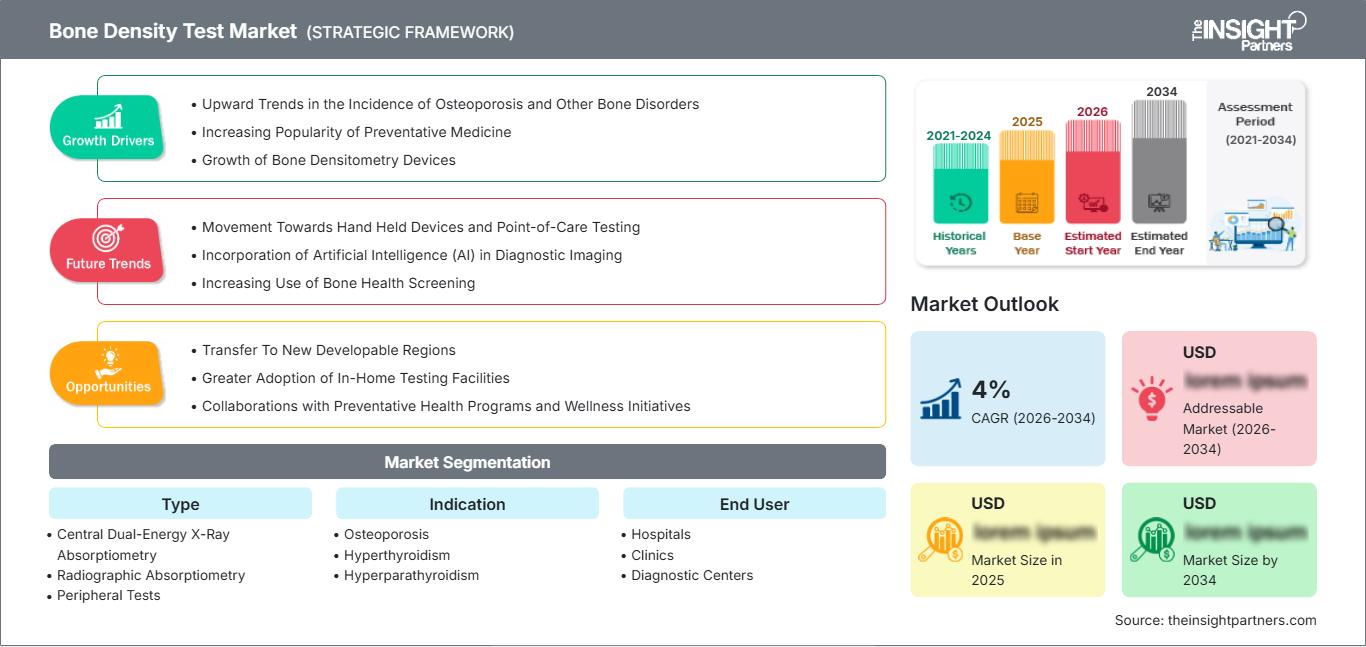
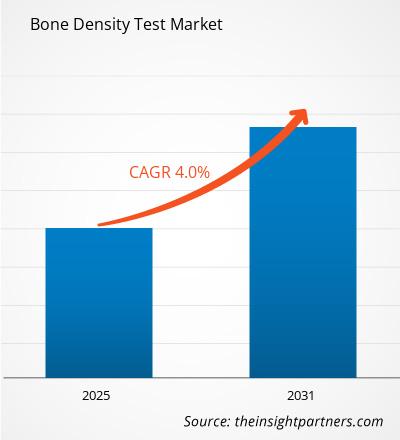
The global Bone Density Test market was valued at US$ 1.25 billion in 2025 and is expected to reach US$ 1.93 billion by 2034; it is estimated to record a CAGR of 4.94% during 2026-2034.
Bone Density Test Market Assessment and Insights
- North America held 38–40% Bone Density Test Market share in 2025 and is expected to grow at a CAGR range of 4.8–5.2% during 2026–2034, supported by osteoporosis surveillance, outpatient imaging access, and replacement demand for DXA platforms.
- US accounted for 78–82% of North America in 2025 and is projected to grow at a CAGR range of 4.7–5.1% during 2026–2034, driven by Medicare-linked screening.
- Europe represented 27–29% share in 2025 and is expected to expand at a CAGR range of 4.4–4.8% during 2026–2034, led by Germany, the UK, France, Italy, and Spain.
- Asia Pacific held 22–24% share in 2025 and is projected to grow at a CAGR range of 6.1–6.5% during 2026–2034, led by China, Japan, South Korea, India, and Australia.
- Largest Segment Central Dual-Energy X-Ray Absorptiometry accounted for 62–66% market share in 2025 and is expected to grow at a CAGR range of 4.9–5.3% during 2026–2034.
- High Growth Segment Peripheral Tests held 18–21% market share in 2025 and is projected to grow at a CAGR range of 6.4–6.8% during 2026–2034.
- Key companies analyzed in detail: GE HealthCare Technologies Inc., Hologic, Inc., BeamMed Ltd., Swissray International, Inc., OsteoSys Co., Ltd., Diagnostic Medical Systems S.A., Medonica Co., Ltd., Osteometer Meditech A/S, Lone Oak Medical Technologies, LLC, Furuno Electric Co., Ltd.
Source: The Insight Partners' analysis based on proprietary research, government publications, company annual reports, investor presentations, industry databases, and expert interviews.
The technology progression in the Bone Density Test market has seen buying trends change from simple densitometers to comprehensive systems that integrate bone mineral density, vertebral fracture assessment, trabecular bone scoring, and body composition analysis. There are improvements being made in terms of detector sensitivity, scan times, radiation doses, software analysis capabilities, and integration with hospital information systems. The production trends are leaning more towards systems that are modular in nature, have service contracts, and can be customized based on the region.
As far as future demand is concerned, the growth drivers are set to come from regions like Asia Pacific and Middle East, whose healthcare systems are focusing more on preventive diagnostics and not just fracture management. Some of the regulatory trends supporting this market will be quality regulations on radiological devices, post-fracture care plans, and population health programs for females older than 50 years.
Bone Density Test Market Report Scope
| Report Attribute | Details |
|---|---|
| Market size in 2025 | US$ 1.25 Billion |
| Market Size by 2034 | US$ 1.93 Billion |
| Global CAGR (2026 - 2034) | 4.94% |
| Historical Data | 2021-2024 |
| Forecast period | 2026-2034 |
Bone Density Test Market Analysis
Demand in the market can be traced to the growing disparity between fractures and early detection. Osteoporosis is a condition that is suffered by a third of all women and about one-fifth of all men above the age of 50 across the world, and this presents a huge patient population base for bone density testing. Hospitals present very high acuity volume demands, while diagnostic centers cater to routine referrals from gynecology, endocrinology, rheumatology, and orthopedics departments.
The market environment encompasses bone density test detector manufacturers, X-ray part manufacturers, software analytical companies, services firms, users, and payers. The supply chain is moderately concentrated in the central DXA bone density test, but there are other technologies like peripheral and ultrasound which enable the screening of patients in mobile camps and primary care settings.
Product specialization is a factor that defines competitive intensity rather than pricing alone. GE HealthCare Technologies Inc. and Hologic, Inc. are dominant players in the premium central DXA market, whereas OsteoSys Co., Ltd., Diagnostic Medical Systems S.A., and Furuno Electric Co., Ltd. meet smaller size and cost sensitive demands. BeamMed Ltd., Medonica Co., Ltd., Swissray International, Inc., Osteometer Meditech A/S, and Lone Oak Medical Technologies, LLC are niche-oriented providers.
According to the Bone Density Test Market analysis, current positioning strategy trends include workflow optimization, extensive distributor network, and evidence-based software differentiation. Providers focus on body composition reporting, fracture risk algorithms, and remote service delivery capabilities. Clinical users assess systems for their reproducibility and longitudinal consistency since small differences in measurement can affect treatment choice for osteopenia and osteoporosis.
● REPORT CUSTOMIZATION
Tailor This Report To Align With Your Specific Business Requirements
This report can be customized to align precisely with your business objectives, scope, and target markets. Customization options include tailored segmentation, geography, competitive analysis, and strategic insights to support informed decision-making.
Customize This Report →WHAT YOU CAN ADJUST
- ● Segmentations
- ● Geography
- ● Competitive Analysis
- ● Language Preferences
Bone Density Test Market: Strategic Insights
Regional Insights
North America Bone Density Test Market
The North American share stood at 38-40% in 2025 and is projected to grow at a CAGR rate of 4.8-5.2% from 2026 to 2034. The North American share in the Bone Density Test Market can be attributed to the reimbursement scenario for DXA, strong osteoporosis advocacy, and presence of high number of outpatient imaging facilities.
The replacement of the systems owing to the advanced features offered by the new generation such as vertebral fracture assessment, trabecular scoring, low dose imaging, and fast scanning, is becoming a key driving factor. United States continues to be the major source of revenue whereas Canada will drive the demand through hospital based imaging services.
U.S. Bone Density Test Market
The U.S. represented 78–82% of North America in 2025 and is projected to grow at a CAGR range of 4.7–5.1% during 2026–2034. The country benefits from strong clinical awareness, Medicare coverage for eligible patients, and a large installed base across hospitals, orthopedic practices, women’s health clinics, and diagnostic imaging centers. Hologic, Inc. and GE HealthCare Technologies Inc. maintain broad channel presence.
Application trends are expanding from osteoporosis diagnosis toward therapy monitoring, body composition, sarcopenia assessment, and fracture risk stratification. Demand is also influenced by rising obesity, diabetes, long-term steroid use, aromatase inhibitor therapy, and thyroid disorders. The testing pathway increasingly connects orthopedics and primary care after low-trauma fractures, improving referral capture for densitometry providers.
Europe Bone Density Test Market
Europe represented a market share of 27-29% in 2025, and is anticipated to register a compound annual growth rate of 4.4-4.8% from 2026-2034. The Germany market is the largest one, owing to well-established radiology facility, physician referrals, and development of hospital diagnostic systems. The market in the UK focuses on fracture-prevention pathways and post-fracture assessment, but capacity constraints at imaging facilities still determine waiting times.
Germany enjoys the benefits of an aging population, presence of effective orthopedic practice communities, and high acceptance of central DXA scans for hip and lumbar spine assessments. The UK market develops under the impact of NHS referral guidelines and secondary fracture prevention strategies via fracture liaison programs.
The stable southern and western Europe market is determined by France, Italy, and Spain. France has good hospital and private radiology applications, Italy has osteoporosis screenings in older women, and Spain demonstrates market demand from outpatient diagnostic centers and regional healthcare initiatives to decrease the fragility fractures burden.
APAC Bone Density Test Market
The Asia Pacific held a market share of 22-24% in 2025 and is expected to witness a CAGR of 6.1-6.5% in 2026-2034. The key driver for the region is the growing imaging infrastructure, increase in elderly population, and purchase from hospitals in tiered cities in China. Demand for miniaturized devices and geriatric check-ups are witnessed in Japan and South Korea.
In India and Australia, there are additional factors driving the growth in the market. In India, private diagnostic chains provide increased access to preventive tests, whereas in Australia, programs for osteoporosis help patients undergo multiple testing and prevent fractures. Increased focus on non-communicable diseases and localization of medical devices in some parts of Asia have improved affordability and availability of products in the market.
Middle East & Africa Bone Density Test Market
The Middle East & Africa region is expected to grow at a CAGR range of 4.9–5.3% during 2026–2034, with Saudi Arabia as the leading country. Demand is supported by hospital infrastructure projects, women’s health screening, and rising endocrinology workloads in Saudi Arabia and the UAE. Private imaging centers are gradually adding bone health services.
South Africa remains the strongest sub-Saharan market, supported by urban hospitals and specialist clinics, while the Rest of MEA shows selective adoption in tertiary facilities. Energy-funded health infrastructure in Gulf countries is improving procurement capacity, although limited trained operators and uneven reimbursement slow broad population-level screening.
Segmentation Analysis
Type
The Type segment is projected to grow at a CAGR of 5.0–5.8% during 2026–2034. Central DXA systems dominate due to high accuracy and clinical acceptance, while peripheral tests and radiographic absorptiometry cater to cost-sensitive and decentralized settings, expanding the Bone Density Test Market scope.
- Central Dual-Energy X-Ray Absorptiometry (DXA): Dominates hospital-based diagnostics due to superior accuracy and reliability, widely used for osteoporosis screening and monitoring treatment outcomes in clinical settings.
- Radiographic Absorptiometry: Offers cost-effective alternatives for smaller clinics, gaining traction in regions with limited healthcare budgets and infrastructure constraints.
- Peripheral Tests: Includes portable and point-of-care devices, increasingly adopted in outpatient and community healthcare settings for quick screening and early detection.
Indication
The Indication segment is expected to grow at a CAGR of 5.3–6.1% during 2026–2034. Osteoporosis remains the primary application, while conditions like hyperthyroidism and osteopenia contribute to expanding diagnostic demand.
- Osteoporosis: Represents the largest demand driver due to high prevalence among aging populations and increasing screening awareness globally.
- Hyperthyroidism: Requires monitoring of bone density due to associated bone loss risks, supporting diagnostic demand in endocrine disorders.
- Hyperparathyroidism: Drives testing due to its impact on calcium metabolism and bone health, particularly in specialized clinical settings.
- Osteopenia: Early-stage bone loss detection is encouraging preventive screening, expanding the patient pool for diagnostic procedures.
Devices
The Devices segment is projected to grow at a CAGR of 5.6–6.4% during 2026–2034. Central DXA scan machines dominate due to clinical accuracy, while handheld devices are gaining momentum for portable applications.
- Central DXA Scan Machine: Preferred in hospitals and diagnostic centers for comprehensive assessments and precise measurement of bone mineral density.
- Hand Held Devices: Increasingly used in primary care and remote settings, offering convenience and cost-effective screening solutions.
End User
The End User segment is expected to grow at a CAGR of 5.4–6.2% during 2026–2034. Hospitals remain the largest users, while clinics and diagnostic centers are expanding due to rising outpatient services.
- Hospitals: Major contributors due to advanced infrastructure and high patient inflow, supporting comprehensive diagnostic services.
- Clinics: Growing adoption driven by decentralized healthcare and increasing demand for outpatient diagnostic services.
- Diagnostic Centers: Expanding rapidly with specialized testing capabilities and increasing focus on preventive healthcare services.
Opportunity Snapshot
| End User | Revenue Contribution | Trend Tag | Adoption Stage |
| Hospitals | High | Clinical Accuracy | Mature |
| Clinics | Medium | Outpatient Care | Scaling |
| Diagnostic Centers | Medium | Preventive Screening | Scaling |
Bone Density Test Market Growth Drivers and Impact Analysis
Rising Fragility Fracture Burden in Aging Populations
Population aging is the most durable demand driver for the Bone Density Test Market because fracture risk rises sharply after midlife, particularly among postmenopausal women and older men with comorbidities. International osteoporosis data indicate that osteoporosis-related fractures affect a substantial share of adults above 50, creating pressure on health systems to diagnose bone loss before hip, spine, or wrist fractures occur. The market impact is direct: higher screening eligibility, more repeat monitoring, and stronger referral flows from orthopedics, endocrinology, and primary care. Hospitals and diagnostic centers are therefore prioritizing systems with reliable precision, fast scan protocols, and longitudinal reporting to support earlier treatment decisions and reduce avoidable fracture costs.
Expansion of Preventive Diagnostics and Outpatient Imaging
Preventive care models are increasing the use of densitometry outside acute hospital settings. Diagnostic centers and multispecialty clinics are integrating bone density tests into women’s health, senior wellness, oncology follow-up, and endocrine care packages. This shift expands access for patients who may not otherwise visit tertiary hospitals until after a fracture. The commercial impact is visible in growing demand for compact systems, efficient scheduling, and software that reduces reporting time. Outpatient operators also prefer equipment with low maintenance requirements and predictable service costs. As diagnostic chains scale across urban and semi-urban locations, vendors with strong distributor training and uptime support gain a practical advantage.
Clinical Value of Multimodal Bone and Body Assessment
Bone density testing is becoming more valuable as systems add vertebral fracture assessment, body composition, sarcopenia-related measurements, and trabecular bone score support. These capabilities allow clinicians to evaluate skeletal strength, metabolic health, muscle loss, and treatment response in a single diagnostic workflow. The impact is strongest in hospitals and advanced diagnostic centers that serve oncology, sports medicine, obesity care, geriatrics, and endocrine disease populations. Multimodal functionality improves equipment utilization beyond osteoporosis alone, supporting better return on capital investment. It also encourages replacement of older systems that lack modern software, lower-dose acquisition, or advanced risk interpretation features.
Bone Density Test Market Future Trends
AI-Assisted Interpretation and Opportunistic Screening
AI-enabled analytics will become a defining layer of Bone Density Test Market trends as providers seek faster reporting, higher consistency, and better fracture risk identification. Algorithms that assist vertebral detection, hip structure assessment, and opportunistic evaluation from existing radiographs can expand screening beyond traditional densitometry appointments. This trend will not remove central DXA from confirmatory diagnosis, but it can improve referral capture by identifying at-risk patients earlier. Vendors that combine validated algorithms with radiology workflow integration, traceable reporting, and regulatory compliance will be better positioned as health systems move toward proactive bone health pathways.
Compact Systems for Decentralized Bone Health Access
Future demand will increasingly favor compact and lower-footprint systems that bring bone health screening closer to primary care, community clinics, and mobile health programs. Peripheral and ultrasound-based devices are likely to gain attention where central DXA capacity is limited or travel distance reduces patient compliance. The trend is particularly relevant in Asia Pacific, the Middle East, and rural markets where preventive imaging infrastructure is still developing. While confirmatory testing will remain centered on DXA, decentralized screening can widen the patient funnel and create new referral pathways for specialist evaluation and treatment monitoring.
Bone Density Test Market Opportunities
Integrated Diagnostic Pathways for Post-Fracture Care
Fracture liaison services create a high-impact commercial opportunity because many patients who experience low-trauma fractures are still not assessed for underlying bone loss. Imaging providers, hospitals, and device manufacturers can build structured pathways connecting emergency departments, orthopedic surgeons, and DXA units. Bone Density Test Market Forecasts indicate that systems capable of reliable follow-up measurement, vertebral assessment, and automated reporting will be favored in these coordinated care models. Vendors can support adoption by offering workflow templates, clinician education, and service packages that reduce implementation barriers. This opportunity aligns equipment utilization with measurable outcomes, including fewer recurrent fractures and improved therapy initiation.
Diagnostic Center Expansion in Emerging Urban Markets
Emerging urban markets offer an attractive investment opportunity as private diagnostic networks expand preventive imaging portfolios. Bone density testing can be positioned alongside mammography, ultrasound, endocrine panels, and senior health packages, creating cross-referral efficiencies and higher equipment utilization. The strongest potential lies in cities where specialist density is rising but public imaging capacity remains constrained. Manufacturers can unlock demand through tiered product configurations, financing support, operator training, and distributor-led maintenance. Diagnostic centers benefit from adding differentiated services that address aging populations, women’s health needs, and chronic disease monitoring without requiring the infrastructure intensity of advanced radiology modalities.
Recent Developments
- July 2025: Furuno Electric Co., Ltd. exhibited its CM-300 ultrasound bone densitometer at Japan Health in Osaka, highlighting calcaneus measurement, automatic printed reference graphs, compact design, and suitability for group medical examinations and early osteoporosis detection. The showcase reinforced the company’s focus on noninvasive screening tools for decentralized healthcare environments.
- May 2025: Diagnostic Medical Systems S.A. received FDA clearance for the !M1 mobile radiology system and began U.S. commercialization with Medlink Imaging. Although the clearance concerned radiology, DMS identified itself as active in digital radiology and bone densitometry, strengthening its North American regulatory and distribution platform.
- August 2024: OsteoSys Co., Ltd. announced EU Medical Device Regulation approval for its DXA bone mineral densitometry systems. The certification supported European market continuity for its osteoporosis, body composition, sarcopenia, veterinary, and preclinical DXA portfolio, reinforcing compliance capacity under stricter medical device rules.
Frequently Asked Questions

- Comprehensive Market Sizing and Forecast Analysis
- Detailed Segmentation Analysis
- In-Depth Market Dynamics Assessment
- Regional and Country-Level Insights
- Competitive Landscape and Company Benchmarking
- Strategic Business Intelligence
Recent Reports
Testimonials

The Insight Partners' SCADA System Market report is comprehensive, with valuable insights on current trends and future forecasts. The team was highly professional, responsive, and supportive throughout. We are very satisfied and highly recommend their services.
RAN KEDEM Partner, Reali Technologies LTDs
I requested a report on a very specific software market and the team produced the report in a few days. The information was very relevant and well presented. I then requested some changes and additions to the report. The team was again very responsive and I got the final report in less than a week.
JEAN-HERVE JENN Chairman, Future Analytica
We worked with The Insight Partners for an important market study and forecast. They gave us clear insights into opportunities and risks, which helped shape our plans. Their research was easy to use and based on solid data. It helped us make smart, confident decisions. We highly recommend them.
PIYUSH NAGPAL Sr. Vice President, High Beam Global
The Insight Partners delivered insightful, well-structured market research with strong domain expertise. Their team was professional and responsive throughout. The user-friendly website made accessing industry reports seamless. We highly recommend them for reliable, high-quality research services
YUKIHIKO ADACHI CEO, Deep Blue, LLC.
This is the first time I have purchased a market report from The Insight Partners.While I was unsure at first, I visited their web site and felt more comfortable to take the risk and purchase a market report.I am completely satisfied with the quality of the report and customer service. I had several questions and comments with the initial report, but after a couple of dialogs over email with their analyst I believe I have a report that I can use as input to our strategic planning process.Thank you so much for taking the extra time and making this a positive experience.I will definitely recommend your service to others and you will be my first call when we need further market data.
JOHN SUZUKI President and Chief Executive Officer, Board Director, BK Technologies
I wish to appreciate your support and the professionalism you displayed in the course of attending to my request for information regarding to infectious disease IVD market in Nigeria. I appreciate your patience, your guidance, and the fact that you were willing to offer a discount, which eventually made it possible for us to close a deal. I look forward to engaging The Insight Partners in the future, all thanks to the impression you have created in me as a result of this first encounter.
DR CHIJIOKE ONYIA MANAGING DIRECTOR, PineCrest Healthcare Ltd.Reason to Buy
- Informed Decision-Making
- Understanding Market Dynamics
- Competitive Analysis
- Identifying Emerging Markets
- Customer Insights
- Market Forecasts
- Risk Mitigation
- Boosting Operational Efficiency
- Strategic Planning
- Investment Justification
- Tracking Industry Innovations
- Aligning with Regulatory Trends





 Get Free Sample for