
Broadcast Equipment Market Size, Share & Forecast by 2034
Coverage: by Product (Dish Antennas, Amplifiers, Switches, Encoders, Servers, Transmitters and Repeaters, Modulators, Others); Technology (Digital Broadcasting, Analog Broadcasting); Application (Television, Radio) , and Geography (North America, Europe, Asia Pacific, and South and Central America)
- Status : Data Released
- Report Code : TIPRE00010755
- Category : Electronics and Semiconductor
- No. of Pages : 150
- Available Report Formats :


- Last update date : July 17, 2026


2025 Market Size
US$ 9.02 Bn
Base year value
2034 Forecast
US$ 16.78 Bn
Projected by 2034
CAGR 2026-2034
7.14 %
Growth rate
Addressable Market
US$ 116.43 Bn
(2026-2034)
Broadcast Equipment market was valued at US$ 9.02 Billion in 2025 and is projected to reach US$ 16.78 Billion by 2034, registering a CAGR of 7.14% during 2026–2034. The demand for broadcast equipment will be driven by factors such as digital broadcasting, HD/UHD broadcasts, IP-based productions, live event distribution, satellite contribution, and modernization of television and radio broadcast infrastructures.
The North America Broadcast Equipment market is projected to register a CAGR of 6.4% to 7.2% from 2026 to 2034, driven by ATSC 3.0 transition planning, improvements in sport productions, and investments in IP-compatible encoders and routers. The broadcasters are focusing on having an infrastructure that can facilitate over-the-air television broadcasting and radio broadcasting.
Broadcast Equipment Market Assessment and Insights
- North America held 31–35% of the Broadcast Equipment Market share in 2025 and is growing at a CAGR of 6.4–7.2% during 2026–2034, led by ATSC 3.0 readiness, sports broadcasting, station modernization, and IP transport upgrades.
- US represented 78–82% of North American revenue in 2025 and is growing at a CAGR of 6.5–7.3% during 2026–2034, supported by television station refresh cycles.
- Europe accounted for 22–26% share in 2025 and is growing at a CAGR of 5.8–6.6% during 2026–2034, with the UK, Germany, France, Italy, and Spain leading replacement demand.
- Asia Pacific held 30–34% share in 2025 and is growing at a CAGR of 7.8–8.7% during 2026–2034, led by China, Japan, South Korea, India, and Australia.
- Largest Segment Encoders held 23–27% market share in 2025 and are growing at a CAGR of 6.8–7.6% during 2026–2034 as multi-format delivery becomes essential.
- High Growth Segment Digital Broadcasting represented 66–70% market share in 2025 and is growing at a CAGR of 7.9–8.8% during 2026–2034, helped by IP workflows.
- Key companies analyzed in detail: AvL Technologies, Inc.; Cisco Systems, Inc.; Clyde Broadcast Technology Ltd.; CommScope Holding Company, Inc.; Eletec Broadcast Telecom S.A.R.L.; Evertz Microsystems Limited; EVS Broadcast Equipment SA; Grass Valley Canada; Harmonic Inc.; Telefonaktiebolaget LM Ericsson.
Source: The Insight Partners' analysis based on proprietary research, government publications, company annual reports, investor presentations, industry databases, and expert interviews.
The Broadcast Equipment Market has evolved from simple transmission technologies to more sophisticated combinations of technologies such as antennas, encoders, servers, modulators, switching and contribution networks. Dynamics in production include IP signal routing, remote operation, software-based compression and multiple distribution pathways. Growth opportunities for Broadcast Equipment will come from markets where television and radio broadcasters need to broadcast reliable linear programs as well as streaming, catch-up, sports production, and emergency communications.
Future demand will depend on spectrum policy, hybrid satellite/terrestrial technology, local content requirements and the costs involved in replacing legacy analog systems. New regions have started installing digital transmitters and repeaters whereas established broadcasters are investing in modular solutions that reduce truck rolls and provide centralised operation of facilities. Regulatory progress towards new television technology standards and public warning systems would support investment in Broadcast Equipment through television and radio broadcasting networks.
Broadcast Equipment Market Report Scope
| Report Attribute | Details |
|---|---|
| Market size in 2025 | US$ 9.02 Billion |
| Market Size by 2034 | US$ 16.78 Billion |
| Global CAGR (2026 - 2034) | 7.14% |
| Historical Data | 2021-2024 |
| Forecast period | 2026-2034 |
Broadcast Equipment Market Analysis
Broadcast Equipment Market include broadcasters transitioning from analog or systems based on SDI to digital equipment that will accommodate IP connectivity, UHD video, and low latency contribution and distribution to multiple platforms. This demand is mainly found in encoders, transmitters, repeaters, switches, and servers, as these will have an impact on the performance of the broadcaster's equipment.
The supply chain participants include manufacturers of radio frequency components, semiconductor manufacturers, codec software suppliers, system integrators, broadcasters, telecommunications carriers, satellite communication companies, and cloud services. The supply chain is influenced by availability of electronics, certification, installation skills, and support by the manufacturer. Buyers are more interested in service life, resilience, and compatibility.
According to Broadcast Equipment Market Report, the competitiveness within the sector will be dictated by the quality of compression, routing, networking orchestration, and Installed Base. Among the competing companies in digital video solutions, IP transport, live production, and contribution are Harmonic Inc., Evertz Microsystems Limited, Grass Valley Canada, EVS Broadcast Equipment SA, Cisco Systems, Inc., and Telefonaktiebolaget LM Ericsson.
Expertise in areas like antennas, radio transmission, infrastructure and transmitter belongs to such players as AvL Technologies, Inc., Clyde Broadcast Technology Ltd., CommScope Holding Company, Inc., and Eletec Broadcast Telecom S.A.R.L. The investments are shifting towards software-based technology, cloud monitoring, portable field solutions, and services-based implementation to minimize risks for broadcasters.
● REPORT CUSTOMIZATION
Tailor This Report To Align With Your Specific Business Requirements
This report can be customized to align precisely with your business objectives, scope, and target markets. Customization options include tailored segmentation, geography, competitive analysis, and strategic insights to support informed decision-making.
Customize This Report →WHAT YOU CAN ADJUST
- ● Segmentations
- ● Geography
- ● Competitive Analysis
- ● Language Preferences
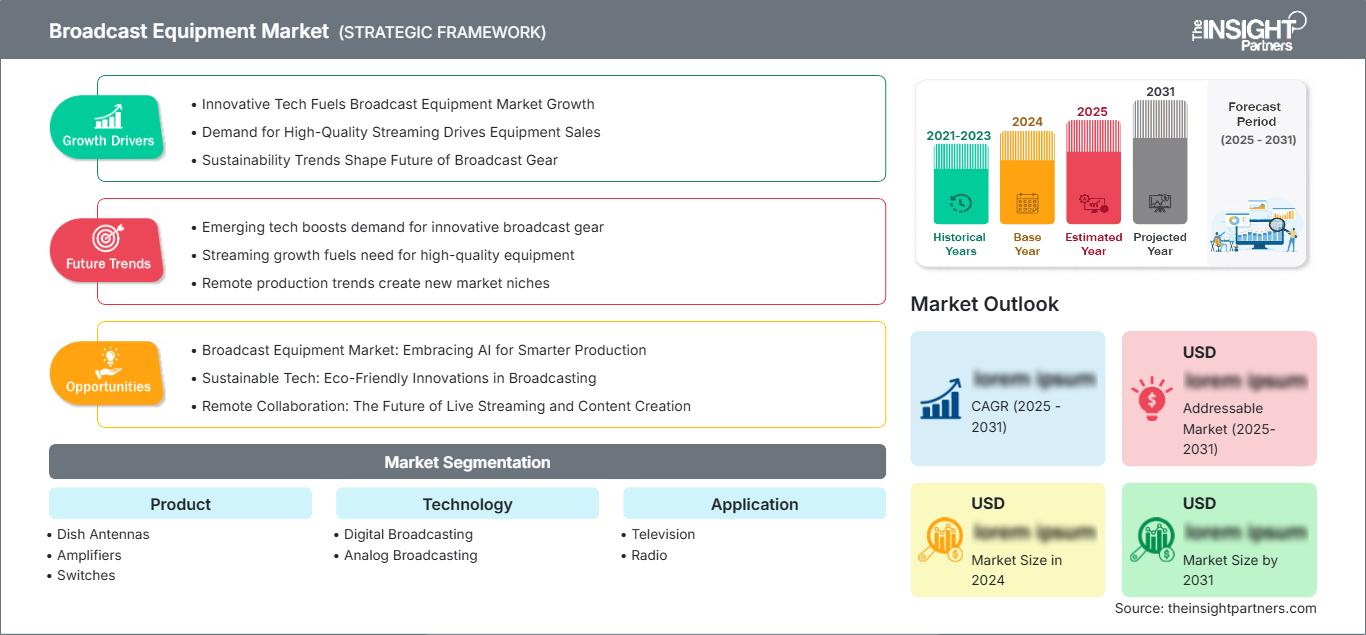
Broadcast Equipment Market: Strategic Insights
Regional Insights
North America Broadcast Equipment Market
North America accounted for 31–35% of Broadcast Equipment share in 2025 and is projected to expand at a CAGR of 6.4–7.2% during 2026–2034. Demand reflects ATSC 3.0 planning, sports rights production, station automation, and replacement of legacy contribution chains with IP-compatible encoders, switches, servers, and monitoring systems.
Broadcasters are also investing in disaster-resilient transmission, emergency alerting, and remote production that lowers travel and outside-broadcast costs. The U.S. leads regional spending, while Canada and Mexico add radio network renewal, satellite contribution, and local television modernization. Equipment suppliers benefit from strong integrator networks and recurring service contracts.
U.S. Broadcast Equipment Market
The U.S. represented 78–82% of North American revenue in 2025 and is expected to grow at a CAGR of 6.5–7.3% during 2026–2034. Application trends center on television station upgrades, live sports, election coverage, local news, radio automation, and contribution links between studios, towers, and cloud production environments.
Company presence includes Cisco Systems, Inc., Harmonic Inc., AvL Technologies, Inc., CommScope Holding Company, Inc., and major operations of global vendors. Federal Communications Commission activity around Next Gen TV supports planning for encoders, modulators, transmitters, monitoring systems, and consumer-facing service continuity, especially where broadcasters balance ATSC 1.0 and 3.0 obligations.
Europe Broadcast Equipment Market
Europe held 22–26% of the Broadcast Equipment Market share in 2025 and is projected to grow at a CAGR of 5.8–6.6% during 2026–2034. The UK is a leading adoption market because public service broadcasting, sports production, and outside broadcast providers continue to refresh encoders, switches, servers, and IP routing equipment.
Germany contributes through engineering-led broadcast networks, manufacturing events, and strong radio infrastructure. France, Italy, and Spain add demand through regional television, digital terrestrial networks, and live production. European buyers emphasize energy efficiency, interoperability, accessibility compliance, and long service life, which favors vendors with proven support and standards-based architectures.
APAC Broadcast Equipment Market
Asia Pacific accounted for 30–34% of the Broadcast Equipment Market share in 2025 and is forecast to grow at a CAGR of 7.8–8.7% during 2026–2034. China leads through large broadcast networks, equipment manufacturing, and digital television expansion.
Japan and South Korea support premium live production, UHD workflows, and compact field systems. India and Australia add demand through public broadcasting, sports, radio digitization, and infrastructure projects. Policy support for digital media access and domestic electronics manufacturing strengthens regional equipment procurement.
Middle East & Africa Broadcast Equipment Market
The Middle East & Africa market is projected to grow at a CAGR of 5.2–6.1% during 2026–2034. Saudi Arabia leads as media, sports, tourism, and infrastructure investments expand professional broadcast requirements.
The UAE supports demand through premium studios, event broadcasting, and satellite contribution, while South Africa remains important for radio, public television, and regional distribution. Rest of MEA growth depends on transmitter reliability, service coverage, and resilient equipment suited to demanding operating environments.
Segmentation Analysis
Product
Product is projected to grow at a CAGR of 6.7–7.5% during 2026–2034. The Broadcast Equipment scope spans RF, compression, routing, and playout assets that determine signal quality and operating continuity. Encoders and servers are gaining priority as broadcasters support multi-format output, while antennas, transmitters, repeaters, switches, amplifiers, and modulators remain essential for resilient distribution.
- Dish Antennas remain strategically important for satellite contribution, remote news gathering, disaster recovery, and sports links where terrestrial fiber is unavailable, congested, or uneconomic.
- Amplifiers support signal strength, tower coverage, and RF chain reliability, especially in radio and television networks operating across varied terrain and weather conditions.
- Switches enable routing flexibility across studios, control rooms, outside broadcast units, and IP workflows, making them critical to centralized production and redundancy planning.
- Encoders lead value creation because compression efficiency determines bandwidth cost, video quality, latency, and compatibility across terrestrial, satellite, cable, and streaming destinations.
- Servers support playout, storage, replay, ingest, and automation, allowing broadcasters to manage live and recorded content with higher operational control.
- Transmitters and Repeaters remain core infrastructure for over-the-air reach, regional coverage extension, emergency communications, and reliable public broadcasting service.
- Modulators convert processed signals into transmission-ready formats and remain vital as broadcasters balance digital standards, spectrum use, and signal robustness.
Technology
Technology is forecast to grow at a CAGR of 7.1–8.0% during 2026–2034. Digital broadcasting dominates equipment spending because it improves spectrum efficiency, supports metadata, enables better compression, and aligns with hybrid broadcast-broadband services. Analog broadcasting remains relevant in selected radio and rural deployments where cost, installed infrastructure, and service continuity influence investment timing.
- Digital Broadcasting leads procurement because broadcasters need scalable compression, better monitoring, improved spectrum efficiency, and compatibility with UHD, IP production, and hybrid delivery models.
- Analog Broadcasting continues in cost-sensitive radio and transitional television environments where legacy receivers, rural reach, and phased capital planning slow immediate replacement.
Application
Application is projected to grow at a CAGR of 6.5–7.4% during 2026–2034. Television accounts for higher equipment intensity because video compression, playout, studio routing, contribution links, and transmission chains require continuous upgrades. Radio remains durable due to emergency communication, local advertising, public service broadcasting, and lower-cost digital migration paths.
- Television drives high revenue contribution through UHD production, local news, live sports, digital terrestrial upgrades, and multi-platform distribution requiring encoders, servers, switches, and transmitters.
- Radio remains strategically important for public alerts, regional advertising, community programming, and cost-effective coverage, sustaining demand for transmitters, amplifiers, antennas, and automation systems.
Opportunity Snapshot
| Application | Revenue Contribution | Trend Tag | Adoption Stage |
| Television | High | UHD Playout | Scaling |
| Radio | Medium | Digital Audio | Mature |
Broadcast Equipment Market Growth Drivers and Impact Analysis
Digital transition accelerates infrastructure refresh
The digital migration has proven itself to be the greatest structural catalyst as it is related to all aspects of broadcasting, from modulation and compression to monitoring and transmission. Broadcasters who transition from conventional analog broadcasting or SDI have to acquire encoders, switches, servers, modulators, and transmitters capable of working with various outputs. Its effects on the market manifest themselves through increased budgets for equipment replacement, higher demands for integration, and more stable partnerships between vendors and broadcasters. The use of digital technology increases the efficiency of broadcasting and allows for emergency alert services, closed captions, metadata, and broadcast broadband services.
Live content economics require reliable low-latency workflows
For sports, elections, concerts, breaking news, and other special events, it is necessary to have a contribution and production process that sustains high-quality standards despite the limited time frame available. This drives the broadcaster to use encoders, servers, switches, and repeaters which can handle low-latency signal processing and fast failover. The importance from a commercial point of view is enormous, since special events are very profitable in terms of advertisement, subscriptions, and sponsorships. Those broadcasters who lower their risks for signal failure can ensure audience trust and rights holder commitments.
Hybrid broadcast and streaming delivery reshapes procurement
It is becoming common practice to deliver identical programming on various platforms such as terrestrials, satellites, cables, radios, mobiles, and streamings, hence the need for equipment that allows multiple delivery channels at once. Encoders and servers are key because they will ensure bitrate management, codec choice, quality assurance, and partner compatibility. This effect goes beyond technology to operating models. Engineers desire reduced isolation, increased visibility, and standardized work process in linear and digital platforms. Technology providers offering open interfacing, remote monitoring, cybersecurity, and cloud orchestration capabilities may benefit from such an opportunity.
Broadcast Equipment Market Future Trends
Software-defined broadcast chains move into mainstream networks
Broadcast Equipment Market trends show that software-defined architectures will become more common as broadcasters seek faster configuration, lower hardware dependency, and centralized control. Future networks will use virtualized processing, IP routing, and automated monitoring to adjust capacity across live events, regional feeds, and streaming outputs. This shift will not eliminate RF hardware, but it will change how buyers evaluate systems. Equipment will need open APIs, cybersecurity controls, redundancy, and cloud visibility. Vendors that combine trusted hardware with flexible software layers should gain advantage as broadcasters modernize without disrupting mission-critical transmission.
Next-generation television standards influence upgrade timing
The development of new TV standards will impact purchases since broadcasters will have to plan for better video, audio, datacasting, accessibility, and public alerting services. Different countries will have different schedules for the transition, but the equipment considerations will be basically the same: the need for flexible encoders, modulators, transmitters, and monitoring systems that are able to deal with simulcasting and the new services. Future purchases will take into account the availability of receivers, flexibility in regulations, and limited spectrum. As the standards evolve, modular equipment will make more sense than single-purpose facilities.
Broadcast Equipment Market Opportunities
Managed modernization for mid-sized broadcasters
Broadcast Equipment Market Forecasts support investment in managed modernization programs for mid-sized broadcasters that lack large engineering teams but face the same digital transition pressures as national networks. Vendors can package encoders, switches, servers, transmitters, training, monitoring, and maintenance into staged upgrade plans. This opportunity is practical because buyers need predictable budgets, minimal downtime, and standards-based migration. Suppliers that provide audits, lifecycle planning, financing, and remote support can reduce adoption barriers. The model also creates recurring revenue through service contracts, firmware updates, spare capacity planning, and periodic compliance reviews.
Radio digitization and resilient public communication
The radio network presents a concentrated opportunity since it still holds an indispensable role when it comes to local news, emergency alerts, regional advertisement, and communication for public services. It is important that many users would appreciate highly efficient transmitters, amplifiers, antennas, automation system, and repeaters, which would help ensure their proper operation without any necessity of having funds comparable with the funds used for television networks. Vendors could concentrate on public service stations, transport companies, and disaster management organizations with durable and reliable equipment kits.
Recent Developments
- February 2026: icsson (NASDAQ: ERIC) is introducing a new suite of radio, antenna, and AI RAN software solutions ahead of Mobile World Congress (MWC) 2026 in Barcelona. The new products will enable communications service providers (CSPs) to monetize AI devices with differentiated connectivity and launch new services. This new lineup includes new AI-ready radios and Ericsson Silicon featuring neural network accelerators that boost AI inference capabilities in Massive MIMO radios. The neural network accelerators are programmable matrix cores that are integrated in the Ericsson Many-Core Architecture and optimized for AI and Machine Learning.
- February 2026: Canon announced two groundbreaking new ultra-wide-angle L-series RF mount lenses for EOS R system cameras. The RF7-14mm f/2.8-3.5L Fisheye STM is the world’s first lens with a circular 190° angle of view, and Canon’s first native RF mount fisheye zoom lens. Faster, lighter, and covering more than its popular EF mount predecessor, it also supports 2D VR image creation, elevating fisheye imaging possibilities into new realms.
- November 2025: Canon announced an addition to the EOS R mirrorless system, the new full-frame EOS R6 MARK III camera and the RF45mm F1.2 STM, a new large aperture standard prime lens designed for professional filmmakers and photographer from across genres. Succeeding the EOS R6 Mark II, which was released in 2023, the EOS R6 MARK III features a higher 32.5-megapixel resolution and improved speed, performance, and reliability. It also incorporates powerful video capabilities that support professional workflows. As for the RF45mm F1.2 STM, it is Canon’s widest aperture non-professional lens in its RF lens lineup. A versatile and easy-to-use 45mm focal length on full-frame cameras, it broadens accessibility of an f/1.2 lens to users. On APS-C cameras like the EOS R50, users can expect a portrait-friendly 72mm full-frame equivalent focal length.
Frequently Asked Questions

- Comprehensive Market Sizing and Forecast Analysis
- Detailed Segmentation Analysis
- In-Depth Market Dynamics Assessment
- Regional and Country-Level Insights
- Competitive Landscape and Company Benchmarking
- Strategic Business Intelligence
Recent Reports
Testimonials

The Insight Partners' SCADA System Market report is comprehensive, with valuable insights on current trends and future forecasts. The team was highly professional, responsive, and supportive throughout. We are very satisfied and highly recommend their services.
RAN KEDEM Partner, Reali Technologies LTDs
I requested a report on a very specific software market and the team produced the report in a few days. The information was very relevant and well presented. I then requested some changes and additions to the report. The team was again very responsive and I got the final report in less than a week.
JEAN-HERVE JENN Chairman, Future Analytica
We worked with The Insight Partners for an important market study and forecast. They gave us clear insights into opportunities and risks, which helped shape our plans. Their research was easy to use and based on solid data. It helped us make smart, confident decisions. We highly recommend them.
PIYUSH NAGPAL Sr. Vice President, High Beam Global
The Insight Partners delivered insightful, well-structured market research with strong domain expertise. Their team was professional and responsive throughout. The user-friendly website made accessing industry reports seamless. We highly recommend them for reliable, high-quality research services
YUKIHIKO ADACHI CEO, Deep Blue, LLC.
This is the first time I have purchased a market report from The Insight Partners.While I was unsure at first, I visited their web site and felt more comfortable to take the risk and purchase a market report.I am completely satisfied with the quality of the report and customer service. I had several questions and comments with the initial report, but after a couple of dialogs over email with their analyst I believe I have a report that I can use as input to our strategic planning process.Thank you so much for taking the extra time and making this a positive experience.I will definitely recommend your service to others and you will be my first call when we need further market data.
JOHN SUZUKI President and Chief Executive Officer, Board Director, BK Technologies
I wish to appreciate your support and the professionalism you displayed in the course of attending to my request for information regarding to infectious disease IVD market in Nigeria. I appreciate your patience, your guidance, and the fact that you were willing to offer a discount, which eventually made it possible for us to close a deal. I look forward to engaging The Insight Partners in the future, all thanks to the impression you have created in me as a result of this first encounter.
DR CHIJIOKE ONYIA MANAGING DIRECTOR, PineCrest Healthcare Ltd.Reason to Buy
- Informed Decision-Making
- Understanding Market Dynamics
- Competitive Analysis
- Identifying Emerging Markets
- Customer Insights
- Market Forecasts
- Risk Mitigation
- Boosting Operational Efficiency
- Strategic Planning
- Investment Justification
- Tracking Industry Innovations
- Aligning with Regulatory Trends





 Get Free Sample for