
Bus Switch IC Market Demand, Trends & Forecast by 2034
Coverage: By Type (Digital, Analog); Operating Supply Voltage (0 to 3.7 V, 3.8 to 5.5 V, 5.6 V and above); Application (Consumer Electronics, Computer Electronics, Data Centers, Others) , and Geography (North America, Europe, Asia Pacific, and South and Central America)
- Status : Data Released
- Report Code : TIPRE00017124
- Category : Electronics and Semiconductor
- No. of Pages : 150
- Available Report Formats :


- Last update date : August 11, 2026


2025 Market Size
US$ 797.49 Mn
Base year value
2034 Forecast
US$ 1,359.96 Mn
Projected by 2034
CAGR 2026-2034
6.11 %
Growth rate
Addressable Market
US$ 9,768.52 Mn
(2026-2034)
The Bus Switch IC Market size stood at US$ 797.49 million in 2025 and estimated to grow up to US$ 1,359.96 million by 2034 with CAGR of 6.11%. The market includes the devices that offer selective coupling or decoupling of digital/analog signals between bus lines and help with signal switching, voltage translation, and isolation in electronic systems. They help in hot swapping, maintaining integrity of the signal and power management in consumer electronics, computers, data centers, and telecommunication equipment.
North America Bus Switch IC market size is expected to register CAGR of 5.5%–6.2% from 2026-2034 due to infrastructure development in the data centers, innovative consumer electronics, and computing needs of enterprises. This is backed by demand for bandwidth, power savings and switching capabilities in computing and communications equipment.
Bus Switch IC Market Assessment and Insights
- North America held 25–28% share in 2025 and is growing at a CAGR of 5.5–6.2% during 2026–2034, led by data center growth, enterprise computing, and consumer electronics innovation across the US and Canada.
- US represented 82–85% of North American revenue in 2025 and is growing at a CAGR of 5.7–6.4% during 2026–2034.
- Europe accounted for 20–23% share in 2025 and is growing at a CAGR of 5.2–5.9% during 2026–2034, led by Germany, the UK, France, Italy, and Spain.
- Asia Pacific held 42–45% share in 2025 and is growing at a CAGR of 7.0–7.7% during 2026–2034, led by China, India, Japan, South Korea, and Australia.
- Largest Segment Digital held 52–55% market share in 2025 and is growing at a CAGR of 6.0–6.7% during 2026–2034.
- High Growth Segment Analog represented 45–48% market share in 2025 and is growing at a CAGR of 6.4–7.1% during 2026–2034.
- Key companies analyzed in detail: Diodes Incorporated; Microchip Technology Inc.; Nexperia; NXP Semiconductors; Renesas Electronics Corporation; Seiko Epson Corporation; Semiconductor Components Industries, LLC; Texas Instruments Incorporated; Toshiba Corporation; WeEn Semiconductors.
Source: The Insight Partners' analysis based on proprietary research, government publications, company annual reports, investor presentations, industry databases, and expert interviews.
The developments in the bus switch IC technology have progressed from simple signal passing to more sophisticated switching systems with low on-resistance, minimal propagation delay, and increased protection against electrostatic discharge for high-speed data and analog signals routing. Manufacturing factors include low-power consumption, compact packaging, wide voltage ranges, and factory testing of products in various operational environments. The demand for Bus Switch IC Market is influenced by the system designers who match switching technologies to bus systems, data speeds, and signal integrity needs in computer and communication platforms.
According to the Bus Switch IC Market report, Future investments will be directed towards Asia Pacific, North America, and Europe – centers of technological innovation where data center construction, 5G network installations, and new consumer electronic devices need improved switching technologies with better performance and reduced energy consumption. Compliance with industry standards and environmental regulations facilitates component qualification. Buyers will prefer manufacturers who provide their design, manufacturing, and technical services along with reliable supply chain management and reasonable cost structure.
Demand for Bus Switch IC Market is continuously rising due to the growing data-intensive nature and connectivity of electronic systems used in various sectors including computing, telecommunications, automotive, industrial automation, and consumer electronics. Rising adoption of high-speed processors, cloud computing, artificial intelligence hardware, Internet of Things (IoT), and edge computing technologies is increasing the necessity of sophisticated signal-routing products which not only ensures signal integrity but also low latency, insertion losses, and low power consumption. Electronic system designers are opting for bus switch ICs which can keep pace with the evolving bus structures, high data transfer rate, and latest interface standards to facilitate effective communications among processors, memories, storage, display, and peripherals. Growing development of 5G networks, data centers, and connected electronic systems is fueling manufacturers to design compact, low-power, and highly reliable switching devices suitable for future electronic systems.
Regulatory compliance and conformity with international standards have become significant considerations in product development and supplier selection. Product qualification processes have started matching global regulations, standards, and reliability criteria for making products compatible with different application fields. Compliance with regulations limiting the use of harmful substances, environmental initiatives, and strict quality management systems helps increase buyer trust as well as promote worldwide distribution of products. Meanwhile, buyers take into consideration the combination of technical skills, manufacturing competence, quality of products, and responsive engineering services when choosing suppliers. Efficient supply chain management, product availability, cost competitiveness, and customization abilities are becoming important competitive advantages. In view of the growing complexity of electronic systems, buyers give preference to strategic suppliers who can provide their assistance in product development from validation to high volume production and ensure reliable product performance on new technology platforms.
Bus Switch IC Market Report Scope
| Report Attribute | Details |
|---|---|
| Market size in 2025 | US$ 797.49 Million |
| Market Size by 2034 | US$ 1,359.96 Million |
| Global CAGR (2026 - 2034) | 6.11% |
| Historical Data | 2021-2024 |
| Forecast period | 2026-2034 |
Bus Switch IC Market Analysis
Bus Switch IC Market growth is driven by data center infrastructure expansion, consumer electronics proliferation, enterprise computing demand, and telecommunications network development. The value chain includes wafer fabrication, assembly and test, distribution, and system integration. Supply dynamics are shaped by manufacturing capacity, technology node transitions, and application-driven qualification cycles. Bus Switch IC Market analysis indicates that digital bus switches gain preference for high-speed data routing while analog solutions address signal integrity applications. Service capability is decisive because technical support, reference designs, and supply consistency affect development cycles and production continuity.
The competitive landscape of the Bus Switch IC Market is characterized by the presence of established semiconductor manufacturers and analog integrated circuit specialists that compete through continuous product innovation, manufacturing capabilities, and extensive customer support. Leading participants include Texas Instruments Incorporated, NXP Semiconductors, Renesas Electronics Corporation, Microchip Technology Inc., Diodes Incorporated, Toshiba Corporation, Semiconductor Components Industries, LLC, Nexperia, WeEn Semiconductors, and Seiko Epson Corporation. These companies leverage broad semiconductor portfolios, advanced fabrication technologies, and global distribution networks to serve consumer electronics, computing, telecommunications, industrial automation, and automotive applications. Competition is centered on delivering bus switch ICs with low on-resistance, minimal propagation delay, high signal integrity, low power consumption, compact package configurations, and robust electrostatic discharge (ESD) protection. Manufacturers continue to invest in low-voltage operation, higher data transmission speeds, reduced insertion loss, improved thermal performance, and integrated protection features while expanding miniature package options and energy-efficient product portfolios to address the requirements of increasingly compact and high-performance electronic systems.
Texas Instruments Incorporated and NXP Semiconductors maintain strong competitive positions through comprehensive switch portfolios, broad global market presence, and extensive application support across multiple industries. Renesas Electronics Corporation and Microchip Technology Inc. benefit from well-established relationships in embedded systems, industrial automation, automotive electronics, and microcontroller ecosystems, enabling them to provide complementary semiconductor solutions alongside bus switch ICs. Meanwhile, Diodes Incorporated, Toshiba Corporation, Semiconductor Components Industries, LLC, Nexperia, WeEn Semiconductors, and Seiko Epson Corporation strengthen their market positions through specialized product offerings, manufacturing efficiency, and application-focused solutions. Strategic positioning in the Bus Switch IC Market increasingly depends on meeting stringent performance specifications, complying with international qualification and environmental standards, maintaining resilient global supply chains, ensuring consistent product availability, and providing responsive technical support alongside competitive pricing.
● REPORT CUSTOMIZATION
Tailor This Report To Align With Your Specific Business Requirements
This report can be customized to align precisely with your business objectives, scope, and target markets. Customization options include tailored segmentation, geography, competitive analysis, and strategic insights to support informed decision-making.
Customize This Report →WHAT YOU CAN ADJUST
- ● Segmentations
- ● Geography
- ● Competitive Analysis
- ● Language Preferences
Bus Switch IC Market: Strategic Insights
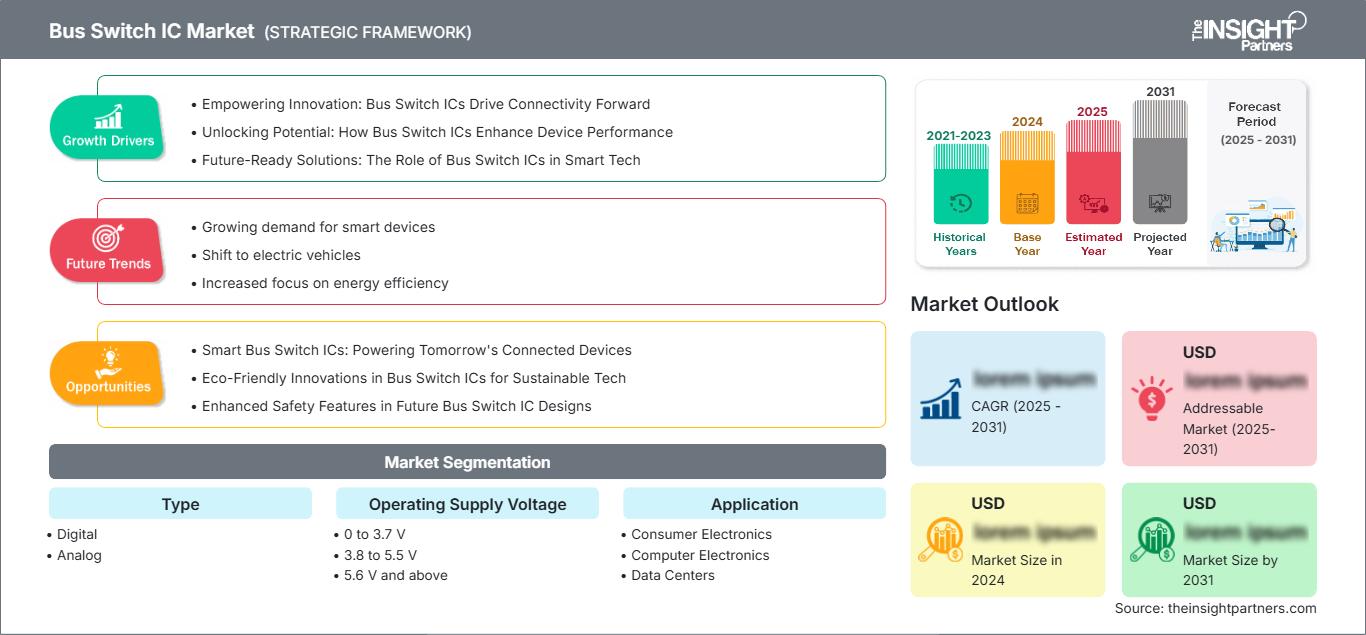
Regional Insights
North America Bus Switch IC Market
North America accounted for 25–28% of Bus Switch IC Market share in 2025 and is projected to grow at a CAGR of 5.5–6.2% during 2026–2034. Demand is supported by data center infrastructure expansion, enterprise computing investment, consumer electronics innovation, and telecommunications network development. The region's technology ecosystem drives consistent demand for bus switching solutions. Texas Instruments Incorporated, NXP Semiconductors, Renesas Electronics Corporation, Microchip Technology Inc., and Diodes Incorporated support installed bases across data center operators, computing manufacturers, and communications equipment providers in the US and Canada.
U.S. Bus Switch IC Market
The U.S. represented 82–85% of North American revenue in 2025 and is forecast to grow at a CAGR of 5.7–6.4% during 2026–2034. Application demand is concentrated in data center equipment, enterprise computing systems, consumer electronics, and telecommunications infrastructure. Company presence is reinforced by Texas Instruments Incorporated, NXP Semiconductors, Renesas Electronics Corporation, Microchip Technology Inc., and Semiconductor Components Industries, LLC. Buyers prioritize on-resistance, bandwidth, power consumption, and ESD protection specifications, plus design support that reduces development cycles and improves confidence in system performance.
Europe Bus Switch IC Market
Europe held 20–23% share in 2025 and is expected to grow at a CAGR of 5.2–5.9% during 2026–2034. Germany leads through industrial electronics and automotive applications, while the UK supports demand from computing and telecommunications sectors. France, Italy, and Spain add demand through consumer electronics and industrial systems. Technology investments and industrial automation favor suppliers with documented quality certifications. Texas Instruments Incorporated, NXP Semiconductors, Renesas Electronics Corporation, and Nexperia remain visible across commercial and industrial applications.
APAC Bus Switch IC Market
Asia Pacific accounted for 42–45% share in 2025 and is projected to grow at a CAGR of 7.0–7.7% during 2026–2034. China leads through consumer electronics manufacturing and computing production, while India expands through electronics manufacturing and infrastructure development. Japan and South Korea prioritize high-performance switches for consumer and automotive electronics, while Australia adds computing and telecommunications infrastructure. Policy support for semiconductor manufacturing and electronics industry growth strengthen Bus Switch IC Market adoption where component performance and cost efficiency carry significant value.
Middle East & Africa Bus Switch IC Market
The Middle East & Africa market is projected to grow at a CAGR of 4.5–5.2% during 2026–2034. Saudi Arabia leads through technology infrastructure investment and digital transformation, while the UAE adds computing and communications infrastructure. South Africa and Rest of MEA rely on technology development and infrastructure investment. Digital transformation and technology adoption create demand for reliable switching solutions. Suppliers succeed when they combine product quality, technical support, and supply chain consistency for diverse applications.
Segmentation Analysis
Type
Type is projected to grow at a CAGR of 6.0–6.7% during 2026–2034. Bus Switch IC Market scope covers Digital and Analog types. Selection depends on signal characteristics, voltage levels, and application requirements. Digital leads through high-speed data routing and established performance in computing and communications applications.
- Digital bus switches route digital signals between bus lines, offering low propagation delay and high bandwidth for computing and communications applications.
- Analog bus switches route analog signals with minimal signal degradation, supporting audio, video, and sensor applications where signal integrity is critical.
Operating Supply Voltage
Operating Supply Voltage is forecast to grow at a CAGR of 6.0–6.7% during 2026–2034. 0 to 3.7 V, 3.8 to 5.5 V, and 5.6 V and above categories address distinct application voltage requirements. Voltage segment adoption reflects system power supply trends and application-specific requirements.
- 0 to 3.7 V covers low-voltage applications including battery-powered devices and portable electronics where power efficiency is critical.
- 3.8 to 5.5 V addresses standard voltage applications across computing and telecommunications equipment.
- 5.6 V and above supports applications requiring higher voltage operation including industrial and automotive systems.
Application
Application is expected to grow at a CAGR of 6.2–6.9% during 2026–2034. Consumer Electronics, Computer Electronics, and Data Centers represent distinct market segments with varying switch requirements. Application adoption grows when system complexity and signal routing requirements drive component selection.
- Consumer Electronics applications include mobile devices, peripherals, and entertainment systems requiring compact, low-power bus switches.
- Computer Electronics encompasses computing systems, servers, and peripherals where bus switches support signal routing and system connectivity.
- Data Centers require high-performance bus switches for server connectivity, network interfaces, and storage systems supporting infrastructure expansion.
Opportunity Snapshot
| Application | Revenue Contribution | Trend Tag | Adoption Stage |
|---|---|---|---|
| Consumer Electronics | High | Mobile Devices | Mature |
| Computer Electronics | High | Computing Systems | Mature |
| Data Centers | High | Infrastructure | Scaling |
Bus Switch IC Market Growth Drivers and Impact Analysis
Data Center Infrastructure Expansion Drives Switch Demand
Global data center capacity continues expanding to support cloud computing, artificial intelligence, and digital services, creating significant demand for bus switch ICs in server, storage, and networking equipment. Each server and network device contains multiple bus switches for signal routing and connectivity. Hyperscale data center operators and enterprise infrastructure investments drive consistent demand for bus switching components. The practical impact is continued demand for low-power, high-bandwidth bus switches supporting data center equipment manufacturing.
Consumer Electronics Innovation Sustains Switch Requirements
Consumer electronics including smartphones, tablets, wearables, and peripherals continue incorporating advanced features requiring efficient bus switching for connectivity, charging, and data routing. Each generation of consumer devices introduces new connectivity requirements and form factor constraints. The expanding installed base of connected devices creates sustained demand for bus switch ICs. This driver benefits suppliers that can deliver compact, low-power switches supporting consumer electronics design requirements.
Enterprise Computing Modernization Creates Replacement Demand
Enterprise computing infrastructure modernization across organizations worldwide creates demand for bus switches in new systems and upgrade cycles. As enterprises refresh computing assets and adopt new architectures, bus switch requirements evolve toward higher performance and lower power consumption. The market impact is demand for bus switches meeting evolving system requirements with consistent quality and supply supporting enterprise infrastructure investment.
Bus Switch IC Market Future Trends
Low-Voltage Operation Enables Power-Efficient Designs
Bus Switch IC Market trends point toward low-voltage operation enabling power-efficient designs for battery-powered and energy-conscious applications. The next product cycle will combine sub-3 V operation with low on-resistance to support portable electronics and green computing requirements. This shift matters because system designers increasingly value power efficiency as performance and portability demands increase. Vendors with low-voltage design expertise will be better positioned as power constraints tighten.
Integrated Protection Features Enhance System Reliability
Integrated ESD protection and overvoltage tolerance are emerging as differentiators for bus switch ICs, enabling more robust system designs with reduced component count. Next-generation switches will incorporate enhanced protection features while maintaining switching performance. This evolution simplifies system design and improves reliability. Suppliers that can deliver integrated protection with established performance will gain credibility with system designers seeking reliability advantages.
Bus Switch IC Market Opportunities
High-Speed Bus Switches for Data Center Applications
Bus Switch IC Market Forecasts support investment in high-speed bus switches for data center networking and computing applications requiring bandwidth and signal integrity. Equipment manufacturers need switches supporting increasing data rates while maintaining low power consumption. Providers can create opportunities by developing switches for data center requirements. The opportunity is strongest where infrastructure expansion creates demand for high-performance switching components.
Low-Power Solutions for Portable Consumer Electronics
Portable consumer electronics continue driving demand for low-power bus switches supporting extended battery life. Manufacturers need compact, efficient switches for mobile and portable devices. Suppliers with low-power design capabilities can capture opportunities in consumer electronics markets. This opportunity rewards companies that can deliver power efficiency and small form factors for portable applications.
Recent Developments
- July 2026: ASML Holding N.V. (ASML) reported that Intel Foundry is using ASML’s High NA EUV technology on the Intel 18A process node to produce a subset of its Intel Core Ultra Series 3 processors. This milestone marks an important step in demonstrating High NA EUV readiness in a production environment. ASML and Intel have worked closely for decades to advance lithography technology and support the continued scaling of semiconductors. The high numerical aperture extreme ultraviolet (High NA EUV) lithography process is an important next step in EUV lithography, developed by ASML to enable more precise patterning for advanced chip manufacturing.
- April 2026: Applied Materials, Inc., the leader in materials engineering for the semiconductor industry, introduced two chipmaking systems designed to create the smallest features in the world’s most advanced logic chips. By controlling materials deposition with atomic-level precision, the technologies enable chipmakers to build faster and more power-efficient transistors at the scale required to sustain the pace of today’s global AI infrastructure buildout.
- December 2024: Nexperia introduced a new portfolio of logic ICs in tiny automotive-qualified MicroPak XSON5 leadless packaging. Miniaturized logic ICs are essential for space constrained applications including sophisticated automotive applications such as chassis safety systems, battery monitoring, infotainment units, and advanced driver assistance systems (ADAS). MicroPak XSON5 is a thermally enhanced plastic enclosure with a 75% smaller PCB footprint than traditional leaded mini logic packages, that also features side-wettable flanks to support automated optical inspection (AOI) of solder joints.
Frequently Asked Questions

- Comprehensive Market Sizing and Forecast Analysis
- Detailed Segmentation Analysis
- In-Depth Market Dynamics Assessment
- Regional and Country-Level Insights
- Competitive Landscape and Company Benchmarking
- Strategic Business Intelligence
Recent Reports
Testimonials

The Insight Partners' SCADA System Market report is comprehensive, with valuable insights on current trends and future forecasts. The team was highly professional, responsive, and supportive throughout. We are very satisfied and highly recommend their services.
RAN KEDEM Partner, Reali Technologies LTDs
I requested a report on a very specific software market and the team produced the report in a few days. The information was very relevant and well presented. I then requested some changes and additions to the report. The team was again very responsive and I got the final report in less than a week.
JEAN-HERVE JENN Chairman, Future Analytica
We worked with The Insight Partners for an important market study and forecast. They gave us clear insights into opportunities and risks, which helped shape our plans. Their research was easy to use and based on solid data. It helped us make smart, confident decisions. We highly recommend them.
PIYUSH NAGPAL Sr. Vice President, High Beam Global
The Insight Partners delivered insightful, well-structured market research with strong domain expertise. Their team was professional and responsive throughout. The user-friendly website made accessing industry reports seamless. We highly recommend them for reliable, high-quality research services
YUKIHIKO ADACHI CEO, Deep Blue, LLC.
This is the first time I have purchased a market report from The Insight Partners.While I was unsure at first, I visited their web site and felt more comfortable to take the risk and purchase a market report.I am completely satisfied with the quality of the report and customer service. I had several questions and comments with the initial report, but after a couple of dialogs over email with their analyst I believe I have a report that I can use as input to our strategic planning process.Thank you so much for taking the extra time and making this a positive experience.I will definitely recommend your service to others and you will be my first call when we need further market data.
JOHN SUZUKI President and Chief Executive Officer, Board Director, BK Technologies
I wish to appreciate your support and the professionalism you displayed in the course of attending to my request for information regarding to infectious disease IVD market in Nigeria. I appreciate your patience, your guidance, and the fact that you were willing to offer a discount, which eventually made it possible for us to close a deal. I look forward to engaging The Insight Partners in the future, all thanks to the impression you have created in me as a result of this first encounter.
DR CHIJIOKE ONYIA MANAGING DIRECTOR, PineCrest Healthcare Ltd.Reason to Buy
- Informed Decision-Making
- Understanding Market Dynamics
- Competitive Analysis
- Identifying Emerging Markets
- Customer Insights
- Market Forecasts
- Risk Mitigation
- Boosting Operational Efficiency
- Strategic Planning
- Investment Justification
- Tracking Industry Innovations
- Aligning with Regulatory Trends





 Get Free Sample for