
Router and Switch Market Size, Demand & Growth by 2034
Coverage: By Product (Internet Exchange Router, Service Provider Core Router, Multiservice Edge Router, Ethernet Service Edge Router, and ATM & Ethernet Switch), Service (BRAS, Ethernet Aggregation, Ethernet Access, Internet Data Center/Collocation/ Hosting, and Others), and Geography
- Status : Data Released
- Report Code : TIPTE100001157
- Category : Electronics and Semiconductor
- No. of Pages : 150
- Available Report Formats :


- Last update date : September 21, 2026


2025 Market Size
US$ 58.43 Bn
Base year value
2034 Forecast
US$ 116.55 Bn
Projected by 2034
CAGR 2026-2034
7.97 %
Growth rate
Addressable Market
US$ 786.81 Bn
(2026-2034)
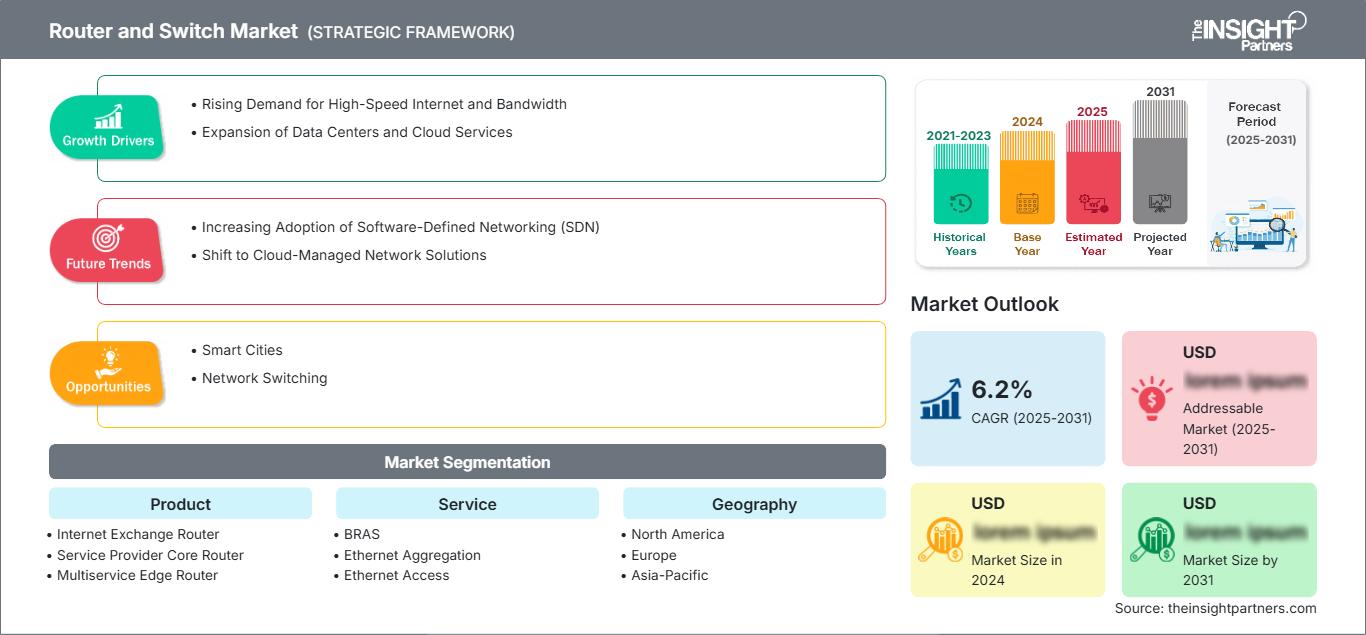
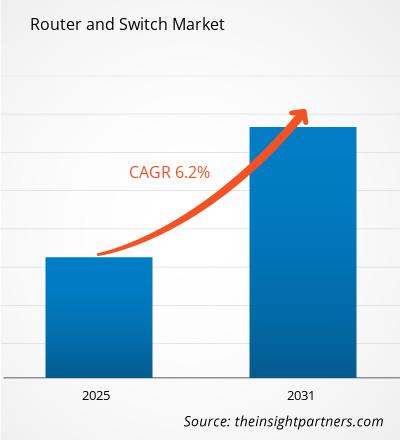
The router and switch market is undergoing a structural transition as enterprises, telecommunications operators, cloud providers, and data centers modernize network infrastructure for higher bandwidth, distributed computing, and AI workloads. The market was valued at US$ 58.43 Billion in 2025 and is projected to reach US$ 116.55 Billion by 2034, expanding at a CAGR of 7.97% from 2026 to 2034. Product modernization increasingly combines routing, switching, automation, security, and software-defined control.
North America remains a technology-intensive market, with the router and switch market size supported by data center expansion, enterprise network refresh cycles, and increasing bandwidth requirements from AI workloads. The region is estimated to expand at a 6.8–8.0% CAGR between 2026 and 2034, supported by hyperscale investment, cloud adoption, Ethernet upgrades, and demand for resilient edge connectivity across distributed enterprise environments.
Router and Switch Market Assessment and Insights
- North America: North America is expected to command a 29–33% share in 2025 and expand at a 6.8–8.0% CAGR between 2026–2034, supported by hyperscale data centers, enterprise modernization, cloud networking, and accelerated adoption of high-speed Ethernet infrastructure.
- US: The US is estimated to represent 82–86% of North America's 2025 revenue and grow at a 6.9–8.1% CAGR between 2026–2034, driven by hyperscale computing, AI infrastructure, and enterprise network refresh programs.
- Europe: Europe is estimated to hold a 23–27% share in 2025 and grow at a 6.2–7.4% CAGR between 2026–2034. Germany, the UK, France, Italy, and Spain remain important markets as cloud migration, industrial digitization, and data sovereignty requirements stimulate network investment.
- Asia Pacific: Asia Pacific is projected to account for a 30–34% share in 2025 and register a 8.2–9.5% CAGR between 2026–2034, with China, Japan, India, South Korea, and Australia benefiting from data center construction, 5G expansion, cloud adoption, and digital infrastructure programs.
- Largest Segment: ATM & Ethernet Switch is estimated to command a 31–35% market share in 2025, with a 7.4–8.6% CAGR between 2026–2034, reflecting broad deployment across data centers and enterprise networks.
- High Growth Segment: Internet Data Center/Collocation/ Hosting is estimated to represent a 19–23% share in 2025 and expand at a 9.0–10.4% CAGR between 2026–2034, supported by hyperscale and colocation capacity expansion.
- Key companies analyzed in detail: ADTRAN, Inc.; Actelis Networks, Inc.; ADVA Optical Networking; Cisco Systems, Inc.; ALE International; Ribbon Communications Operating Company, Inc.; Telefonaktiebolaget LM Ericsson; Extreme Networks, Inc.; Dell Technologies Inc.; Huawei Technologies Co., Ltd.
Source: The Insight Partners' analysis based on proprietary research, government publications, company annual reports, investor presentations, industry databases, and expert interviews.
The network infrastructure has gone from having separate routing and switching systems to systems that are programmable and are designed to provide telemetry, automation, security, and cloud services. The Ethernet speed technology has been developing quickly, but the design for data centers has now become spine-leaf and high-density. In 2025, data center Ethernet switching had particular momentum due to AI applications requiring more bandwidth and lower latency, while the need for routers was mostly driven by service providers and cloud companies.
Over the forecast period, investments are expected to move beyond the hyperscale space into enterprise branches, industrial campuses, telecom access and regional data centers. Asia Pacific will become increasingly important due to growing digital infrastructure investments, but North America will remain influential because of its cloud and AI infrastructure. The Router and Switch Market report indicates that regulatory attention toward cybersecurity, supply-chain resilience, data sovereignty, and energy efficiency will continue to shape vendor selection and network architecture decisions.
Router and Switch Market Report Scope
| Report Attribute | Details |
|---|---|
| Market size in 2025 | US$ 58.43 Billion |
| Market Size by 2034 | US$ 116.55 Billion |
| Global CAGR (2026 - 2034) | 7.97% |
| Historical Data | 2021-2024 |
| Forecast period | 2026-2034 |
Router and Switch Market Analysis
Demand is increasingly connected to cloud computing, AI workloads, 5G transport, edge computing, and enterprise application modernization. The router and switch market growth is therefore influenced by both traffic expansion and the need to improve network efficiency. This ecosystem encompasses chipmakers, optical component suppliers, hardware vendors, telecommunication service providers, cloud providers, system integrators, and managed service providers. Increased speeds on the Ethernet and programmable routers are driving procurement based on performance per watt, automation, and life cycle costs.
Ecosystem dynamics continue to be driven by the need for the switch to silicon, processors, optics, memory, power components, and manufacturing capabilities. Differentiation is becoming increasingly important in proprietary silicon, silicon from merchant vendors, software-defined networking, telemetry, and orchestration. Telecommunication service providers, too, look at equipment based on how well they fit into existing architectures and ease of operations since the large networks are configured consistently at access, aggregation, edge, and core network levels.
Competitive positioning is becoming more technology-intensive as vendors target AI data centers and high-performance enterprise environments. Cisco maintains broad exposure across routing and switching, while Huawei has substantial positioning in both enterprise and data center networking. Ericsson is strengthening wireless-first enterprise connectivity, while ADTRAN addresses service-provider and edge requirements. The Router and Switch Market trends increasingly reflect differentiation based on silicon performance, optical integration, automation, cybersecurity, and the ability to support multi-vendor environments. Recent market data also shows strong growth in high-speed Ethernet and continued expansion of router revenues.
Investment priorities are shifting toward 400G and 800G connectivity, AI-ready fabrics, software-defined operations, and energy-efficient equipment. Cisco's 2026 introduction of Silicon One G300 illustrates the movement toward extremely high-capacity switching for AI clusters, while Huawei has emphasized 400GE and 800GE architectures. Vendors such as Extreme Networks, Dell Technologies, ALE International, Ribbon Communications, and Actelis Networks can compete through specialized enterprise, access, industrial, and edge-networking propositions.
● REPORT CUSTOMIZATION
Tailor This Report To Align With Your Specific Business Requirements
This report can be customized to align precisely with your business objectives, scope, and target markets. Customization options include tailored segmentation, geography, competitive analysis, and strategic insights to support informed decision-making.
Customize This Report →WHAT YOU CAN ADJUST
- ● Segmentations
- ● Geography
- ● Competitive Analysis
- ● Language Preferences
Router and Switch Market: Strategic Insights
Regional Insights
North America router and switch market
North America is estimated at 29–33% of the global router and switch market revenue in 2025, with a 6.8–8.0% CAGR through 2034. The US dominates regional demand because hyperscale operators, cloud platforms, telecom carriers, and large enterprises continue investing in network capacity. Canada contributes through data centers, telecommunications modernization, and public-sector digital infrastructure.
AI infrastructure is an important incremental demand source because high-performance computing clusters require low-latency, high-throughput fabrics. Enterprise refresh programs are also supporting campus and branch switching, while software-defined WAN deployments encourage edge-routing modernization. Network resilience, cybersecurity, and power efficiency increasingly influence procurement decisions, particularly for large data centers. The Americas recorded strong Ethernet switching momentum in 2025, reinforcing the region's position as a major investment center.
U.S. router and switch Market
The US represents an estimated 82–86% of North America's 2025 router and switch market revenue and is projected to expand at a 6.9–8.1% CAGR. Cisco, Dell Technologies, Extreme Networks, and other suppliers maintain broad enterprise and data center exposure, while hyperscalers drive demand for high-capacity switching and routing infrastructure.
Application demand extends from cloud data centers to enterprise campuses, telecommunications, financial services, healthcare, government, and industrial environments. AI is accelerating the replacement of conventional switching platforms with higher-speed fabrics capable of supporting intensive east-west traffic. Cisco's 2026 AI networking announcements demonstrate the scale of technology development around high-capacity switching, while Ericsson's wireless-first architecture combines 5G, Wi-Fi, SD-WAN, and LAN switching for distributed enterprise deployments.
Europe router and switch Market
Europe is estimated to hold a 23–27% of the router and switch market share in 2025, growing at a 6.2–7.4% CAGR, with Germany positioned as the leading national market. Network modernization is supported by cloud adoption, industrial digitization, data sovereignty requirements, and investments in resilient digital infrastructure.
The UK and Germany remain major demand centers. The UK benefits from extensive cloud, financial services, telecom, and data center activity, while Germany's manufacturing base creates sustained requirements for industrial Ethernet, campus networks, and secure edge connectivity. France, Italy, and Spain are also expanding digital infrastructure, with demand shaped by public-sector modernization, telecom upgrades, and enterprise cloud migration. Energy efficiency and regulatory compliance increasingly influence equipment specifications across European deployments.
APAC router and switch Market
APAC is projected to represent 30–34% of 2025 revenue, with an 8.2–9.5% CAGR, led by China. Japan and South Korea contribute mature enterprise and telecom demand, while India and Australia are expanding data center and cloud infrastructure.
China benefits from large-scale digital infrastructure investment, while India is accelerating data center construction and enterprise connectivity. South Korea remains important for advanced telecommunications and semiconductor-linked infrastructure, and Japan continues network modernization. Australia contributes through cloud and data center expansion. Regional momentum is supported by 5G, AI computing, smart manufacturing, cloud adoption, and national digitalization programs.
Middle East & Africa router and switch Market
The Middle East and Africa router and switch market represents a smaller portion of global demand but is projected to expand at a 7.0–8.5% CAGR, with Saudi Arabia leading Gulf investment. UAE demand is supported by cloud and data center development, while South Africa remains an important regional connectivity hub.
Energy-sector digitization, smart-city programs, government cloud initiatives, and data center construction are increasing requirements for reliable routing and switching. Saudi Arabia's diversification programs and UAE digital infrastructure investments support high-capacity deployments, while South Africa provides demand across telecommunications, financial services, and enterprise networks. Northern and Southern African markets are also becoming more relevant as AI and cloud infrastructure expands. Huawei's 2026 Northern and Southern African networking initiatives illustrate growing regional emphasis on resilient data center networks.
Segmentation Analysis
Product
Product selection is increasingly determined by bandwidth, latency, service density, programmability, and lifecycle economics. The router and switch market scope spans carrier-grade routing, edge aggregation, Internet exchange infrastructure, and Ethernet switching. Product modernization favors high-speed interfaces and software-defined control, with a 7.5–8.6% CAGR between 2026–2034 for the overall product segment.
- Internet Exchange Router: Supports high-volume traffic exchange between networks and content providers, with demand influenced by peering growth, Internet traffic concentration, and requirements for resilient interconnection infrastructure.
- Service Provider Core Router: Remains strategically important for carrier backbones, where high forwarding capacity, reliability, traffic engineering, and optical integration determine procurement priorities.
- Multiservice Edge Router: Serves converged enterprise and service-provider environments, supporting multiple services at distributed locations while reducing equipment complexity and operational overhead.
- Ethernet Service Edge Router: Addresses carrier Ethernet and business connectivity applications, with demand shaped by bandwidth upgrades, aggregation requirements, and managed connectivity services.
- ATM & Ethernet Switch: Provides broad switching functionality across enterprise, carrier, and data center networks, benefiting from Ethernet's expanding role in high-capacity infrastructure.
Service
Service requirements are shifting toward scalable aggregation, access, and data center connectivity as operators seek to monetize higher bandwidth and simplify network operations. The service segment is projected to register a 7.8–9.0% CAGR between 2026–2034, supported by cloud connectivity and enterprise service expansion.
- BRAS: Supports broadband subscriber aggregation and policy enforcement, remaining strategically relevant where service providers manage large fixed broadband customer bases.
- Ethernet Aggregation: Consolidates traffic from access networks and improves network utilization, particularly where carriers migrate toward higher-capacity Ethernet architectures.
- Ethernet Access: Enables business and residential connectivity at the network edge, with demand tied to fiber deployment, enterprise bandwidth requirements, and access modernization.
- Internet Data Center/Collocation/ Hosting: Connects high-density computing environments and is strategically positioned for AI, cloud, colocation, and inter-data-center traffic requirements.
- Others: Excluded from detailed analysis in accordance with the defined segmentation scope.
Opportunity Snapshot
| Service | Revenue Contribution (High/Medium/Low) | Trend Tag | Adoption Stage |
| BRAS | Medium | Broadband Edge | Mature |
| Ethernet Aggregation | High | Traffic Aggregation | Mature |
| Ethernet Access | High | Fiber Access | Scaling |
| Internet Data Center/Collocation/ Hosting | High | AI Fabrics | Scaling |
| Others | Low | Legacy Services | Mature |
Router and Switch Market Growth Drivers and Impact Analysis
AI data center expansion increases high-speed switching requirements
Workloads associated with the training and inference processes for AI require significantly more east-west bandwidth than many traditional enterprise workloads, resulting in the need for high-radix switches, lower latency fabrics, advanced telemetry, and increased speeds of optical interconnects. From a commercial perspective, the implications go beyond the hyperscale organizations since enterprises continue to invest in private AI infrastructure and inference capabilities within regions. It also increases the need for equipment that is capable of delivering consistent performance with workloads characterized by bursts of traffic. Industry statistics point out to very healthy growth in the data center Ethernet switch market in 2025, with 800G making a significant contribution to revenue.
Cloud and edge architectures broaden network modernization requirements
There are shifts in the realm of distributed computing that affect traffic creation, traffic processing, and storage. Many organizations are increasingly favoring integration of their centralized cloud infrastructure with their branch, edge, and private infrastructure, necessitating routers and switches that could work seamlessly from multiple locations. This brings about a larger pool of potential customers because, aside from networking needs, there are branches of enterprises, industrial sites, retail sites, and regional data centers. Cloud networking also affects purchasing processes in that it focuses on centralized provisioning, observability, zero-touch deployment, and subscriptions. The wireless first enterprise architecture for 2025 suggested by Ericsson is an example of what can be expected when it comes to the convergence of routing, switching, Wi-Fi, 5G, and SD-WAN solutions in branch settings.
Bandwidth-intensive digital services accelerate infrastructure refresh cycles
Network use continues to rise due to video content, cloud applications, AI services, connected devices, and real-time enterprise applications. In order to manage the load and avoid approaching the limits of the network capacity, service providers have to upgrade their switching fabrics, aggregation layer, and routers in addition to software optimization. This is especially the case when old infrastructures cannot handle current interface speeds and requirements for automation. Moreover, enterprise customers are looking at new technologies in terms of total cost of ownership, power usage, and security, not just the number of ports. This means that high throughput with low operational overhead will be rewarded.
Router and Switch Market Future Trends
AI-native network fabrics become mainstream architecture
The future AI infrastructure will demand networking designs optimized for the communication of accelerators rather than traditional applications. Determinism, congestion management, adaptivity, high radix switches, and automatic telemetry are key themes in the design of future networks. Networking operating systems will be equipped with AI-based fault identification and workload optimization capabilities, which will enable the infrastructure engineers to recognize problems before they disrupt the performance of the models. Optics will also find increased synergy with switch platforms as the bandwidth demands increase. Port speed will no longer matter as the competitive parameter in the future; vendors will focus on maximizing the utilization of compute, as inefficient networking impacts the efficiency of expensive accelerators.
Network automation shifts from configuration to autonomous operations
Network management practices have already started shifting from automated provisioning to closed-loop processes driven by telemetry, policy engines, machine learning, and intent-driven automation. During the forecast period, organizations are expected to perform more operations within the lifecycle of networks, such as configuration verification, anomaly detection, capacity planning, and remediation. This will drive the requirement for devices that feature an open API, streaming telemetry, programmability pipelines, and security features. Organizations that rely significantly on manual configurations may be under more pressure owing to the growing decentralization of network estates. Procurement will be affected as well because customers will consider operational expenses, in addition to hardware costs. The architecture built in the future should be based on interoperable platforms that can manage routers, switches, optical devices, security systems, and cloud infrastructure.
Router and Switch Market Opportunities
High-speed networking for regional AI and colocation facilities
The router and switch market forecasts indicate an opportunity for vendors to target regional AI and colocation facilities rather than focusing exclusively on hyperscale customers. Many enterprises require localized inference, data residency, and lower latency without building hyperscale infrastructure. Suppliers can develop modular platforms optimized for medium-sized clusters, offering 400G and 800G connectivity with simplified management and energy-efficient designs. Colocation providers represent another attractive customer group because they need standardized, repeatable network architectures that can accommodate multiple tenants and rapidly changing traffic patterns. Vendors that package switching hardware with orchestration, telemetry, optics, and lifecycle services can create differentiated propositions while reducing deployment complexity for operators with smaller network engineering teams.
Software-led monetization of distributed connectivity
There is more value to be captured by integrating routing and switching hardware with software-based services, security, analytics, and cloud management. This is especially true in terms of the enterprise edge, which requires software-defined connectivity with managed services rather than standalone network devices that require complex operation. This transformation may be facilitated by the following: virtual routing, subscription management, remote provisioning, and integrated policy enforcement. The ADTRAN 2025 Ensemble Cloudlet vRouter launch showcases the path towards software-defined services at the edge via a subscription-based approach. The same can enable operators to generate more recurring revenue without being dependent on hardware revenues. For equipment vendors, it allows differentiating mature hardware portfolios with operational features.
Frequently Asked Questions

- Comprehensive Market Sizing and Forecast Analysis
- Detailed Segmentation Analysis
- In-Depth Market Dynamics Assessment
- Regional and Country-Level Insights
- Competitive Landscape and Company Benchmarking
- Strategic Business Intelligence
Recent Reports
Testimonials

The Insight Partners' SCADA System Market report is comprehensive, with valuable insights on current trends and future forecasts. The team was highly professional, responsive, and supportive throughout. We are very satisfied and highly recommend their services.
RAN KEDEM Partner, Reali Technologies LTDs
I requested a report on a very specific software market and the team produced the report in a few days. The information was very relevant and well presented. I then requested some changes and additions to the report. The team was again very responsive and I got the final report in less than a week.
JEAN-HERVE JENN Chairman, Future Analytica
We worked with The Insight Partners for an important market study and forecast. They gave us clear insights into opportunities and risks, which helped shape our plans. Their research was easy to use and based on solid data. It helped us make smart, confident decisions. We highly recommend them.
PIYUSH NAGPAL Sr. Vice President, High Beam Global
The Insight Partners delivered insightful, well-structured market research with strong domain expertise. Their team was professional and responsive throughout. The user-friendly website made accessing industry reports seamless. We highly recommend them for reliable, high-quality research services
YUKIHIKO ADACHI CEO, Deep Blue, LLC.
This is the first time I have purchased a market report from The Insight Partners.While I was unsure at first, I visited their web site and felt more comfortable to take the risk and purchase a market report.I am completely satisfied with the quality of the report and customer service. I had several questions and comments with the initial report, but after a couple of dialogs over email with their analyst I believe I have a report that I can use as input to our strategic planning process.Thank you so much for taking the extra time and making this a positive experience.I will definitely recommend your service to others and you will be my first call when we need further market data.
JOHN SUZUKI President and Chief Executive Officer, Board Director, BK Technologies
I wish to appreciate your support and the professionalism you displayed in the course of attending to my request for information regarding to infectious disease IVD market in Nigeria. I appreciate your patience, your guidance, and the fact that you were willing to offer a discount, which eventually made it possible for us to close a deal. I look forward to engaging The Insight Partners in the future, all thanks to the impression you have created in me as a result of this first encounter.
DR CHIJIOKE ONYIA MANAGING DIRECTOR, PineCrest Healthcare Ltd.Reason to Buy
- Informed Decision-Making
- Understanding Market Dynamics
- Competitive Analysis
- Identifying Emerging Markets
- Customer Insights
- Market Forecasts
- Risk Mitigation
- Boosting Operational Efficiency
- Strategic Planning
- Investment Justification
- Tracking Industry Innovations
- Aligning with Regulatory Trends





 Get Free Sample for