
Membrane Switch Market Growth, Demand & Size by 2034
Coverage: By Type (Tactile and Non-tactile); Product (Polyester and Polycarbonate); and Application (Industrial, Medical, and Consumer Electronics), and Geography
- Status : Data Released
- Report Code : TIPTE100001058
- Category : Electronics and Semiconductor
- No. of Pages : 150
- Available Report Formats :


- Last update date : October 15, 2026


2025 Market Size
US$ 8.13 Bn
Base year value
2034 Forecast
US$ 10.66 Bn
Projected by 2034
CAGR 2026-2034
3.06 %
Growth rate
Addressable Market
US$ 85.33 Bn
(2026-2034)
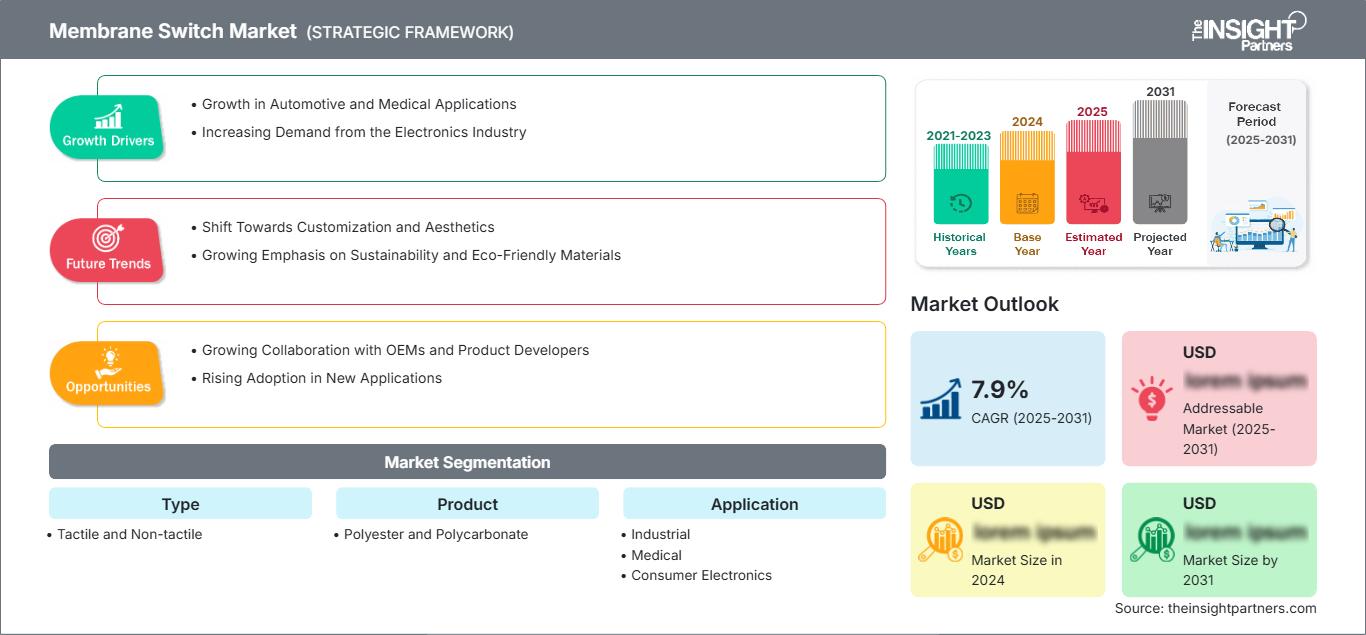
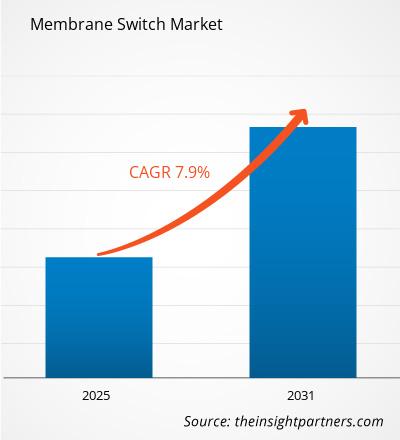
Membrane switch market was valued at US$ 8.13 Billion in 2025 and is projected to reach US$ 10.66 Billion by 2034, registering a CAGR of 3.06% during 2026–2034. The industry is witnessing steady expansion due to increasing demand for compact human-machine interfaces, durable control panels, and customized switching solutions across industrial equipment, medical devices, and consumer electronics applications.
The membrane switch market size in North America is supported by advanced manufacturing ecosystems, increasing automation adoption, and rising demand for medical and industrial control interfaces. The region is expected to register a CAGR range of 3.0–3.5% during 2026–2034, driven by replacement of traditional mechanical switches with lightweight, sealed, and cost-efficient interface technologies.
Membrane Switch Market Assessment and Insights
- North America: North America is estimated to hold a 30–34% share in 2025, supported by industrial automation, healthcare equipment manufacturing, and aerospace applications. The region is projected to grow at a CAGR of 3.0–3.5% during 2026–2034 due to technology upgrades and customized interface requirements.
- US: The US accounts for approximately 24–28% share of the global industry in 2025, supported by medical electronics, defense systems, and industrial controls. The country is expected to record a CAGR of 3.1–3.6% between 2026–2034.
- Europe: Europe represents nearly 25–29% share in 2025, with Germany, the UK, France, and Italy contributing significantly through automotive electronics, industrial machinery, and healthcare applications. The region is expected to expand at a CAGR of 2.8–3.4% during 2026–2034.
- Asia Pacific: Asia Pacific holds an estimated 28–32% share in 2025 and is anticipated to achieve a CAGR of 3.4–4.0% during 2026–2034. China, Japan, South Korea, and India are driving adoption through electronics manufacturing, automation investments, and expanding medical equipment production.
- Largest Segment: The non-tactile segment is estimated to maintain a 52–56% market share in 2025, growing at a CAGR of 2.8–3.3% during 2026–2034 due to cost efficiency and simplified interface designs.
- High Growth Segment: The medical application segment is expected to hold a 22–26% share in 2025 and grow at a CAGR of 3.8–4.4% during 2026–2034 due to increasing demand for hygienic and durable control interfaces.
- Key companies analyzed in detail: Molex, LLC, Xymox Technologies, Inc., Douglas Corporation, Dyna-Graphics Corporation, GOT Interface, LLC, Esterline Technologies Corporation, Epec, LLC, Butler Technologies, Design Mark Industries, Inc., Nelson-Miller, Inc., and Pannam Imaging.
Source: The Insight Partners' analysis based on proprietary research, government publications, company annual reports, investor presentations, industry databases, and expert interviews.
Improvements in interface technologies have resulted in major changes in how electronic systems work with users within both industrial and consumer sectors. Companies have moved beyond simple printed switches to use custom multilayered interface options that include graphic overlays, flexible circuits, LEDs, and improved sealing. Material innovations such as polyester and polycarbonate films have allowed for higher durability and more design flexibility. Automation in production has enabled suppliers to handle high volume needs while delivering accurate customizations. All these have contributed to the importance of membrane switches in those applications that need reliability, small size and ease of use.
Future adoption will be positively affected by growing spending on smart manufacturing, healthcare technology and connected devices production. Emerging markets in Asia Pacific and the Middle East offer new prospects through initiatives of industrialization and infrastructural development. Regulations regarding the necessity of equipment reliability and hygiene standards in medical settings are promoting adoption of sealed interfaces as well. Suppliers targeting advanced materials, electronics and customization capabilities are likely to enhance their market position over the forecast period.
Membrane Switch Market Report Scope
| Report Attribute | Details |
|---|---|
| Market size in 2025 | US$ 8.13 Billion |
| Market Size by 2034 | US$ 10.66 Billion |
| Global CAGR (2026 - 2034) | 3.06% |
| Historical Data | 2021-2024 |
| Forecast period | 2026-2034 |
Membrane Switch Market Analysis
The growth in the demand for membrane switches is driven by the growing popularity of miniature control panels in machinery and equipment, both industrial and medical as well as consumer devices. The popularity of such membranes is driven by the fact that they are resistant to moisture and dust contamination while at the same time allowing for customized designs. The value chain involves raw materials producers, producers of printed electronics, designers, manufacturers of component parts, and end-use equipment producers. Among important raw materials are polyester film, conductive inks, adhesive materials, and electronic components. The growing degree of automation in the manufacture of machinery is driving constant demand for efficient operator interfaces. Nevertheless, the efficiency of the supply chain depends on the availability of materials, printing capability and customization requirements for particular applications.
Producers are optimizing production through using digital design software, printing technologies, and quality control procedures. The supply landscape includes specialized companies which produce customized low volumes of products as well as mass-production companies producing industrial applications. The growing use of touch-based technologies imposes competition pressure but the membrane switches are still relevant in cases when tactile response is important.
The competitive environment of membrane switch market report consists of a mixture of global component manufacturers and specialty interface solution providers. Such firms include Molex, LLC, Xymox Technologies, Inc., Douglas Corporation, Dyna-Graphics Corporation, GOT Interface, LLC, Esterline Technologies Corporation, Epec, LLC, Butler Technologies, Design Mark Industries, Inc., Nelson-Miller, Inc., and Pannam Imaging. These firms compete by means of customizing abilities, engineering skills, and providing application-specific solutions.
The strategies for investing are directed at improving design ability, manufacturing efficiency, and incorporating new technologies in the switching process. Major suppliers are building strategic relations with the manufacturers of medical equipment, industrial automation systems, and electronics products to enter into long-term agreements. Firms with experience in working with flexible circuits, graphic overlay technologies, and rapid prototyping are expected to benefit from customized solutions.
● REPORT CUSTOMIZATION
Tailor This Report To Align With Your Specific Business Requirements
This report can be customized to align precisely with your business objectives, scope, and target markets. Customization options include tailored segmentation, geography, competitive analysis, and strategic insights to support informed decision-making.
Customize This Report →WHAT YOU CAN ADJUST
- ● Segmentations
- ● Geography
- ● Competitive Analysis
- ● Language Preferences
Membrane Switch Market: Strategic Insights
Regional Insights
North America Membrane Switch Market
North America holds a Membrane Switch Market share of 30–34% in 2025 and is expected to grow at a CAGR of 3.0–3.5% over 2026–2034. North America offers a conducive environment in terms of industrial automation adoption, developed healthcare sector, and electronics manufacturing capabilities. Growth in the region is backed by applications that need a reliable seal in medical devices, aerospace, and heavy industry machinery.
The ecosystem of the region comprises of companies that manufacture switches, develop new technologies for switches, and use these switches in their respective industries. The USA is the dominant player as the country has a well-developed healthcare device manufacturing industry and an advanced industrial technology industry. Smart factory investments and modernization of equipment will aid growth in the coming years.
U.S. Membrane Switch Market
The U.S. membrane switch market is estimated to represent 75–82% of the North American share in 2025 and is expected to grow at a CAGR of 3.1–3.6% during 2026–2034. The country benefits from strong presence of medical equipment producers, defense manufacturers, industrial automation companies, and electronics suppliers.
The companies like Molex, LLC, Xymox Technologies, Inc., and Douglas Corporation offer much industry participation through their specially designed interface systems. The acceptance rate is increasing in areas like diagnostic devices, labs, manufacturing control system and consumer electronics. Some of the demand drivers are the requirement of reliable but small interface systems which can improve the performance. The presence of high-end engineering and logistics capability assures the importance of the country in the regional context.
Europe Membrane Switch Market
Europe is expected to possess a market share of 25-29% in 2025 with a CAGR of 2.8-3.4% for the forecast period of 2026-2034. Germany is considered the major market owing to its state-of-the-art industrial machinery, automobile manufacturing, and automation industries. The contribution from the United Kingdom includes health care technologies and unique uses of electronic components.
The demand in Germany comes from precise engineering industries that need dependable control panels and operator interfaces. France and Italy have been increasingly making use of the membrane switches in medical devices, industrial products, and transport industry. Spain is experiencing an increase in usage of the same in manufacturing industries and consumer electronics industry.
APAC Membrane Switch Market
The APAC region is estimated to hold a market share of 28-32% in 2025 and have a CAGR of 3.4-4.0% from 2026 to 2034. China emerges as the leader in terms of implementation due to manufacturing capabilities in electronics and automation in industry.
Industries with advanced technology in Japan and South Korea are contributing to this region as well. The demand for customized switching devices is rising in India and Australia due to the use of healthcare equipment and infrastructure projects. Favorable conditions are being created due to the development of manufacturing and electronics industries by the government.
Middle East & Africa Membrane Switch Market
The Middle East & Africa region is expected to experience steady expansion with a CAGR range of 2.5–3.2% during 2026–2034. Saudi Arabia and the UAE are key contributors due to investments in infrastructure, healthcare modernization, and industrial development. South Africa represents an important market through manufacturing and healthcare applications.
Membrane switching solution adoption is affected by energy sector equipment needs, industrial upgradation, and infrastructure development schemes. UAE shows growing demand for high-end control systems, and the diversification efforts of Saudi Arabia promote adoption of technology. RoMEA region is progressively adopting such solutions via industrial and commercial projects that require sturdy electronic interface solutions.
Segmentation Analysis
Type
The Type segment of the membrane switch market includes Tactile and Non-tactile solutions. This segment is expected to expand at a CAGR of 2.8–3.3% during 2026–2034. Selection between tactile and non-tactile designs depends on application requirements, user interaction preferences, durability expectations, and cost considerations. Industrial equipment and medical devices increasingly require customized interfaces that balance operational feedback, reliability, and compact design.
- Tactile: Tactile switches provide physical feedback through embossed metal domes or similar mechanisms, improving user confidence during operation. These solutions are preferred in applications where operators require confirmation of input, including industrial controls, medical devices, and specialized electronic equipment.
- Non-tactile: Non-tactile solutions represent a significant portion of adoption due to their simplified construction, lower manufacturing complexity, and suitability for applications requiring flat, low-profile interfaces. Consumer electronics and cost-sensitive industrial applications commonly utilize these designs.
Product
The Product segment consists of Polyester and Polycarbonate materials and is projected to register a CAGR of 2.9–3.4% during 2026–2034. Material selection influences durability, resistance properties, appearance, and performance characteristics. Manufacturers are focusing on advanced films and printing technologies to improve product lifespan and support specialized applications requiring chemical resistance and environmental protection.
- Polyester: Polyester-based products maintain strong adoption due to flexibility, durability, and resistance to moisture and chemicals. These materials are widely used in industrial and medical applications where reliable performance under demanding operating conditions is essential.
- Polycarbonate: Polycarbonate products are valued for high optical clarity, impact resistance, and premium appearance. They are increasingly used in applications requiring enhanced aesthetics, transparent overlays, and improved mechanical strength for electronic interfaces.
Application
The Application segment covers Industrial, Medical, Consumer Electronics categories and is anticipated to grow at a CAGR of 3.2–3.8% during 2026–2034. Growing demand for customized human-machine interfaces across multiple sectors is strengthening adoption. The integration of indicators, sensors, and printed electronics is increasing the functional capabilities of application-specific switching systems.
- Industrial: Industrial applications represent a major adoption area due to increasing automation, machinery modernization, and demand for durable operator control systems. Manufacturers use these solutions in equipment panels, process controls, and factory automation interfaces.
- Medical: Medical applications are gaining importance because healthcare equipment requires hygienic, sealed, and easy-to-clean interfaces. Diagnostic systems, monitoring devices, and laboratory equipment increasingly utilize customized solutions to support reliability and regulatory requirements.
- Consumer Electronics: Consumer electronics applications benefit from lightweight designs and flexible customization options. These products are used in appliances, electronic devices, and specialized consumer equipment where compact interfaces and cost efficiency are important considerations.
Opportunity Snapshot
| Application | Revenue Contribution | Trend Tag | Adoption Stage |
|---|---|---|---|
| Industrial | High | Smart Controls | Mature |
| Medical | Medium | Digital Care | Scaling |
| Consumer Electronics | Medium | Flexible Interfaces | Mature |
Membrane Switch Market Growth Drivers and Impact Analysis
Expansion of Industrial Automation and Smart Manufacturing
Increasing adoption of automation technologies across manufacturing facilities is creating sustained demand for reliable operator interfaces. Industrial equipment manufacturers are integrating advanced control systems that require compact, durable, and customizable switching solutions. Smart factory initiatives are encouraging upgrades of machinery panels, production monitoring systems, and human-machine interfaces. The adoption of Industry 4.0 technologies is increasing the need for interfaces capable of operating in demanding environments with exposure to dust, moisture, and frequent usage. Suppliers are responding by developing enhanced materials, improved sealing technologies, and application-specific designs. This trend is expected to strengthen the role of membrane switching solutions within industrial automation ecosystems while encouraging manufacturers to invest in advanced production capabilities.
Growing Demand for Hygienic Interfaces in Medical Equipment
Healthcare equipment manufacturers are increasingly adopting sealed interface technologies to meet operational reliability and hygiene requirements. Medical devices used in hospitals, laboratories, and diagnostic facilities require surfaces that can withstand frequent cleaning procedures while maintaining consistent performance. The rising deployment of monitoring systems, diagnostic instruments, and portable medical equipment is supporting demand for customized switching technologies. Manufacturers are focusing on antimicrobial materials, improved durability, and ergonomic designs to address healthcare application requirements. Regulatory emphasis on equipment safety and infection-control practices is further influencing product development strategies. As healthcare infrastructure expands globally, suppliers offering specialized solutions for medical applications are expected to benefit from increasing customization requirements and long-term equipment replacement cycles.
Integration of Flexible Electronics and Advanced Materials
Advancements in flexible electronics and material engineering are improving the functionality and design possibilities of switching technologies. Manufacturers are incorporating advanced films, conductive inks, printed circuits, and integrated lighting features to create more sophisticated interfaces. These developments allow equipment designers to reduce product dimensions while improving user interaction and operational efficiency. Flexible electronic components are becoming increasingly important in applications requiring lightweight and space-efficient designs. The availability of improved polyester and polycarbonate materials is enabling better resistance against environmental conditions and repeated usage. These innovations are encouraging broader adoption across industrial, medical, and specialized electronic applications while supporting manufacturers in developing differentiated solutions for evolving customer requirements.
Membrane Switch Market Future Trends
Adoption of Integrated Smart Interface Solutions
Future development will increasingly focus on integrating membrane switches with sensors, touch functionality, lighting systems, and connected electronic components. Equipment manufacturers are seeking interface solutions that provide enhanced user interaction while maintaining compact designs. The combination of flexible electronics and intelligent control features is expected to create Membrane Switch Market trends in medical devices, industrial systems, and advanced consumer equipment. Suppliers are investing in engineering capabilities to develop multifunctional interfaces that support improved diagnostics, operational monitoring, and user customization. This transition will encourage collaboration between switching manufacturers and electronic system developers, creating more advanced solutions for next-generation equipment designs.
Increasing Customization Through Digital Manufacturing
Digital manufacturing technologies are expected to transform production processes by enabling faster prototyping, improved precision, and greater customization flexibility. Advanced design software, automated printing systems, and efficient production workflows will allow manufacturers to support diverse customer requirements. Small-batch production for specialized applications is likely to become more feasible, benefiting industries such as medical technology and industrial equipment. Companies are expected to prioritize shorter development cycles and improved quality management to remain competitive. These capabilities will help suppliers respond more effectively to changing customer specifications while maintaining cost efficiency. The trend toward digitalized production will influence future strategies across the switching technology ecosystem.
Membrane Switch Market Opportunities
Expansion in Emerging Manufacturing Economies
Growing industrial development in emerging economies presents significant opportunities for suppliers of customized switching solutions. Countries investing in manufacturing infrastructure, electronics production, and healthcare expansion are creating new demand channels. Asia Pacific economies, particularly China, India, and Southeast Asian countries, are increasing their requirements for industrial equipment interfaces and electronic components. Companies that establish localized production capabilities and strengthen partnerships with regional manufacturers can benefit from expanding application opportunities. Investment in supply chain efficiency, technical support, and application-specific designs will be important for capturing demand from developing industrial ecosystems. These Membrane Switch Market forecast are expected to support broader adoption of advanced switching technologies across multiple sectors.
Development of Specialized Medical and Healthcare Interfaces
Healthcare modernization is creating opportunities for manufacturers to develop specialized interface solutions designed for advanced medical equipment. Increasing investments in diagnostic systems, patient monitoring devices, and laboratory technologies are encouraging demand for durable and hygienic control panels. Suppliers focusing on healthcare-specific designs can differentiate through improved materials, antimicrobial coatings, and customized layouts. The growing emphasis on equipment reliability and operational efficiency is expected to encourage partnerships between switching manufacturers and medical device producers. Companies capable of meeting strict performance requirements and supporting regulatory compliance will be positioned to access expanding healthcare applications. These opportunities highlight the importance of innovation and application expertise within future growth strategies.
Frequently Asked Questions

- Comprehensive Market Sizing and Forecast Analysis
- Detailed Segmentation Analysis
- In-Depth Market Dynamics Assessment
- Regional and Country-Level Insights
- Competitive Landscape and Company Benchmarking
- Strategic Business Intelligence
Recent Reports
Testimonials

The Insight Partners provided valuable market intelligence that supported our global go-to-market strategy. Their team was professional, responsive, and attentive to our feedback, providing thoughtful analysis and helpful methodological clarifications throughout the project.
Junmo Kim Chief Financial Officer (CFO), Enertech Co., Ltd.
The Insight Partners' SCADA System Market report is comprehensive, with valuable insights on current trends and future forecasts. The team was highly professional, responsive, and supportive throughout. We are very satisfied and highly recommend their services.
RAN KEDEM Partner, Reali Technologies LTDs
I requested a report on a very specific software market and the team produced the report in a few days. The information was very relevant and well presented. I then requested some changes and additions to the report. The team was again very responsive and I got the final report in less than a week.
JEAN-HERVE JENN Chairman, Future Analytica
We worked with The Insight Partners for an important market study and forecast. They gave us clear insights into opportunities and risks, which helped shape our plans. Their research was easy to use and based on solid data. It helped us make smart, confident decisions. We highly recommend them.
PIYUSH NAGPAL Sr. Vice President, High Beam Global
The Insight Partners delivered insightful, well-structured market research with strong domain expertise. Their team was professional and responsive throughout. The user-friendly website made accessing industry reports seamless. We highly recommend them for reliable, high-quality research services
YUKIHIKO ADACHI CEO, Deep Blue, LLC.
This is the first time I have purchased a market report from The Insight Partners.While I was unsure at first, I visited their web site and felt more comfortable to take the risk and purchase a market report.I am completely satisfied with the quality of the report and customer service. I had several questions and comments with the initial report, but after a couple of dialogs over email with their analyst I believe I have a report that I can use as input to our strategic planning process.Thank you so much for taking the extra time and making this a positive experience.I will definitely recommend your service to others and you will be my first call when we need further market data.
JOHN SUZUKI President and Chief Executive Officer, Board Director, BK Technologies
I wish to appreciate your support and the professionalism you displayed in the course of attending to my request for information regarding to infectious disease IVD market in Nigeria. I appreciate your patience, your guidance, and the fact that you were willing to offer a discount, which eventually made it possible for us to close a deal. I look forward to engaging The Insight Partners in the future, all thanks to the impression you have created in me as a result of this first encounter.
DR CHIJIOKE ONYIA MANAGING DIRECTOR, PineCrest Healthcare Ltd.Reason to Buy
- Informed Decision-Making
- Understanding Market Dynamics
- Competitive Analysis
- Identifying Emerging Markets
- Customer Insights
- Market Forecasts
- Risk Mitigation
- Boosting Operational Efficiency
- Strategic Planning
- Investment Justification
- Tracking Industry Innovations
- Aligning with Regulatory Trends





 Get Free Sample for