
Rotary Coded Switches Market Share, Size & Demand by 2034
Coverage: By Type (SMT, Through Hole); Application (Telecommunications, Industrial, Medical, Others), and Geography (North America, Europe, Asia Pacific, and South and Central America)
- Status : Data Released
- Report Code : TIPRE00015024
- Category : Electronics and Semiconductor
- No. of Pages : 150
- Available Report Formats :


- Last update date : September 18, 2026


2025 Market Size
US$ 821.09 Mn
Base year value
2034 Forecast
US$ 1,039.32 Mn
Projected by 2034
CAGR 2026-2034
2.65 %
Growth rate
Addressable Market
US$ 8,441.47 Mn
(2026-2034)
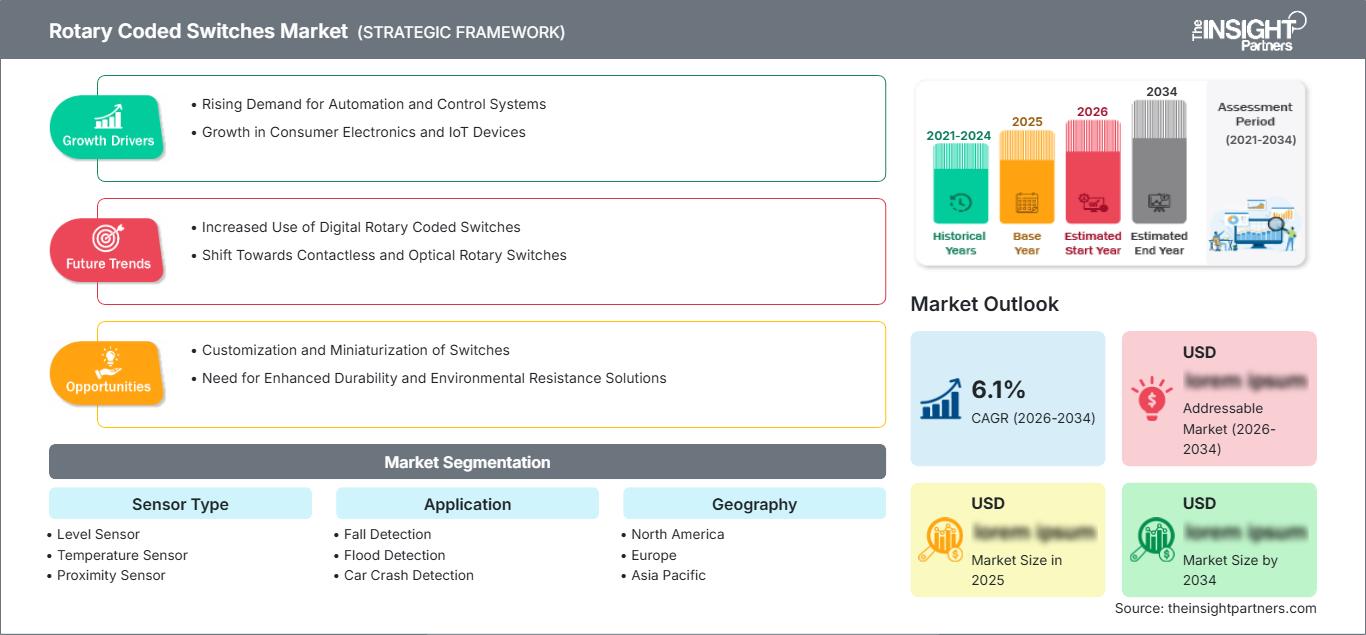
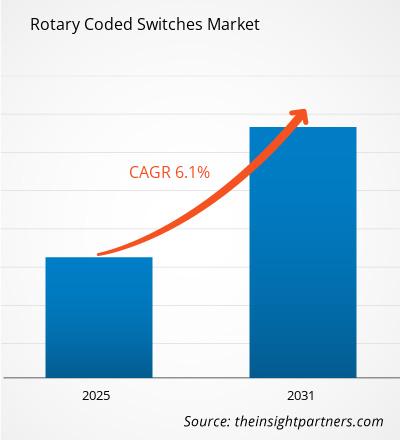
The rotary coded switches market is projected to grow from US$ 821.09 Million in 2025 to US$ 1039.32 Million by 2034, registering a CAGR of 2.65% during 2026–2034. Demand is supported by compact circuit configuration needs, industrial automation upgrades, telecommunications hardware, consumer electronics assemblies, and rugged control interfaces that require repeatable mechanical selection.
North America remains a design-led region where rotary coded switches market size is supported by industrial controls, data communication equipment, medical instruments, and aerospace-grade electronics. Regional demand is expected to expand at a CAGR of 2.3–2.8% during 2026–2034 as OEMs continue to specify reliable human-machine interface components for device addressing, mode selection, calibration, and maintenance access.
Rotary Coded Switches Market Assessment and Insights
- North America accounted for 24–27% share in 2025 and is expected to grow at a CAGR of 2.3–2.8% during 2026–2034, supported by industrial automation, telecom equipment maintenance, and high-reliability electronics design.
- US represented 76–80% of North America demand in 2025 and is projected to expand at 2.2–2.7% CAGR, led by control panels, instrumentation, and industrial device manufacturing.
- Europe held 22–25% share in 2025 and is expected to grow at 2.0–2.5% CAGR, with Germany, the UK, France, Italy, and Spain contributing through automation, transportation, and equipment manufacturing.
- Asia Pacific represented 38–42% share in 2025 and is forecast to grow at 2.9–3.4% CAGR, supported by China, Japan, South Korea, India, and Taiwan electronics supply chains.
- Largest Segment: Industrial control and infrastructure-related applications held 39–43% share in 2025 and are projected to expand at 2.7–3.2% CAGR due to parameter-setting and service configuration needs.
- High Growth Segment: Proximity sensor-linked and infrastructure failure detection use cases accounted for 18–22% share in 2025 and are expected to grow at 3.1–3.6% CAGR as monitoring devices become more distributed.
- Key companies analyzed in detail: Elma Electronic AG, APEM SAS, Omron Corporation, Contitec Electronics Co., Ltd., Nidec Corporation, TE Connectivity Ltd., CTS Corporation, Würth Elektronik GmbH & Co. KG, C&K Components LLC, and CODICO GmbH.
Source: The Insight Partners' analysis based on proprietary research, government publications, company annual reports, investor presentations, industry databases, and expert interviews.
Component selection has shifted from basic board-level switching toward miniaturized, sealed, high-cycle, and surface-mount compatible solutions. The rotary coded switches market reflects this evolution because OEMs want compact components that provide dependable tactile feedback, coding flexibility, and PCB integration across electronics exposed to vibration, dust, service handling, or field recalibration.
Future demand will be shaped by distributed monitoring systems, compact industrial devices, and continued electronics localization in APAC. Rotary coded switches remain relevant because they support address setting and configuration without complex software interfaces. The market is expected to grow steadily as device manufacturers balance digital control with simple, serviceable manual input.
Rotary Coded Switches Market Report Scope
| Report Attribute | Details |
|---|---|
| Market size in 2025 | US$ 821.09 Million |
| Market Size by 2034 | US$ 1,039.32 Million |
| Global CAGR (2026 - 2034) | 2.65% |
| Historical Data | 2021-2024 |
| Forecast period | 2026-2034 |
Rotary Coded Switches Market Analysis
The rotary coded switches market growth is influenced by the need for reliable component-level configuration in equipment that must operate for long service lives. These switches are employed in instances when the engineers require tactile feedback, repeatable position coding, and compact substitutes for slide DIP switches. They continue to be critical components in telecom circuits boards, automation modules, medical controls, and installed sensors in the field.
The supply landscape is dominated by a combination of worldwide manufacturers of switches, specialists in electromechanical components, and distributor catalog businesses. The buyers evaluate the codes that include BCD, hexadecimal, and Gray code; sealing, actuation type, mounting method, contact rating, and operating temperature range. Surface mount usage is on the rise, yet there are still applications for the through-hole technology.
The rotary coded switches market analysis shows a fragmented but technically specialized competitive landscape. Elma Electronic AG emphasizes rugged coded switches with HEX, Gray, and BCD coding, while APEM SAS offers DIP and coded rotary products for PCB applications. TE Connectivity Ltd., CTS Corporation, C&K Components LLC, Omron Corporation, Nidec Corporation, Würth Elektronik GmbH & Co. KG, Contitec Electronics Co., Ltd., and CODICO GmbH support broad electronics procurement channels.
Strategic positioning is increasingly tied to lifecycle support, distributor stock, compliance documentation, and the ability to supply sealed or low-profile variants. OEMs value manufacturers that can provide consistent product availability, design-in support, and variants suited to both automated PCB assembly and rugged field control needs.
● REPORT CUSTOMIZATION
Tailor This Report To Align With Your Specific Business Requirements
This report can be customized to align precisely with your business objectives, scope, and target markets. Customization options include tailored segmentation, geography, competitive analysis, and strategic insights to support informed decision-making.
Customize This Report →WHAT YOU CAN ADJUST
- ● Segmentations
- ● Geography
- ● Competitive Analysis
- ● Language Preferences
Rotary Coded Switches Market: Strategic Insights
Regional Insights
North America Rotary Coded Switches Market
North America accounted for 24–27% share in 2025, with a projected CAGR of 2.3–2.8% during 2026–2034. Regional consumption is linked to industrial automation, communications infrastructure, test equipment, aerospace electronics, and medical devices. The rotary coded switches market share is reinforced by OEMs that need dependable configuration components for long-cycle equipment.
Demand is stable rather than high-volume because many applications use coded switches in low unit counts per board. However, replacement demand, safety-critical equipment, and customization requirements sustain premium component selection. U.S. design centers and distributor ecosystems help maintain access to TE Connectivity Ltd., CTS Corporation, C&K Components LLC, APEM SAS, and Elma Electronic AG products.
U.S. Rotary Coded Switches Market
The U.S. represented 76–80% of North America Rotary Coded Switches Market demand in 2025 and is expected to grow at 2.2–2.7% CAGR through 2034. Industrial controls, telecom hardware, defense electronics, laboratory equipment, and medical instruments remain the leading consumption areas. OEMs prioritize sealed construction, compliance assurance, and distributor availability.
Application trends favor components used for board addressing, calibration, service-mode selection, and manual override functions. The country benefits from strong electronics distribution, engineering support, and continued automation investment. Although touch interfaces reduce some mechanical switch usage, coded components remain attractive where simple physical confirmation improves maintenance reliability.
Europe Rotary Coded Switches Market
Europe held 22–25% share of the Rotary Coded Switches Market in 2025 and is projected to expand at a 2.0–2.5% CAGR. Germany dominates the region as there is a continuous need for coded switch assemblies in areas like machinery, plant automation, transport electronics, and industrial control systems. Test equipment and communication devices make up the demand from the UK.
The contribution from France, Italy, and Spain comes in the form of electrical devices, medical devices, building automation, and transport electronics. The European market is buoyed by the requirement of high quality, RoHS compliance, and use of components with a long life span. Elma Electronic AG, APEM SAS, Würth Elektronik GmbH & Co. KG, and CODICO GmbH provide additional strength to the region.
APAC Rotary Coded Switches Market
APAC represented 38–42% share of the Rotary Coded Switches Market in 2025 and is forecast to grow at 2.9–3.4% CAGR. China, Japan, South Korea, India, and Taiwan lead through electronics manufacturing, sensor module production, telecom equipment, and industrial device assembly. China remains the largest country due to scale.
Regional growth is supported by PCB assembly capacity, automation investment, and domestic electronics production. Japan and South Korea emphasize precision components and reliable interfaces, while India is expanding industrial electronics manufacturing. APAC suppliers also benefit from global OEM sourcing strategies that combine cost efficiency with qualified component availability.
Middle East & Africa Rotary Coded Switches Market
The Middle East & Africa market is expected to grow at 1.8–2.3% CAGR, driven by infrastructure controls, energy systems, industrial panels, telecom maintenance, and building automation. Saudi Arabia, the UAE, and South Africa represent the most visible demand centers for imported electronic components.
South Africa leads regional adoption due to its industrial base, while the UAE supports distribution and systems integration. Demand is typically project-based and service-led rather than manufacturing-led. Component reliability, availability through distributors, and suitability for harsh field conditions remain critical selection factors.
Segmentation Analysis
Sensor Type
Sensor Type covers Level Sensor, Temperature Sensor, Proximity Sensor, Acoustic Wave Sensor, Pressure Sensor, Humidity Sensor, and Gas Sensor. The rotary coded switches market scope under this segment reflects use in field configuration, address setting, threshold selection, and calibration interfaces. Sensor-type applications are expected to grow at 2.5–3.0% CAGR during 2026–2034.
- Level Sensor: Level-sensing systems use coded switches for threshold configuration, tank identification, and service settings where technicians need a physical, repeatable input during commissioning or maintenance.
- Temperature Sensor: Temperature sensing equipment benefits from coded switches in calibration, range setting, and module addressing, especially in industrial environments requiring dependable manual configuration.
- Proximity Sensor: Proximity sensors use compact coded interfaces for detection mode selection, address coding, and installation adjustment across automation lines and machine monitoring systems.
- Acoustic Wave Sensor: Acoustic wave devices require reliable parameter selection where vibration, frequency, or material-response settings must be adjusted without relying solely on software access.
- Pressure Sensor: Pressure monitoring equipment uses rotary coded switches for setpoint configuration, communication addressing, and service-mode activation in process control and safety devices.
- Humidity Sensor: Humidity sensors use coded switches in building systems, storage environments, and industrial monitoring, where simple field adjustment improves commissioning speed.
- Gas Sensor: Gas detection devices rely on durable configuration inputs for alarm thresholds, device identification, and maintenance modes in industrial safety and infrastructure monitoring.
Application
Applications include fall detection, flood detection, car crash detection, and infrastructure failure detection systems. Application-level demand is projected to grow at a CAGR of 2.6% to 3.1% during 2026–2034, driven by the increasing deployment of distributed monitoring devices that require compact setup and configuration controls. Industrial and infrastructure-related detectors represent the strongest long-term opportunity, supported by rising investments in smart monitoring and predictive maintenance technologies, according to the Rotary Coded Switches Market report.
- Fall Detection: Fall detection devices use coded switches in development, calibration, and service configuration, where compact physical settings support reliability without adding complex user interfaces.
- Flood Detection: Flood monitoring equipment benefits from addressable configuration, alarm-level selection, and installation settings that can be adjusted quickly during field deployment.
- Car Crash Detection: Crash detection electronics require high reliability and stable configuration components during testing, module validation, and specialized system integration work.
- Infrastructure Failure Detectors: Infrastructure monitoring devices use coded switches for sensor addressing, data node configuration, and maintenance settings across bridges, utilities, rail, and industrial assets.
Opportunity Snapshot
| Application | Revenue Contribution | Trend Tag | Adoption Stage |
| Fall Detection | Low | Wearable Safety | Emerging |
| Flood Detection | Medium | Water Alerts | Scaling |
| Car Crash Detection | Low | Vehicle Safety | Mature |
| Infrastructure Failure Detectors | High | Asset Monitoring | Scaling |
Rotary Coded Switches Market Growth Drivers and Impact Analysis
Industrial Automation and Device Addressing Requirements
Compactness and reliability are needed when it comes to configuring various devices such as modules, sensors, drives, and controllers. The rotary code switch provides this requirement through the provision of a visible positioning mechanism, tactile feedback, and coded data without the need for a display or software utility. The demand driver in question is particularly important in cases involving the use of distributed I/O, field sensors, and control cabinets where configuration must be done quickly and reliably. There is no denying that the adoption of these switches will remain steady in applications related to factory automation, process control, machine tools, and instrumentation. These factors are expected to support sustained market expansion during the forecast period, as highlighted in the Rotary Coded Switches Market forecast.
Telecommunications and Infrastructure Electronics Expansion
The configuration of telecom and infrastructure equipment depends on the configuration at the board level, which includes the setting of frequencies, identification of modules, network addresses, and other services. The advantages of rotary encoded switches include their small size, low power consumption, and ease of visual inspection during maintenance. The demand is driven by 5G infrastructure, hardware for data communication, signaling systems, and monitoring networks. Although many parameters are set by software, hardware configuration is still relevant where fixed and accessible states are necessary. Thereby, there is a demand from base stations, routers, control modules, and infrastructure nodes.
Need for Rugged Manual Interfaces in Long-Life Electronics
Industrial, medical and transportation equipment often relies on adjustable features that continue to function for a long time during operation. The rotary encoded switches make an easy-to-use and robust interface for cases when the touchscreen interfaces, membrane keypad interfaces, or menu-driven software interfaces are not suitable for maintenance staff. It enables adjustment of equipment that does not need power, network connection or complicated software interface to stay configurable. There is a demand for such parts because of tough conditions, like vibrations, dust or temperature change. The vendors providing sealed versions, high-cycle contacts and several actuator types have a good opportunity.
Rotary Coded Switches Market Future Trends
Shift Toward Low-Profile Surface-Mount Designs
The rotary-coded switches market trends point toward thinner, lighter, and more assembly-friendly components as OEMs redesign electronics around dense printed circuit boards. The surface mount type of connector decreases manual insertion steps and goes with automated assembly lines. The low-profile actuator is useful in accommodating coded switches in sensor modules, communication devices, and portable instruments. Nevertheless, through-hole types will continue to be useful when mechanical strength and serviceability outweigh circuit board density.
Greater Use of Sealed and Ruggedized Switch Variants
Sealing, contamination resistance, and uniform tactile feedback will be the hallmarks of future designs. Equipment used in industry, outdoors, and for infrastructural detection needs parts that can withstand dust, moisture, and frequent adjustments in the field. This will create an increased demand for IP ratings, high temperatures, and vibration resistance. Suppliers that provide durable mechanical design and wide coding capabilities will be able to design into future products.
Rotary Coded Switches Market Opportunities
Design-In Support for Distributed Sensor Networks
Rotary Coded Switches Forecasts indicate a growing opportunity in distributed sensor networks used for utilities, buildings, industrial plants, and infrastructure monitoring. Device makers need compact configuration inputs for addressing and commissioning large node populations. Suppliers can capture demand by offering design guides, reference boards, long lifecycle commitments, and variants that support both automated assembly and field service. This opportunity favors companies that work closely with OEM engineers during early product architecture decisions.
Aftermarket and Replacement Demand Through Authorized Distribution
Because rotary-coded switches are often designed into long-life equipment, authorized distribution creates a meaningful aftermarket opportunity. Maintenance teams require replacement parts with matching coding, actuator type, mounting style, and compliance status. Suppliers can strengthen revenue through stable part numbering, cross-reference tools, stocked variants, and documentation support. This opportunity is especially relevant in North America and Europe, where legacy industrial, telecom, and medical equipment remains in service for many years.
Frequently Asked Questions

- Comprehensive Market Sizing and Forecast Analysis
- Detailed Segmentation Analysis
- In-Depth Market Dynamics Assessment
- Regional and Country-Level Insights
- Competitive Landscape and Company Benchmarking
- Strategic Business Intelligence
Recent Reports
Testimonials

The Insight Partners' SCADA System Market report is comprehensive, with valuable insights on current trends and future forecasts. The team was highly professional, responsive, and supportive throughout. We are very satisfied and highly recommend their services.
RAN KEDEM Partner, Reali Technologies LTDs
I requested a report on a very specific software market and the team produced the report in a few days. The information was very relevant and well presented. I then requested some changes and additions to the report. The team was again very responsive and I got the final report in less than a week.
JEAN-HERVE JENN Chairman, Future Analytica
We worked with The Insight Partners for an important market study and forecast. They gave us clear insights into opportunities and risks, which helped shape our plans. Their research was easy to use and based on solid data. It helped us make smart, confident decisions. We highly recommend them.
PIYUSH NAGPAL Sr. Vice President, High Beam Global
The Insight Partners delivered insightful, well-structured market research with strong domain expertise. Their team was professional and responsive throughout. The user-friendly website made accessing industry reports seamless. We highly recommend them for reliable, high-quality research services
YUKIHIKO ADACHI CEO, Deep Blue, LLC.
This is the first time I have purchased a market report from The Insight Partners.While I was unsure at first, I visited their web site and felt more comfortable to take the risk and purchase a market report.I am completely satisfied with the quality of the report and customer service. I had several questions and comments with the initial report, but after a couple of dialogs over email with their analyst I believe I have a report that I can use as input to our strategic planning process.Thank you so much for taking the extra time and making this a positive experience.I will definitely recommend your service to others and you will be my first call when we need further market data.
JOHN SUZUKI President and Chief Executive Officer, Board Director, BK Technologies
I wish to appreciate your support and the professionalism you displayed in the course of attending to my request for information regarding to infectious disease IVD market in Nigeria. I appreciate your patience, your guidance, and the fact that you were willing to offer a discount, which eventually made it possible for us to close a deal. I look forward to engaging The Insight Partners in the future, all thanks to the impression you have created in me as a result of this first encounter.
DR CHIJIOKE ONYIA MANAGING DIRECTOR, PineCrest Healthcare Ltd.Reason to Buy
- Informed Decision-Making
- Understanding Market Dynamics
- Competitive Analysis
- Identifying Emerging Markets
- Customer Insights
- Market Forecasts
- Risk Mitigation
- Boosting Operational Efficiency
- Strategic Planning
- Investment Justification
- Tracking Industry Innovations
- Aligning with Regulatory Trends





 Get Free Sample for