
Broadcast Switcher Market Demand, Trends & Forecast by 2034
Coverage: by Product (Production Switchers, Routing Switchers, Master Control Switchers); Resolution (High Definition, 4K, Standard Definition); Port (Coaxial, Uncompressed IP, Compressed IP, Others (HDMI, DVI, And VGA)); Application (Sports Broadcasting, Studio Production, Production Trucks, News Production, Post-production, Others) , and Geography (North America, Europe, Asia Pacific, and South and Central America)
- Status : Data Released
- Report Code : TIPRE00007963
- Category : Electronics and Semiconductor
- No. of Pages : 150
- Available Report Formats :


- Last update date : July 27, 2026


2025 Market Size
US$ 2.59 Bn
Base year value
2034 Forecast
US$ 3.98 Bn
Projected by 2034
CAGR 2026-2034
4.91 %
Growth rate
Addressable Market
US$ 29.85 Bn
(2026-2034)
The Broadcast Switcher Market size was valued at US$ 2.59 billion in 2025 and forecasted to be worth US$ 3.98 billion by 2034, registering a CAGR of 4.19% over the period of 2026-2034. The market demonstrates constant modernization of live production control rooms and increased adoption of multi-camera productions along with investments in video switchers for broadcast and/or streaming services.
For North America, the market is driven by the replacement demand from television stations, sports events, and production trucks, where CAGR of 2026-2034 is estimated to be within the range of 3.9-4.5%. Transition to IP control rooms, UHD sports feeds, and automated studios are enhancing the equipment replacement cycle, especially when broadcasters require scalable switching among SDI, ST 2110, NDI, and cloud contributions.
Broadcast Switcher Market Assessment and Insights
- North America accounted for 32–35% Broadcast Switcher Market share in 2025 and is expected to grow at a CAGR of 3.9–4.5% between 2026–2034, supported by sports broadcasting, local news automation, and IP control-room upgrades.
- US represented 78–82% of North America in 2025 and is projected to expand at 3.8–4.4% CAGR between 2026–2034, led by network studios and live event production.
- Europe held 23–26% share in 2025 and is forecast to grow at 3.6–4.2% CAGR, with the UK, Germany, France, Italy, and Spain leading HD-to-UHD transitions.
- Asia Pacific captured 27–30% share in 2025 and may advance at 4.7–5.4% CAGR between 2026–2034, driven by China, Japan, South Korea, India, and Australia.
- Largest Segment Production Switchers held 39–42% market share in 2025 and is projected to grow at 4.0–4.6% CAGR as live programming uses more multi-source switching.
- High Growth Segment Uncompressed IP represented 18–21% market share in 2025 and is expected to grow at 5.3–6.0% CAGR as broadcasters deploy low-latency IP facilities.
- Key companies analyzed in detail: Blackmagic Design Pty. Ltd., Broadcast Pix, Inc., Evertz Microsystems Ltd., FOR-A Company Limited, Grass Valley USA, LLC, Harris Broadcast, Ikegami Electronics U.S.A. Inc., Panasonic Corporation, Ross Video Ltd., Sony Electronics Inc.
Source: The Insight Partners' analysis based on proprietary research, government publications, company annual reports, investor presentations, industry databases, and expert interviews.
In terms of broadcast production, SDI islands are no longer prevalent as control rooms based on software become common, with switchers controlling cameras, graphics, replay, audio, routing, and feeds from other sources. The market will develop due to the necessity of operators to have the capacity for working with different formats (HD, 4K, HDR, and IP-based transmission), without affecting existing baseband infrastructure. Buyers of this product will still include sports facilities and newsrooms, with production trucks preferring compact switchers with multiple I/O connections.
During the forecast period, new geographies will drive demand by upgrading digital terrestrial broadcasting, investing in streaming-driven studios, and modernizing media infrastructure in the public sector. The necessity for robust communication solutions, the growing number of local-language broadcasts, and efficient production processes will stimulate demand. The most promising segments of the market will be those where broadcasters use automation and IP-based routing along with switchers.
Broadcast Switcher Market Report Scope
| Report Attribute | Details |
|---|---|
| Market size in 2025 | US$ 2.59 Billion |
| Market Size by 2034 | US$ 3.98 Billion |
| Global CAGR (2026 - 2034) | 4.91% |
| Historical Data | 2021-2024 |
| Forecast period | 2026-2034 |
Broadcast Switcher Market Analysis
Demand centers on live sports broadcasts, news broadcasting, studio productions, and streaming activities that necessitate accurate source selection in low latency environment. Growth in the Broadcast Switcher Market will be fueled by increasing number of 4K program feeds, multi-camera broadcasts, e-sports tournaments, and corporate broadcast studios. Purchasers consider switchers not only as a standalone solution but as a part of an integrated system including routers, multiviewers, graphic engines, replay servers, intercom, and remote contribution systems.
Suppliers with interoperable platforms, solid network of channel partners, and lifecycle support for SDI/IP hybrid ecosystems have competitive advantages. Availability of components has improved compared to the previous period, but the purchasing process still depends on technical specifications because broadcasters require high durability in their gear. The market will get a boost if vendors provide licensing options, modular I/O, and software upgrades.
Positioning is impacted by product breadth and workflow integration. Blackmagic Design Pty. Ltd. stands out in terms of compact live production, whereas Ross Video Ltd. and Grass Valley USA, LLC offer automation and enterprise workflows solutions, and Sony Electronics Inc., Panasonic Corporation, Evertz Microsystems Ltd., and FOR-A Company Limited cater to premium broadcast and routing requirements.
According to the Broadcast Switcher Market forecast, investment focus will be on hybrid production capabilities, cloud-adjacent switchers, and IP native signal management. For legacy systems, Broadcast Pix, Inc., Harris Broadcast, and Ikegami Electronics U.S.A. Inc. remain relevant when the installed base and newsroom and camera-control workflows are considered. The strategic buyers' primary focus will be on roadmap-based positioning that minimizes risks of migration, makes operator training easy, and enables simultaneous broadcasting and OTT distribution.
● REPORT CUSTOMIZATION
Tailor This Report To Align With Your Specific Business Requirements
This report can be customized to align precisely with your business objectives, scope, and target markets. Customization options include tailored segmentation, geography, competitive analysis, and strategic insights to support informed decision-making.
Customize This Report →WHAT YOU CAN ADJUST
- ● Segmentations
- ● Geography
- ● Competitive Analysis
- ● Language Preferences
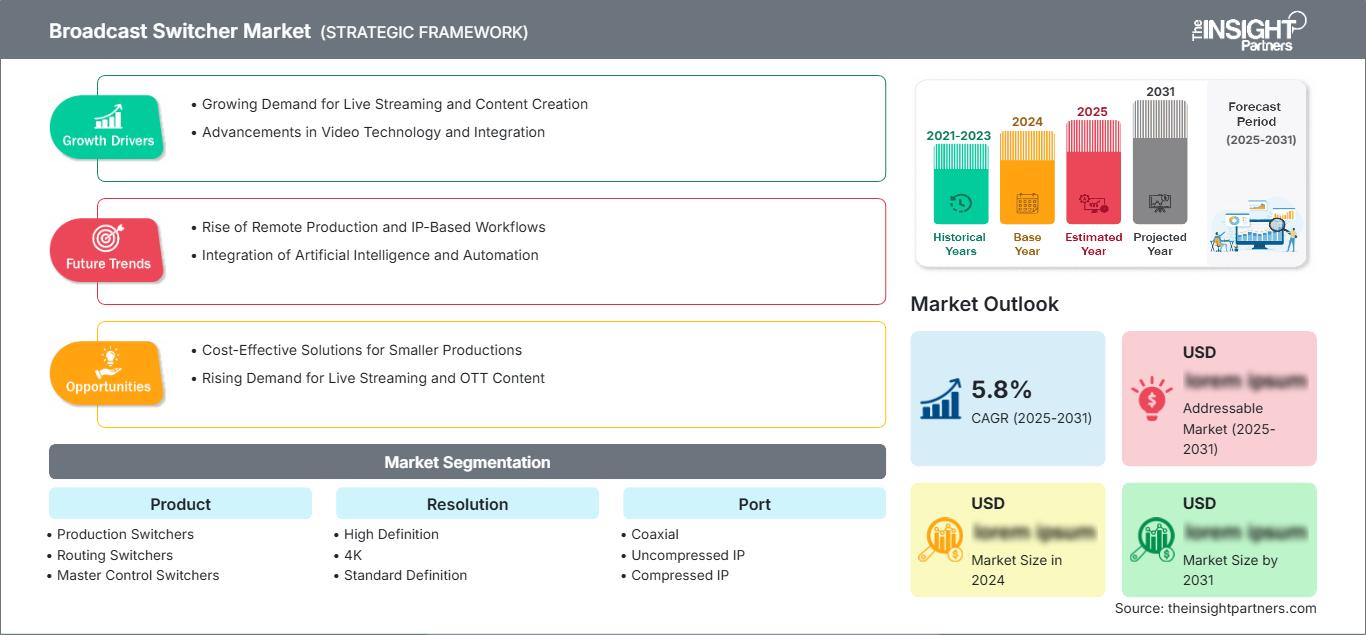
Broadcast Switcher Market: Strategic Insights
Regional Insights
North America Broadcast Switcher Market
The share of North America in the total revenue of the global market stood between 32%-35% in 2025 and is anticipated to expand with the 3.9%-4.5% CAGR over the forecast period from 2026 to 2034. The major factors influencing the regional market include national broadcasting networks, sports production, upgrades to local stations, and advanced outside broadcast technology.
Moreover, procurement activity is highly limited to the United States and Canada, where broadcasters are facing the challenge of upgrading their existing SDI equipment to the IP infrastructure. More facilities now prefer to install modular switching systems that will provide them with increased input capacity, remote capability, and automation capabilities. Besides, streaming-oriented production companies are acquiring compact systems.
U.S. Broadcast Switcher Market
The US accounted for 78–82% of North America in 2025 and is projected to record a 3.8–4.4% CAGR during 2026–2034. Demand is led by national sports networks, regional sports channels, broadcast newsrooms, production trucks, and digital studios that require high-reliability switching for simultaneous linear and streaming distribution.
The company's coverage is quite wide-ranging, including Ross Video Ltd., Grass Valley USA, LLC, Sony Electronics Inc., Panasonic Corporation, and Blackmagic Design Pty. Ltd. The US market prefers sports broadcasts, studio automation, newsroom rundown management, and cloud contribution. Slow migration towards the technology means that hybrid SDI/IP connectivity is an essential purchasing factor.
Europe Broadcast Switcher Market
Europe was estimated to have a market share of 23–26% in 2025, and it is forecasted to experience a compound annual growth rate of 3.6–4.2%, led by the UK market. The UK enjoys well-connected studio facilities, outside-broadcast expertise, and high-end production of sports content. Germany is on the verge of an upgrade owing to the modernization of public broadcasting services, innovative, engineering-based content production, and demand for reliable routing and master control solutions.
The French, Italian, and Spanish markets have grown owing to upgrades in the HD content production sector, regional broadcaster consolidation, and rise in streaming production of entertainment and sports content. Users in these countries prioritize flexible switching and management of language feeds within the existing studio facility.
APAC Broadcast Switcher Market
The APAC region held a share of 27-30% in 2025 and is expected to grow with a CAGR of 4.7-5.4%, emerging as the fastest growing region. While China dominates the market by size, Japan and South Korea are known for their advancements in the field of UHD and sports.
The presence of favorable policies related to digital broadcast, broadband infrastructure, and production of local content makes procurement easier in the region. There is a trend among broadcasters toward adopting compact and medium-sized switchers that support the creation of regional studios, educational streaming, and mobile production.
Middle East & Africa Broadcast Switcher Market
Middle East and Africa is expected to grow at a 4.1–4.8% CAGR during 2026–2034. Saudi Arabia leads regional spending through media infrastructure, sports events, and entertainment production, while the UAE remains an important hub for satellite broadcasting, live events, and regional content distribution.
South Africa contributes through established broadcast networks and sports coverage, while the rest of MEA is shaped by selective public broadcaster upgrades. Energy-sector investment, urban infrastructure projects, and tourism-led events create demand for mobile and studio production systems, though budget cycles vary widely across countries.
Segmentation Analysis
Product
The Product segment is projected to grow at a 3.9–4.6% CAGR during 2026–2034. Broadcast Switcher Market scope across products is shaped by production environments, routing complexity, and master-control continuity needs. Production switchers dominate live event and studio use, routing switchers support signal orchestration, and master control switchers remain critical for channel playout and compliance switching.
- Production Switchers held the strongest position in live studios, sports venues, and production trucks, where operators need real-time effects, multiview monitoring, tally control, and reliable switching under pressure.
- Routing Switchers are strategically important in larger facilities because they distribute video signals across studios, control rooms, ingest areas, and output chains while supporting phased SDI-to-IP migration.
- Master Control Switchers serve playout continuity, emergency switching, branding insertion, and channel handoff requirements, making them essential for broadcasters managing multiple linear feeds and compliance workflows.
Resolution
The Resolution segment is expected to grow at a 4.0–4.8% CAGR from 2026–2034. Demand is moving toward UHD-ready systems, but HD remains widely deployed because many broadcasters still deliver mixed-format output. Standard-definition use is declining, yet legacy channels and cost-sensitive installations continue to require compatible switching during transition periods.
- High Definition remains the operational baseline for many studios and newsrooms, offering cost-effective picture quality, mature interoperability, and compatibility with existing cameras, routers, and transmission chains.
- 4K is gaining priority in sports, premium entertainment, and event production because broadcasters need sharper images, HDR support, and future-ready infrastructure for high-value content.
- Standard Definition persists in selected legacy playout, archival, and low-budget broadcast environments, but procurement is increasingly limited to replacement or compatibility-driven use cases.
Port
The Port segment is forecast to grow at a 4.2–5.0% CAGR during 2026–2034. Coaxial connectivity remains important in installed SDI facilities, while uncompressed IP is gaining momentum in premium and greenfield broadcast plants. Compressed IP supports remote contribution, streaming workflows, and cost-efficient distribution where bandwidth constraints influence architecture.
- Coaxial remains widely used because SDI infrastructure is dependable, familiar to engineers, and deeply embedded in studios, trucks, routers, and monitoring systems worldwide.
- Uncompressed IP is the high-growth path for low-latency production because it enables scalable routing, flexible source access, and efficient integration across modern broadcast facilities.
- Compressed IP supports distributed production, remote interviews, and streaming contribution, especially when networks must balance video quality, transport cost, and available bandwidth.
Application
The Application segment is projected to grow at a 4.1–4.9% CAGR between 2026–2034. Sports broadcasting generates premium demand because live events need many camera feeds, replay integration, and fast transitions. Studio production and news production sustain recurring replacement, while production trucks and post-production use cases require compact, reliable, and format-flexible systems.
- Sports Broadcasting commands strategic spending because rights holders require multi-camera switching, replay coordination, UHD output, and low-latency feeds for both broadcast and digital platforms.
- Studio Production relies on switchers for scripted, unscripted, and corporate programming, where consistent quality, operator familiarity, and integration with graphics and audio systems matter.
- Production Trucks need rugged, compact, high-I/O switchers that support fast setup, mobile routing, remote production links, and multiple event formats.
- News Production depends on automation-friendly systems that manage anchors, field feeds, graphics, weather visuals, and live shots under tight rundown schedules.
- Post-production uses switching for review rooms, finishing suites, live-to-tape workflows, and hybrid production environments where multiple sources must be previewed or routed efficiently.
Opportunity Snapshot
| Application | Revenue Contribution | Trend Tag | Adoption Stage |
| Sports Broadcasting | High | Live Sports | Scaling |
| Studio Production | High | Automation | Mature |
| Production Trucks | Medium | Mobile UHD | Scaling |
| News Production | Medium | Rundown Control | Mature |
| Post-production | Low | Hybrid Review | Scaling |
| Others | Low | Event Streaming | Emerging |
Broadcast Switcher Market Growth Drivers and Impact Analysis
Rising Live Sports and Event Production Complexity
Sports and live events are generating more switcher demands due to the combination of main cameras, specialty cameras, replay cameras, graphic overlays, augmented video, and platform-based video outputs. This is beneficial for the market in light of the demand for production quality that facilitates high-value advertising and subscription maintenance. Large scale events will be generating demands for switchers with increased inputs, multiview displays, macros, and redundancy options. Mid-scale leagues will be demanding affordable and compact switchers. These changes make the buyer segment wider, including universities, esport organizations, venues, and production service providers. The effect on practice is increased demand for versatile switchers that would allow both broadcast outputs and platform streams.
Migration from SDI to IP-Based Broadcast Workflows
IP-based workflows are transforming the ways that broadcasters distribute their video feeds around facilities through routing, switching, and sharing of video feeds. Through the use of managed IP networks, control rooms will be able to handle more than one studio and other sites such as remote locations and cloud contributions. There are benefits for the market from such a transition in the sense that switchers need to be compatible with other technologies such as routers, gateways, audio over IP, synchronization systems, and monitoring systems. The importance of phased implementation should not be overlooked since most broadcasters do not have the means to fully replace SDI infrastructures.
Expansion of Automated and Remote Production Models
Automation and remote productions are cutting down on the requirement that each individual production activity be present within one single physical control room. News rooms, sport broadcasters, and event producers are making use of automated control, template-based operations, and remote operator accessibility to generate many more hours of content using limited man power resources. This will have positive implications for the market, since current requirements call for modern-day switchers to provide control interfaces, macro functions, newsroom system integration, and reliable operation in distributed environments. Remote operations also generate the requirement for smaller scale system solutions at event locations.
Broadcast Switcher Market Future Trends
Software-Defined Switching Becomes Mainstream
Broadcast Switcher Market trends point toward software-defined switching that separates control logic from fixed hardware. Future systems will increasingly use scalable processing, license-based features, and virtualized panels so broadcasters can configure resources around each production. This shift will help facilities handle seasonal sports peaks, pop-up studios, and remote event coverage without permanent overbuild. Software-defined platforms also make updates faster, allowing vendors to add protocol support, automation features, and cloud connectivity after installation. Buyers will still value tactile control surfaces, but investment decisions will increasingly depend on processing flexibility, cybersecurity posture, and integration depth across the production stack.
AI-Assisted Production Control and Quality Monitoring
AI-assisted production will gradually influence switching decisions by supporting shot recommendation, audio-video alignment checks, scene recognition, and automated quality monitoring. In high-volume environments such as local sports, education, and corporate broadcasting, AI can reduce operator workload while maintaining consistent output. The market will not shift to fully autonomous switching in premium events immediately, because creative judgment remains essential. However, AI-enabled assistance can improve efficiency, detect signal issues, and simplify training for smaller teams. Vendors that embed AI responsibly into monitoring, macros, and production templates will differentiate without asking broadcasters to abandon established operating discipline.
Broadcast Switcher Market Opportunities
IP Retrofit Packages for Legacy Broadcast Facilities
Legacy facilities offer a practical investment opportunity because most broadcasters need IP capabilities without abandoning SDI equipment that still performs reliably. Vendors can package switchers with gateways, routers, timing tools, and engineering support to create phased migration bundles. The Broadcast Switcher Market benefits when suppliers reduce integration complexity and provide clear upgrade paths from HD-SDI to UHD and ST 2110 workflows. System integrators also gain service revenue through design, commissioning, and operator training. This opportunity is strongest in North America and Europe, where installed infrastructure is large, but budget approval often depends on minimizing operational disruption and protecting prior capital expenditure.
Compact Switchers for Streaming-Led Professional Production
Streaming-led production is creating demand below traditional broadcast budgets but above consumer-grade tools. Universities, houses of worship, corporate studios, regional sports clubs, and event organizers need dependable switching, audio integration, recording, and direct platform output. The Broadcast Switcher Market can capture this opportunity through compact systems that combine professional controls with simplified setup and lower total cost. Channel partners can bundle cameras, microphones, lighting, and switchers into turnkey kits. Suppliers that provide training, templates, and remote support will improve adoption because many buyers operate with small technical teams. This segment also creates entry points for later upgrades.
Recent Developments
- April 2026: Sony announced its showcase for NAB Show 2026, where it will unveil new broadcast and production technologies, including advanced system cameras, live production solutions, AI-powered workflows, and cloud-based media processing tools for content creators and broadcasters.
- July 2026: Estonia's Kanal 2 has invested in EVS' DYVI production switcher to modernize its live production infrastructure. The upgrade is expected to improve operational efficiency, flexibility, and the quality of live television broadcasts.
- April 2026: Panasonic announced its showcase for NAB Show 2026, highlighting advanced video production solutions for broadcasters and content creators. The company will demonstrate its KAIROS IP-based live production platform, AI-powered PTZ camera workflows, and next-generation studio camera systems designed to improve production efficiency and creative flexibility.
Frequently Asked Questions

- Comprehensive Market Sizing and Forecast Analysis
- Detailed Segmentation Analysis
- In-Depth Market Dynamics Assessment
- Regional and Country-Level Insights
- Competitive Landscape and Company Benchmarking
- Strategic Business Intelligence
Recent Reports
Testimonials

The Insight Partners' SCADA System Market report is comprehensive, with valuable insights on current trends and future forecasts. The team was highly professional, responsive, and supportive throughout. We are very satisfied and highly recommend their services.
RAN KEDEM Partner, Reali Technologies LTDs
I requested a report on a very specific software market and the team produced the report in a few days. The information was very relevant and well presented. I then requested some changes and additions to the report. The team was again very responsive and I got the final report in less than a week.
JEAN-HERVE JENN Chairman, Future Analytica
We worked with The Insight Partners for an important market study and forecast. They gave us clear insights into opportunities and risks, which helped shape our plans. Their research was easy to use and based on solid data. It helped us make smart, confident decisions. We highly recommend them.
PIYUSH NAGPAL Sr. Vice President, High Beam Global
The Insight Partners delivered insightful, well-structured market research with strong domain expertise. Their team was professional and responsive throughout. The user-friendly website made accessing industry reports seamless. We highly recommend them for reliable, high-quality research services
YUKIHIKO ADACHI CEO, Deep Blue, LLC.
This is the first time I have purchased a market report from The Insight Partners.While I was unsure at first, I visited their web site and felt more comfortable to take the risk and purchase a market report.I am completely satisfied with the quality of the report and customer service. I had several questions and comments with the initial report, but after a couple of dialogs over email with their analyst I believe I have a report that I can use as input to our strategic planning process.Thank you so much for taking the extra time and making this a positive experience.I will definitely recommend your service to others and you will be my first call when we need further market data.
JOHN SUZUKI President and Chief Executive Officer, Board Director, BK Technologies
I wish to appreciate your support and the professionalism you displayed in the course of attending to my request for information regarding to infectious disease IVD market in Nigeria. I appreciate your patience, your guidance, and the fact that you were willing to offer a discount, which eventually made it possible for us to close a deal. I look forward to engaging The Insight Partners in the future, all thanks to the impression you have created in me as a result of this first encounter.
DR CHIJIOKE ONYIA MANAGING DIRECTOR, PineCrest Healthcare Ltd.Reason to Buy
- Informed Decision-Making
- Understanding Market Dynamics
- Competitive Analysis
- Identifying Emerging Markets
- Customer Insights
- Market Forecasts
- Risk Mitigation
- Boosting Operational Efficiency
- Strategic Planning
- Investment Justification
- Tracking Industry Innovations
- Aligning with Regulatory Trends





 Get Free Sample for